
Class 10 Science Chapter 12 NCERT Solutions Hinglish mein: Magnetic Effects of Electric Current
Class 10 ki NCERT textbook Science ke Chapter 12, Magnetic Effects of Electric Current, ke andar ke paanch Questions boxes, dono solved examples, activities aur saare 9 end-of-chapter exercises ke jawab. Page numbers 2026-27 reprint ke hisaab se hain (pages 195–207). Exercises ke sawal Hinglish mein diye hain; chapter ke andar ke sawal chhote mein apne shabdon mein likhe hain. Har disha right-hand thumb rule ya Fleming’s left-hand rule se nikaali aur cross product se check ki gayi hai, aur jawab book ke end ki answer key se milte hain. Jo baatein chapter se aage ki hain, un par “Extra” likha hai. Ghar ke circuits sirf jaankari ke liye hain: ghar ki wiring, sockets ya mains ko kabhi chhoona, kholna ya unke saath experiment mat karo. Chhote notes: Chapter 12 ke notes.
Question, page 196
Question 1 (page 196): bar magnet ke paas compass needle kyun ghoomti hai? Compass needle khud ek chhota magnet hai. Bar magnet ke chaaron taraf magnetic field hai, jo needle ke ulte pole ko kheenchta hai aur same pole ko dhakelta hai. Ye forces needle ko tab tak ghumaate hain jab tak wo bar magnet ke field ki disha mein na aa jaaye.
Example 12.1 aur Questions, page 200
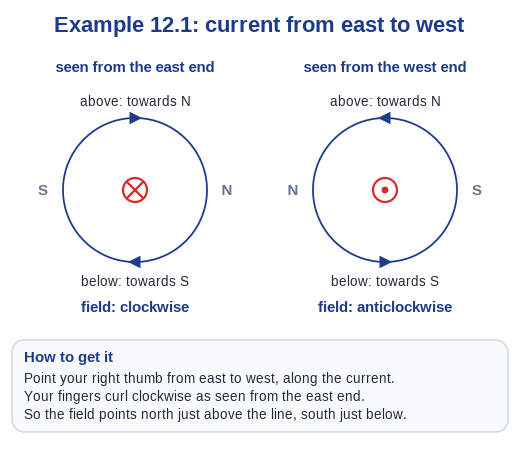
Example 12.1 (page 200): horizontal power line mein current east se west; theek neeche aur theek upar field ki disha? Right angootha east se west ki taraf rakho. Ungliyaan taar se right angle waale plane mein east wale sire se dekhne par clockwise, aur west wale sire se anticlockwise mudti hain; ye upar aur neeche dono points par sach hai. Aage nikaalein to: west ki taraf munh karo to north right haath par hai, isliye field line ke theek upar north aur theek neeche south ki taraf hai.
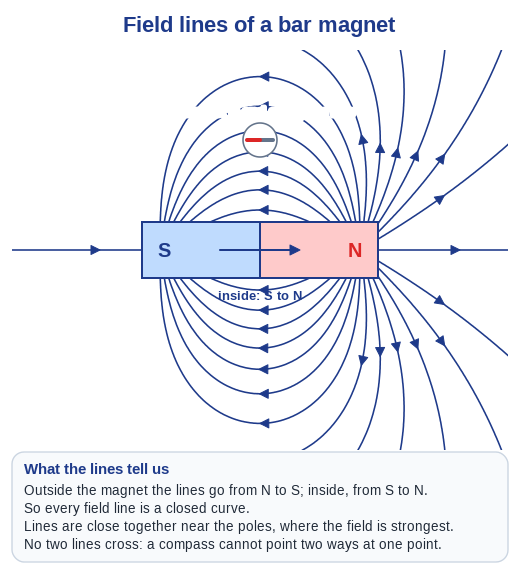
Question 1 (page 200): bar magnet ke chaaron taraf field lines banao. Neeche ka diagram dekho: lines N pole se nikal kar ghoomti hain aur S pole mein jaati hain, magnet ke andar S se N chalti hain, aur poles ke paas ghani hain. Har line par arrow lagao, magnet ke bahar N se door ki taraf.
Question 2 (page 200): magnetic field lines ki properties.
- Magnet ke bahar ye north pole se south pole jaati hain; andar south pole se north pole. Isliye ye band curves hain.
- Kisi point par field ki disha wahan line ke tangent ki disha hai, yaani jidhar compass needle ka north pole point kare.
- Jahan field strong ho wahan ye paas-paas hoti hain (poles ke paas) aur jahan kamzor ho wahan door-door.
- Do field lines kabhi cross nahi karti.
Question 3 (page 200): do field lines intersect kyun nahi karti? Intersection point par field ki do dishaayein hongi, to wahan rakhi compass needle ko ek saath do taraf point karna padega. Ye possible nahi, kyunki kisi bhi point par field ki sirf ek disha hoti hai.
Questions, pages 201–202
Question 1 (page 201): table par ek circular loop hai aur current (upar se dekhne par) clockwise hai; loop ke andar aur bahar field? Right haath ki ungliyaan clockwise, current ki disha mein, modo: angootha neeche point karta hai. To loop ke andar field table ke andar (seedha neeche) hai. Loop ke bahar field lines taar ke chaaron taraf doosri taraf ghoom kar aati hain, isliye wahan field table se bahar (seedha upar) hai.
Question 2 (page 201): uniform magnetic field ka diagram banao. Uniform field parallel seedhi lines se, baraabar doori par, sab par ek hi disha ke arrows ke saath dikhaate hain, jaisa neeche diagram ke right mein hai.
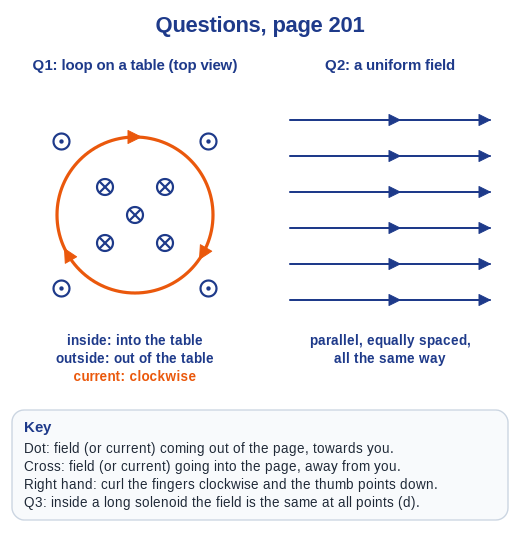
Question 3 (page 202): lambe seedhe current waale solenoid ke andar field? (d) har point par same hai. Lambe solenoid ke andar field lines parallel seedhi lines hain, to field uniform hai.
Example 12.2 aur Questions, pages 203–204
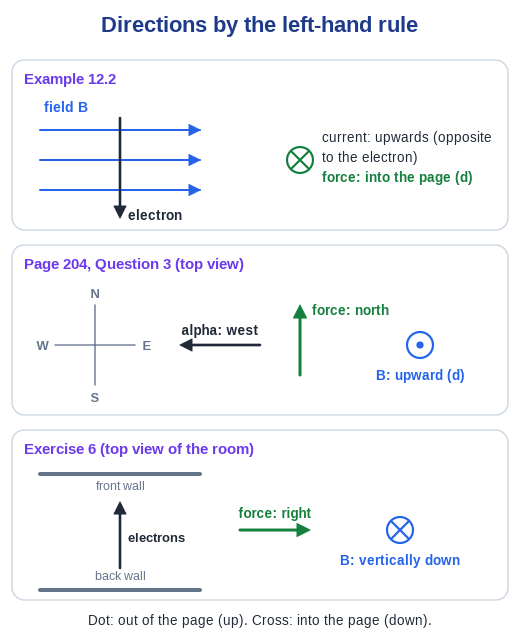
Example 12.2 (page 203): ek electron magnetic field mein usse right angle par ghusta hai (Fig. 12.14); force ki disha? (d) page ke andar. Figure mein field right ki taraf hai aur electron page mein neeche ja raha hai. Current electron ki motion ke ulta hai, to wo page mein upar hai. Left haath: pehli ungli right (field), beech ki ungli upar (current); angootha page ke andar point karta hai.
Question 1 (page 203): magnetic field mein chalte proton ki kaun si property badal sakti hai? (ek se zyaada jawab) (c) velocity aur (d) momentum. Magnetic force proton ki motion se right angle par hai, isliye ye motion ki disha badalta hai par speed nahi. Velocity aur momentum (mass × velocity) mein disha shaamil hai, isliye ye badalte hain. Speed same rehti hai, aur mass nahi badalta.
Question 2 (page 204): Activity 12.7 mein rod AB ka displacement kaise badlega agar (i) current badhaaya jaaye, (ii) zyaada strong horse-shoe magnet lagaaya jaaye, (iii) rod lambi kar di jaaye?
- (i) Zyaada current se force zyaada, to rod zyaada khisakti hai.
- (ii) Strong magnet se field strong aur force zyaada, to rod zyaada khisakti hai.
- (iii) Field mein padi lambi rod par bhi force zyaada lagta hai, to wo zyaada khisakti hai. (Extra: uniform field se right angle par seedhe conductor par force field ke andar uski lambaai ke proportional hota hai; chapter ye nahi kehta.)
Question 3 (page 204): west ki taraf chalaaya gaya alpha particle (positive) north ki taraf mud jaata hai; field ki disha? (d) upar. Particle positive hai, to current west ki taraf hai. Left haath: beech ki ungli west (current), angootha north (force); tab pehli ungli seedha upar point karti hai. Baaki options kaam nahi karte: south ki taraf field particle ko upar dhakelega, east ki taraf field (motion ki disha mein) koi force nahi dega, aur neeche ki taraf field use south dhakelega.
Questions, page 205
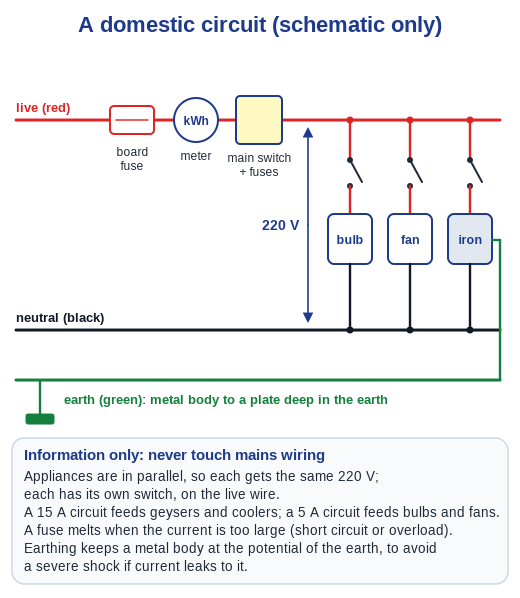
Question 1 (page 205): circuits aur appliances mein do aam safety measures. (1) Har circuit mein electric fuse, jo current had se zyaada hone par pighal kar circuit tod deta hai. (2) Earthing: appliances ki metal body earth wire se judi hoti hai, taaki leak hua current zameen mein chala jaaye aur user ko tez shock na lage.
Question 2 (page 205): 220 V ke 5 A rating waale ghar ke circuit par 2 kW ka oven; kya hoga? Oven I = P/V = 2000 W ÷ 220 V ≈ 9.1 A leta hai, jo 5 A ki rating ka lagbhag dugna hai. Circuit overload hota hai: wires apni had se zyaada current le jaate hain aur garam hote hain, aur fuse pighal kar circuit kaat deta hai. Aisa appliance 15 A circuit par chalana chahiye. (Ye numbers sirf calculation ke liye hain.)
Question 3 (page 205): ghar ke circuits ki overloading se bachne ki saavdhaaniyaan. Ek socket par bahut saare appliances mat jodo; geyser, heater aur oven jaise zyaada power waale appliances sirf sahi current rating (15 A) waale circuit par chalao; har circuit mein sahi rating ka fuse rakho; aur kharab insulation ya kharab appliances trained electrician se theek karwao, kyunki inse short circuit ho sakta hai.
Activities kya dikhaati hain (Activities 12.1–12.7)
Inhe sirf teacher ke saath karo, cells ya battery se, mains se kabhi nahi.
- Activity 12.1: current waale copper taar ke paas compass needle ghoom jaati hai: current ka magnetic effect hota hai.
- Activities 12.2 aur 12.3: lohe ka buraada, aur kadam-kadam chalaaya gaya compass, bar magnet ke chaaron taraf field lines banaate hain.
- Activity 12.4: compass needle ke upar taar, current north se south: needle ka north pole east ki taraf; current ulta karo to west. (Check: taar ke neeche field I × r̂ = (south) × (neeche) ki disha mein hai, jo east hai.)
- Activity 12.5: khade current waale taar ke chaaron taraf buraada concentric circles banata hai; field current ke saath badhta aur doori ke saath ghatta hai.
- Activity 12.6: bahut turns waali coil ke beech se lagbhag seedhi lines ka pattern banta hai.
- Activity 12.7: horse-shoe magnet ke poles ke beech current waali rod side mein dhakeli jaati hai; current ya field ulta karne par dhakka ulta ho jaata hai.
Exercises 1 se 5
1. Lambe seedhe taar ke paas magnetic field ko inme se kaun sa sahi batata hai? (a) Field taar ke perpendicular seedhi lines se bana hai. (b) Field taar ke parallel seedhi lines se bana hai. (c) Field taar se nikalti radial lines se bana hai. (d) Field taar ko centre maan kar concentric circles se bana hai.
(d) Field taar ko centre maan kar concentric circles se bana hai. Activity 12.5 mein lohe ka buraada yahi dikhaata hai.
2. Short circuit ke samay circuit mein current (a) kaafi kam ho jaata hai. (b) nahi badalta. (c) bahut zyaada badh jaata hai. (d) lagaataar badalta rehta hai.
(c) bahut zyaada badh jaata hai. Short circuit mein live aur neutral wire chhoo jaate hain, raaste ka resistance bahut kam ho jaata hai, aur current achaanak badh jaata hai.
3. Batao ki ye statements sahi hain ya galat. (a) Current waali lambi circular coil ke centre par field parallel seedhi lines hoga. (b) Hare insulation waala wire aam taur par electric supply ka live wire hota hai.
- (a) Sahi (True). Current waali circular coil ke centre par coil ka har hissa field ko ek hi taraf bhejta hai, aur wahan lines seedhi aur parallel hoti hain.
- (b) Galat (False). Hara wire aam taur par earth wire hota hai. Live wire ka insulation laal aur neutral ka kaala hota hai.
4. Magnetic field banaane ke do tareeke likho.
(1) Permanent magnet se, jaise bar magnet ya horse-shoe magnet. (2) Kisi conductor mein electric current bhej kar: seedha taar, circular coil ya solenoid; soft iron core waala solenoid electromagnet banata hai.
5. Magnetic field mein rakhe current waale conductor par force sabse zyaada kab hota hai?
Jab current ki disha magnetic field ki disha se right angle (perpendicular) par ho.
Exercises 6 se 9
6. Socho ki tum ek kamre mein ek deewar ki taraf peeth karke baithe ho. Ek electron beam, peeche ki deewar se saamne ki deewar ki taraf horizontal chalte hue, ek strong magnetic field se tumhare right side ki taraf mud jaati hai. Magnetic field ki disha kya hai?
Seedha neeche (vertically downwards). Electrons aage chal rahe hain, to current peeche, peechhli deewar ki taraf hai. Force tumhare right ki taraf hai. Left haath: beech ki ungli peeche (current), angootha right (force); tab pehli ungli neeche point karti hai. Cross product se check: x tumhara right, y aage aur z upar lo, to F = I × B = (−y) × (−z) = y × z = x, yaani right. Ye answer key se milta hai.
7. Disha nikaalne ka rule batao: (i) current waale seedhe conductor ke chaaron taraf bane magnetic field ki, (ii) usse perpendicular magnetic field mein rakhe current waale seedhe conductor par lagne waale force ki, aur (iii) magnetic field mein coil ke ghoomne se usme induce hue current ki.
- (i) Right-hand thumb rule: conductor ko right haath mein pakdo aur angootha current ki disha mein rakho; ungliyaan field lines ki disha mein mudti hain.
- (ii) Fleming’s left-hand rule: left haath ka angootha, pehli ungli aur beech ki ungli right angle par failao; pehli ungli field ki disha mein aur beech ki ungli current ki disha mein ho to angootha force ki disha batata hai.
- (iii) Extra: Fleming’s right-hand rule. Right haath ka angootha, pehli ungli aur beech ki ungli right angle par failao; pehli ungli field ki disha mein aur angootha conductor ki motion ki disha mein ho to beech ki ungli induced current ki disha batati hai. Induced current 2026-27 ke chapter mein nahi hai, aur answer key sirf (i) aur (ii) deti hai.
8. Electric short circuit kab hota hai?
Short circuit tab hota hai jab live wire aur neutral wire seedhe ek doosre ko chhoo lein. Aisa wires ka insulation kharab hone ya kisi appliance mein fault hone par hota hai. Resistance bahut kam ho jaata hai aur current achaanak badh jaata hai.
9. Earth wire ka kaam kya hai? Metal ke appliances ko earth karna kyun zaroori hai?
Earth wire (hara insulation) appliance ki metal body ko zameen mein gehre metal plate se jodta hai. Ye body tak leak hue kisi bhi current ko kam resistance ka raasta deta hai aur body ko earth ke potential par rakhta hai. Metal body waale appliances, jaise electric press, toaster, table fan ya refrigerator, ko earth karna zaroori hai, kyunki earth connection ke bina body tak current leak hone par use chhoone waale ko tez electric shock lag sakta hai.
Wapas jaao Chapter 12 ke notes par, ya padho current se magnetic field, current waale conductor pe force aur ghar ke electric circuits.
Practice karo
-
Ek horizontal taar mein current south se north beh raha hai. Uske theek neeche field point karta hai:
Jawab dekho
Jawab: (c) west
-
Lambe current waale solenoid ke andar field lines hoti hain:
Jawab dekho
Jawab: (b) parallel seedhi lines
-
Ek proton magnetic field mein chal raha hai. Inme se kya same rehta hai?
Jawab dekho
Jawab: (c) uski speed
-
1.5 kW ka geyser 220 V par chalta hai. Wo kitna current leta hai, aur use ghar ka kaun sa circuit chahiye?
Jawab dekho
Jawab: I = P/V = 1500 W ÷ 220 V ≈ 6.8 A. Ye 5 A se zyaada hai, isliye use 15 A ka circuit chahiye, jaisa chapter geyser ke liye kehta hai. (Numbers sirf calculation ke liye.)
-
Ek electron beam page par left se right ja rahi hai, aur field page ke andar hai. Electrons par force kis taraf hai?
Jawab dekho
Jawab: Current electrons ke ulta, right se left hai. Left haath: pehli ungli page ke andar, beech ki ungli left; angootha page mein neeche point karta hai. To beam page mein neeche dhakeli jaati hai. Check: I × B = (left) × (page ke andar) neeche ki taraf hai.
Koi sawal atak gaya?
Photo lo, Lagnever AI step-by-step samjhayega. 7 din ka trial sirf ₹2.
Google Play se app lo Browser mein kholo
Parents ke liye: trial ke baad plan har mahine UPI ya card autopay se renew hota hai. App mein kabhi bhi cancel kar sakte hain.