
NCERT Solutions Class 10 Science Chapter 12: Magnetic Effects of Electric Current
Answers to the five Questions boxes inside Chapter 12, Magnetic Effects of Electric Current, the two solved examples, the activities and all 9 end-of-chapter exercises, from Science, the Class 10 NCERT textbook. Page numbers follow the 2026-27 reprint (pages 195–207). The exercises are quoted from the book; the in-chapter questions are restated in short. Every direction is worked out with the right-hand thumb rule or Fleming’s left-hand rule and checked with a cross product, and the answers match the answer key at the end of the book. Points that go beyond the chapter are marked “Extra”. Domestic circuits are described as information only: never touch, open or experiment with household wiring, sockets or the mains. Short notes: Chapter 12 notes.
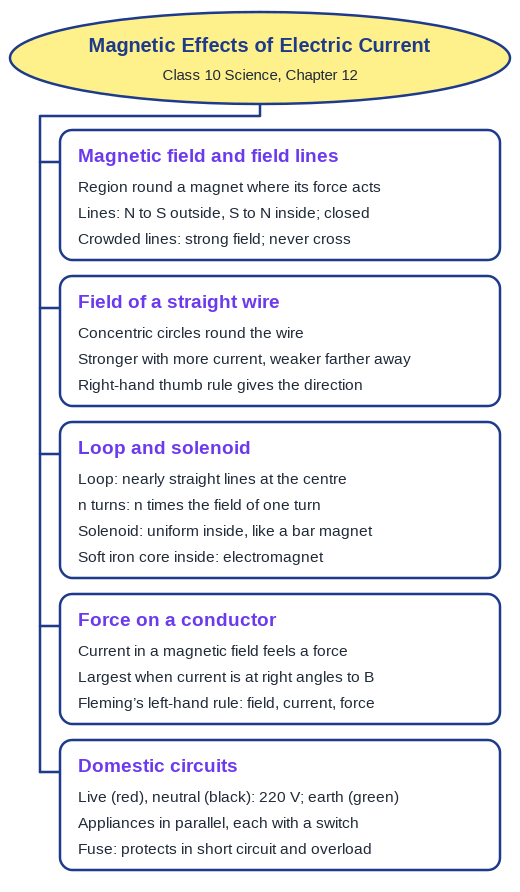
Question, page 196
Question 1 (page 196): why is a compass needle deflected near a bar magnet? A compass needle is itself a small magnet. The bar magnet has a magnetic field round it, which pulls on the unlike pole of the needle and pushes on the like pole. These forces turn the needle until it lies along the field of the bar magnet.
Example 12.1 and Questions, page 200
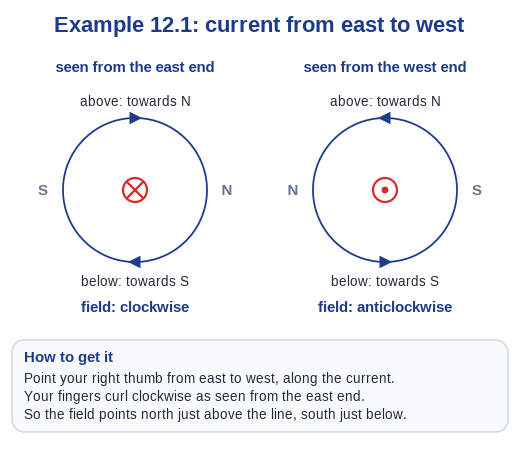
Example 12.1 (page 200): a horizontal power line carries current from east to west; the field directly below and directly above it? Point the right thumb from east to west. The fingers curl clockwise in a plane at right angles to the wire as seen from the east end, and anticlockwise as seen from the west end; this holds at points above and below. Worked further: facing west, north is on your right, so the field points north just above the line and south just below it.
Question 1 (page 200): draw field lines round a bar magnet. See the diagram below: the lines leave the N pole, curve round and enter the S pole, run from S to N inside the magnet, and are crowded near the poles. Put arrows on every line, pointing away from N outside the magnet.
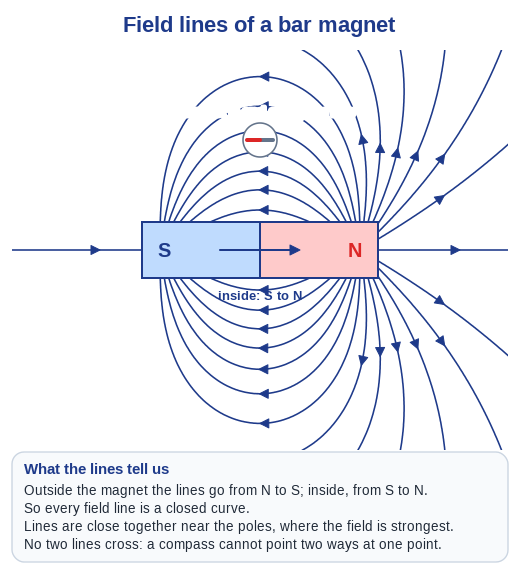
Question 2 (page 200): properties of magnetic field lines.
- Outside a magnet they go from the north pole to the south pole; inside, from the south pole to the north pole. So they are closed curves.
- The direction of the field at a point is the direction of the tangent to the line there, the way the north pole of a compass needle points.
- They are closer together where the field is stronger (near the poles) and farther apart where it is weaker.
- No two field lines cross each other.
Question 3 (page 200): why don’t two field lines intersect? At a point of intersection there would be two directions of the field, so a compass needle placed there would have to point in two directions at once. That is not possible, because the field at any point has only one direction.
Questions, pages 201–202
Question 1 (page 201): a circular loop lies on a table with the current clockwise (seen from above); field inside and outside the loop? Curl the fingers of your right hand clockwise, along the current: the thumb points down. So inside the loop the field points into the table (vertically downwards). Outside the loop the field lines come back round the wire the other way, so there the field points out of the table (vertically upwards).
Question 2 (page 201): draw a uniform magnetic field. A uniform field is shown by parallel straight lines, equally spaced, all with arrows in the same direction, as on the right of the diagram below.
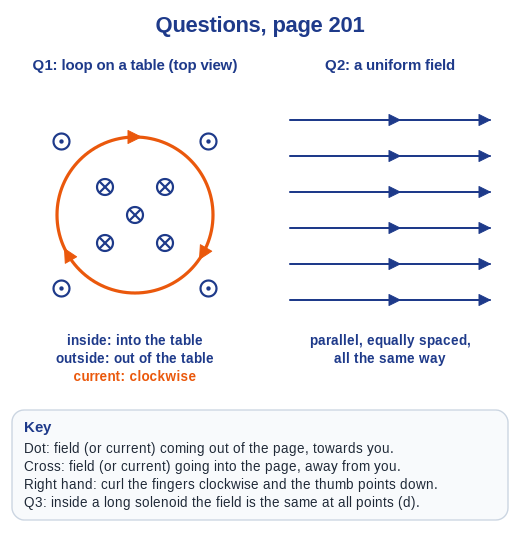
Question 3 (page 202): the field inside a long straight current-carrying solenoid? (d) is the same at all points. Inside a long solenoid the field lines are parallel straight lines, so the field is uniform.
Example 12.2 and Questions, pages 203–204
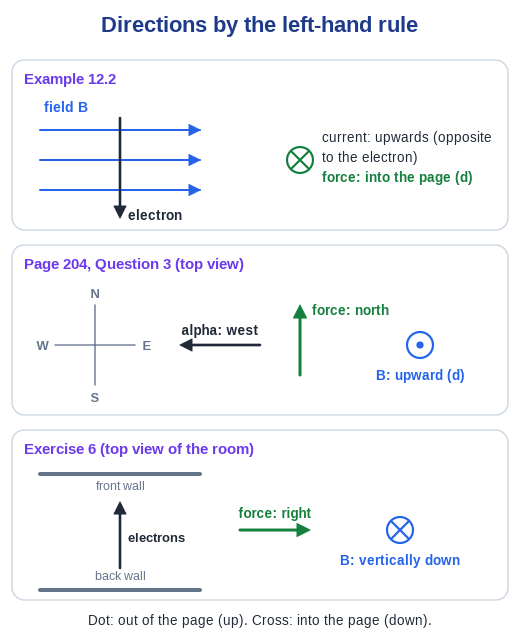
Example 12.2 (page 203): an electron enters a magnetic field at right angles to it (Fig. 12.14); direction of the force? (d) into the page. In the figure the field points to the right and the electron moves down the page. The current is opposite to the electron’s motion, so it points up the page. Left hand: first finger to the right (field), second finger up (current); the thumb points into the page.
Question 1 (page 203): which property of a proton can change while it moves in a magnetic field? (more than one answer) (c) velocity and (d) momentum. The magnetic force is at right angles to the proton’s motion, so it changes the direction of motion but not the speed. Velocity and momentum (mass × velocity) include the direction, so they change. The speed stays the same, and the mass does not change.
Question 2 (page 204): in Activity 12.7, how is the displacement of rod AB affected if (i) the current is increased, (ii) a stronger horse-shoe magnet is used, (iii) the rod is made longer?
- (i) A larger current gives a larger force, so the rod is displaced more.
- (ii) A stronger magnet gives a stronger field and a larger force, so the rod is displaced more.
- (iii) A longer rod lying in the field also feels a larger force, so it is displaced more. (Extra: the force on a straight conductor at right angles to a uniform field is proportional to its length in the field; the chapter does not state this.)
Question 3 (page 204): an alpha particle (positive) moving west is deflected north; the direction of the field? (d) upward. The particle is positive, so the current is towards the west. Left hand: second finger west (current), thumb north (force); the first finger then points vertically upward. The other options do not work: a field towards the south would push the particle upward, a field towards the east (along its motion) would give no force, and a downward field would push it south.
Questions, page 205
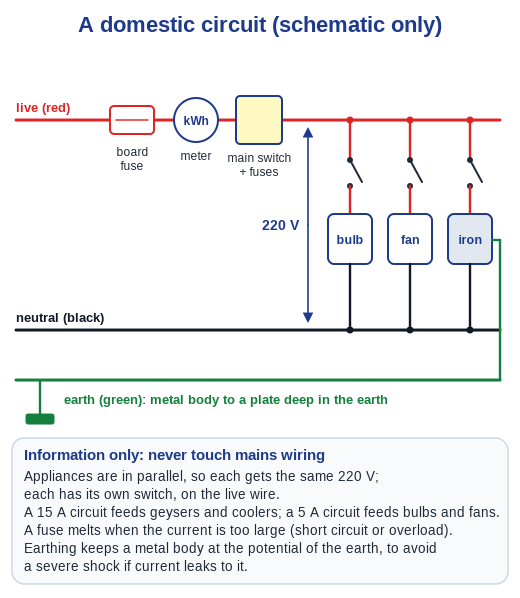
Question 1 (page 205): two common safety measures in circuits and appliances. (1) An electric fuse in each circuit, which melts and breaks the circuit when the current is unduly high. (2) Earthing: the metal bodies of appliances are joined to the earth wire, so leaking current goes to the earth and the user does not get a severe shock.
Question 2 (page 205): a 2 kW oven on a 220 V domestic circuit rated 5 A; what happens? The oven draws I = P/V = 2000 W ÷ 220 V ≈ 9.1 A, nearly twice the 5 A rating. The circuit is overloaded: the wires carry more current than they are meant for and heat up, and the fuse melts and cuts off the circuit. Such an appliance should be used on the 15 A circuit. (These numbers are for calculation only.)
Question 3 (page 205): precautions against overloading. Do not connect too many appliances to a single socket; use high-power appliances such as geysers, heaters and ovens only on a circuit of suitable current rating (15 A); keep a fuse of the correct rating in every circuit; and have damaged insulation or faulty appliances repaired by a trained electrician, as they can cause short circuits.
What the activities show (Activities 12.1–12.7)
Do these only with a teacher, with cells or a battery and never with the mains.
- Activity 12.1: a compass needle near a current-carrying copper wire is deflected: a current has a magnetic effect.
- Activities 12.2 and 12.3: iron filings, and a compass moved step by step, trace the field lines round a bar magnet.
- Activity 12.4: a wire over a compass needle, current north to south: the needle’s north pole moves east; reverse the current and it moves west. (Checked: the field under the wire is along I × r̂ = (south) × (down), which points east.)
- Activity 12.5: iron filings round a vertical current-carrying wire form concentric circles; the field grows with the current and falls with distance.
- Activity 12.6: a coil of many turns gives a field pattern of nearly straight lines through the middle of the coil.
- Activity 12.7: a rod carrying current between the poles of a horse-shoe magnet is pushed sideways; the push reverses when the current or the field reverses.
Exercises 1 to 5
1. “Which of the following correctly describes the magnetic field near a long straight wire? (a) The field consists of straight lines perpendicular to the wire. (b) The field consists of straight lines parallel to the wire. (c) The field consists of radial lines originating from the wire. (d) The field consists of concentric circles centred on the wire.”
(d) The field consists of concentric circles centred on the wire. This is what the iron filings show in Activity 12.5.
2. “At the time of short circuit, the current in the circuit (a) reduces substantially. (b) does not change. (c) increases heavily. (d) vary continuously.”
(c) increases heavily. In a short circuit the live and neutral wires touch, the resistance of the path becomes very small, and the current rises abruptly.
3. “State whether the following statements are true or false. (a) The field at the centre of a long circular coil carrying current will be parallel straight lines. (b) A wire with a green insulation is usually the live wire of an electric supply.”
- (a) True. At the centre of a current-carrying circular coil every part of the coil sends the field the same way, and the lines there are straight and parallel.
- (b) False. The green wire is usually the earth wire. The live wire has red insulation, and the neutral wire black.
4. “List two methods of producing magnetic fields.”
(1) Using a permanent magnet, such as a bar magnet or a horse-shoe magnet. (2) Passing an electric current through a conductor: a straight wire, a circular coil or a solenoid; a solenoid with a soft iron core makes an electromagnet.
5. “When is the force experienced by a current–carrying conductor placed in a magnetic field largest?”
When the direction of the current is at right angles (perpendicular) to the direction of the magnetic field.
Exercises 6 to 9
6. “Imagine that you are sitting in a chamber with your back to one wall. An electron beam, moving horizontally from back wall towards the front wall, is deflected by a strong magnetic field to your right side. What is the direction of magnetic field?”
Vertically downwards. The electrons move forward, so the current is backward, towards the back wall. The force is to your right. Left hand: second finger pointing backward (current), thumb to the right (force); the first finger then points down. Check by cross product: with x to your right, y forward and z up, F = I × B = (−y) × (−z) = y × z = x, to the right. This agrees with the answer key.
7. “State the rule to determine the direction of a (i) magnetic field produced around a straight conductor-carrying current, (ii) force experienced by a current-carrying straight conductor placed in a magnetic field which is perpendicular to it, and (iii) current induced in a coil due to its rotation in a magnetic field.”
- (i) Right-hand thumb rule: hold the conductor in your right hand with the thumb along the current; the fingers curl in the direction of the field lines.
- (ii) Fleming’s left-hand rule: stretch the thumb, first finger and second finger of the left hand at right angles; with the first finger along the field and the second finger along the current, the thumb gives the force.
- (iii) Extra: Fleming’s right-hand rule. Stretch the thumb, first finger and second finger of the right hand at right angles; with the first finger along the field and the thumb along the motion of the conductor, the second finger gives the direction of the induced current. Induced current is not part of the 2026-27 chapter, and the answer key gives only (i) and (ii).
8. “When does an electric short circuit occur?”
A short circuit occurs when the live wire and the neutral wire come into direct contact. This happens when the insulation of the wires is damaged or there is a fault in an appliance. The resistance becomes very small and the current rises abruptly.
9. “What is the function of an earth wire? Why is it necessary to earth metallic appliances?”
The earth wire (green insulation) joins the metal body of an appliance to a metal plate deep in the earth. It gives a low-resistance path for any current that leaks to the body and keeps the body at the potential of the earth. Appliances with a metal body, such as an electric press, toaster, table fan or refrigerator, must be earthed because, if current leaked to the body without an earth connection, a person touching it could get a severe electric shock.
Go back to the Chapter 12 notes, or read magnetic field due to a current, force on a current-carrying conductor and domestic electric circuits.
Practice
-
A horizontal wire carries current from south to north. The field just below it points:
Show answer
Answer: (c) west
-
Inside a long current-carrying solenoid the field lines are:
Show answer
Answer: (b) parallel straight lines
-
A proton moves through a magnetic field. Which of these stays the same?
Show answer
Answer: (c) its speed
-
A 1.5 kW geyser runs on 220 V. Find the current it draws, and say which domestic circuit it needs.
Show answer
Answer: I = P/V = 1500 W ÷ 220 V ≈ 6.8 A. That is more than 5 A, so it needs the 15 A circuit, as the chapter says for geysers. (Numbers for calculation only.)
-
An electron beam moves from left to right across the page, and the field points into the page. Which way is the force on the electrons?
Show answer
Answer: The current is opposite to the electrons, from right to left. Left hand: first finger into the page, second finger to the left; the thumb points down the page. So the beam is pushed down the page. Check: I × B = (left) × (into the page) points down.
Stuck on a question?
Take a photo and Lagnever AI explains it step by step. Try it for 7 days for ₹2.
Get it on Google Play Open in browser
For parents: after the trial, the plan renews monthly by UPI or card autopay. You can cancel anytime in the app.