
What magnetic field does an electric current produce?
Answer in short
A current produces a magnetic field round the wire. For a straight wire the field lines are concentric circles, stronger for a larger current and weaker farther away; the right-hand thumb rule gives their direction. A loop gives nearly straight lines at its centre, and a solenoid gives a uniform field inside, like a bar magnet.
Stuck on a question? Take a photo and Lagnever AI explains it step by step. Try it for 7 days for ₹2. Get it on Google Play
What is a magnetic field?
A compass needle is a tiny bar magnet. The end that points roughly north is its north pole, and the other end its south pole. Like poles repel and unlike poles attract, so a compass needle turns near a bar magnet.
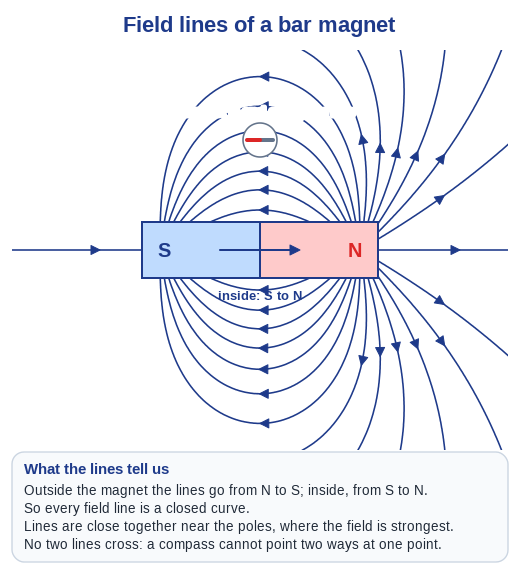
The space round a magnet in which its force can be detected is its magnetic field. Iron filings sprinkled round a bar magnet (Activity 12.2) line up along curves, and the same curves can be drawn point by point with a small compass (Activity 12.3). These curves are magnetic field lines.
The field has a size and a direction. Its direction at a point is the way the north pole of a compass needle points there. This gives the rules for field lines:
- Outside the magnet they go from N to S; inside, from S to N. So they are closed curves.
- They are closer together where the field is stronger, as near the poles.
- No two lines cross, because at a crossing a compass needle would have to point two ways.
How does a straight wire’s field look?
Pass a current through a long straight copper wire held over a compass needle and parallel to it (Activity 12.4, with two or three 1.5 V cells and a key). When the current flows from north to south, the north pole of the needle moves east; reverse the current and it moves west. So the direction of the field depends on the direction of the current.
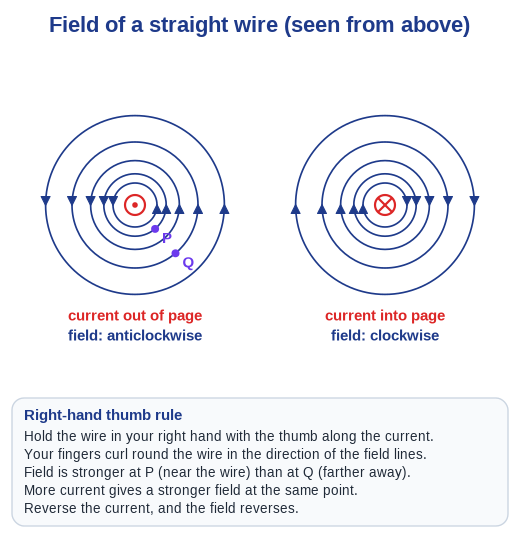
Now pass a thick wire vertically through a horizontal piece of cardboard and sprinkle iron filings on it (Activity 12.5). With the current on, the filings form concentric circles centred on the wire. A compass on any circle shows the direction of the field there. The activity also shows that:
- if the current increases, the compass is deflected more: the field grows with the current;
- if the compass is moved farther away, it is deflected less: the field weakens with distance. The circles get bigger and spread out.
What is the right-hand thumb rule?
Imagine holding the wire in your right hand with your thumb pointing along the current. Your fingers curl round the wire in the direction of the field lines. This is the right-hand thumb rule, also called Maxwell’s corkscrew rule: drive a corkscrew along the current, and it turns the way the field goes.
So, seen from above:
- current coming out of the page (towards you): field lines go anticlockwise;
- current going into the page (away from you): field lines go clockwise.
Example 12.1: a horizontal power line carries current from east to west. Point your right thumb towards the west. Seen from the east end (the current going away from you), the field turns clockwise in a plane at right angles to the wire; seen from the west end, it turns anticlockwise. Facing west, north is on your right, so the field points north just above the line and south just below it. (The book gives the clockwise and anticlockwise answer; the north and south are worked out from it.)
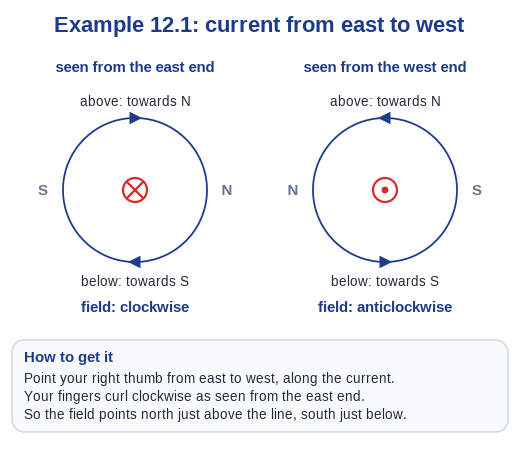
The same rule explains Activity 12.4: with the wire above the needle and the current flowing north to south, the field under the wire points east, so the north pole of the needle turns east.
What field does a circular loop make?
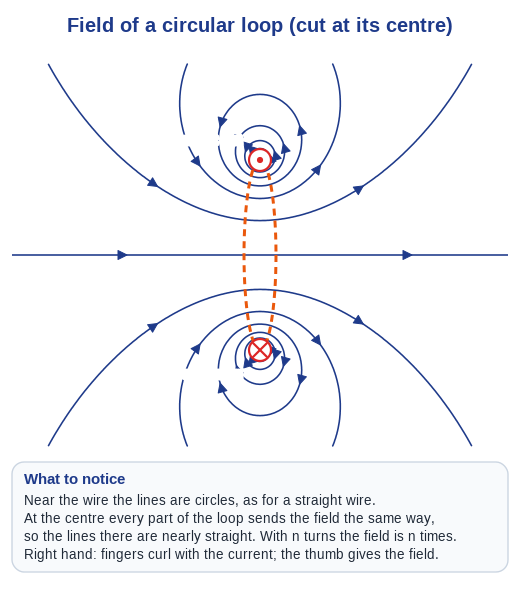
Bend the wire into a circular loop. Close to every part of the wire the field lines are still circles round it, and they grow larger farther from the wire. Near the centre of the loop these large circles look like straight lines. Apply the right-hand rule to any part of the loop and you find that every part sends the field the same way through the loop.
The field of a wire at a point is proportional to its current. In a coil of n turns the current goes round the same way in every turn, so the fields add up: the field is n times that of a single turn. Activity 12.6 shows the pattern with iron filings on a cardboard through which a coil of many turns passes.
What is a solenoid?
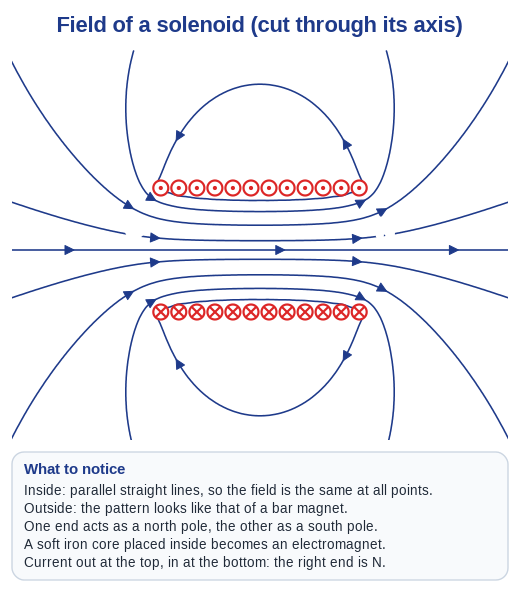
A solenoid is a coil of many circular turns of insulated copper wire, wrapped closely in the shape of a cylinder. With a current in it:
- the field pattern outside is just like that of a bar magnet: one end acts as a north pole and the other as a south pole;
- inside, the field lines are parallel straight lines, so the field is uniform: the same at all points inside.
To find which end is north, use the right-hand rule on the turns: curl your fingers along the current in the turns, and your thumb points along the field inside, towards the north end.
What is an electromagnet?
The strong field inside a solenoid can magnetise a piece of magnetic material such as soft iron placed inside the coil. The magnet formed in this way is an electromagnet: a core of soft iron with a coil of insulated copper wire wound round it.
The activities use cells or a battery, a key and a rheostat. Do them only with a teacher, and never with the mains. The questions on this topic are solved in the NCERT solutions for Chapter 12. See also force on a current-carrying conductor, or go back to the Chapter 12 notes.
Practice
-
Field lines of a bar magnet, outside the magnet, go:
Show answer
Answer: (b) from N to S
-
The field at a point near a straight wire is doubled if:
Show answer
Answer: (b) the current is doubled
-
A coil of 50 turns carries the same current as a coil of one turn of the same size. Its field at the centre is:
Show answer
Answer: (c) 50 times
-
A vertical wire carries current upwards. Seen from above, which way do its field lines go?
Show answer
Answer: Point the right thumb up, along the current: the fingers curl anticlockwise as seen from above. So the field lines go anticlockwise round the wire.
-
Why is the field inside a long solenoid called uniform?
Show answer
Answer: Inside it the field lines are parallel straight lines, equally spaced. So the field has the same size and the same direction at all points inside.
Questions students ask
How was the link between current and magnetism found?
In 1820 Hans Christian Oersted noticed by chance that a compass needle turned when a current flowed in a wire nearby. The chapter repeats this in Activity 12.1.
What is Maxwell’s corkscrew rule?
Another name for the right-hand thumb rule. If a corkscrew is driven forward along the current, the way it turns is the direction of the magnetic field.
How is a solenoid like a bar magnet?
Its field pattern outside matches that of a bar magnet, and one end behaves as a north pole while the other behaves as a south pole.
What is an electromagnet made of?
A core of soft iron with a coil of insulated copper wire wound round it. When current flows in the coil, the strong field inside magnetises the soft iron.
Stuck on a question?
Take a photo and Lagnever AI explains it step by step. Try it for 7 days for ₹2.
Get it on Google Play Open in browser
For parents: after the trial, the plan renews monthly by UPI or card autopay. You can cancel anytime in the app.