
Why does a current-carrying conductor feel a force in a magnetic field?
Answer in short
A current-carrying conductor in a magnetic field feels a force. The force reverses when the current or the field is reversed, and is largest when the current is at right angles to the field. Then it is at right angles to both, and Fleming’s left-hand rule gives its direction: first finger field, second finger current, thumb force.
Stuck on a question? Take a photo and Lagnever AI explains it step by step. Try it for 7 days for ₹2. Get it on Google Play
Does a magnet push on a current?
A current makes a magnetic field, and that field pushes on a magnet near it: this is why a compass needle turns near a current-carrying wire. The French scientist André-Marie Ampère (1775–1836) suggested that it must work both ways: the magnet must also exert an equal and opposite force on the current-carrying conductor.
What does Activity 12.7 show?
A small aluminium rod AB, about 5 cm long, hangs horizontally from a stand by two connecting wires. A strong horse-shoe magnet is placed so that the rod lies between its poles, with the N pole below and the S pole above, so the field between them points upwards. The rod is joined in series with a battery, a key and a rheostat. The book records these results:
- with current from B to A, the rod is pushed to one side (to the left in the book’s figure);
- reverse the current, and the rod moves the other way;
- swap the poles, so the field points down, and the force reverses again.
So the force on a conductor depends on the direction of the current and the direction of the field. Experiments show that the rod moves most, that is, the force is largest, when the current is at right angles to the field.
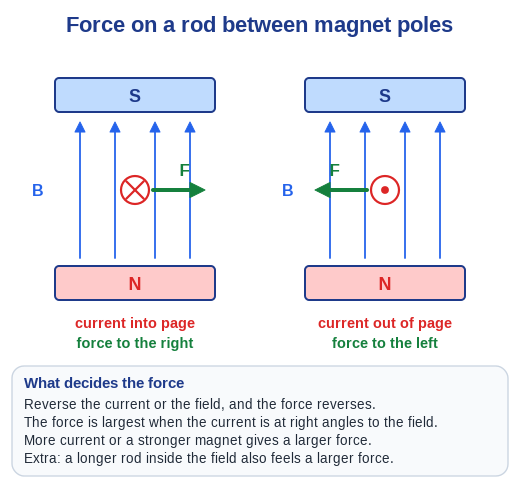
This activity uses a battery and must be done only with a teacher. Keep the current on only for a moment, and never use the mains.
What is Fleming’s left-hand rule?
When the current and the field are at right angles, the force is at right angles to both. Fleming’s left-hand rule puts the three directions on one hand:
- Stretch the thumb, first finger (forefinger) and second (middle) finger of your left hand so that they are mutually at right angles.
- Point the first finger along the magnetic field.
- Point the second finger along the current.
- The thumb then points along the force (motion) on the conductor.
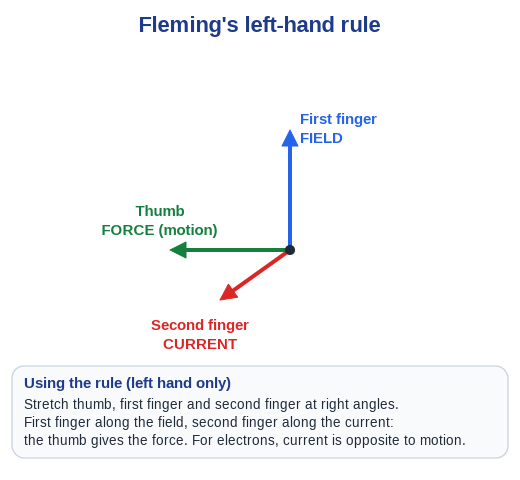
Extra, for checking: the force is along the cross product I × B (current direction × field direction), which gives the same answer as the left hand. Every direction in the diagrams on this page was checked this way.
How is the rule used for moving charges?
A moving charge is a current. For a positive particle the current is along its motion; for an electron the current is opposite to its motion.
Example 12.2: an electron enters a magnetic field at right angles to it. In the book’s figure the field points to the right and the electron moves down the page. The current is therefore up the page. First finger right, second finger up: the thumb points into the page. Answer: (d) into the page.
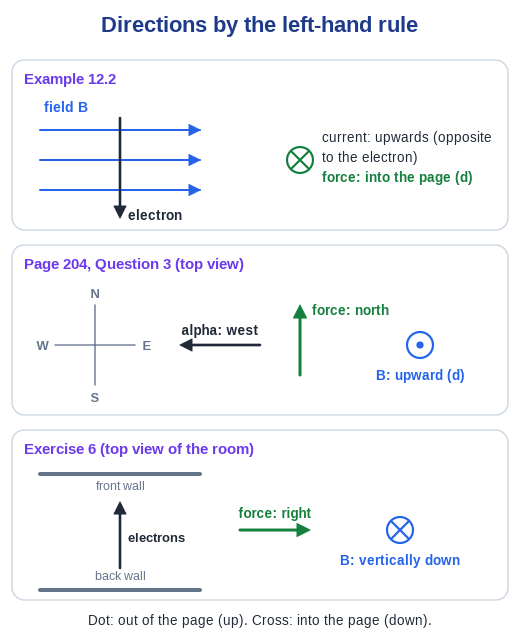
The force on a moving charge is always at right angles to its motion. So it changes the direction of the motion (its velocity and momentum) but not its speed, and the mass does not change either.
Where is this force used?
Devices that use current-carrying conductors in magnetic fields include the electric motor, the electric generator, loudspeakers, microphones and measuring instruments. (The 2026-27 chapter names them but does not explain how they work.)
Magnetism in medicine
The chapter’s “More to Know” box notes that every current makes a magnetic field, even the weak ion currents in our nerve cells. These fields are very weak, about one-billionth of the earth’s field. They are significant in two organs, the heart and the brain. Magnetic Resonance Imaging (MRI) uses the magnetic field inside the body to make images of body parts, which help doctors in diagnosis.
The questions on this topic are solved in the NCERT solutions for Chapter 12. See also magnetic field due to a current, or go back to the Chapter 12 notes.
Practice
-
The force on a current-carrying conductor in a magnetic field is largest when the angle between the current and the field is:
Show answer
Answer: (c) 90°
-
If both the current and the field are reversed, the force on the conductor:
Show answer
Answer: (b) stays in the same direction
-
In Fleming’s left-hand rule the first finger points along the:
Show answer
Answer: (c) magnetic field
-
A field points vertically up and a horizontal wire carries current towards you. Which way is the force on the wire?
Show answer
Answer: Left hand: first finger up (field), second finger towards you (current). The thumb then points to your left, so the force on the wire is to the left. As a check, F is along I × B = (towards you) × (up), which points to the left.
-
An electron moves east in a field that points vertically up. Which way is the force on it?
Show answer
Answer: The current is opposite to the electron, so it is towards the west. First finger up, second finger west: the thumb points north. The force on the electron is towards the north.
Questions students ask
Who first suggested that a magnet exerts a force on a current?
The French scientist André-Marie Ampère (1775–1836). Since a current exerts a force on a magnet, he suggested the magnet must exert an equal and opposite force on the current.
How do I remember which finger is which in Fleming’s left-hand rule?
A common memory aid (Extra): First finger for Field, seCond finger for Current, and thuMb for Motion. Keep the three at right angles, and use the left hand.
Does the force depend on how strong the current and the magnet are?
Yes. A larger current or a stronger magnet gives a larger force, so the rod in Activity 12.7 moves more. (Extra: the force also grows with the length of the conductor inside the field.)
Is the electric motor in the 2026-27 chapter?
No. The chapter names the motor, the generator, loudspeakers, microphones and measuring instruments as devices that use current-carrying conductors in magnetic fields, but it does not explain how a motor works.
Stuck on a question?
Take a photo and Lagnever AI explains it step by step. Try it for 7 days for ₹2.
Get it on Google Play Open in browser
For parents: after the trial, the plan renews monthly by UPI or card autopay. You can cancel anytime in the app.