
How is electricity wired in our homes?
Answer in short
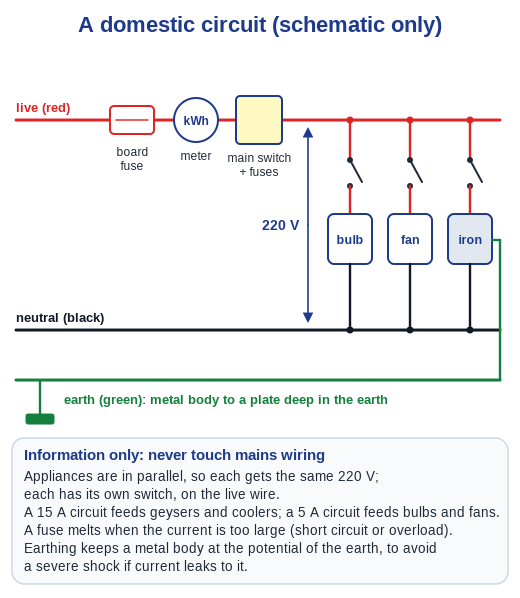
A house gets 220 V through a live wire (red) and a neutral wire (black), plus an earth wire (green) joined to a metal plate deep in the earth. Appliances are joined in parallel, each with its own switch. Earthing protects users from shocks, and a fuse melts to stop the unduly high current of a short circuit or overload.
Stuck on a question? Take a photo and Lagnever AI explains it step by step. Try it for 7 days for ₹2. Get it on Google Play
This page describes section 12.4 of the chapter as information only. It has no activity. Never touch, open or experiment with household wiring, sockets, fuses or the mains.
How does electricity reach a house?
Electric power comes to our homes through the main supply, or mains, carried on overhead electric poles or by underground cables. The supply has two wires:
- the live wire (also called positive), usually with red insulation;
- the neutral wire (also called negative), with black insulation.
In our country the potential difference between them is 220 V. The chapter’s summary adds that the supply is AC (alternating current) with a frequency of 50 Hz.
What happens at the meter-board?
At the meter-board of the house, the two wires pass through a main fuse into the electricity meter. Through the main switch they are joined to the line wires in the house, which feed separate circuits. Often there are two:
- a 15 A circuit for appliances of higher power, such as geysers and air coolers;
- a 5 A circuit for bulbs and fans.
Why are appliances joined in parallel?
In each circuit, the appliances are connected across the live and neutral wires, that is, in parallel. So every appliance gets the same potential difference, 220 V, and each has its own switch to turn it on and off without affecting the others. (The previous chapter explained why a series circuit would not work at home.)
What is the earth wire for?
The third wire, the earth wire, has green insulation and is joined to a metal plate deep in the earth near the house. It is a safety measure, especially for appliances with a metallic body, such as an electric press (iron), a toaster, a table fan or a refrigerator.
The metal body is joined to the earth wire, which gives a low-resistance conducting path for current. If any current leaks to the body, the earth wire keeps the body at the potential of the earth, so a user who touches it does not get a severe electric shock.
What do short circuits and overloading mean?
The electric fuse is an important part of every domestic circuit; its principle was studied in the previous chapter (section 11.7). A fuse protects the circuit and the appliances from damage due to overloading, which can happen in three ways:
- Short-circuiting: the live wire and the neutral wire come into direct contact, because the insulation is damaged or there is a fault in an appliance. The current then increases abruptly.
- An accidental rise in the supply voltage.
- Too many appliances connected to a single socket.
In each case the current becomes unduly high. Joule heating in the fuse melts it and breaks the circuit, which stops the current and protects the wiring and the appliances.
A worked check (Questions, page 205): a 2 kW oven on a 220 V circuit rated 5 A draws I = P/V = 2000/220 ≈ 9.1 A, much more than 5 A. The circuit is overloaded, so the fuse melts and the circuit breaks. Such an oven belongs on the 15 A circuit. (These numbers are for calculation only.)
Two safety measures to remember
- Electric fuse, joined in series, for protection against short-circuiting and overloading. The chapter calls it the most important safety device.
- Earthing of appliances with metal bodies, through the earth wire.
To avoid overloading, do not connect too many appliances to one socket, and use appliances of high power only on a circuit of suitable current rating.
The questions on this topic are solved in the NCERT solutions for Chapter 12. See also force on a current-carrying conductor, or go back to the Chapter 12 notes.
Practice
-
The wire with red insulation in a house supply is the:
Show answer
Answer: (c) live wire
-
Appliances in a house are joined in parallel so that:
Show answer
Answer: (b) each gets the same potential difference
-
At the time of a short circuit the current in the circuit:
Show answer
Answer: (c) increases heavily
-
A 1.1 kW heater is used on 220 V. Can it be put on a 5 A circuit? (Numbers for calculation only.)
Show answer
Answer: I = P/V = 1100 W ÷ 220 V = 5 A. That is just the rating of the circuit, with no margin, so it should go on the 15 A circuit meant for high-power appliances.
-
Why is the metal body of a refrigerator joined to the earth wire?
Show answer
Answer: If current leaks to the metal body, the earth wire gives it a low-resistance path to the earth and keeps the body at the potential of the earth. So a person who touches it does not get a severe shock.
Questions students ask
What is the difference between a short circuit and overloading?
A short circuit happens when the live and neutral wires touch directly, because of damaged insulation or a faulty appliance; the current then rises abruptly. Overloading means too large a current in general: from a short circuit, an accidental rise in the supply voltage, or too many appliances on one socket.
How does a fuse protect a circuit?
It is a wire in series with the circuit. When the current becomes unduly high, Joule heating melts the fuse wire and breaks the circuit, which saves the wiring and the appliances from damage.
Which appliances need earthing?
Especially those with a metallic body, such as an electric press (iron), a toaster, a table fan and a refrigerator.
Can I check the wiring or a fuse at home myself?
No. This chapter describes domestic circuits only as information. Never touch, open or experiment with household wiring, sockets, fuses or the mains; that is work for a trained electrician.
Stuck on a question?
Take a photo and Lagnever AI explains it step by step. Try it for 7 days for ₹2.
Get it on Google Play Open in browser
For parents: after the trial, the plan renews monthly by UPI or card autopay. You can cancel anytime in the app.