
Class 10 Science Chapter 12: Magnetic Effects of Electric Current Notes
This chapter in five lines
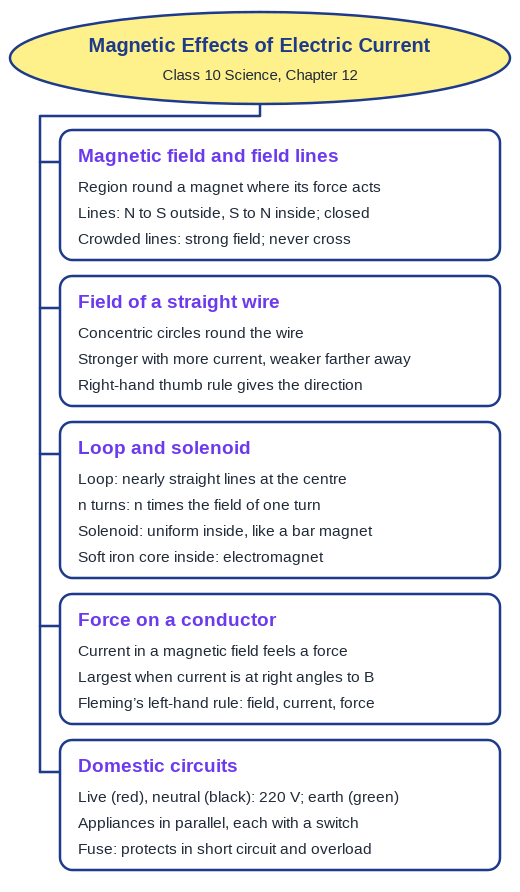
An electric current produces a magnetic field around it. Round a straight wire the field lines are concentric circles, whose direction is given by the right-hand thumb rule; a circular loop gives nearly straight lines at its centre, and a solenoid gives a uniform field inside and behaves like a bar magnet. A current-carrying conductor in a magnetic field feels a force, whose direction is given by Fleming’s left-hand rule. Homes get 220 V through live, neutral and earth wires, with appliances in parallel and fuses for safety.
What is this chapter about?
The last chapter showed that a current heats a wire. This chapter shows its other main effect: a current-carrying wire behaves like a magnet. In Activity 12.1 a thick copper wire is joined in a circuit and a small compass is placed near it; when the key is plugged in, the compass needle turns. Hans Christian Oersted noticed this by chance in 1820, and it showed that electricity and magnetism are linked. (The unit of magnetic field strength, the oersted, is named after him.) The chapter then answers three questions: what pattern of field does a current make, what force does a magnet put on a current, and how is electricity brought safely into our homes?
What is a magnetic field?
A compass needle is a small bar magnet. Its end that points roughly north is the north-seeking or north pole, and the other end is the south pole. Like poles repel and unlike poles attract, so a compass needle turns when a bar magnet comes near it.
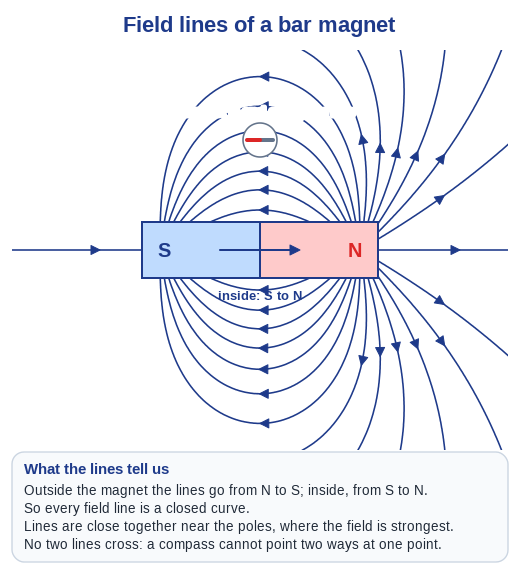
In Activity 12.2, iron filings sprinkled round a bar magnet on a sheet of paper arrange themselves in a pattern when the board is tapped. The magnet acts on them in the space round it. The region round a magnet in which its force can be detected is its magnetic field, and the lines along which the filings line up are magnetic field lines. In Activity 12.3 the same lines are drawn with a small compass, moving it step by step from the N pole to the S pole and marking where its ends point.
A magnetic field has both a size and a direction. The direction at a point is the way the north pole of a compass needle points there. So:
- outside a magnet, field lines go from the N pole to the S pole; inside it, from S to N, so field lines are closed curves;
- where the lines are crowded, the field is stronger (near the poles);
- no two field lines cross: at a crossing, a compass would have to point two ways at once.
What field does a straight wire carrying current make?
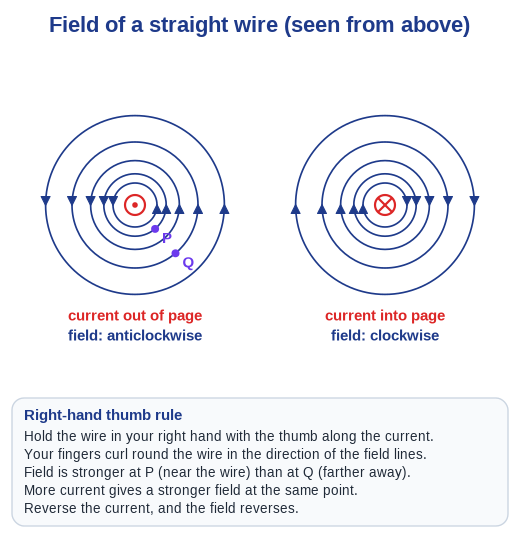
In Activity 12.4 a straight copper wire is held over a compass needle, parallel to it, and joined to two or three 1.5 V cells. With the current flowing from north to south, the north pole of the needle moves east; when the cell connections are reversed, the current flows from south to north and the needle moves west. Reversing the current reverses the field.
In Activity 12.5 a thick wire passes straight through a horizontal cardboard sheet, and iron filings on the sheet form concentric circles round the wire. A compass placed on a circle shows the direction of the field. Two results matter:
- a larger current gives a larger deflection, so the field at a point grows with the current;
- farther from the wire the deflection is smaller, so the field gets weaker with distance, and the circles get larger and farther apart.
The right-hand thumb rule gives the direction: hold the wire in your right hand with the thumb pointing along the current; your fingers curl round the wire in the direction of the field lines. (It is also called Maxwell’s corkscrew rule: a corkscrew driven along the current turns the way the field goes.) In Example 12.1, a power line carries current from east to west; the field round it turns clockwise as seen from the east end and anticlockwise from the west end. Read more in magnetic field due to a current.
What about a circular loop and a solenoid?
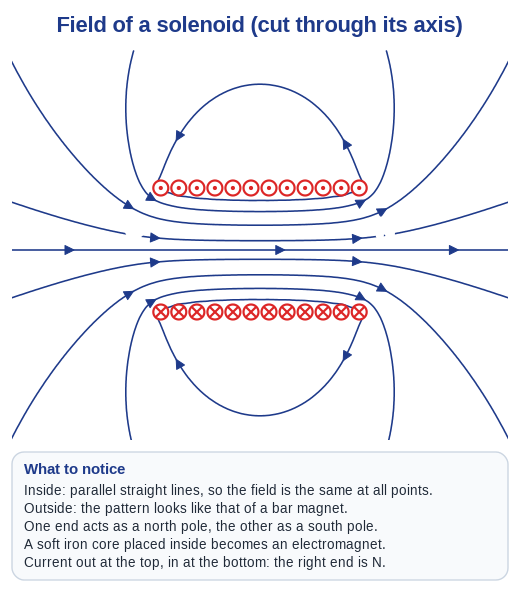
Bend the wire into a circular loop. Near each part of the wire the field lines are still circles, which grow larger away from the wire. By the centre of the loop these big circles look like straight lines, and the right-hand rule shows that every part of the loop sends the field the same way inside the loop. The field is proportional to the current, so a coil of n turns gives a field n times that of one turn (Activity 12.6 shows the pattern with iron filings).
A solenoid is a coil of many circular turns of insulated copper wire wound closely in the shape of a cylinder. Its field pattern is like that of a bar magnet: one end acts as a north pole and the other as a south pole. Inside, the field lines are parallel straight lines, so the field is uniform (the same at all points). This strong field can magnetise a piece of soft iron placed inside the coil; the magnet so formed is an electromagnet.
What force acts on a current in a magnetic field?
A current makes a field that pushes on a nearby magnet. André-Marie Ampère suggested that the magnet must push back on the current with an equal and opposite force. In Activity 12.7 a short aluminium rod hangs between the poles of a horse-shoe magnet, with the field pointing up, and is joined to a battery, a key and a rheostat. When current flows the rod moves sideways, and:
- reversing the current reverses the force;
- reversing the field (swapping the poles) also reverses the force;
- the force is largest when the current is at right angles to the field.
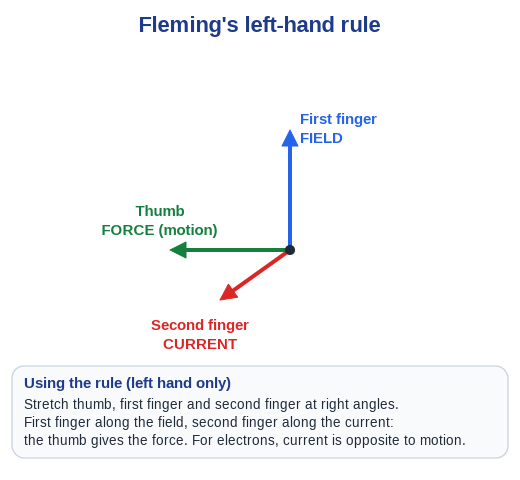
Then the force is at right angles to both. Fleming’s left-hand rule gives its direction: stretch the thumb, first finger and second finger of your left hand at right angles to each other. Point the first finger along the field and the second finger along the current: the thumb gives the direction of the force or motion. For a moving electron, the current is taken opposite to its motion (Example 12.2). Motors, generators, loudspeakers, microphones and measuring instruments all use current-carrying conductors in magnetic fields. Read more in force on a current-carrying conductor.
The chapter’s “More to Know” box adds that even the weak ion currents in our nerves make tiny magnetic fields, about one-billionth of the earth’s field; those of the heart and brain are significant, and Magnetic Resonance Imaging (MRI) uses magnetism inside the body to make images for medical diagnosis.
How is electricity wired in our homes?
This part is information only, as in the book. Never touch, open or experiment with household wiring, sockets or the mains.
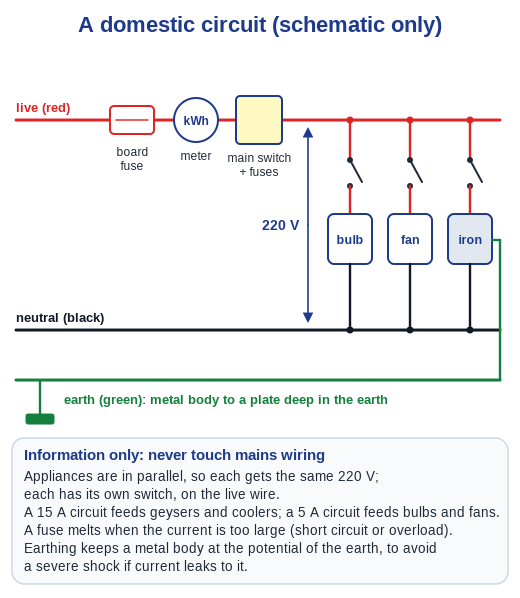
Power reaches a house through the mains, on overhead poles or underground cables. The live wire has red insulation and the neutral wire black; in India the potential difference between them is 220 V (AC at 50 Hz). At the meter-board the wires go through a main fuse into the electricity meter, and through the main switch to the line wires of the house. Often there are two circuits: one of 15 A for high-power appliances such as geysers and air coolers, and one of 5 A for bulbs and fans. The earth wire, with green insulation, goes to a metal plate deep in the earth near the house.
Appliances are joined in parallel across the live and neutral wires, so each gets the same potential difference, and each has its own switch. Two safety measures protect people and appliances:
- Earthing: the metal body of an iron, toaster, table fan or refrigerator is joined to the earth wire. It gives any leaking current a low-resistance path and keeps the body at the potential of the earth, so the user does not get a severe shock.
- Fuse: if the live and neutral wires touch (short-circuiting), or the supply voltage rises by accident, or too many appliances are on one socket (overloading), the current becomes too large; Joule heating melts the fuse wire and breaks the circuit.
Read more in domestic electric circuits.
Before we move on
The activities in this chapter use dry cells or a battery, a key, a rheostat, a compass and iron filings. Do them only with a teacher; switch the current on only while you take a reading, as a thick wire can get warm. Never use the mains or a household socket for any experiment. Answers to all five Questions boxes, both examples and all 9 exercises are in the NCERT solutions for Chapter 12.
Key terms
| Term | Meaning |
|---|---|
| Magnetic field | The region round a magnet in which its force can be detected. It has both a magnitude and a direction. |
| Magnetic field lines | Lines that show a magnetic field. The direction at a point is the way the north pole of a compass needle points there. They leave the N pole, enter the S pole and run from S to N inside the magnet, so they are closed curves. |
| North pole and south pole | The end of a compass needle (a small magnet) that points roughly north is its north-seeking or north pole; the other end is the south pole. Like poles repel and unlike poles attract. |
| Right-hand thumb rule | Hold a current-carrying straight wire in the right hand with the thumb along the current; the fingers wrap round the wire in the direction of the field lines. Also called Maxwell’s corkscrew rule. |
| Solenoid | A coil of many circular turns of insulated copper wire wound closely in the shape of a cylinder. With a current, its field is like that of a bar magnet and uniform inside. |
| Electromagnet | A piece of magnetic material, such as soft iron, magnetised by the strong field inside a current-carrying solenoid; it is a core of soft iron with a coil of insulated copper wire round it. |
| Fleming’s left-hand rule | Stretch the thumb, first finger and second finger of the left hand at right angles. First finger along the field, second finger along the current: the thumb gives the force (motion) on the conductor. |
| Live, neutral and earth wires | In a house supply the live wire has red insulation and the neutral wire black; the potential difference between them is 220 V. The earth wire has green insulation and goes to a metal plate deep in the earth. |
| Short-circuiting | When the live and neutral wires come into direct contact (damaged insulation or a faulty appliance), the current suddenly becomes very large. |
| Overloading | Too large a current in a circuit: from a short circuit, an accidental rise in the supply voltage, or too many appliances on one socket. |
| Electric fuse | A safety device in series with a circuit: its wire melts by Joule heating and breaks the circuit when the current is unduly high. |
Topics in this chapter
Practice
-
The magnetic field lines round a long straight current-carrying wire are:
Show answer
Answer: (c) concentric circles round the wire
-
Inside a long current-carrying solenoid the magnetic field is:
Show answer
Answer: (b) the same at all points
-
Which rule gives the direction of the force on a current-carrying conductor in a magnetic field?
Show answer
Answer: (c) Fleming’s left-hand rule
-
The insulation of the earth wire is usually:
Show answer
Answer: (c) green
-
Appliances in a house are joined:
Show answer
Answer: (b) in parallel
Questions students ask
What are the main topics of Class 10 Science Chapter 12?
Magnetic field and field lines, the magnetic field of a current in a straight wire, a circular loop and a solenoid, the right-hand thumb rule, the electromagnet, the force on a current-carrying conductor in a magnetic field with Fleming’s left-hand rule, and domestic electric circuits with the fuse and earthing.
Is Magnetic Effects of Electric Current in the 2026-27 NCERT book?
Yes. It is Chapter 12 of Science, the Class 10 NCERT textbook marked Reprint 2026-27, on pages 195 to 207. It has two solved examples, five Questions boxes and 9 exercises.
Are the electric motor, electromagnetic induction and the generator in this chapter?
No. The 2026-27 chapter has four sections: 12.1 magnetic field and field lines, 12.2 field due to a current, 12.3 force on a current-carrying conductor and 12.4 domestic electric circuits. It names the motor and generator only as devices that use current-carrying conductors and magnetic fields.
Which parts of this chapter should I practise for the board exam?
Drawing field lines of a bar magnet, a straight wire, a loop and a solenoid with correct arrows; finding directions with the right-hand thumb rule and Fleming’s left-hand rule; and the reasons behind the fuse, earthing, parallel wiring and overloading.
Why do the field lines of a magnet never cross?
At a crossing point a compass needle would have to point in two directions at once, which is not possible. So the field at any point has only one direction.
Stuck on a question?
Take a photo and Lagnever AI explains it step by step. Try it for 7 days for ₹2.
Get it on Google Play Open in browser
For parents: after the trial, the plan renews monthly by UPI or card autopay. You can cancel anytime in the app.