
NCERT Solutions Class 10 Science Chapter 9: Light – Reflection and Refraction (Hinglish)
Class 10 ki NCERT textbook Science ke Chapter 9, Light – Reflection and Refraction, ke andar ke chaaron Questions boxes, chaar solved examples, activities aur saare 17 end-of-chapter exercises ke jawab. Page numbers 2026-27 reprint ke hisaab se hain (pages 134–160). Exercises ke sawal Hinglish mein diye hain; chapter ke andar ke sawal chhote mein apne shabdon mein likhe hain. Har numerical New Cartesian sign convention se hal kiya aur calculation se check kiya gaya hai. Jo baatein chapter se aage ki hain, un par “Extra” likha hai. Chhote notes: Chapter 9 ke notes.
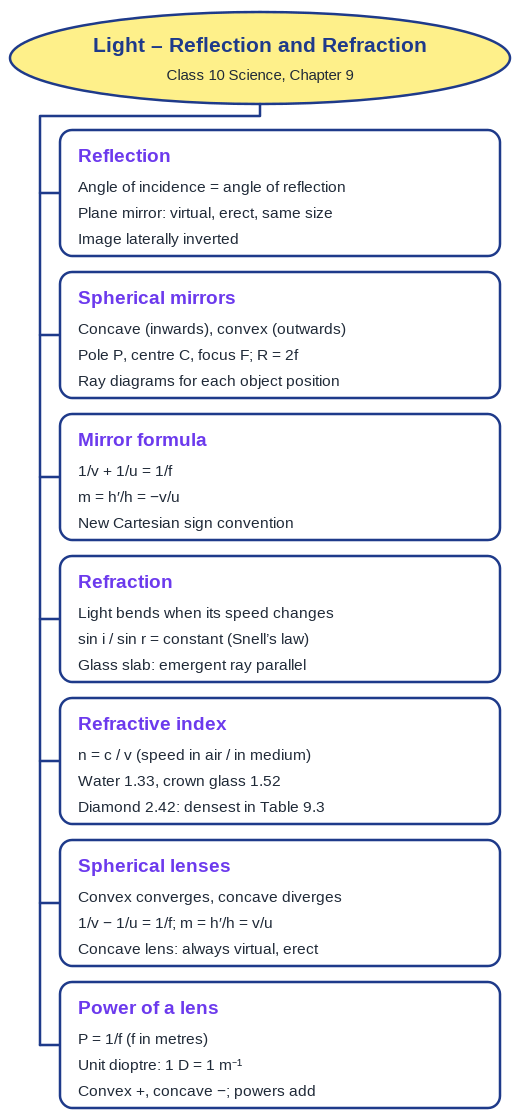
Questions, page 142
Question 1 (page 142): concave mirror ka principal focus define karo. Ye principal axis par wo point hai jahan principal axis ke parallel aati light ki rays concave mirror se reflect hokar milti hain. Ise F likhte hain.
Question 2 (page 142): R = 20 cm; f nikaalo. Chhote aperture wale spherical mirror ke liye f = R/2 = 20/2 = 10 cm.
Question 3 (page 142): kaun sa mirror erect aur enlarged image de sakta hai? Concave mirror, jab object pole aur principal focus ke beech ho.
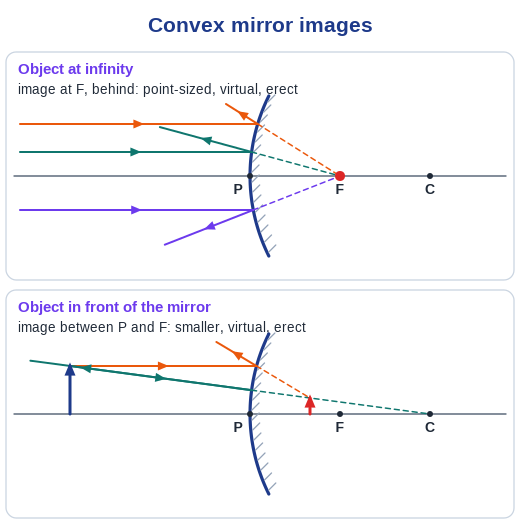
Question 4 (page 142): rear-view mirror ke liye convex mirror kyun pasand kiya jaata hai? Ye hamesha erect image deta hai, bhale chhoti, aur bahar ubhra hone se iska field of view wide hai, isliye driver plane mirror se kaafi zyaada area peeche dekh paata hai.
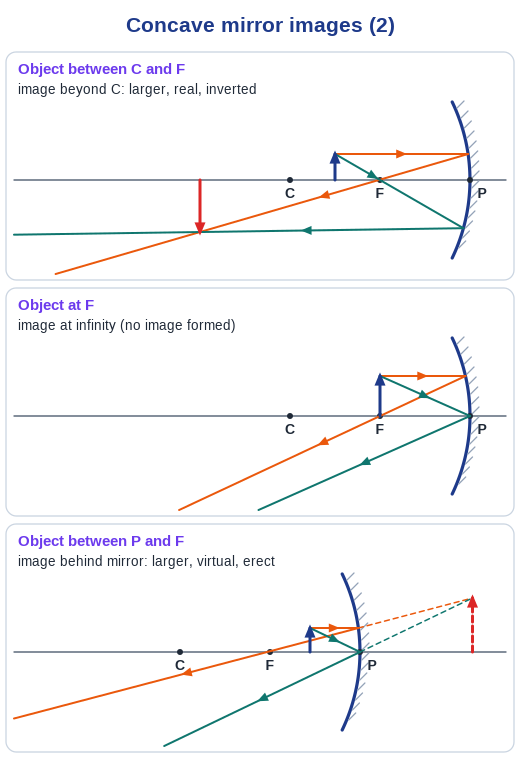
Examples 9.1 aur 9.2 (pages 144–145)
Example 9.1 (page 144): convex rear-view mirror, R = 3.00 m, bus 5.00 m par. R = +3.00 m, to f = +1.50 m (convex mirror ka focus uske peeche); u = −5.00 m. 1/v = 1/f − 1/u = 1/1.50 + 1/5.00 = 6.50/7.50, to v = +1.15 m. m = −v/u = −1.15/(−5.00) = +0.23. Image mirror ke 1.15 m peeche, virtual, erect aur bus ki 0.23 guna size ki hai.
Example 9.2 (page 144): 4.0 cm ka object, 15.0 cm focal length wale concave mirror se 25.0 cm aage. u = −25.0 cm, f = −15.0 cm. 1/v = −1/15.0 + 1/25.0 = (−5.0 + 3.0)/75.0 = −2.0/75.0, to v = −37.5 cm: screen mirror ke 37.5 cm aage. h′ = −vh/u = −(−37.5)(4.0)/(−25.0) = −6.0 cm: real, inverted, enlarged. (Book ki working mein “From Eq. (10.1)” likha hai; matlab mirror formula, Eq. (9.1), hai.)
Questions, page 145
Question 1 (page 145): R = 32 cm wale convex mirror ki focal length. f = R/2 = +16 cm (positive, kyunki focus mirror ke peeche hai).
Question 2 (page 145): concave mirror 10 cm aage rakhe object ki teen guna badi real image banata hai; image kahan hai? Real image inverted hoti hai, to m = −3, aur u = −10 cm. m = −v/u se v = −m × u = −(−3)(−10) = −30 cm: image mirror ke 30 cm aage hai. (Extra: tab 1/f = 1/v + 1/u = −1/30 − 1/10, to f = −7.5 cm.)
Questions, page 150
Question 1 (page 150): hawa se paani mein tirchhi ray: normal ki taraf ya door? Normal ki taraf. Paani hawa se optically denser hai (n = 1.33), isliye paani mein jaate hue light dheemi hoti hai aur normal ki taraf mudti hai.
Question 2 (page 150): refractive index 1.50 wale glass mein light ki speed. n = c/v, to v = c/n = (3 × 10⁸ m/s)/1.50 = 2 × 10⁸ m/s.
Question 3 (page 150): Table 9.3 mein sabse zyaada aur sabse kam optical density. Sabse zyaada: diamond (2.42). Sabse kam: hawa (1.0003).
Question 4 (page 150): kerosene, turpentine aur paani: light sabse tez kahan? Refractive indices: paani 1.33, kerosene 1.44, turpentine oil 1.47. Jahan n sabse chhota ho wahan light sabse tez hai (v = c/n), yaani paani mein.
Question 5 (page 150): “diamond ka refractive index 2.42 hai” ka matlab. Hawa (vacuum) mein light ki speed diamond mein uski speed ki 2.42 guna hai; yaani diamond mein light 2.42 guna dheemi chalti hai. (Extra: v = 3 × 10⁸/2.42 ≈ 1.24 × 10⁸ m/s.)
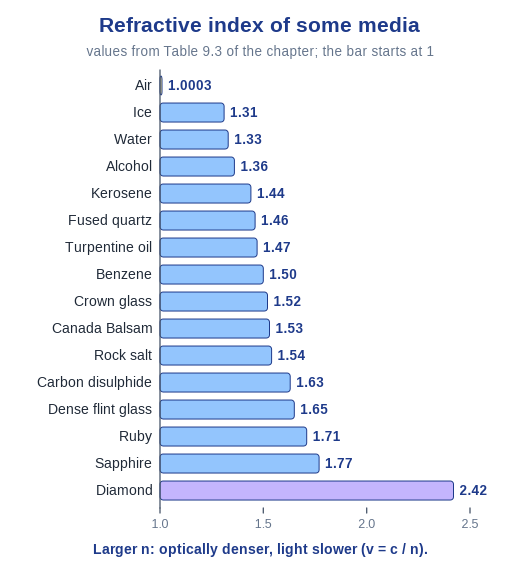
Examples 9.3 aur 9.4 (pages 156–157)
Example 9.3 (page 156): concave lens, f = 15 cm, image 10 cm par; u aur m nikaalo. Concave lens object ki taraf virtual image banata hai, to v = −10 cm, f = −15 cm. 1/u = 1/v − 1/f = −1/10 + 1/15 = −1/30, to u = −30 cm. m = v/u = (−10)/(−30) = +1/3 ≈ +0.33: virtual, erect, ek-tihaai size.
Example 9.4 (page 156): 2.0 cm ka object, 10 cm focal length wale convex lens se 15 cm par. u = −15 cm, f = +10 cm. 1/v = 1/f + 1/u = 1/10 − 1/15 = 1/30, to v = +30 cm. m = v/u = 30/(−15) = −2 aur h′ = mh = −4.0 cm. Image doosri taraf 30 cm par, real, inverted, 4.0 cm oonchi (double size).
Questions, page 158
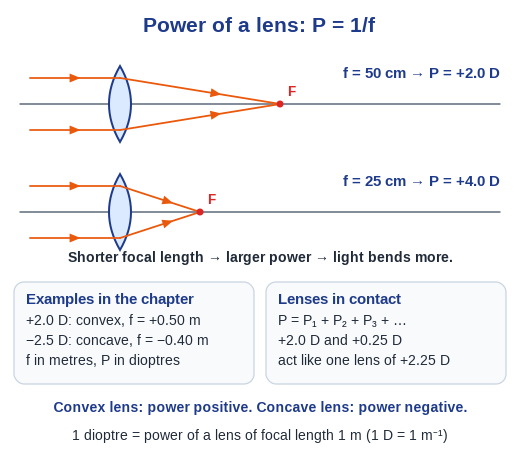
Question 1 (page 158): 1 dioptre define karo. 1 dioptre us lens ki power hai jiski focal length 1 metre ho: 1 D = 1 m⁻¹.
Question 2 (page 158): convex lens 50 cm door suee ki real, inverted image banata hai jo suee ke hi size ki hai; suee kahan hai, aur power kitni? Same size ki real image tab banti hai jab object 2F1 par aur image 2F2 par ho. To suee lens ke 50 cm aage hai (u = −50 cm, v = +50 cm). 1/f = 1/v − 1/u = 1/50 + 1/50 = 1/25, to f = +25 cm = +0.25 m aur P = 1/f = +4 D.
Question 3 (page 158): 2 m focal length wale concave lens ki power. f = −2 m, to P = 1/f = −0.5 D.
Activities kya dikhaati hain (Activities 9.1–9.13)
- 9.1, chamakta chammach: andar wala hissa concave mirror jaisa hai. Normal doori par aapka chehra uske focus se aage hota hai, isliye image ulti aur chhoti dikhti hai; bilkul paas laane par hi erect aur badi hoti hai. Peeche wala hissa convex mirror jaisa hai aur hamesha erect, chhoti image deta hai.
- 9.2 aur 9.11, concave mirror ya convex lens se dhoop focus karna: kaagaz par bana chamakta spot Sooraj ki real image hai, aur mirror ya lens se uski doori lagbhag focal length hai. Ikatthi light kaagaz mein dhuaan aur aag laga sakti hai, isliye ye sirf teacher ke saath karo. Sooraj ko kabhi mat dekho, na seedhe, na mirror mein, na lens se, aur dhoop ko kabhi skin par focus mat karo. Focal length kisi door ki khidki ya ped ki image se safely nikaal sakte ho.
- 9.3 aur 9.4, concave mirror aur candle: results Table 9.1 se milte hain. Candle P aur F ke beech ho to screen par image nahi aati; mirror mein virtual, erect, badi image dikhti hai. Jalti candle sirf teacher ke saath use karo.
- 9.5, convex mirror aur pencil: image hamesha erect aur chhoti; pencil door jaaye to image aur chhoti hoti hai aur focus ke paas aati hai.
- 9.6, oonche, door ke ped ki poori image: chhota convex mirror poora ped dikha deta hai, kyunki uski images chhoti hoti hain aur field of view wide hai.
- 9.7 aur 9.8, paani ke neeche sikka: sikka upar utha lagta hai, isliye ek baar mein uthaana mushkil hai, aur nazar se hata sikka paani daalne par phir dikhta hai. Dono paani ki surface par refraction ki wajah se.
- 9.9, glass slab ke neeche line: slab line se tirchhi ho to line slab ke kinaaron par mudi lagti hai; slab line ke seedhe (square) ho to mudi nahi lagti; upar se dekho to upar uthi lagti hai.
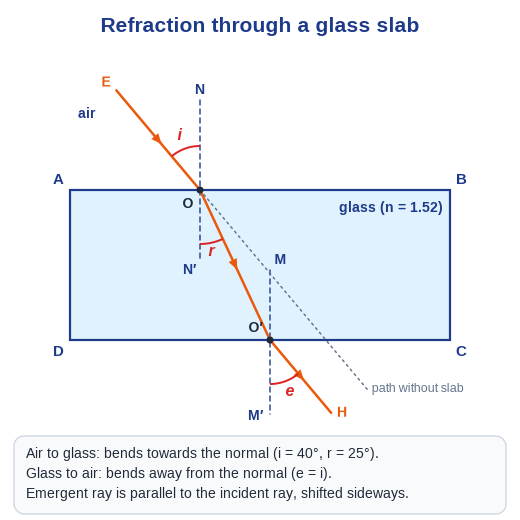
- 9.10, pins aur glass slab: ray andar jaate hue normal ki taraf, bahar nikalte hue normal se door mudti hai, aur incident ray ke parallel, side mein khiski hui nikalti hai.
- 9.12 aur 9.13, convex aur concave lens ke saath candle: results Tables 9.4 aur 9.5 se milte hain. Concave lens hamesha virtual, erect, chhoti image deta hai.
Exercises 1 se 6: multiple choice
1. Inme se kis material se lens nahi ban sakta? (a) Paani (b) Glass (c) Plastic (d) Mitti (clay)
(d) Clay. Lens transparent hona chahiye taaki light aar-paar jaakar refract ho. Clay opaque hai.
2. Concave mirror ki image virtual, erect aur object se badi dikhti hai. Object kahan hona chahiye? (a) Principal focus aur centre of curvature ke beech (b) Centre of curvature par (c) Centre of curvature se aage (d) Mirror ke pole aur principal focus ke beech.
(d). Sirf jab object P aur F ke beech ho, concave mirror virtual, erect, enlarged image deta hai (Table 9.1). Baaki teen positions mein image real aur inverted hai.
3. Convex lens ke aage object kahan rakhein ki object ke size ki real image mile? (a) Lens ke principal focus par (b) Focal length ke do guna par (c) Infinity par (d) Lens ke optical centre aur principal focus ke beech.
(b) Focal length ke do guna par (2F1 par). Tab image 2F2 par, real, inverted aur same size ki hoti hai (Table 9.4).
4. Ek spherical mirror aur ek thin spherical lens dono ki focal length –15 cm hai. Mirror aur lens shaayad hain (a) dono concave. (b) dono convex. (c) mirror concave aur lens convex. (d) mirror convex, par lens concave.
(a) dono concave. Sign convention se concave mirror ka focus aage hai (negative f) aur concave lens ki focal length negative hai.
5. Aap mirror se kitni bhi door khade hon, aapki image erect dikhti hai. Mirror shaayad hai (a) sirf plane. (b) sirf concave. (c) sirf convex. (d) plane ya convex.
(d) plane ya convex. Dono hamesha erect image dete hain. Concave mirror mein focus se aage khade hote hi image ulti ho jaati hai.
6. Dictionary ke chhote akshar padhne ke liye aap kaun sa lens pasand karoge? (a) 50 cm focal length ka convex lens. (b) 50 cm focal length ka concave lens. (c) 5 cm focal length ka convex lens. (d) 5 cm focal length ka concave lens.
(c) 5 cm focal length ka convex lens. Akshar O aur F1 ke beech hon to convex lens virtual, erect, enlarged image deta hai. Concave lens sirf chhoti images deta hai, aur chhoti focal length aaraamdeh doori par zyaada magnification deti hai.
Exercises 7 se 9: mirrors aur lens shabdon mein
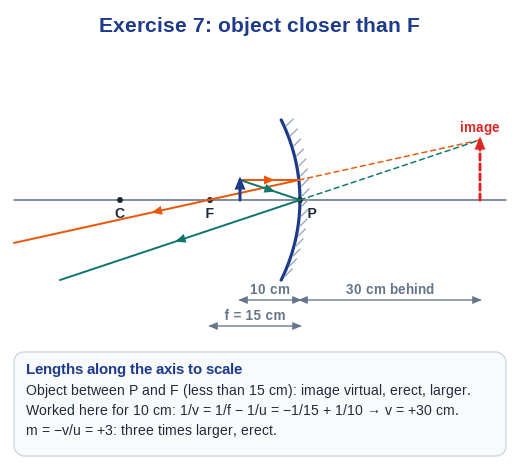
7. Hum 15 cm focal length wale concave mirror se object ki erect image chahte hain. Mirror se object ki doori ki range kya ho? Image kaisi hogi? Image object se badi hogi ya chhoti? Is case ka ray diagram banao.
Object pole aur focus ke beech: mirror se 15 cm se kam door hona chahiye (0 < doori < 15 cm). Image virtual aur erect, mirror ke peeche, aur object se badi hogi. Jaise object 10 cm par ho: 1/v = 1/f − 1/u = −1/15 + 1/10 = 1/30, to v = +30 cm aur m = −v/u = +3.
8. In jagahon par kaun sa mirror lagta hai, naam batao. (a) Car ki headlights. (b) Gaadi ka side/rear-view mirror. (c) Solar furnace. Apne jawab ka kaaran do.
- (a) Concave mirror. Bulb focus par rakha jaata hai, isliye reflect hui light shaktishaali parallel beam ban kar nikalti hai.
- (b) Convex mirror. Ye hamesha erect, chhoti image deta hai aur iska field of view wide hai, isliye driver peeche ka bada area dekhta hai.
- (c) Concave mirror. Bada concave mirror dhoop ko apne focus par ikattha karta hai, jisse wahan bahut garmi paida hoti hai.
9. Convex lens ka aadha hissa kaale kaagaz se dhaka hai. Kya ye lens object ki poori image banayega? Experiment se check karo. Apne observations samjhao.
Haan, lens ab bhi poori image banata hai, bas wo dhundhli (kam chamakdaar) hoti hai. Object ka har point poore lens par rays bhejta hai; khula aadha hissa ab bhi har point se kuch rays leta hai aur unhe image point par milaata hai, isliye image ka koi hissa gayab nahi hota. Image tak sirf aadhi light pahunchti hai, isliye chamak kam hoti hai.
Check karne ke liye, teacher ke saath, convex lens se jalti candle ki saaf image screen par banao, phir lens ka upar ya neeche wala aadha hissa kaale kaagaz se dhako. Screen par poori lau ab bhi dikhti hai, par halki.
Exercises 10 se 15: numericals
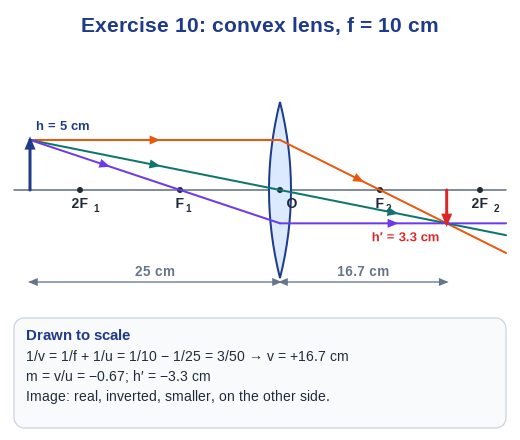
10. 5 cm lamba object 10 cm focal length wale converging lens se 25 cm door hai. Ray diagram banao aur image ki position, size aur nature nikaalo.
Lens formula 1/v − 1/u = 1/f lagao, New Cartesian sign convention ke signs ke saath.
- Data likho: h = +5 cm, u = −25 cm (object lens ke left mein hai), f = +10 cm (converging lens matlab convex lens, to f positive hai).
- v nikaalo: 1/v = 1/f + 1/u = 1/10 − 1/25 = (5 − 2)/50 = 3/50. To v = 50/3 = +16.7 cm.
- Magnification nikaalo: m = v/u = 16.7/(−25) = −0.67.
- Image ka size nikaalo: h′ = m × h = −0.67 × 5 = −3.3 cm. Minus sign ka matlab image ulti hai.
Answer: image lens ki doosri taraf 16.7 cm par banti hai. Wo 3.3 cm lambi hai, aur real, inverted aur object se chhoti hai.
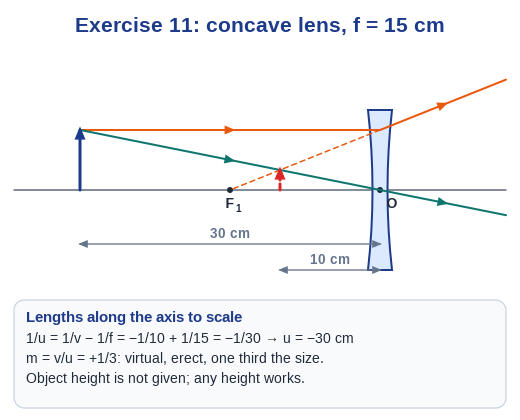
11. 15 cm focal length wala concave lens lens se 10 cm par image banata hai. Object lens se kitni door hai? Ray diagram banao.
- Concave lens hamesha object wali taraf hi virtual image banata hai. To v = −10 cm. Concave lens ki focal length negative hoti hai: f = −15 cm.
- Lens formula se, 1/u = 1/v − 1/f = −1/10 + 1/15 = (−3 + 2)/30 = −1/30. To u = −30 cm.
- Image check karo: m = v/u = (−10)/(−30) = +1/3. Image virtual, erect aur object ki ek-tihaai size ki hai.
Answer: object lens se 30 cm door hai, usi taraf jahan image hai.
12. 15 cm focal length wale convex mirror se 10 cm ki doori par object hai. Image ki position aur nature nikaalo.
Mirror formula 1/v + 1/u = 1/f lagao.
- Data likho: u = −10 cm. Convex mirror ka focus uske peeche hota hai, to f = +15 cm.
- v nikaalo: 1/v = 1/f − 1/u = 1/15 + 1/10 = (2 + 3)/30 = 1/6. To v = +6 cm. Plus sign ka matlab image mirror ke peeche hai.
- Magnification nikaalo: m = −v/u = −6/(−10) = +0.6.
Answer: image mirror ke 6 cm peeche hai. Wo virtual, erect aur chhoti (object ki 0.6 guna) hai.
13. Plane mirror ka magnification +1 hai. Iska kya matlab hai?
m = h′/h = 1 matlab image object ke same size ki hai. Positive sign matlab image virtual aur erect hai. (Ye v = −u se bhi milta hai: image mirror ke utni hi peeche jitna object aage.)
14. 5.0 cm lamba object 30 cm radius of curvature wale convex mirror ke 20 cm aage rakha hai. Image ki position, nature aur size nikaalo.
- Data likho: convex mirror ke liye R = +30 cm, to f = R/2 = +15 cm. u = −20 cm aur h = +5.0 cm.
- v nikaalo: 1/v = 1/f − 1/u = 1/15 + 1/20 = (4 + 3)/60 = 7/60. To v = 60/7 = +8.6 cm (mirror ke peeche).
- Magnification nikaalo: m = −v/u = −(60/7)/(−20) = 3/7 = +0.43.
- Image ka size nikaalo: h′ = m × h = (3/7) × 5.0 = 15/7 = +2.1 cm.
Answer: image mirror ke 8.6 cm peeche hai. Wo virtual, erect aur chhoti hai, aur 2.1 cm lambi hai.
Book ki answer key par note: key 2.2 cm deti hai. Exact value v = 60/7 cm lene par h′ = 15/7 = 2.14 cm, jo round karke 2.1 cm hai. Key ka 2.2 cm pehle v ko 8.6 cm round karne se aata hai (8.6/20 × 5 = 2.15).
15. 7.0 cm ka object 18 cm focal length wale concave mirror ke 27 cm aage rakha hai. Screen mirror se kitni door rakhein ki saaf focused image mile? Image ka size aur nature nikaalo.
- Data likho: u = −27 cm, f = −18 cm (concave mirror ka focus uske aage hota hai), h = +7.0 cm.
- v nikaalo: 1/v = 1/f − 1/u = −1/18 + 1/27 = (−3 + 2)/54 = −1/54. To v = −54 cm. Minus sign ka matlab image mirror ke aage hai, isliye wo real hai aur screen par aa sakti hai.
- Magnification nikaalo: m = −v/u = −(−54)/(−27) = −2.
- Image ka size nikaalo: h′ = m × h = −2 × 7.0 = −14 cm.
Answer: screen mirror ke 54 cm aage rakho. Image 14 cm lambi, real, inverted aur badi (double size) hai. Ye concave mirror ke rule se milta hai: object F aur C ke beech hai, to image C ke aage banti hai.
Exercises 16 aur 17: power
16. – 2.0 D power wale lens ki focal length nikaalo. Ye kaun sa lens hai?
Power aur focal length ka rishta P = 1/f hai, f metre mein. To f = 1/P = 1/(−2.0 D) = −0.50 m = −50 cm.
Answer: f = −0.50 m. Negative focal length matlab concave (diverging) lens.
17. Doctor ne +1.5 D power ka corrective lens likha hai. Lens ki focal length nikaalo. Ye lens diverging hai ya converging?
f = 1/P = 1/(+1.5 D) = +0.67 m = 66.7 cm.
Answer: f = +0.67 m. Positive power matlab convex lens, jo converging hota hai.
Wapas Chapter 9 ke notes par jao, ya padho spherical mirror aur mirror formula, refraction aur refractive index aur refraction aur lens.
Practice karo
-
Concave mirror object se double size ki real image banata hai. Magnification hai:
Jawab dekho
Jawab: (b) −2
-
Ek medium ka refractive index 1.25 hai. Usme light ki speed hai (c = 3 × 10⁸ m/s):
Jawab dekho
Jawab: (b) 2.4 × 10⁸ m/s
-
Ek lens ki focal length −50 cm hai. Uski power hai:
Jawab dekho
Jawab: (b) −2 D
-
15 cm focal length wale convex mirror se 30 cm par object hai. Image ki position aur magnification nikaalo.
Jawab dekho
Jawab: u = −30 cm, f = +15 cm. 1/v = 1/f − 1/u = 1/15 + 1/30 = 3/30, to v = +10 cm: mirror ke 10 cm peeche. m = −v/u = −10/(−30) = +1/3: virtual, erect, ek-tihaai size.
-
8 cm focal length wale convex lens se 12 cm par object hai. Image kahan hai aur kaisi hai?
Jawab dekho
Jawab: u = −12 cm, f = +8 cm. 1/v = 1/f + 1/u = 1/8 − 1/12 = 1/24, to v = +24 cm. m = v/u = 24/(−12) = −2. Image lens ki doosri taraf 24 cm par, real, inverted aur double size ki hai (object F1 aur 2F1 ke beech hai).
Koi sawal atak gaya?
Photo lo, Lagnever AI step-by-step samjhayega. 7 din ka trial sirf ₹2.
Google Play se app lo Browser mein kholo
Parents ke liye: trial ke baad plan har mahine UPI ya card autopay se renew hota hai. App mein kabhi bhi cancel kar sakte hain.