
NCERT Solutions Class 10 Science Chapter 9: Light – Reflection and Refraction
Answers to the four Questions boxes inside Chapter 9, Light – Reflection and Refraction, the four solved examples, the activities and all 17 end-of-chapter exercises, from Science, the Class 10 NCERT textbook. Page numbers follow the 2026-27 reprint (pages 134–160). The exercises are quoted from the book; the in-chapter questions are restated in short. Every numerical is worked with the New Cartesian sign convention and checked by computation. Points that go beyond the chapter are marked “Extra”. Short notes: Chapter 9 notes.
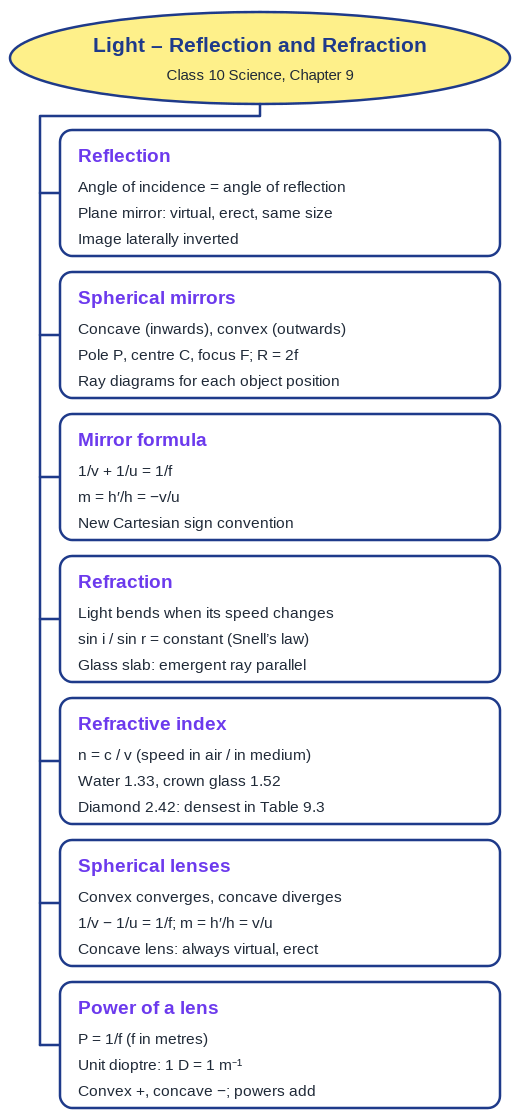
Questions, page 142
Question 1 (page 142): define the principal focus of a concave mirror. It is the point on the principal axis where rays of light parallel to the principal axis meet after reflection from a concave mirror. It is marked F.
Question 2 (page 142): R = 20 cm; find f. For a spherical mirror of small aperture, f = R/2 = 20/2 = 10 cm.
Question 3 (page 142): a mirror that can give an erect and enlarged image. A concave mirror, with the object between its pole and principal focus.
Question 4 (page 142): why a convex mirror is preferred as a rear-view mirror. It always gives an erect image, though diminished, and because it bulges outwards it has a wider field of view, so the driver sees a much larger area behind than with a plane mirror.
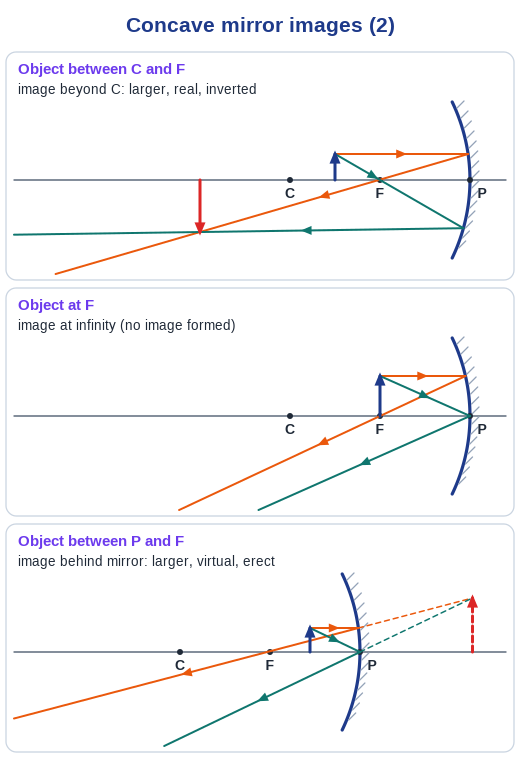
Examples 9.1 and 9.2 (pages 144–145)
Example 9.1 (page 144): convex rear-view mirror, R = 3.00 m, bus at 5.00 m. R = +3.00 m, so f = +1.50 m (the focus of a convex mirror is behind it); u = −5.00 m. 1/v = 1/f − 1/u = 1/1.50 + 1/5.00 = 6.50/7.50, so v = +1.15 m. m = −v/u = −1.15/(−5.00) = +0.23. The image is 1.15 m behind the mirror, virtual, erect and 0.23 times the size of the bus.
Example 9.2 (page 144): object 4.0 cm tall, 25.0 cm in front of a concave mirror of focal length 15.0 cm. u = −25.0 cm, f = −15.0 cm. 1/v = −1/15.0 + 1/25.0 = (−5.0 + 3.0)/75.0 = −2.0/75.0, so v = −37.5 cm: the screen goes 37.5 cm in front of the mirror. h′ = −vh/u = −(−37.5)(4.0)/(−25.0) = −6.0 cm: real, inverted, enlarged. (The book’s working says “From Eq. (10.1)”; it means the mirror formula, Eq. (9.1).)
Questions, page 145
Question 1 (page 145): focal length of a convex mirror with R = 32 cm. f = R/2 = +16 cm (positive, since the focus is behind the mirror).
Question 2 (page 145): a concave mirror gives a real image three times enlarged of an object 10 cm in front of it; where is the image? A real image is inverted, so m = −3, and u = −10 cm. From m = −v/u, v = −m × u = −(−3)(−10) = −30 cm: the image is 30 cm in front of the mirror. (Extra: then 1/f = 1/v + 1/u = −1/30 − 1/10, so f = −7.5 cm.)
Questions, page 150
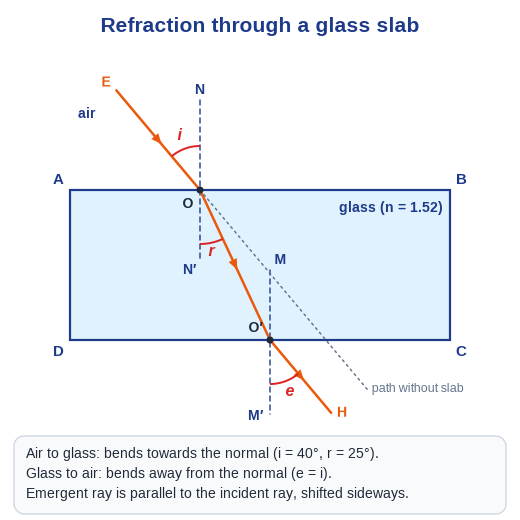
Question 1 (page 150): air to water, obliquely: towards or away from the normal? Towards the normal. Water is optically denser than air (n = 1.33), so light slows down as it enters water and bends towards the normal.
Question 2 (page 150): speed of light in glass of refractive index 1.50. n = c/v, so v = c/n = (3 × 10⁸ m/s)/1.50 = 2 × 10⁸ m/s.
Question 3 (page 150): highest and lowest optical density in Table 9.3. Highest: diamond (2.42). Lowest: air (1.0003).
Question 4 (page 150): kerosene, turpentine and water: where is light fastest? The refractive indices are water 1.33, kerosene 1.44 and turpentine oil 1.47. Light is fastest where n is smallest (v = c/n), so in water.
Question 5 (page 150): meaning of “the refractive index of diamond is 2.42”. The speed of light in air (vacuum) is 2.42 times its speed in diamond; that is, light travels 2.42 times slower in diamond. (Extra: v = 3 × 10⁸/2.42 ≈ 1.24 × 10⁸ m/s.)
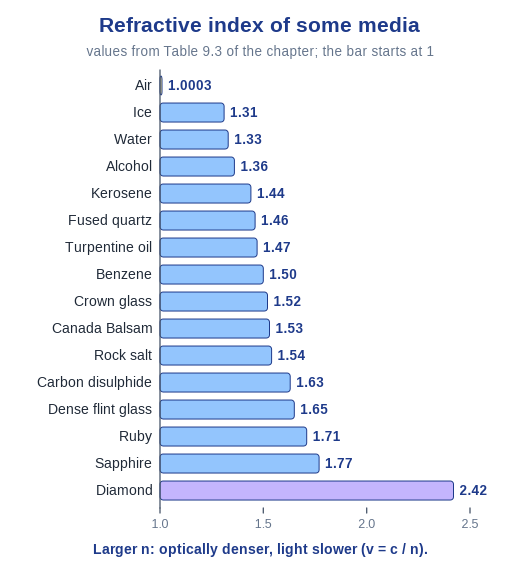
Examples 9.3 and 9.4 (pages 156–157)
Example 9.3 (page 156): concave lens, f = 15 cm, image at 10 cm; find u and m. A concave lens gives a virtual image on the object side, so v = −10 cm, f = −15 cm. 1/u = 1/v − 1/f = −1/10 + 1/15 = −1/30, so u = −30 cm. m = v/u = (−10)/(−30) = +1/3 ≈ +0.33: virtual, erect, one third the size.
Example 9.4 (page 156): object 2.0 cm tall, 15 cm from a convex lens of focal length 10 cm. u = −15 cm, f = +10 cm. 1/v = 1/f + 1/u = 1/10 − 1/15 = 1/30, so v = +30 cm. m = v/u = 30/(−15) = −2 and h′ = mh = −4.0 cm. The image is 30 cm on the other side, real, inverted, 4.0 cm tall (twice the size).
Questions, page 158
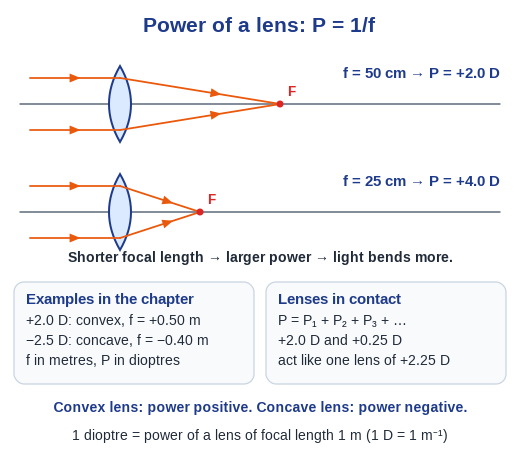
Question 1 (page 158): define 1 dioptre. 1 dioptre is the power of a lens whose focal length is 1 metre: 1 D = 1 m⁻¹.
Question 2 (page 158): a convex lens forms a real, inverted image of a needle 50 cm away, the same size as the needle; where is the needle, and what is the power? A real image of the same size is formed when the object is at 2F1 and the image at 2F2. So the needle is 50 cm in front of the lens (u = −50 cm, v = +50 cm). 1/f = 1/v − 1/u = 1/50 + 1/50 = 1/25, so f = +25 cm = +0.25 m and P = 1/f = +4 D.
Question 3 (page 158): power of a concave lens of focal length 2 m. f = −2 m, so P = 1/f = −0.5 D.
What the activities show (Activities 9.1–9.13)
- 9.1, a shining spoon: the inner side acts as a concave mirror. At a normal viewing distance your face is beyond its focus, so the image is inverted and smaller; only very close to the spoon is it erect and enlarged. The back acts as a convex mirror and always gives an erect, smaller image.
- 9.2 and 9.11, focusing sunlight with a concave mirror or a convex lens: the bright spot on the paper is a real image of the Sun, and its distance from the mirror or lens is roughly the focal length. The concentrated light can make the paper smoke and catch fire, so do these only with a teacher. Never look at the Sun, directly, in a mirror or through a lens, and never focus sunlight on skin. You can find the focal length safely from the image of a distant window or tree.
- 9.3 and 9.4, a concave mirror and a candle: the results match Table 9.1. With the candle between P and F there is no image on the screen; a virtual, erect, enlarged image is seen in the mirror. Use a lit candle only with a teacher.
- 9.5, a convex mirror and a pencil: the image is always erect and diminished; as the pencil moves away, the image gets smaller and moves closer to the focus.
- 9.6, the full image of a tall, distant tree: a small convex mirror shows the whole tree, because its images are diminished and it has a wide field of view.
- 9.7 and 9.8, a coin under water: the coin appears raised, so it is hard to pick up in one go, and a coin just out of sight becomes visible again when water is poured in. Both are due to refraction at the water surface.
- 9.9, a line under a glass slab: with the slab at an angle to the line, the line looks bent at the edges of the slab; with the slab placed square to the line it does not look bent; from above, it looks raised.
- 9.10, pins and a glass slab: the ray bends towards the normal on entering, away from it on leaving, and emerges parallel to the incident ray, shifted sideways.
- 9.12 and 9.13, a candle with a convex lens and a concave lens: the results match Tables 9.4 and 9.5. A concave lens always gives a virtual, erect, diminished image.
Exercises 1 to 6: multiple choice
1. “Which one of the following materials cannot be used to make a lens? (a) Water (b) Glass (c) Plastic (d) Clay”
(d) Clay. A lens must be transparent so that light can pass through and refract. Clay is opaque.
2. “The image formed by a concave mirror is observed to be virtual, erect and larger than the object. Where should be the position of the object? (a) Between the principal focus and the centre of curvature (b) At the centre of curvature (c) Beyond the centre of curvature (d) Between the pole of the mirror and its principal focus.”
(d). Only when the object is between P and F does a concave mirror give a virtual, erect, enlarged image (Table 9.1). In the other three positions the image is real and inverted.
3. “Where should an object be placed in front of a convex lens to get a real image of the size of the object? (a) At the principal focus of the lens (b) At twice the focal length (c) At infinity (d) Between the optical centre of the lens and its principal focus.”
(b) At twice the focal length (at 2F1). The image is then at 2F2, real, inverted and the same size (Table 9.4).
4. “A spherical mirror and a thin spherical lens have each a focal length of –15 cm. The mirror and the lens are likely to be (a) both concave. (b) both convex. (c) the mirror is concave and the lens is convex. (d) the mirror is convex, but the lens is concave.”
(a) both concave. By the sign convention, a concave mirror has its focus in front (negative f) and a concave lens has a negative focal length.
5. “No matter how far you stand from a mirror, your image appears erect. The mirror is likely to be (a) only plane. (b) only concave. (c) only convex. (d) either plane or convex.”
(d) either plane or convex. Both always give erect images. A concave mirror gives an inverted image once you stand beyond its focus.
6. “Which of the following lenses would you prefer to use while reading small letters found in a dictionary? (a) A convex lens of focal length 50 cm. (b) A concave lens of focal length 50 cm. (c) A convex lens of focal length 5 cm. (d) A concave lens of focal length 5 cm.”
(c) A convex lens of focal length 5 cm. Held with the letters between O and F1, a convex lens gives a virtual, erect, enlarged image. A concave lens only gives diminished images, and the shorter focal length gives more magnification at a convenient distance.
Exercises 7 to 9: mirrors and lenses in words
7. “We wish to obtain an erect image of an object, using a concave mirror of focal length 15 cm. What should be the range of distance of the object from the mirror? What is the nature of the image? Is the image larger or smaller than the object? Draw a ray diagram to show the image formation in this case.”
The object must be between the pole and the focus: closer than 15 cm to the mirror (0 < distance < 15 cm). The image is virtual and erect, formed behind the mirror, and larger than the object. For example, with the object at 10 cm: 1/v = 1/f − 1/u = −1/15 + 1/10 = 1/30, so v = +30 cm and m = −v/u = +3.
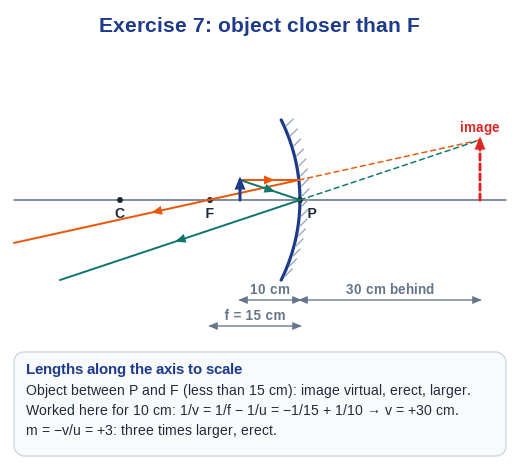
8. “Name the type of mirror used in the following situations. (a) Headlights of a car. (b) Side/rear-view mirror of a vehicle. (c) Solar furnace. Support your answer with reason.”
- (a) Concave mirror. The bulb is placed at the focus, so the reflected light goes out as a powerful parallel beam.
- (b) Convex mirror. It always gives an erect, diminished image and has a wide field of view, so the driver sees a large area of traffic behind.
- (c) Concave mirror. A large concave mirror concentrates sunlight at its focus, producing a lot of heat there.
9. “One-half of a convex lens is covered with a black paper. Will this lens produce a complete image of the object? Verify your answer experimentally. Explain your observations.”
Yes, the lens still produces a complete image, but it is dimmer. Every point of the object sends rays to the whole lens; the uncovered half still collects some rays from every point and brings them together at the image point, so no part of the image is missing. Only half as much light reaches the image, so it is less bright.
To verify, with a teacher, form a sharp image of a lit candle on a screen with a convex lens, then cover the upper or lower half of the lens with black paper. The whole candle flame is still seen on the screen, but fainter.
Exercises 10 to 15: numericals
10. “An object 5 cm in length is held 25 cm away from a converging lens of focal length 10 cm. Draw the ray diagram and find the position, size and the nature of the image formed.”
Use the lens formula 1/v − 1/u = 1/f, with the signs of the New Cartesian convention.
- Write the data: h = +5 cm, u = −25 cm (the object is on the left of the lens), f = +10 cm (a converging lens is a convex lens, so f is positive).
- Find v: 1/v = 1/f + 1/u = 1/10 − 1/25 = (5 − 2)/50 = 3/50. So v = 50/3 = +16.7 cm.
- Find the magnification: m = v/u = 16.7/(−25) = −0.67.
- Find the image size: h′ = m × h = −0.67 × 5 = −3.3 cm. The minus sign means the image is upside down.
Answer: the image is 16.7 cm from the lens, on the other side. It is 3.3 cm tall, and it is real, inverted and smaller than the object.
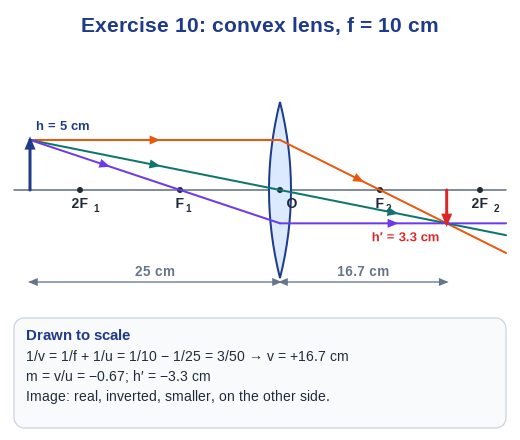
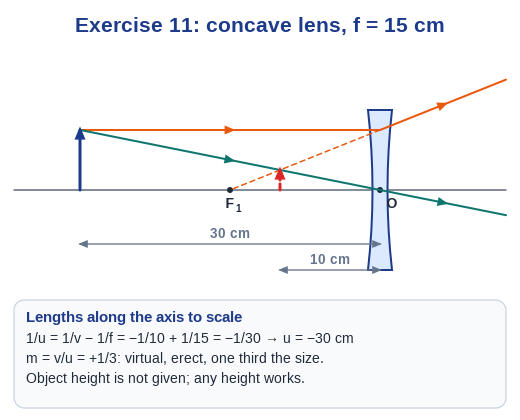
11. “A concave lens of focal length 15 cm forms an image 10 cm from the lens. How far is the object placed from the lens? Draw the ray diagram.”
- A concave lens always forms a virtual image on the same side as the object. So v = −10 cm. The focal length of a concave lens is negative: f = −15 cm.
- From the lens formula, 1/u = 1/v − 1/f = −1/10 + 1/15 = (−3 + 2)/30 = −1/30. So u = −30 cm.
- Check the image: m = v/u = (−10)/(−30) = +1/3. It is virtual, erect and one third the size of the object.
Answer: the object is 30 cm from the lens, on the same side as the image.
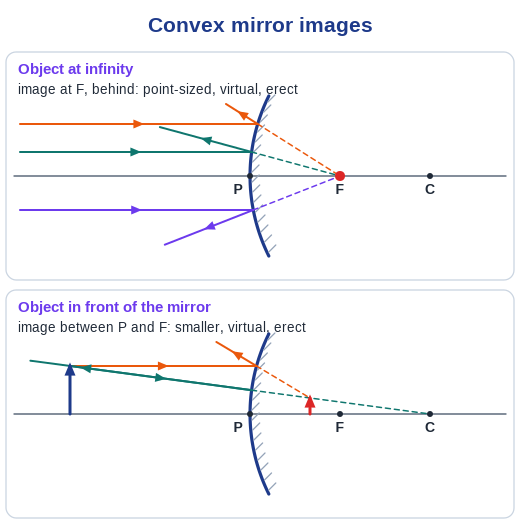
12. “An object is placed at a distance of 10 cm from a convex mirror of focal length 15 cm. Find the position and nature of the image.”
Use the mirror formula 1/v + 1/u = 1/f.
- Write the data: u = −10 cm. A convex mirror has its focus behind it, so f = +15 cm.
- Find v: 1/v = 1/f − 1/u = 1/15 + 1/10 = (2 + 3)/30 = 1/6. So v = +6 cm. The plus sign means the image is behind the mirror.
- Find the magnification: m = −v/u = −6/(−10) = +0.6.
Answer: the image is 6 cm behind the mirror. It is virtual, erect and smaller (0.6 times the size of the object).
13. “The magnification produced by a plane mirror is +1. What does this mean?”
m = h′/h = 1 means the image is the same size as the object. The positive sign means the image is virtual and erect. (It also matches v = −u: the image is as far behind the mirror as the object is in front.)
14. “An object 5.0 cm in length is placed at a distance of 20 cm in front of a convex mirror of radius of curvature 30 cm. Find the position of the image, its nature and size.”
- Write the data: for a convex mirror R = +30 cm, so f = R/2 = +15 cm. u = −20 cm and h = +5.0 cm.
- Find v: 1/v = 1/f − 1/u = 1/15 + 1/20 = (4 + 3)/60 = 7/60. So v = 60/7 = +8.6 cm (behind the mirror).
- Find the magnification: m = −v/u = −(60/7)/(−20) = 3/7 = +0.43.
- Find the image size: h′ = m × h = (3/7) × 5.0 = 15/7 = +2.1 cm.
Answer: the image is 8.6 cm behind the mirror. It is virtual, erect and smaller, and 2.1 cm tall.
Note on the book’s answer key: it gives 2.2 cm. With the exact value v = 60/7 cm, h′ = 15/7 = 2.14 cm, which rounds to 2.1 cm. The key’s 2.2 cm comes from rounding v to 8.6 cm first (8.6/20 × 5 = 2.15).
15. “An object of size 7.0 cm is placed at 27 cm in front of a concave mirror of focal length 18 cm. At what distance from the mirror should a screen be placed, so that a sharp focussed image can be obtained? Find the size and the nature of the image.”
- Write the data: u = −27 cm, f = −18 cm (a concave mirror has its focus in front), h = +7.0 cm.
- Find v: 1/v = 1/f − 1/u = −1/18 + 1/27 = (−3 + 2)/54 = −1/54. So v = −54 cm. The minus sign means the image is in front of the mirror, so it is real and can be caught on a screen.
- Find the magnification: m = −v/u = −(−54)/(−27) = −2.
- Find the image size: h′ = m × h = −2 × 7.0 = −14 cm.
Answer: place the screen 54 cm in front of the mirror. The image is 14 cm tall, real, inverted and enlarged (twice the size). This fits the rule for a concave mirror: the object is between F and C, so the image forms beyond C.
Exercises 16 and 17: power
16. “Find the focal length of a lens of power – 2.0 D. What type of lens is this?”
Power and focal length are linked by P = 1/f, with f in metres. So f = 1/P = 1/(−2.0 D) = −0.50 m = −50 cm.
Answer: f = −0.50 m. A negative focal length means a concave (diverging) lens.
17. “A doctor has prescribed a corrective lens of power +1.5 D. Find the focal length of the lens. Is the prescribed lens diverging or converging?”
f = 1/P = 1/(+1.5 D) = +0.67 m = 66.7 cm.
Answer: f = +0.67 m. A positive power means a convex lens, which is converging.
Go back to the Chapter 9 notes, or read spherical mirrors and the mirror formula, refraction and refractive index and refraction and lenses.
Practice
-
A concave mirror forms a real image twice the size of the object. The magnification is:
Show answer
Answer: (b) −2
-
The refractive index of a medium is 1.25. The speed of light in it is (c = 3 × 10⁸ m/s):
Show answer
Answer: (b) 2.4 × 10⁸ m/s
-
A lens has focal length −50 cm. Its power is:
Show answer
Answer: (b) −2 D
-
An object is 30 cm from a convex mirror of focal length 15 cm. Find the image position and magnification.
Show answer
Answer: u = −30 cm, f = +15 cm. 1/v = 1/f − 1/u = 1/15 + 1/30 = 3/30, so v = +10 cm: 10 cm behind the mirror. m = −v/u = −10/(−30) = +1/3: virtual, erect, one third the size.
-
An object is 12 cm from a convex lens of focal length 8 cm. Where is the image, and what is its nature?
Show answer
Answer: u = −12 cm, f = +8 cm. 1/v = 1/f + 1/u = 1/8 − 1/12 = 1/24, so v = +24 cm. m = v/u = 24/(−12) = −2. The image is 24 cm on the other side of the lens, real, inverted and twice the size (the object is between F1 and 2F1).
Stuck on a question?
Take a photo and Lagnever AI explains it step by step. Try it for 7 days for ₹2.
Get it on Google Play Open in browser
For parents: after the trial, the plan renews monthly by UPI or card autopay. You can cancel anytime in the app.