
Why does light bend, and what does refractive index tell us?
Answer in short
Light changes speed when it passes from one transparent medium into another, so a ray entering obliquely changes direction: refraction. It bends towards the normal entering a denser medium and away from it entering a rarer one. The refractive index, n = c/v, compares the speed of light in air with its speed in the medium.
Stuck on a question? Take a photo and Lagnever AI explains it step by step. Try it for 7 days for ₹2. Get it on Google Play
What everyday effects show refraction?
The bottom of a tank of water looks raised. Letters under a thick glass slab seem to lift up. A pencil standing in a glass of water looks broken at the water surface, and a lemon in water looks bigger from the side. With kerosene or turpentine instead of water, or plastic instead of glass, the effect has a different size. So light does not travel the same way in every medium: when it passes obliquely from one transparent medium into another, its direction changes. This is refraction of light.
Activities 9.7 to 9.9 show it. A coin at the bottom of a bucket of water is hard to pick up in one go, because it is not quite where it seems. A coin in a bowl that has just slipped out of sight becomes visible again when a friend pours water in: it appears raised. A thick line seen through a glass slab placed at an angle looks bent at the edges of the slab.
What happens in a rectangular glass slab?
In Activity 9.10 you trace the path of a ray through a glass slab ABCD with four pins. The ray EO meets face AB at O, travels inside the glass along OO′ and leaves face CD at O′ along O′H.
- At O light goes from air (rarer) into glass (denser) and bends towards the normal NN′.
- At O′ it goes from glass into air and bends away from the normal MM′.
- The two bendings are equal and opposite, because the faces are parallel, so the emergent ray O′H is parallel to the incident ray EO, shifted sideways a little.
- A ray that meets the surface along the normal goes straight through.
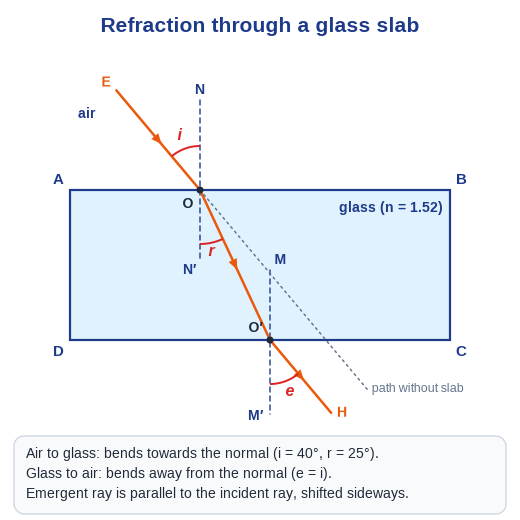
In our drawing the slab is crown glass (n = 1.52 from Table 9.3) and i = 40°; Snell’s law then gives r ≈ 25°. These angle values are our worked example (Extra), not the chapter’s.
Why does light bend?
Refraction happens because light travels at different speeds in different media. It is fastest in vacuum, 3 × 10⁸ m/s, very slightly slower in air, and much slower in water or glass. A ray going into a medium where it is slower bends towards the normal; going into one where it is faster, it bends away.
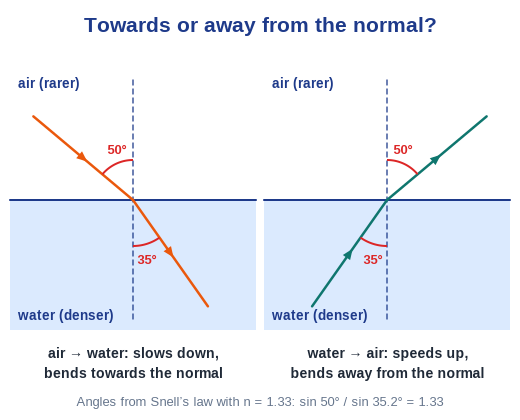
The angles in this drawing (water with n = 1.33 from Table 9.3, 50° in air and about 35° in water by Snell’s law) are our worked example (Extra), not the chapter’s.
What are the laws of refraction?
- The incident ray, the refracted ray and the normal at the point of incidence all lie in the same plane.
- For light of a given colour and a given pair of media, sin i / sin r = constant, where i is the angle of incidence and r the angle of refraction. This is Snell’s law (true for 0° < i < 90°).
The constant is the refractive index of the second medium with respect to the first.
What is the refractive index?
If light travels at speed v1 in medium 1 and v2 in medium 2, the refractive index of medium 2 with respect to medium 1 is n21 = v1/v2, and that of medium 1 with respect to medium 2 is n12 = v2/v1. When medium 1 is vacuum or air, we get the absolute refractive index of the medium, simply called its refractive index:
n = c / v = speed of light in air ÷ speed of light in the medium.
For water n = 1.33: light in air is 1.33 times as fast as in water. For crown glass n = 1.52. For glass with n = 1.50, the speed of light is 3 × 10⁸ ÷ 1.50 = 2 × 10⁸ m/s.
What is optical density?
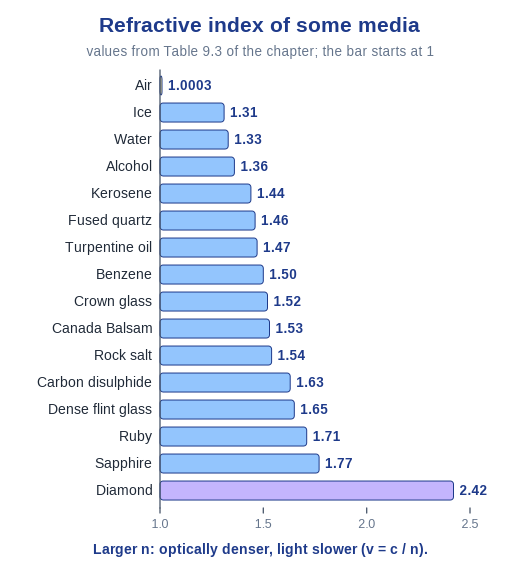
Of two media, the one with the larger refractive index is optically denser; the other is optically rarer. When this chapter says “denser” and “rarer”, it means optically. Optical density is not mass density: kerosene (n = 1.44) is optically denser than water (n = 1.33), although its mass density is less than that of water. Diamond (2.42) has the highest refractive index in Table 9.3 and air (1.0003) the lowest.
Lenses use refraction to form images: see refraction and lenses. Numericals on refractive index are solved in the NCERT solutions for Chapter 9. Go back to the Chapter 9 notes.
Practice
-
In which medium of Table 9.3 does light travel slowest?
Show answer
Answer: (d) diamond
-
A ray goes obliquely from glass into air. It:
Show answer
Answer: (b) bends away from the normal
-
Light travels at 2.25 × 10⁸ m/s in a liquid. Its refractive index is about (c = 3 × 10⁸ m/s):
Show answer
Answer: (b) 1.33
-
Why does a coin at the bottom of a bowl become visible again when water is poured in (Activity 9.8)?
Show answer
Answer: Light from the coin bends away from the normal as it leaves the water into the air, so it reaches the eye along a new path. The coin appears raised above its actual position and comes back into view.
-
Why does the ray leaving a rectangular glass slab travel parallel to the ray entering it?
Show answer
Answer: The two faces of the slab are parallel. The bending towards the normal at the first face and away from the normal at the second face are equal and opposite, so the ray leaves in its original direction, only shifted sideways.
Questions students ask
Why does a pencil look bent in a glass of water?
Light from the part of the pencil under water bends as it passes from water into air, so it reaches your eye from a different direction than light from the part above water. The pencil seems displaced at the surface.
Is an optically denser medium always heavier?
No. Optical density depends on the refractive index, not on mass density. The chapter’s example is kerosene, which has a higher refractive index than water but a lower mass density.
Does the refractive index depend on the colour of light?
Snell’s law is stated for light of a given colour and a given pair of media, which means the constant can be different for different colours. Extra: this is why white light splits into colours in a prism, as the next chapter shows.
Do I need to memorise Table 9.3?
No. The chapter says you need not memorise the data. Learn how to use it: a larger refractive index means slower light and an optically denser medium.
Stuck on a question?
Take a photo and Lagnever AI explains it step by step. Try it for 7 days for ₹2.
Get it on Google Play Open in browser
For parents: after the trial, the plan renews monthly by UPI or card autopay. You can cancel anytime in the app.