
How do spherical mirrors form images, and what is the mirror formula?
Answer in short
A concave mirror curves inwards, a convex mirror bulges outwards; for both R = 2f. Two rays locate the image. A concave mirror gives real, inverted images unless the object is inside F; a convex mirror always gives a small, erect, virtual image. With the sign convention, 1/v + 1/u = 1/f and m = −v/u.
Stuck on a question? Take a photo and Lagnever AI explains it step by step. Try it for 7 days for ₹2. Get it on Google Play
What are the parts of a spherical mirror?
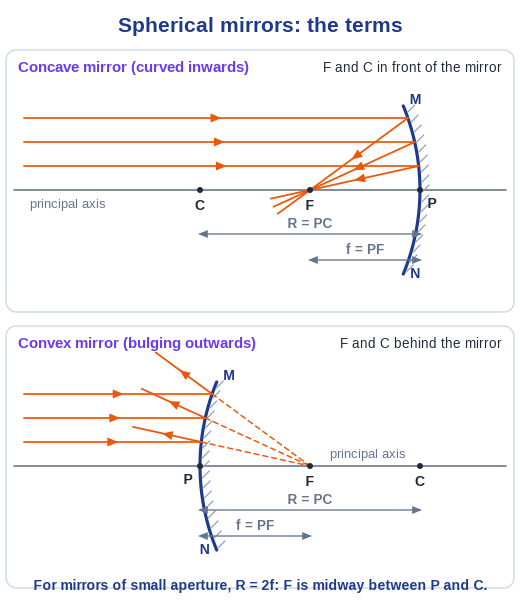
A spherical mirror is a piece of a hollow sphere with one shiny side. A concave mirror reflects from the inner side, so its surface curves inwards; a convex mirror reflects from the outer side, so it bulges outwards. In drawings, the back of the mirror is shaded.
- Pole (P): the centre of the reflecting surface.
- Centre of curvature (C): the centre of the sphere. It is not on the mirror: it lies in front of a concave mirror and behind a convex one.
- Radius of curvature (R): the radius of that sphere, R = PC.
- Principal axis: the straight line through P and C. It is normal to the mirror at P.
- Principal focus (F): rays parallel to the axis meet at F after reflection from a concave mirror, or seem to come from F behind a convex mirror.
- Focal length (f): the distance PF. Aperture: the diameter of the mirror’s outline (MN).
For mirrors of small aperture, R = 2f: F lies midway between P and C. So a mirror with R = 20 cm has f = 10 cm.
Which rays help to draw ray diagrams?
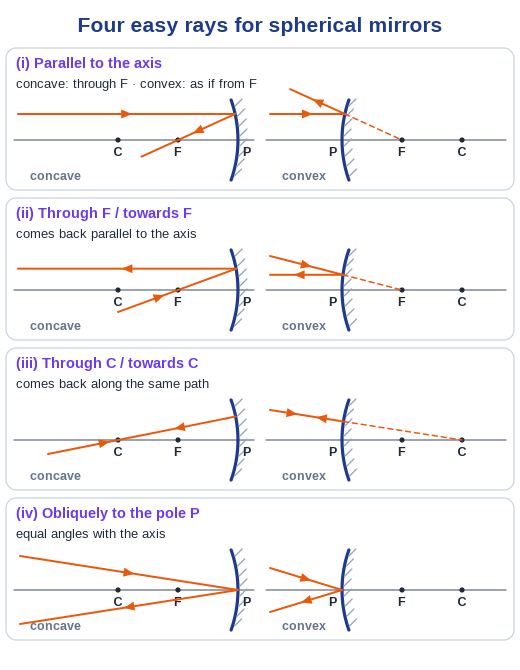
Every point of an object sends out countless rays, but two are enough to find its image. These four are easy because their paths after reflection are known:
- A ray parallel to the axis passes through F (concave) or seems to come from F (convex).
- A ray through F (concave) or heading towards F (convex) comes back parallel to the axis.
- A ray through C (concave) or heading towards C (convex) hits the mirror along the normal and comes straight back.
- A ray to the pole P reflects at the same angle on the other side of the axis.
Where does a concave mirror form images?
| Object | Image | Size | Nature |
|---|---|---|---|
| At infinity | At F | Point-sized | Real, inverted |
| Beyond C | Between F and C | Diminished | Real, inverted |
| At C | At C | Same size | Real, inverted |
| Between C and F | Beyond C | Enlarged | Real, inverted |
| At F | At infinity | No image formed | — |
| Between P and F | Behind the mirror | Enlarged | Virtual, erect |
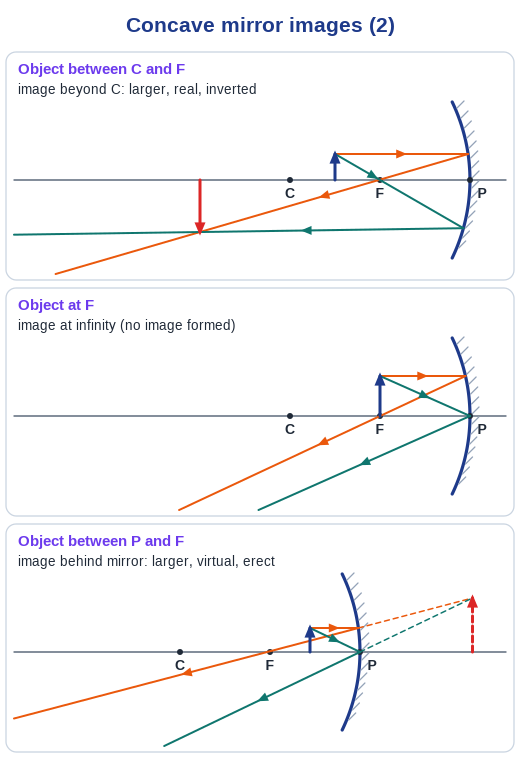
Our diagrams are drawn to scale from the mirror formula, so you can check them with a ruler. Uses: torches, search-lights and vehicle headlights (a lamp at F gives a parallel beam), shaving mirrors and dentists’ mirrors (enlarged, erect images), and solar furnaces (large concave mirrors concentrate sunlight to produce heat).
What image does a convex mirror form?
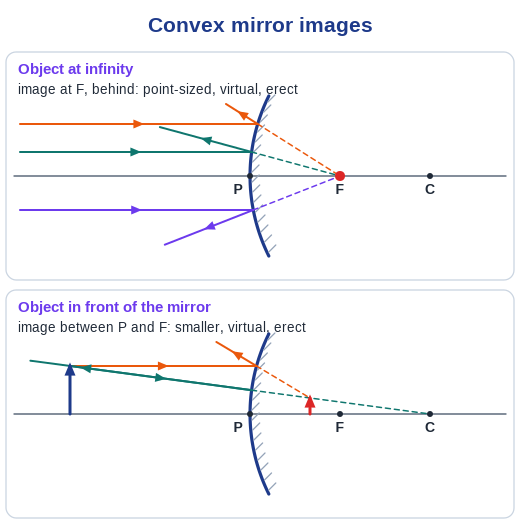
With the object at infinity the image is at F behind the mirror, point-sized. For an object anywhere in front, the image is behind the mirror between P and F, diminished, virtual and erect. As the object moves away, the image moves closer to F and gets smaller. A small convex mirror can therefore show a whole tall building, and it gives drivers a wide, erect view of the traffic behind (Activity 9.6).
What is the sign convention?
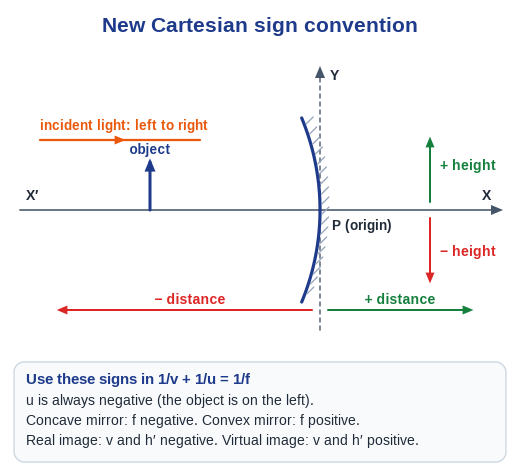
The chapter uses the New Cartesian sign convention: the pole P is the origin and the principal axis is the x-axis; the object is placed on the left; distances to the right of P are positive and to the left negative; heights above the axis are positive and below negative. So u is always negative, f is negative for a concave mirror and positive for a convex one, and a real image (in front of the mirror) has a negative v.
How is the mirror formula used?
The mirror formula links u, v and f: 1/v + 1/u = 1/f. The magnification is m = h′/h = −v/u.
Example 9.1 (convex rear-view mirror): R = +3.00 m, so f = +1.50 m; a bus is at u = −5.00 m. Then 1/v = 1/1.50 + 1/5.00 = 6.50/7.50, so v = +1.15 m: the image is 1.15 m behind the mirror. m = −(1.15)/(−5.00) = +0.23: virtual, erect, 0.23 times the size.
Example 9.2 (concave mirror): h = +4.0 cm, u = −25.0 cm, f = −15.0 cm. 1/v = −1/15.0 + 1/25.0 = −2.0/75.0, so v = −37.5 cm: put the screen 37.5 cm in front of the mirror. h′ = −vh/u = −6.0 cm: real, inverted, enlarged.
More questions on mirrors are solved in the NCERT solutions for Chapter 9. Go back to the Chapter 9 notes.
Practice
-
An object is placed between F and C of a concave mirror. The image is:
Show answer
Answer: (c) beyond C, enlarged
-
A convex mirror has f = 20 cm. An object is 20 cm in front of it. Where is the image?
Show answer
Answer: (a) v = +10 cm
-
Why is a concave mirror used in a torch?
Show answer
Answer: (b) a lamp at its focus gives a parallel beam
-
A concave mirror of focal length 10 cm has an object at 30 cm. Find v and m.
Show answer
Answer: u = −30 cm, f = −10 cm. 1/v = 1/f − 1/u = −1/10 + 1/30 = −2/30, so v = −15 cm. m = −v/u = −(−15)/(−30) = −0.5. The image is 15 cm in front of the mirror, real, inverted and half the size.
-
What does a magnification of +0.4 tell you about the image?
Show answer
Answer: The positive sign means the image is virtual and erect, and 0.4 means it is 0.4 times the height of the object, that is, smaller. A convex mirror always gives such an image.
Questions students ask
Why is the focal length half the radius of curvature?
For a mirror whose aperture is small compared with its radius, rays parallel to the axis reflect and meet at a point midway between P and C. The chapter states this result as R = 2f; the proof is Extra and comes in higher classes.
Why are convex mirrors used as rear-view mirrors?
They always give an erect image, though smaller, and because they bulge outwards they show a much wider area behind the vehicle than a plane mirror of the same size.
Can a concave mirror give an erect image?
Yes, but only when the object is between the pole and the focus. The image is then behind the mirror, virtual, erect and enlarged, which is why concave mirrors are used as shaving mirrors and by dentists.
How do I find the focal length of a concave mirror at school?
Form a sharp image of a distant object, such as a window or a tree, on a sheet of paper and measure the distance from the mirror to the paper. Do not point the mirror at the Sun yourself: the chapter’s sunlight version (Activity 9.2) burns paper, so do it only with a teacher, and never look at the Sun or its reflection.
Stuck on a question?
Take a photo and Lagnever AI explains it step by step. Try it for 7 days for ₹2.
Get it on Google Play Open in browser
For parents: after the trial, the plan renews monthly by UPI or card autopay. You can cancel anytime in the app.