
Class 10 Science Chapter 9: Light – Reflection and Refraction Notes
This chapter in five lines
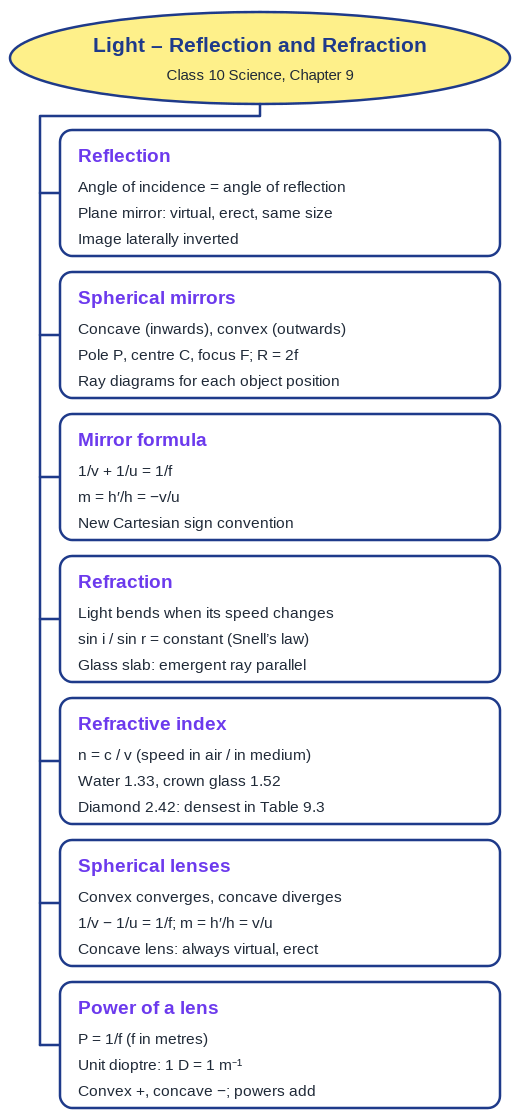
Light travels in straight lines and obeys the laws of reflection at every surface. Concave and convex mirrors form images that follow 1/v + 1/u = 1/f. Light bends when it passes from one medium into another because its speed changes; the refractive index measures this. Lenses form images by refraction, follow 1/v − 1/u = 1/f, and have a power P = 1/f in dioptres.
What is this chapter about?
We see an object when light coming from it, often light it reflects, enters our eyes. A small source of light casts a sharp shadow of an opaque object, which tells us that light travels in straight lines, called rays. This chapter uses rays to study two things: reflection, the bouncing back of light from mirrors, and refraction, the bending of light when it passes from one transparent medium into another. Both explain how mirrors and lenses form images. (The chapter adds a note that rays are a simplified picture: around very small obstacles light bends, which needs the wave idea, and light also behaves like particles. You will study this in higher classes.)
What are the laws of reflection?
A polished surface such as a mirror reflects most of the light falling on it. Two laws hold for every reflecting surface, flat or curved:
- The angle of incidence equals the angle of reflection.
- The incident ray, the normal at the point of incidence and the reflected ray all lie in the same plane.
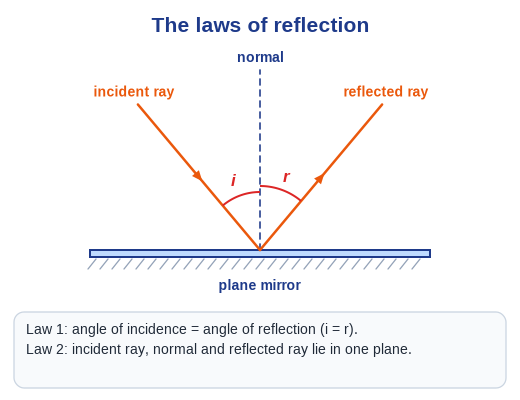
A plane mirror gives an image that is virtual and erect, the same size as the object, as far behind the mirror as the object is in front, and laterally inverted (left and right swapped).
What are spherical mirrors?
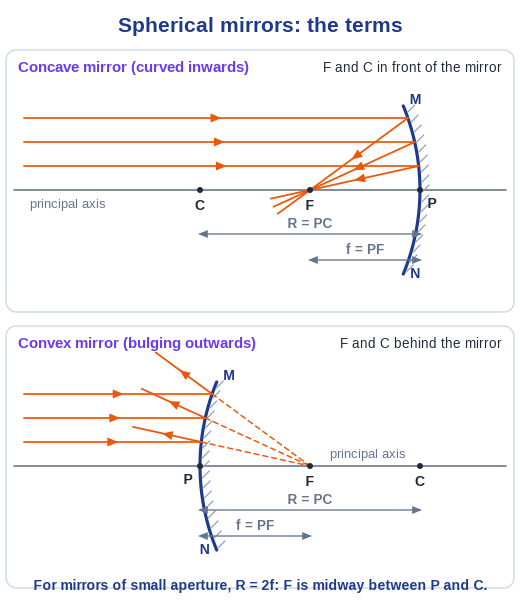
A mirror whose reflecting surface is part of a sphere is a spherical mirror. If the reflecting surface curves inwards, towards the centre of the sphere, it is a concave mirror; if it bulges outwards, it is a convex mirror. The inside of a shiny spoon behaves like a concave mirror and the back like a convex mirror (Activity 9.1).
The terms you need: the pole P (centre of the mirror surface), the centre of curvature C (centre of the sphere, in front of a concave mirror and behind a convex one), the radius of curvature R = PC, the principal axis (the line through P and C), the principal focus F (where rays parallel to the axis meet after reflection, or seem to come from) and the focal length f = PF. For mirrors of small aperture, R = 2f. Read more in spherical mirrors and the mirror formula.
How do mirrors form images?
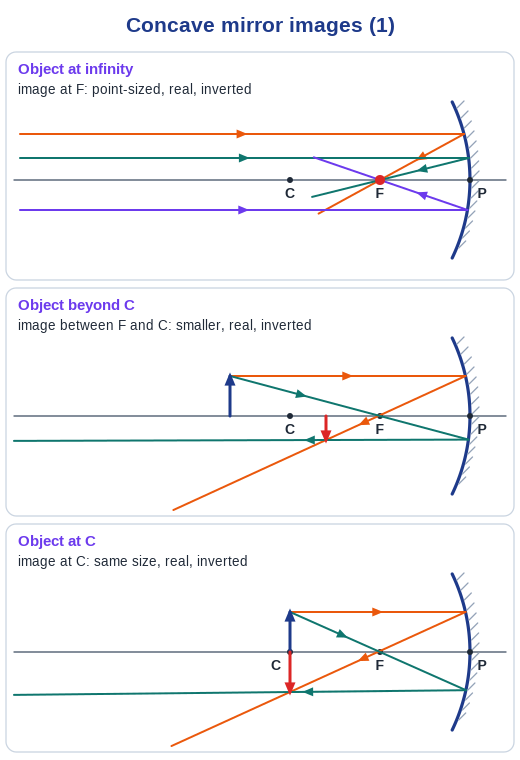
To locate an image, draw any two of four easy rays from the top of the object: a ray parallel to the axis, a ray through (or towards) F, a ray through (or towards) C, and a ray to the pole P. Where the reflected rays meet, or seem to meet, is the image.
- Concave mirror: object at infinity → point image at F; beyond C → between F and C, diminished; at C → at C, same size; between C and F → beyond C, enlarged (all real and inverted); at F → image at infinity; between P and F → behind the mirror, enlarged, virtual and erect.
- Convex mirror: the image is always behind the mirror between P and F, diminished, virtual and erect.
Concave mirrors are used in torches, search-lights and headlights (for parallel beams), as shaving mirrors and by dentists (for enlarged images), and in solar furnaces. Convex mirrors are used as rear-view mirrors because they always give an erect image and show a wider field of view.
What is the mirror formula?
With the New Cartesian sign convention, the pole is the origin, the object is on the left, distances in the direction of the incident light (to the right) are positive and those to the left negative, and heights above the axis are positive. Then the object distance u, image distance v and focal length f obey
1/v + 1/u = 1/f, and the magnification is m = h′/h = −v/u.
A negative m means a real, inverted image; a positive m means a virtual, erect one. For example, in Example 9.2 an object 4.0 cm tall is 25.0 cm in front of a concave mirror of focal length 15.0 cm: 1/v = −1/15 + 1/25, so v = −37.5 cm and h′ = −6.0 cm (real, inverted, enlarged).
What is refraction of light?
The bottom of a pond looks raised, a pencil in water looks broken at the surface, and letters under a thick glass slab seem lifted. These happen because light changes direction when it passes obliquely from one transparent medium into another: refraction. It is caused by the change in the speed of light. Going from a rarer to a denser medium, light slows and bends towards the normal; going from denser to rarer, it speeds up and bends away from the normal. Through a rectangular glass slab, the bending at the two parallel faces is equal and opposite, so the emergent ray is parallel to the incident ray but shifted sideways.
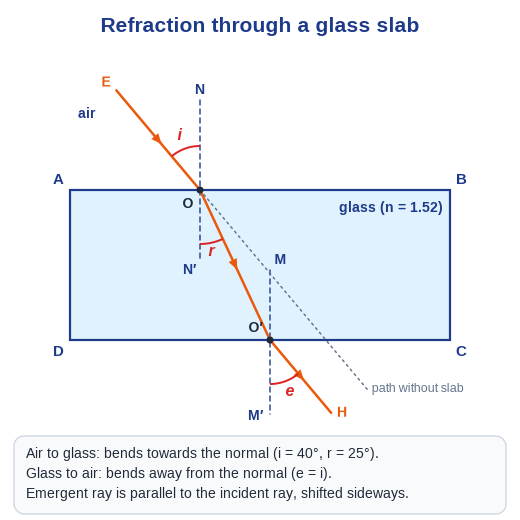
The laws of refraction: the incident ray, the refracted ray and the normal lie in one plane; and sin i / sin r is a constant for a given pair of media and a given colour of light (Snell’s law). Read more in refraction and refractive index.
What is refractive index?
The constant in Snell’s law is the refractive index of the second medium with respect to the first: n21 = v1/v2, the speed of light in medium 1 divided by that in medium 2. With respect to vacuum (or air), it is the absolute refractive index n = c/v, where c = 3 × 10⁸ m/s. From Table 9.3, water is 1.33, crown glass 1.52 and diamond 2.42. A larger refractive index means an optically denser medium, which is not the same as greater mass density: kerosene (1.44) is optically denser than water though it is lighter.
How do lenses form images?
A convex lens is thicker in the middle and converges parallel rays to its principal focus; a concave lens is thicker at the edges and diverges them as if from its focus. Each lens has an optical centre O, two principal foci F1 and F2, and a focal length f. Rays for diagrams: parallel to the axis (then through F2, or as if from F1), through F1 or towards F2 (then parallel), and through O (undeviated).
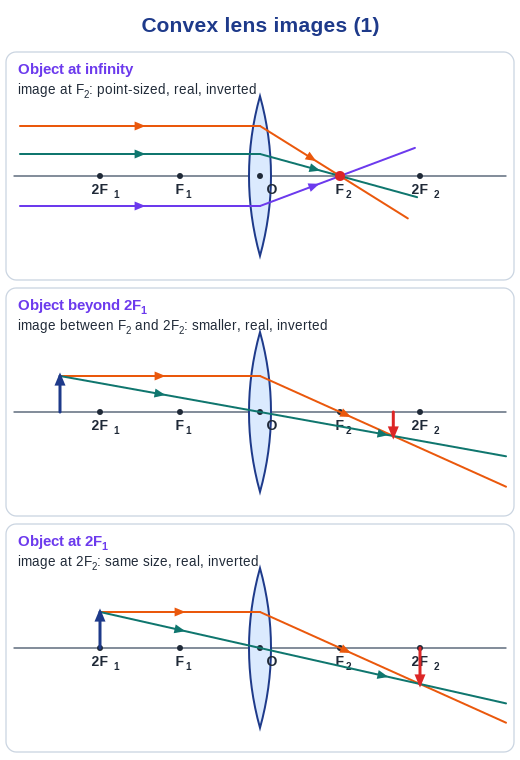
A convex lens gives real, inverted images when the object is beyond F1, and a virtual, erect, enlarged image when the object is between F1 and O (a magnifying glass). A concave lens always gives a virtual, erect, diminished image. The lens formula is 1/v − 1/u = 1/f and the magnification is m = h′/h = v/u; f is positive for a convex lens and negative for a concave one. Read more in refraction and lenses.
What is the power of a lens?
The power of a lens is P = 1/f, with f in metres; its unit is the dioptre (1 D = 1 m⁻¹). A lens of short focal length bends light more and has more power. Convex lenses have positive power, concave lenses negative: +2.0 D means a convex lens with f = +0.50 m, and −2.5 D a concave lens with f = −0.40 m. Powers of lenses in contact add: +2.0 D and +0.25 D act as +2.25 D.
Before we move on
Two activities in this chapter focus sunlight on paper with a concave mirror or a convex lens until it smokes. Do them only with a teacher. Never look at the Sun, directly or in a mirror or through a lens, and never focus sunlight on skin. Practise the ray diagrams until you can draw each case from memory, and always write the signs before solving. Answers to all four Questions boxes, the examples and all 17 exercises are in the NCERT solutions for Chapter 9.
Key terms
| Term | Meaning |
|---|---|
| Laws of reflection | The angle of incidence equals the angle of reflection, and the incident ray, the normal and the reflected ray lie in one plane. |
| Concave and convex mirror | Spherical mirrors whose reflecting surface curves inwards (concave) or bulges outwards (convex). |
| Pole (P) and centre of curvature (C) | P is the centre of the mirror’s surface. C is the centre of the sphere of which the mirror is a part; PC is the radius of curvature R. |
| Principal focus (F) and focal length (f) | The point where rays parallel to the principal axis meet (or seem to come from) after reflection or refraction. f is its distance from the pole or optical centre; for mirrors R = 2f. |
| Real and virtual image | A real image is formed where rays actually meet and can be caught on a screen. A virtual image is where rays only appear to come from. |
| New Cartesian sign convention | Distances are measured from the pole (or optical centre). In the direction of the incident light they are positive, against it negative; heights above the axis are positive. |
| Magnification (m) | Height of the image divided by height of the object: m = h′/h. For mirrors m = −v/u, for lenses m = v/u. |
| Refraction | The change in direction of light when it passes obliquely from one transparent medium into another, because its speed changes. |
| Refractive index | For two media, n21 = v1/v2, the ratio of the speeds of light. The absolute refractive index is n = c/v, the speed in air (vacuum) divided by the speed in the medium. |
| Optical centre (O) | The central point of a lens. A ray through it goes straight on without bending. |
| Power of a lens | P = 1/f with f in metres. Its unit is the dioptre (D). Convex lenses have positive power, concave lenses negative. |
Topics in this chapter
Practice
-
The radius of curvature of a spherical mirror is 30 cm. Its focal length is:
Show answer
Answer: (c) 15 cm
-
Which mirror always gives an erect, diminished image?
Show answer
Answer: (c) convex mirror
-
A ray of light goes from air into glass obliquely. It:
Show answer
Answer: (b) bends towards the normal
-
The speed of light in a medium of refractive index 1.5 is (speed in vacuum 3 × 10⁸ m/s):
Show answer
Answer: (c) 2 × 10⁸ m/s
-
A lens has a power of −4 D. It is a:
Show answer
Answer: (b) concave lens of focal length 25 cm
Questions students ask
What are the main topics of Class 10 Science Chapter 9?
Reflection of light and its laws; spherical mirrors, their image formation with ray diagrams, uses, sign convention, the mirror formula and magnification; refraction, its laws and the glass slab; refractive index; spherical lenses, their images, the lens formula, magnification and power.
Is Light – Reflection and Refraction in the 2026-27 NCERT book?
Yes. It is Chapter 9 of Science, the Class 10 NCERT textbook marked Reprint 2026-27, on pages 134 to 160. It has four Questions boxes, four solved examples and 17 exercises.
Which parts of this chapter should I practise for the board exam?
Ray diagrams for every object position of a concave mirror and a convex lens, the convex mirror and concave lens cases, and numericals on the mirror formula, lens formula, magnification and power. Always write the signs of u, v and f before you substitute.
Why is the mirror formula 1/v + 1/u = 1/f but the lens formula 1/v − 1/u = 1/f?
Both use the same sign convention, but a mirror sends light back towards the object while a lens lets it through. That changes how v is related to u, so the two formulas differ by one sign. Learn them separately, and the magnification too: −v/u for mirrors, v/u for lenses.
Stuck on a question?
Take a photo and Lagnever AI explains it step by step. Try it for 7 days for ₹2.
Get it on Google Play Open in browser
For parents: after the trial, the plan renews monthly by UPI or card autopay. You can cancel anytime in the app.