
How do lenses form images, and what are the lens formula and power?
Answer in short
A convex lens converges light and a concave lens diverges it. A convex lens gives real, inverted images unless the object is between F1 and O; a concave lens always gives a virtual, erect, diminished image. With the sign convention, 1/v − 1/u = 1/f and m = v/u. Power P = 1/f, in dioptres.
Stuck on a question? Take a photo and Lagnever AI explains it step by step. Try it for 7 days for ₹2. Get it on Google Play
What are convex and concave lenses?
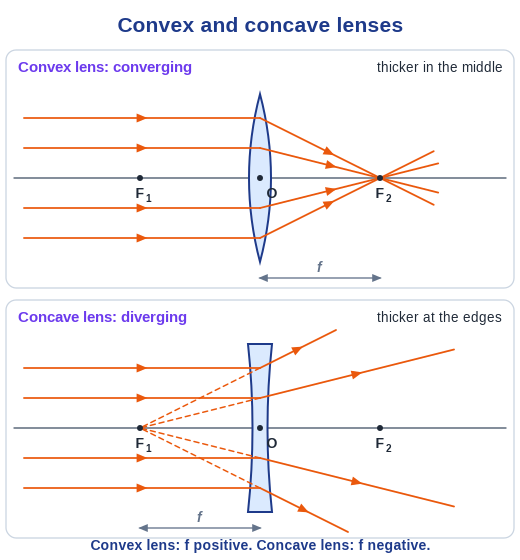
A lens is a piece of transparent material bounded by two surfaces, at least one of them spherical. A double convex lens, simply a convex lens, bulges outwards on both sides and is thicker in the middle; it converges light, so it is also called a converging lens. A double concave lens curves inwards on both sides and is thicker at the edges; it diverges light (a diverging lens).
- Centres of curvature (C1, C2): the centres of the two spheres of which the surfaces are parts. The line through them is the principal axis.
- Optical centre (O): the central point of the lens. A ray through O goes on without deviation.
- Principal focus: parallel rays meet at it after a convex lens, or seem to come from it after a concave lens. A lens has two, F1 and F2, one on each side.
- Focal length (f): the distance from O to a principal focus. Aperture: the effective diameter of the lens.
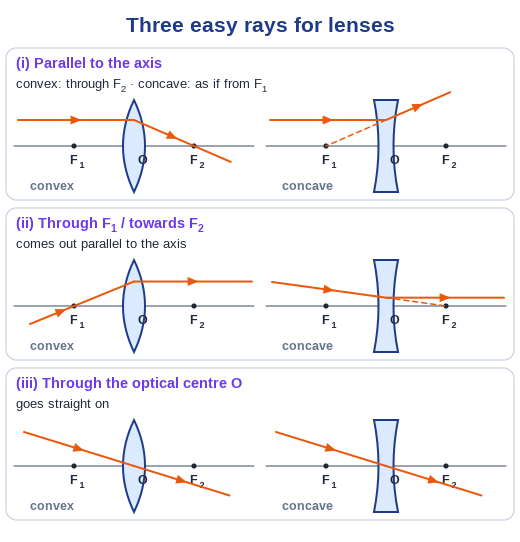
Which rays help to draw lens diagrams?
- A ray parallel to the axis passes through F2 after a convex lens, or seems to come from F1 after a concave lens.
- A ray through F1 of a convex lens, or heading towards F2 of a concave lens, comes out parallel to the axis.
- A ray through O goes straight on.
Where does a convex lens form images?
| Object | Image | Size | Nature |
|---|---|---|---|
| At infinity | At F2 | Point-sized | Real, inverted |
| Beyond 2F1 | Between F2 and 2F2 | Diminished | Real, inverted |
| At 2F1 | At 2F2 | Same size | Real, inverted |
| Between F1 and 2F1 | Beyond 2F2 | Enlarged | Real, inverted |
| At F1 | At infinity | No image formed | — |
| Between F1 and O | Same side as the object | Enlarged | Virtual, erect |
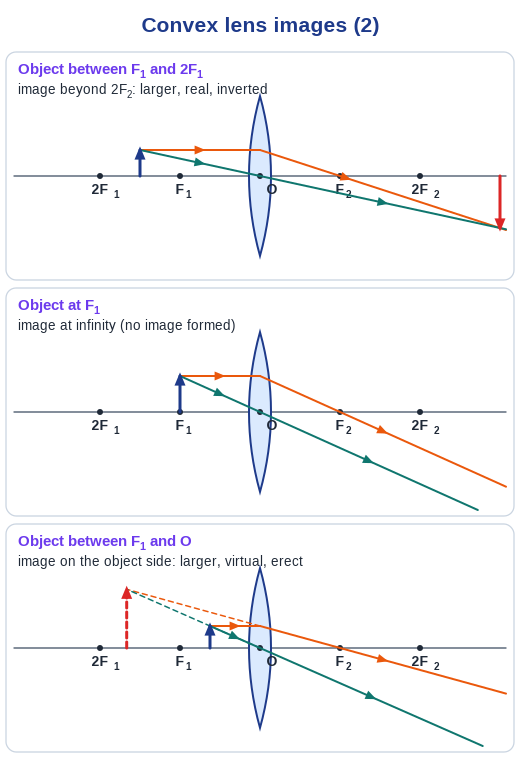
The last case is how a magnifying glass works. Activity 9.12 checks the table with a candle, a lens and lines drawn one focal length apart. Never use the Sun as the object.
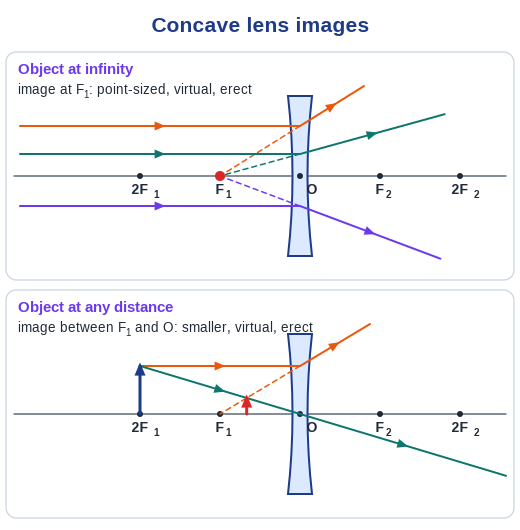
What image does a concave lens form?
With the object at infinity the image is at F1, point-sized. For any other position it lies between F1 and O on the object side. Either way a concave lens gives a virtual, erect, diminished image, and the image gets smaller as the object moves away (Activity 9.13).
What are the lens formula and magnification?
Lenses use the same sign convention as mirrors, with distances measured from O. The focal length of a convex lens is positive and that of a concave lens negative.
Lens formula: 1/v − 1/u = 1/f. Magnification: m = h′/h = v/u.
Example 9.3: a concave lens (f = −15 cm) forms an image at v = −10 cm. 1/u = 1/v − 1/f = −1/10 + 1/15 = −1/30, so u = −30 cm, and m = (−10)/(−30) = +1/3: virtual, erect, one third the size.
Example 9.4: a 2.0 cm object is 15 cm from a convex lens (f = +10 cm). 1/v = 1/f + 1/u = 1/10 − 1/15 = 1/30, so v = +30 cm. m = 30/(−15) = −2 and h′ = −4.0 cm: real, inverted, twice the size, 30 cm on the other side.
What is the power of a lens?
A lens of short focal length bends light through larger angles. The power of a lens measures how strongly it converges or diverges light: P = 1/f, with f in metres. The SI unit is the dioptre (D): 1 D is the power of a lens of focal length 1 m, so 1 D = 1 m⁻¹. Convex lenses have positive power, concave lenses negative.
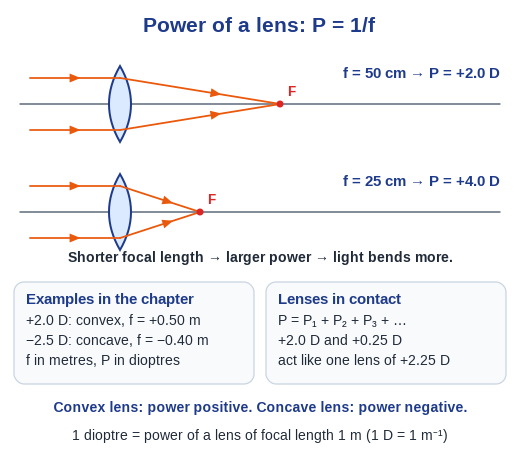
A prescription of +2.0 D means a convex lens with f = +0.50 m; −2.5 D means a concave lens with f = −0.40 m. For lenses in contact, P = P1 + P2 + P3 + …, which is why opticians, cameras, microscopes and telescopes combine lenses.
Exercises on lenses are solved in the NCERT solutions for Chapter 9. Read about bending at a surface in refraction and refractive index, or go back to the Chapter 9 notes.
Practice
-
To get a real image of the same size with a convex lens, the object must be at:
Show answer
Answer: (b) 2F1
-
A concave lens of focal length 20 cm has an object at 20 cm. The image distance is:
Show answer
Answer: (a) −10 cm
-
Two lenses of power +1.5 D and −0.5 D are placed in contact. The combined power is:
Show answer
Answer: (b) +1.0 D
-
A convex lens of focal length 20 cm has an object at 30 cm. Find v and m.
Show answer
Answer: u = −30 cm, f = +20 cm. 1/v = 1/f + 1/u = 1/20 − 1/30 = 1/60, so v = +60 cm. m = v/u = 60/(−30) = −2. The image is 60 cm on the other side, real, inverted and twice the size.
-
Why is a convex lens of short focal length used as a magnifying glass?
Show answer
Answer: With the object between F1 and O, a convex lens gives a virtual, erect and enlarged image. A shorter focal length (greater power) bends light more, so it gives a larger image of small things, such as the tiny print in a dictionary.
Questions students ask
What is the difference between F1 and F2?
A lens has two principal foci, one on each side. For a convex lens, parallel rays from the left meet at F2 on the right. For a concave lens, they seem to spread out from F1 on the left. Both are one focal length from O for a thin lens.
Can a concave lens ever form a real image?
Not of a real object. The chapter’s Table 9.5 shows that whatever the object position, a concave lens gives a virtual, erect, diminished image.
Why do opticians use power instead of focal length?
Powers of lenses in contact simply add. During an eye test, the optician puts lenses of known power together in the trial frame and adds their powers, for example +2.0 D and +0.25 D make +2.25 D.
What is a thin lens?
The chapter considers lenses whose aperture is much smaller than the radius of curvature and whose two centres of curvature are equally far from O. For such thin lenses the simple rules and formulas hold.
Stuck on a question?
Take a photo and Lagnever AI explains it step by step. Try it for 7 days for ₹2.
Get it on Google Play Open in browser
For parents: after the trial, the plan renews monthly by UPI or card autopay. You can cancel anytime in the app.