
Class 12 Biology Chapter 11 NCERT Solutions Hinglish mein: Organisms and Populations
Class 12 NCERT textbook Biology ke Chapter 11, Organisms and Populations, ki saari 10 end-of-chapter exercises ke answers. Page numbers 2026-27 reprint ke hain (pages 190–204). Sawaal Hinglish mein translate kiye gaye hain; answers hamare apne hain, chapter par based, aur chapter ke bahar ki har baat Extra likhi gayi hai. Exercise 2 ka r aur is page ka har number script se nikaala gaya hai. Chapter ke beech mein poochhe gaye sawaal aakhir mein short mein hal hain. Book is chapter ki answer key nahi deti. Short notes: Chapter 11 notes.
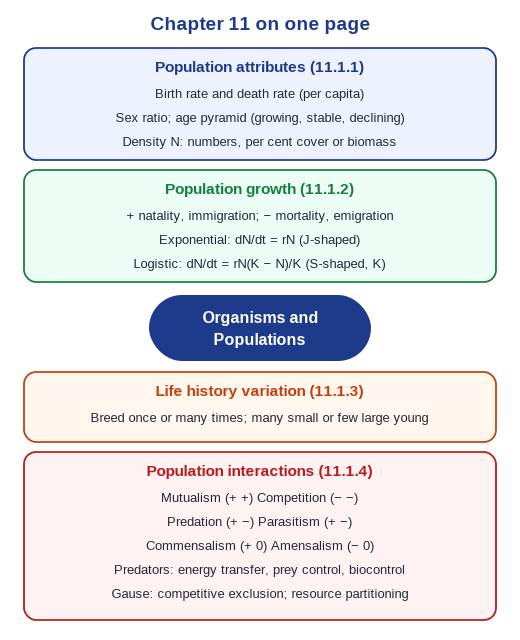
Exercises 1 se 3: attributes, r aur plant defences
1. Wo attributes list karo jo populations ke paas hote hain par individuals ke paas nahi.
Individual paida hota hai aur marta hai, aur male ya female hota hai; rates aur ratios sirf group ke ho sakte hain. Population ke attributes:
- Birth rate (natality): unit time mein per individual births, jaise 20 lotus ke talaab mein 8 naye plants se 8/20 = 0.4 per lotus per year.
- Death rate (mortality): unit time mein per individual deaths, jaise 40 fruit flies mein ek hafte mein 4 deaths se 0.1 per fly per week.
- Sex ratio: females aur males ka hissa, jaise 60 per cent females aur 40 per cent males.
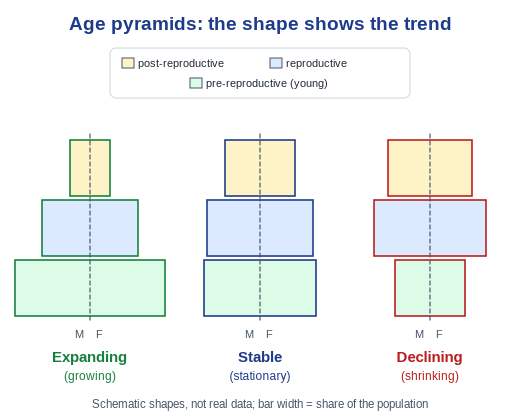
- Age distribution (age pyramid): har age group ke individuals ka per cent; shape batata hai ki population badh rahi hai, stable hai ya ghat rahi hai.
- Population density (N): population ka size, numbers, per cent cover, biomass ya relative density mein.
- Growth rate aur intrinsic rate of natural increase (r = b − d), immigration aur emigration ke saath.
2. Agar exponentially badhti ek population 3 saal mein size mein double ho jaati hai, to population ka intrinsic rate of increase (r) kya hai?
Exponential growth ke liye Nt = N0 e^rt.
- Double hone ka matlab t = 3 saal par Nt = 2N0.
- To 2N0 = N0 e^(3r), yaani e^(3r) = 2.
- Natural log lene par: 3r = ln 2 = 0.6931.
- r = 0.6931 ÷ 3 ≈ 0.231 per year (lagbhag 0.23 per individual per year).
Check: e^(0.231 × 3) = e^0.693 ≈ 2. Common log se yahi steps: r = 2.303 × log 2 ÷ 3 = 2.303 × 0.3010 ÷ 3 ≈ 0.231.
3. Plants mein herbivory ke khilaaf zaroori defence mechanisms ke naam batao.
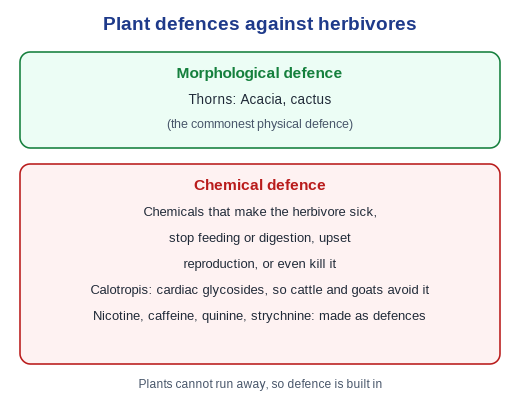
Plants bhaag nahi sakte, aur lagbhag ek chauthai insects plants khaate hain, isliye plants ne do tarah ke defences evolve kiye:
- Morphological defences: thorns, jaise Acacia aur cactus mein, sabse aam hain.
- Chemical defences: aise chemicals jo herbivore ko beemar kar dein, khaana ya pachaana rok dein, uska reproduction bigaad dein ya use maar dein. Calotropis bahut zehreele cardiac glycosides banata hai, isliye cattle aur goats ise nahi charte. Nicotine, caffeine, quinine, strychnine aur opium, jo hum commercially nikaalte hain, plants grazers aur browsers se bachaav ke liye banaate hain.
Exercises 4 se 6: orchid, biological control aur definitions
4. Ek orchid plant mango tree ki daal par ug raha hai. Orchid aur mango tree ke beech is interaction ko kaise describe karoge?
Ye commensalism (+ 0) hai. Orchid ek epiphyte hai: wo mango ki daal par ugta hai, jo use sahaara aur roshni ke paas jagah deti hai (Extra), isliye use faayda hai. Wo mango tree se khaana ya paani nahi leta, isliye parasite nahi hai, aur mango tree ko na koi dikhne wala faayda hai na nuksaan.
5. Pest insects ko sambhaalne ke biological control method ke peeche kaun sa ecological principle hai?
Principle: predator apne prey ki population ko control mein rakh sakta hai.
- Pest us jagah tezi se phailta hai jahan uske natural dushman nahi hote.
- Agar uska natural predator laaya jaaye, to wo pest ko khaata hai aur uski sankhya kam rakhta hai.
- Is tarah chemical pesticides ke bina pest control ho jaata hai.
Chapter ka example: 1920s ki shuruaat mein Australia laaya gaya prickly pear cactus millions of hectares rangeland mein phail gaya. Wo tabhi control hua jab cactus ke asli ghar se cactus khaane wala moth laaya gaya.
6. Population aur community define karo.
- Population: ek tay geographical area mein rehne wale same species ke individuals ka group, jo same resources share ya unke liye compete karte hain aur interbreed kar sakte hain. Example: talaab ke lotus plants.
- Community: ek area mein rehne wali aur aapas mein interact karti alag-alag species ki saari populations, jaise ek talaab ke plants, janwar aur microbes milkar. Koi species akeli nahi rehti, isliye populations hamesha ek biological community banaati hain.
Exercises 7 aur 8: terms aur logistic curve
7. Neeche diye terms define karo aur har ek ka ek example do: (a) Commensalism (b) Parasitism (c) Camouflage (d) Mutualism (e) Interspecific competition
| Term | Definition | Chapter ka example |
|---|---|---|
| (a) Commensalism | Ek species ko faayda; doosri ko na nuksaan na faayda (+ 0) | Charti cattle se uthe insects khaata cattle egret |
| (b) Parasitism | Ek species (parasite) doosri (host) par ya andar rehkar usse khaana aur jagah leti hai aur use nuksaan pahunchaati hai (+ −) | Hedge plants par Cuscuta; insaanon par lice |
| (c) Camouflage | Cryptic rang jisse prey predator ko aasaani se dikhta nahi | Insects aur frogs ki kuch species |
| (d) Mutualism | Dono species ko faayda (+ +) | Lichen: fungus ke saath photosynthetic algae ya cyanobacteria |
| (e) Interspecific competition | Do species ek hi resource use karti hain, jisse doosri ke hone par ek ki fitness (r) saaf kam ho jaati hai (− −) | South American jheelon mein zooplankton ke liye flamingoes aur wahan ki fishes |
8. Suitable diagram ki madad se logistic population growth curve describe karo.
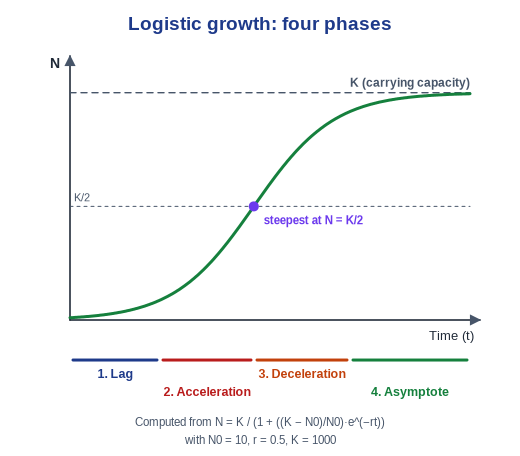
Jab resources limited hon, habitat ek species ki ek maximum sankhya hi sambhaal sakta hai, carrying capacity (K). Tab growth Verhulst-Pearl logistic equation follow karti hai:
dN/dt = rN (K − N)/K
jahan N time t par population density hai aur r intrinsic rate of natural increase. Time ke against N plot karne par chaar phases wala sigmoid (S-shaped) curve banta hai:
- Lag phase: individuals kam, isliye sankhya dheere badhti hai.
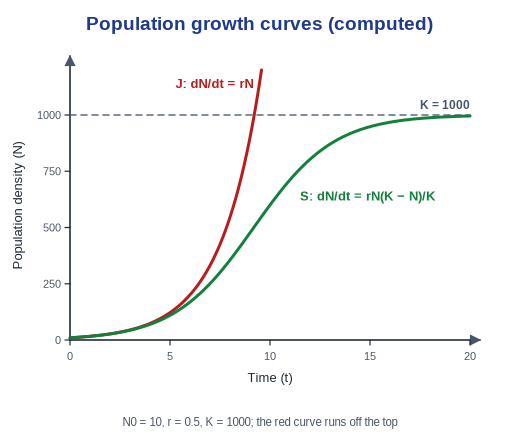
- Acceleration: zyada breeders aur bharpoor resources se growth tez hoti hai; jab tak N chhota hai, (K − N)/K lagbhag 1 hai aur growth lagbhag exponential hai.
- Deceleration: resources kam padne lagte hain aur competition badhta hai, isliye growth dheemi hoti hai. Growth N = K/2 par sabse tez hai (hamari calculation: wahan dN/dt = rK/4).
- Asymptote: N, K tak pahunchta hai, to (K − N) = 0, dN/dt = 0, aur curve flat ho jaata hai.
Diagram ka curve isi equation ke solution se N0 = 10, r = 0.5 aur K = 1000 lekar compute kiya gaya. Kyunki resources der-saver khatam hote hi hain, logistic model exponential growth se zyada realistic hai.
Exercises 9 aur 10: parasitism aur population ki khaasiyatein
9. Kaun sa statement parasitism ko sabse sahi tarah samjhaata hai? (a) Ek organism ko faayda hota hai. (b) Dono organisms ko faayda hota hai. (c) Ek organism ko faayda hota hai, doosre par asar nahi hota. (d) Ek organism ko faayda hota hai, doosre par asar hota hai.
Answer: (d). Parasitism mein parasite ko faayda aur host ko nuksaan hota hai (+ −). Option (a) adhoora hai, (b) mutualism hai aur (c) commensalism.
10. Population ki koi teen zaroori khaasiyatein list karo aur samjhao.
- Birth rate: ek time mein per individual births. Ye per capita hai, isliye alag size ki populations compare ho sakti hain: 20 lotus mein 8 naye judna 8/20 = 0.4 offspring per lotus per year hai.
- Death rate: ek time mein per individual deaths: 40 fruit flies mein ek hafte mein 4 deaths 0.1 per fly per week hai. Birth rate minus death rate se r, intrinsic rate of natural increase, milta hai.
- Age distribution: har age group ke individuals ka per cent, age pyramid ki tarah. Chauda base (bahut young) badhti population, barabar shape stable, aur patla base ghat-ti population dikhata hai.
(Sex ratio, jaise 60 per cent females aur 40 per cent males, aur population density bhi sahi choices hain.)
Chapter ke andar poochhe gaye sawaal
Ye quote nahi kiye gaye; har ek short mein page ke saath likha hai.
Page 190: ‘how’ aur ‘why’ sawaal. Chapter aise sawaal deta hai jaise raat mein khilne wale flowers aksar safed kyun hote hain aur bee ko kaise pata chalta hai ki kis flower mein nectar hai. ‘How’ sawaal mechanism poochhte hain (bee nectar kaise dhoondhti hai); ‘why’ sawaal significance (raat ke flowers halke rang ke kyun). Extra: ek sambhavit ‘why’ jawaab ye hai ki kam roshni mein raat ke pollinators ko safed flowers aasaani se dikhte hain.
Page 192: petri dish mein ghane bacterial culture ki density kaise report karein? Har cell ginna mumkin nahi, isliye ginti ke bajaaye biomass ya plate ka per cent cover (ya koi relative measure) behtar hai.
Page 194: India ka abhi ka r value kya hai? Latest birth aur death rates lekar r = b − d use karo. Extra: official sources crude rates per 1000 log per year mein dete hain, isliye pehle har ek ko 1000 se divide karo; jaise 20 ka birth rate aur 7 ka death rate per 1000 se r = 0.020 − 0.007 = 0.013 milega (sirf samjhaane ke liye, asli figure nahi). Abhi ke rates teacher ke saath dekho.
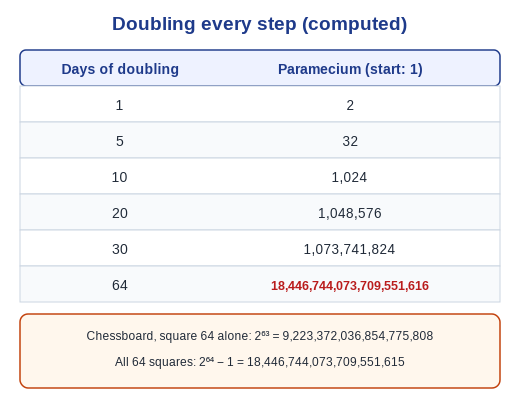
Page 195: 64 din roz double hone par kitne Paramecium? Ek se shuru karke 2⁶⁴ = 18,446,744,073,709,551,616, lagbhag 1.8 × 10¹⁹, agar khaana aur jagah kabhi kam na pade. Kahaani ke chessboard ko kul 2⁶⁴ − 1 daane chahiye.
Page 196: pichhle 100 saal ke India ke census figures plot karo. Har census ki total population lo, saal ke against plot karo aur shape ko J aur S curve se milao. Extra: pichhli sadi mein India ki population tezi se badhi hai, J-shaped curve ke upar jaate hisse ke zyada kareeb; dekho ki sabse naya badhaav dheema hona shuru hua hai ya nahi, jo S shape ka pehla nishaan hoga.
Page 196: fitness ke liye ek baar breed karna behtar hai ya kai baar? Aam taur par koi bhi nahi. Fitness badhaane wali strategy us habitat ki abiotic aur biotic seemaon par depend karti hai jisme species rehti hai.
Page 196: kya koi natural habitat sirf ek species ka ghar hai? Nahi. Har species ko khaane ke liye kam se kam ek aur species chahiye; plant ko bhi nutrients recycle karne ke liye soil microbes aur aksar ek animal pollinator chahiye.
Page 197: agar koi janwar plants na khaaye to plants ki fix ki hui energy ka kya hoga? Wo consumers ke zariye upar ke trophic levels tak nahi pahunchegi. Predation (herbivory samet) hi wo tareeka hai jisse ye energy food chain mein upar jaati hai. Extra: plant matter jama hota rahega jab tak maut ke baad decomposers use tod na dein.
Page 200: natural selection ne bilkul nuksaan na karne wale parasites kyun nahi banaaye? Extra (chapter se aage ka reasoning): parasite host ke khaane aur tissues par jeeta hai, isliye kuch nuksaan uske jeene ke tareeke mein hi hai; aur kyunki host defences evolve karta rehta hai, jo parasite unhe harane laayak tez badhta aur reproduce karta hai wo zyada offspring chhodta hai, bhale hi host ko nuksaan ho.
Page 200: female mosquito ko parasite kyun nahi kehte? Wo host ke paas sirf thodi der khoon peene aati hai, jo use ande banaane ke liye chahiye, aur phir chali jaati hai. Wo parasite ki tarah host par ya andar nahi rehti, na hi poori zindagi rehne aur khaane ke liye us par depend karti hai.
Page 201: koel aur crow ko dekho. Spring aur summer mein dekho ki koel crows ke ghonslon ke paas kahan jaati hai aur crows kya karte hain. Ye brood parasitism dikhata hai: koel ke ande, jo crow ke andon jaise dikhte hain, crow seta (incubate karta) hai.
Practice karo
-
Exponentially badhti ek population 5 saal mein double hoti hai. Uska r lagbhag hai:
Jawab dekho
Jawab: (b) 0.139 per year
-
Whale ki peeth par ugte barnacles dikhaate hain:
Jawab dekho
Jawab: (b) commensalism
-
Equation Nt+1 = Nt + [(B + I) − (D + E)] mein E ka matlab hai:
Jawab dekho
Jawab: (b) emigration
-
50 ki population mein ek saal mein 10 births aur 5 deaths hain. Per capita birth aur death rate aur r nikaalo.
Jawab dekho
Jawab: Birth rate b = 10/50 = 0.2 per individual per year; death rate d = 5/50 = 0.1 per individual per year; r = b − d = 0.1 per individual per year.
-
Chapter se ek ectoparasite aur ek brood parasite ka example do.
Jawab dekho
Jawab: Ectoparasite: insaanon par lice (ya kutton par ticks, ya hedge plants par Cuscuta). Brood parasite: cuckoo (koel), jo crow ke ghonsle mein ande deti hai.
Koi sawal atak gaya?
Photo lo, Lagnever AI step-by-step samjhayega. 7 din ka trial sirf ₹2.
Google Play se app lo Browser mein kholo
Parents ke liye: trial ke baad plan har mahine UPI ya card autopay se renew hota hai. App mein kabhi bhi cancel kar sakte hain.