
NCERT Solutions Class 12 Biology Chapter 11: Organisms and Populations
Answers to all 10 end-of-chapter exercises of Chapter 11, Organisms and Populations, of Biology, the Class 12 NCERT textbook. Page numbers follow the 2026-27 reprint (pages 190–204). The exercises are quoted from the book as printed, except Exercise 9, whose wording is restated (see the note at the end); the answers are our own, built from the chapter, and every fact from outside the chapter is marked Extra. The value of r in Exercise 2 and every number on this page were computed by script. The questions the chapter text asks along the way are answered in short at the end. The book prints no answer key for this chapter. Short notes: Chapter 11 notes.
Exercises 1 to 3: attributes, r and plant defences
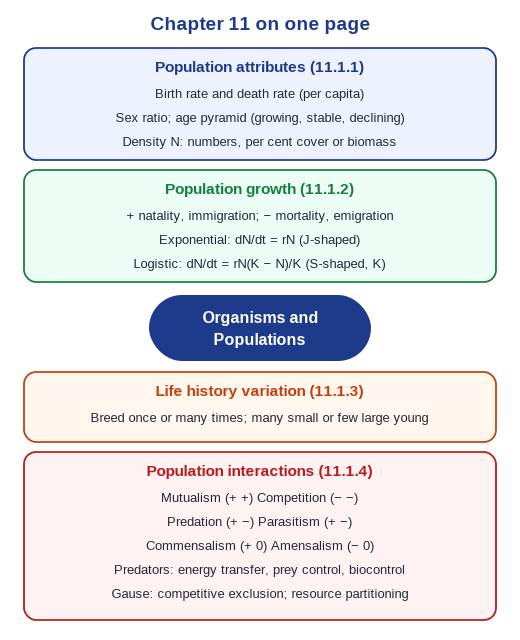
1. “List the attributes that populations possess but not individuals.”
An individual is born and dies, and is either male or female; only a group can have rates and ratios. Attributes of a population:
- Birth rate (natality): births per individual per unit time, for example 8 new lotus plants in a pond of 20 give 8/20 = 0.4 per lotus per year.
- Death rate (mortality): deaths per individual per unit time, for example 4 deaths among 40 fruit flies in a week give 0.1 per fly per week.
- Sex ratio: the share of females and males, for example 60 per cent females and 40 per cent males.
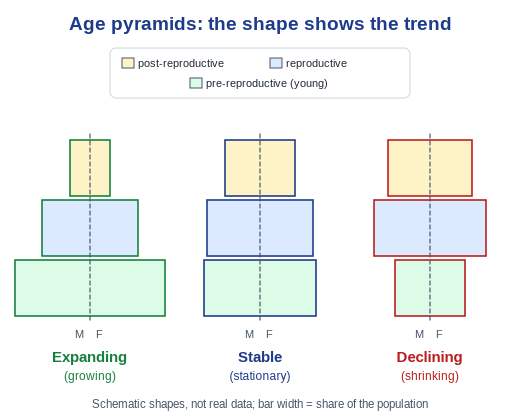
- Age distribution (age pyramid): the per cent of individuals in each age group; its shape shows whether the population is growing, stable or declining.
- Population density (N): the size of the population, as numbers, per cent cover, biomass or relative density.
- Growth rate and the intrinsic rate of natural increase (r = b − d), together with immigration and emigration.
2. “If a population growing exponentially double in size in 3 years, what is the intrinsic rate of increase (r) of the population?”
For exponential growth, Nt = N0 e^rt.
- Doubling means Nt = 2N0 when t = 3 years.
- So 2N0 = N0 e^(3r), which gives e^(3r) = 2.
- Taking natural logs: 3r = ln 2 = 0.6931.
- r = 0.6931 ÷ 3 ≈ 0.231 per year (about 0.23 per individual per year).
Check: e^(0.231 × 3) = e^0.693 ≈ 2. With common logs the same steps read r = 2.303 × log 2 ÷ 3 = 2.303 × 0.3010 ÷ 3 ≈ 0.231.
3. “Name important defence mechanisms in plants against herbivory.”
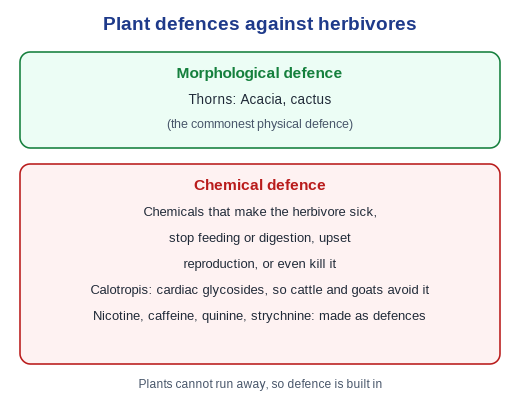
Plants cannot run away, and about a quarter of all insects feed on plants, so plants have evolved two kinds of defence:
- Morphological defences: thorns, as in Acacia and cactus, are the most common.
- Chemical defences: chemicals that make the herbivore sick, stop it feeding or digesting, disturb its reproduction or kill it. Calotropis makes highly poisonous cardiac glycosides, so cattle and goats do not browse it. Nicotine, caffeine, quinine, strychnine and opium, which we extract commercially, are made by plants as defences against grazers and browsers.
Exercises 4 to 6: orchid, biological control and definitions
4. “An orchid plant is growing on the branch of mango tree. How do you describe this interaction between the orchid and the mango tree?”
It is commensalism (+ 0). The orchid is an epiphyte: it grows on the mango branch, which gives it support and a place nearer the light (Extra), so it benefits. It does not take food or water from the mango tree, so it is not a parasite, and the mango tree gets no apparent benefit and no harm.
5. “What is the ecological principle behind the biological control method of managing with pest insects?”
Principle: a predator can keep the population of its prey under control.
- A pest spreads fast in a place where its natural enemies are absent.
- If its natural predator is brought in, the predator eats the pest and keeps its numbers low.
- So the pest is controlled without chemical pesticides.
Example from the chapter: the prickly pear cactus, brought into Australia in the early 1920s, spread over millions of hectares of rangeland. It was controlled only when a cactus-feeding moth from the cactus’s native home was brought in.
6. “Define population and community.”
- Population: a group of individuals of the same species living in a well-defined geographical area, sharing or competing for similar resources and able to interbreed. Example: the lotus plants in a pond.
- Community: all the populations of different species living in an area and interacting with one another, for example the plants, animals and microbes of a pond together. No species lives alone, so populations always form a biological community.
Exercises 7 and 8: terms and the logistic curve
7. “Define the following terms and give one example for each: (a) Commensalism (b) Parasitism (c) Camouflage (d) Mutualism (e) Interspecific competition”
| Term | Definition | Example from the chapter |
|---|---|---|
| (a) Commensalism | One species benefits; the other is neither harmed nor helped (+ 0) | Cattle egret feeding on insects stirred up by grazing cattle |
| (b) Parasitism | One species (the parasite) lives on or in another (the host) and gets food and shelter from it, harming it (+ −) | Cuscuta on hedge plants; lice on humans |
| (c) Camouflage | Cryptic colouring that makes prey hard for a predator to detect | Some species of insects and frogs |
| (d) Mutualism | Both species benefit (+ +) | Lichen: a fungus with photosynthetic algae or cyanobacteria |
| (e) Interspecific competition | Two species using the same resource, so that the fitness (r) of one is clearly lower in the other’s presence (− −) | Flamingoes and resident fishes competing for zooplankton in South American lakes |
8. “With the help of suitable diagram describe the logistic population growth curve.”
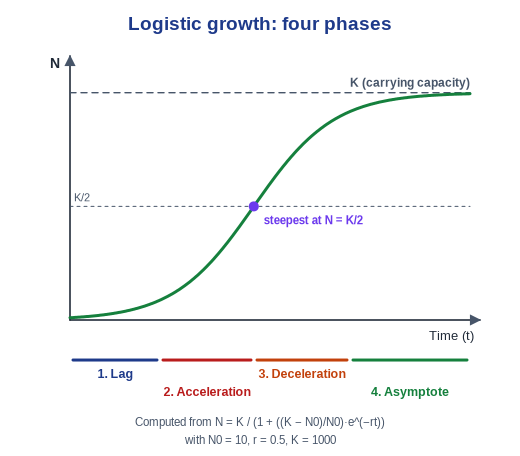
When resources are limited, a habitat can support only a certain maximum number of a species, the carrying capacity (K). Growth then follows the Verhulst-Pearl logistic equation:
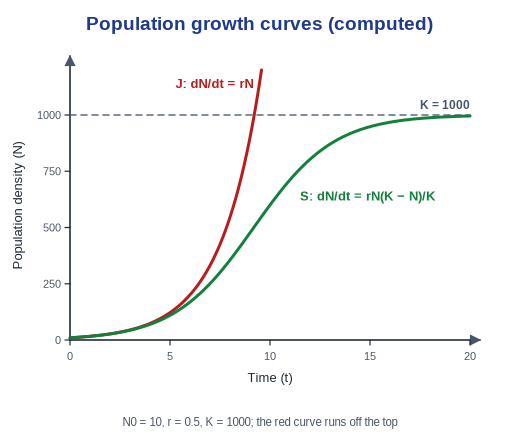
dN/dt = rN (K − N)/K
where N is the density at a given time t and r the intrinsic rate of natural increase. Plotting N against time gives a sigmoid (S-shaped) curve with four phases:
- Lag phase: few individuals, so numbers rise slowly.
- Acceleration: with more breeders and plenty of resources, growth speeds up; while N is small, (K − N)/K is close to 1 and growth is nearly exponential.
- Deceleration: resources start to run short and competition rises, so growth slows. Growth is fastest at N = K/2 (our calculation: dN/dt = rK/4 there).
- Asymptote: N reaches K, so (K − N) = 0, dN/dt = 0, and the curve levels off.
The curve in the diagram was computed from the solution of this equation with N0 = 10, r = 0.5 and K = 1000. Because resources always run out sooner or later, the logistic model is more realistic than exponential growth.
Exercises 9 and 10: parasitism and population characteristics
9. (Restated) The book asks which of four statements describes parasitism most accurately. The four options are quoted: “(a) One organism is benefited. (b) Both the organisms are benefited. (c) One organism is benefited, other is not affected. (d) One organism is benefited, other is affected.”
Answer: (d). In parasitism the parasite benefits and the host is harmed (+ −). Option (a) is incomplete, (b) describes mutualism and (c) describes commensalism.
10. “List any three important characteristics of a population and explain.”
- Birth rate: the number of births per individual in a given time. It is per capita, so populations of different sizes can be compared: 8 new lotus plants added to 20 is 8/20 = 0.4 offspring per lotus per year.
- Death rate: the number of deaths per individual in a given time: 4 deaths among 40 fruit flies in a week is 0.1 per fly per week. Birth rate minus death rate gives r, the intrinsic rate of natural increase.
- Age distribution: the per cent of individuals in each age group, drawn as an age pyramid. A broad base (many young) shows a growing population, an even shape a stable one, and a narrow base a declining one.
(Sex ratio, for example 60 per cent females and 40 per cent males, and population density are also correct choices.)
Questions asked in the chapter text
These are not quoted; each is restated briefly with its page.
Page 190: ‘how’ and ‘why’ questions. The chapter lists questions such as why night-blooming flowers are mostly white and how a bee knows which flower has nectar. ‘How’ questions ask for a mechanism (how a bee finds nectar); ‘why’ questions ask for significance (why flowers that open at night are pale). Extra: a likely ‘why’ answer is that white flowers are easier for night-flying pollinators to see in dim light.
Page 192: how should the density of a dense bacterial culture in a petri dish be reported? Counting every cell is impossible, so a measure like biomass or the per cent cover of the plate (or a relative measure) suits it better than a count.
Page 194: what is India’s current r value? Use r = b − d with the latest birth and death rates. Extra: official sources give crude rates per 1000 people per year, so divide each by 1000 first; for example, a birth rate of 20 and a death rate of 7 per 1000 would give r = 0.020 − 0.007 = 0.013 (an illustration, not a real figure). Look up the current rates with your teacher.
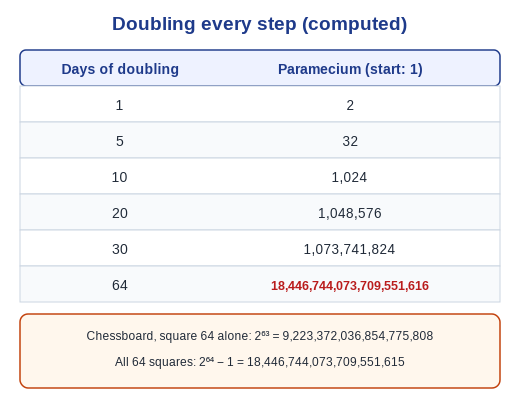
Page 195: how many Paramecium after 64 days of daily doubling? Starting from one, 2⁶⁴ = 18,446,744,073,709,551,616, about 1.8 × 10¹⁹, if food and space never ran out. The chessboard in the story needs 2⁶⁴ − 1 grains in all.
Page 196: plot India’s census figures for the last 100 years. Take the total population from each census, plot it against the year and compare the shape with a J and an S curve. Extra: India’s population has risen steeply over the last century, closer to the rising part of a J-shaped curve; check whether the most recent rise has started to slow, which would be a first sign of an S shape.
Page 196: is breeding once or many times better for fitness? Neither in general. The strategy that maximises fitness depends on the abiotic and biotic limits of the habitat in which the species lives.
Page 196: is any natural habitat home to just one species? No. Every species needs at least one other to feed on; even a plant needs soil microbes to recycle nutrients and often an animal pollinator.
Page 197: what would happen to the energy fixed by plants if no animals ate them? It would not pass on to higher trophic levels through consumers. Predation (including herbivory) is how that energy moves up the food chain. Extra: the plant matter would build up until decomposers broke it down after death.
Page 200: why did natural selection not produce totally harmless parasites? Extra (reasoning beyond the chapter): a parasite lives on the host’s food and tissues, so some harm is built into the way it lives; and because the host keeps evolving defences, a parasite that grows and reproduces fast enough to beat them leaves more offspring, even if that harms the host.
Page 200: why is the female mosquito not called a parasite? She visits a host only briefly to take a blood meal, which she needs for egg production, and then leaves. She does not live on or in the host or depend on it for shelter and food throughout her life, as a parasite does.
Page 201: watch the koel and the crow. In spring and summer, note where koels go near crows’ nests and how the crows react. It shows brood parasitism: the koel’s eggs, which resemble the crow’s, are hatched by the crow.
Note
- Exercise 9 is restated rather than quoted because its wording contains a word the site does not print; its four options are quoted.
Practice
-
A population growing exponentially doubles in 5 years. Its r is about:
Show answer
Answer: (b) 0.139 per year
-
Barnacles attached to a whale's skin show:
Show answer
Answer: (b) commensalism
-
In the equation Nt+1 = Nt + [(B + I) − (D + E)], E stands for:
Show answer
Answer: (b) emigration
-
A population of 50 has 10 births and 5 deaths in a year. Find the per capita birth and death rates and r.
Show answer
Answer: Birth rate b = 10/50 = 0.2 per individual per year; death rate d = 5/50 = 0.1 per individual per year; r = b − d = 0.1 per individual per year.
-
Name one example each of an ectoparasite and a brood parasite from the chapter.
Show answer
Answer: Ectoparasite: lice on humans (or ticks on dogs, or Cuscuta on hedge plants). Brood parasite: the cuckoo (koel), which lays its eggs in the crow's nest.
Stuck on a question?
Take a photo and Lagnever AI explains it step by step. Try it for 7 days for ₹2.
Get it on Google Play Open in browser
For parents: after the trial, the plan renews monthly by UPI or card autopay. You can cancel anytime in the app.