
Class 12 Biology Chapter 11: Organisms and Populations Notes
This chapter in five lines
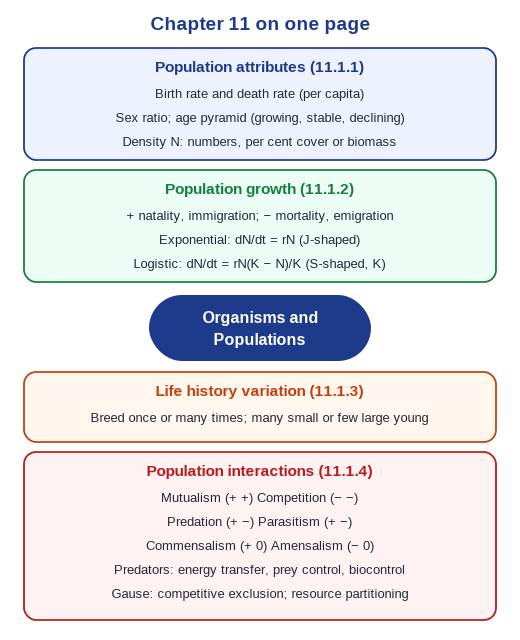
A population is a group of one species in a defined area. It has attributes an individual lacks: birth and death rates, sex ratio and age structure. Its density rises through natality and immigration and falls through mortality and emigration. Growth is exponential (dN/dt = rN) with unlimited resources and logistic, levelling off at the carrying capacity K, when they are limited. Species interact as mutualists, competitors, predators, parasites, commensals or amensals.
What is this chapter about?
This chapter opens Unit X, Ecology. The unit’s opening page introduces Ramdeo Misra (1908–1998), honoured as the Father of Ecology in India, who built ecology teaching and research at Banaras Hindu University. In the rationalised book the chapter has a single main section, 11.1 Populations, with four parts: population attributes, population growth, life history variation and population interactions.
Two topic pages go deeper: population attributes and growth and population interactions. All 10 exercises are answered in the NCERT solutions.
How and why questions
At every level of biological organisation, from molecules to biomes, we can ask two kinds of question. A ‘how’ question asks for the mechanism: how does a bird produce its song? A ‘why’ question asks for the significance: why does the bird sing at all? For the bulbul, the first answer lies in its voice box and a vibrating bone; the second may be that it needs to call a mate in the breeding season.
Ecology studies the interactions of organisms with each other and with their abiotic (physical) surroundings. It works at four levels: organisms, populations, communities and biomes. This chapter stays at the population level.
What is a population?
Single, isolated individuals are rare in nature. Most live in groups in a defined area, use or compete for the same resources and can interbreed: such a group is a population. Groups formed by asexual reproduction are also treated as populations in ecology. Examples from the chapter: the cormorants of one wetland, the rats in an abandoned house, the teak trees of a forest patch, the bacteria on one culture plate and the lotus plants of a pond.
An individual has to cope with a changing environment, but natural selection works at the population level. That is why population ecology connects ecology with population genetics and evolution (Chapter 6, Evolution).
Population attributes
A population has properties that no single individual can have.
- Birth rate and death rate, expressed per capita (per individual). Twenty lotus plants that gain 8 new plants in a year have a birth rate of 8/20 = 0.4 offspring per lotus per year. If 4 of 40 laboratory fruit flies die in a week, the death rate is 4/40 = 0.1 per fruit fly per week.
- Sex ratio: an individual is male or female, but a population has a ratio, for example 60 per cent females and 40 per cent males.
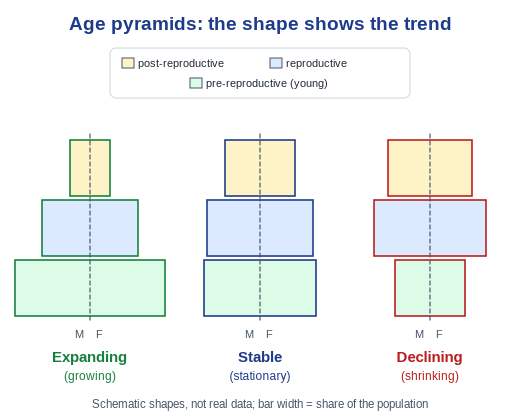
- Age distribution: the per cent of individuals in each age group, drawn as an age pyramid. For humans, males and females are drawn on either side. The shape tells whether the population is growing, stable or declining.
Population size or density (N). Any effect on a population, from a competitor, a predator or a pesticide, is judged by the change in N. N ranges from fewer than 10 (Siberian cranes at the Bharatpur wetlands in a year) to millions (Chlamydomonas in a pond). A count is usually the right measure, but not always:
- One huge banyan tree matters far more to its community than 200 plants of carrot grass (Parthenium hysterophorus), so per cent cover or biomass is a fairer measure there.
- When counting is impossible or too slow, relative density is enough: the number of fish caught per trap reflects the fish population of a lake.
- Often we estimate without seeing the animals at all: the tiger census in national parks and tiger reserves relies on pug marks and fecal pellets.
How does a population grow?
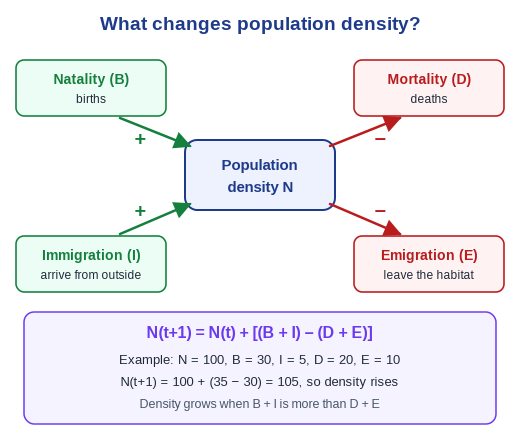
Population density keeps changing with food supply, predation pressure and bad weather. Four processes are responsible:
- Natality (B): births in a given period, added to the population.
- Mortality (D): deaths in that period.
- Immigration (I): individuals of the same species that arrive from elsewhere.
- Emigration (E): individuals that leave for elsewhere.
Nt+1 = Nt + [(B + I) − (D + E)]
Density rises when B + I is more than D + E. Usually births and deaths matter most; immigration becomes important in special cases, such as a habitat that is just being colonised.
Exponential growth
With unlimited food and space, each species can realise its full potential to multiply, as Darwin noted. If b and d are the per capita birth and death rates:
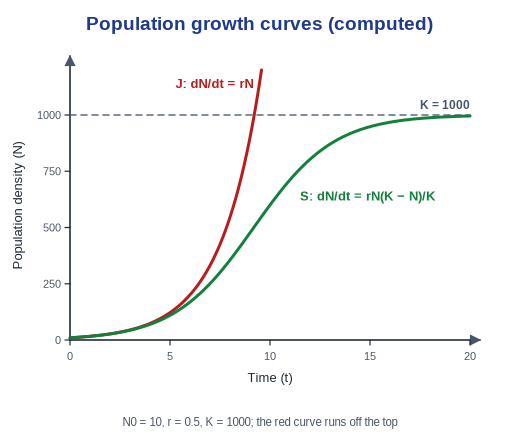
dN/dt = (b − d) × N, and with r = b − d, dN/dt = rN
r is the intrinsic rate of natural increase, used to judge how any biotic or abiotic factor affects growth. Values given in the chapter: Norway rat 0.015, flour beetle 0.12, and India’s human population in 1981, 0.0205. The integrated form is Nt = N0 e^rt, where e = 2.71828. Plotting N against time gives a J-shaped curve.
The chapter tells the story of a king who loses a chess game and has to place 1 grain on the first square, 2 on the second, 4 on the third and so on. Our calculation: the last square alone needs 2⁶³ ≈ 9.2 × 10¹⁸ grains, and the whole board 2⁶⁴ − 1 ≈ 1.8 × 10¹⁹. A Paramecium doubling daily from one cell would reach 2⁶⁴ ≈ 1.8 × 10¹⁹ cells in 64 days, if food and space never ran out.
Logistic growth
No natural population has unlimited resources. Individuals compete, and the fittest survive and reproduce. Each habitat can support at most a certain number of a species, its carrying capacity (K). A population in such a habitat shows a lag phase, then acceleration, then deceleration, and finally levels off (asymptote) at K. The curve is sigmoid (S-shaped); this is Verhulst-Pearl logistic growth:
dN/dt = rN (K − N)/K
When N is small, (K − N)/K is close to 1 and growth is nearly exponential; when N reaches K, the bracket becomes 0 and growth stops. Because resources always run short sooner or later, the logistic model is considered more realistic.
Life history variation
Over generations, a population is shaped to raise its reproductive (Darwinian) fitness, that is, a high r value, in its own habitat. Strategies differ:
- Some breed once in a lifetime (Pacific salmon, bamboo); others breed many times (most birds and mammals).
- Some produce many small offspring (oysters, pelagic fishes); others a few large ones (birds, mammals).
Ecologists think these life history traits evolved under the limits set by the abiotic and biotic parts of each habitat. It is an active research area.
Population interactions
No habitat holds just one species. An animal needs at least one other species to eat; even a plant needs soil microbes to recycle nutrients and often an animal to pollinate it. Interactions between two species (interspecific) can help (+), harm (−) or not affect (0) each partner.
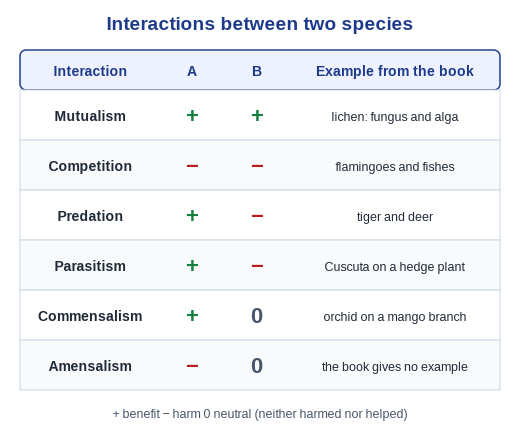
- Predation (+ −). Nature’s way of passing the energy fixed by plants to higher trophic levels; a sparrow eating seeds is a predator too, and herbivores are not very different. Predators keep prey numbers in check: the prickly pear cactus, brought into Australia in the early 1920s, spread over millions of hectares until a cactus-eating moth was introduced. Biological control of pests rests on this. Predators also maintain diversity: removing the starfish Pisaster from an intertidal area led to more than 10 invertebrate species dying out within a year. Prey defend themselves by camouflage (some insects and frogs) or by being poisonous: the Monarch butterfly gets a distasteful chemical from a poisonous weed it eats as a caterpillar. Plants use thorns (Acacia, cactus) and chemicals: Calotropis makes cardiac glycosides, and nicotine, caffeine, quinine, strychnine and opium are plant defences too.
- Competition (− −). Even unrelated species compete: flamingoes and resident fishes share zooplankton in some South American lakes. In interference competition, one species lowers the other’s feeding efficiency even when food is plentiful. So the chapter defines competition by its effect: a significant fall in one species’ r in the presence of another. Evidence: the Abingdon tortoise of the Galapagos died out within a decade of goats arriving; and competitive release, where a species held to a small range by a stronger rival spreads widely once the rival is removed. In Connell’s field experiments on the rocky coasts of Scotland, the larger barnacle Balanus holds the intertidal zone and keeps the smaller barnacle (Chathamalus in the book; Extra: usually spelled Chthamalus) out of it. Herbivores and plants seem to suffer more from competition than carnivores. Gause’s competitive exclusion principle holds when resources are limited, but species can co-exist by resource partitioning, as MacArthur’s five warbler species on one tree do.
- Parasitism (+ −). Parasites get shelter and food from the host; many are host-specific and co-evolve with their hosts. Adaptations: loss of unneeded sense organs and the digestive system, suckers, high reproductive capacity, intermediate hosts (the liver fluke uses a snail and a fish; the malarial parasite uses a mosquito vector). Ectoparasites: lice on humans, ticks on dogs, copepods on marine fish, Cuscuta on hedge plants. Endoparasites live inside the body. Brood parasitism: the koel lays eggs that resemble the crow’s in the crow’s nest.
- Commensalism (+ 0). An orchid living as an epiphyte on the branch of a mango tree; barnacles on a whale; the cattle egret catching insects stirred up by grazing cattle; the clown fish sheltering among a sea anemone’s stinging tentacles.
- Mutualism (+ +). Lichens (fungus with algae or cyanobacteria); mycorrhizae (fungi helping roots absorb nutrients in return for carbohydrates); plants rewarding pollinators with nectar and pollen and seed dispersers with fruit. In many figs, one wasp species pollinates the inflorescence while laying eggs, and its larvae eat some developing seeds. The Mediterranean orchid Ophrys has a petal that looks like a female bee; the male bee ‘pseudocopulates’ with it and carries pollen, an example of co-evolution.
- Amensalism (− 0). One species is harmed and the other unaffected. The chapter gives no example; Extra: a common one is the mould Penicillium releasing a substance that kills nearby bacteria.
Predation, parasitism and commensalism have one thing in common: the two species live closely together. More on each, with the book’s examples, is on population interactions.
Before we move on
Know the population attributes with the lotus and fruit-fly numbers, the equation Nt+1 = Nt + [(B + I) − (D + E)], both growth equations with their curves, the meaning of r and K, and the six interactions with their signs and one example each. The next chapters of Unit X, Ecosystem and Biodiversity and Conservation, build on these ideas. All 10 exercises are answered in the NCERT solutions for Chapter 11.
Key terms
| Term | Meaning |
|---|---|
| Ecology | The study of how organisms interact with one another and with their physical (abiotic) surroundings. The chapter names four levels it deals with: organisms, populations, communities and biomes. |
| Population | Individuals of one species living together in a well-defined area, sharing or competing for the same resources and able to interbreed. Groups formed by asexual reproduction are also counted as populations in ecology. |
| Birth rate and death rate | Births or deaths per individual (per capita) in a given time, for example 8 new lotus plants added to 20 gives 8/20 = 0.4 offspring per plant per year. |
| Age pyramid | A plot of the share of individuals in each age group, usually with males and females on either side. Its shape shows whether a population is growing, stable or declining. |
| Population density (N) | The size of a population. It is usually a count, but per cent cover, biomass or a relative measure (such as fish caught per trap) can be more useful. |
| Natality, mortality, immigration, emigration | Births and arrivals from outside add to density; deaths and departures to other places remove from it. |
| Intrinsic rate of natural increase (r) | The per capita birth rate minus the per capita death rate, r = b − d. It measures a population's built-in ability to grow. |
| Carrying capacity (K) | The largest population a habitat's resources can support. Logistic growth levels off at K. |
| Exponential growth | Growth with unlimited resources, dN/dt = rN, or Nt = N0 e^rt; numbers plotted against time give a J-shaped curve. |
| Logistic growth | Growth with limited resources, dN/dt = rN(K − N)/K (Verhulst-Pearl model); numbers plotted against time give an S-shaped (sigmoid) curve. |
| Competitive exclusion principle | Gause's idea that when two closely related species need the same limited resource, they cannot live together for ever; the weaker competitor is eventually eliminated. |
| Resource partitioning | Competing species avoiding direct competition, for example by feeding at different times or in different ways, so that they can co-exist. |
| Brood parasitism | A parasitic bird laying its eggs in another bird's nest so that the host incubates them, as the cuckoo (koel) does with the crow. |
Topics in this chapter
Practice
-
In a pond, 20 lotus plants become 28 in a year through reproduction. The birth rate is:
Show answer
Answer: (b) 0.4 per lotus per year
-
Which pair of processes increases population density?
Show answer
Answer: (b) Natality and immigration
-
In the logistic equation dN/dt = rN(K − N)/K, growth stops when:
Show answer
Answer: (b) N = K
-
An interaction in which one species is harmed and the other is unaffected is:
Show answer
Answer: (c) amensalism
-
Five warbler species feeding on the same tree co-exist because of:
Show answer
Answer: (b) resource partitioning
-
Calotropis is avoided by cattle and goats because it makes:
Show answer
Answer: (b) cardiac glycosides
Questions students ask
What are the main topics of Class 12 Biology Chapter 11?
Populations: population attributes (birth and death rates, sex ratio, age pyramids, density), population growth (natality, mortality, immigration, emigration, exponential and logistic growth), life history variation, and population interactions (predation, competition, parasitism, commensalism, mutualism and amensalism).
Is Organisms and Populations in the 2026-27 NCERT Class 12 Biology book?
Yes. It is Chapter 11, the first chapter of Unit X, Ecology, in the Class 12 Biology textbook marked Reprint 2026-27, on pages 190 to 204. It has 10 end-of-chapter exercises.
What is the difference between exponential and logistic growth?
Exponential growth assumes unlimited food and space, so the population keeps multiplying at the rate r and the curve is J-shaped. Logistic growth assumes limited resources, so growth slows as N approaches the carrying capacity K and the curve is S-shaped. The logistic model is the more realistic one.
Which diagrams should I practise for this chapter?
Age pyramids for growing, stable and declining populations, the four processes that change density with the equation for Nt+1, the J-shaped and S-shaped growth curves with K marked, and the table of interactions with +, − and 0 signs.
Stuck on a question?
Take a photo and Lagnever AI explains it step by step. Try it for 7 days for ₹2.
Get it on Google Play Open in browser
For parents: after the trial, the plan renews monthly by UPI or card autopay. You can cancel anytime in the app.