
Class 12 Biology Chapter 6: Evolution Notes
This chapter in five lines
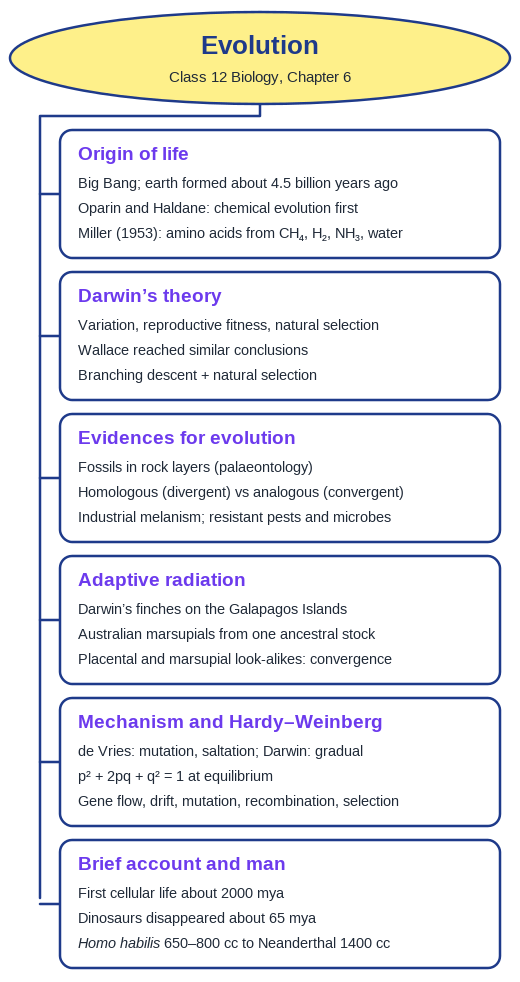
Evolutionary biology studies the history of life forms on earth. The chapter starts with the origin of the universe, the earth and life, including chemical evolution and Miller's experiment. It then explains Darwin's theory of natural selection, the evidences for evolution, adaptive radiation, the Hardy–Weinberg principle, a brief account of evolution through geological time, and the origin and evolution of man.
What is this chapter about?
Evolutionary biology is the study of the history of life forms on earth. To understand how plants and animals have changed over millions of years, the chapter first places the origin of life against the background of the evolution of the earth, the stars and the universe.
The chapter itself calls this a long story that is partly built on conjecture. It is told here as the textbook tells it, with each time scale and figure exactly as the book prints it. Two topic pages go deeper: evidences for evolution (with adaptive radiation) and natural selection and the Hardy–Weinberg principle.
How did the universe, the earth and life begin?
Looking at stars at night is, in a way, looking back in time: their light set out millions of years ago. Compared with the universe, the earth is only a speck.
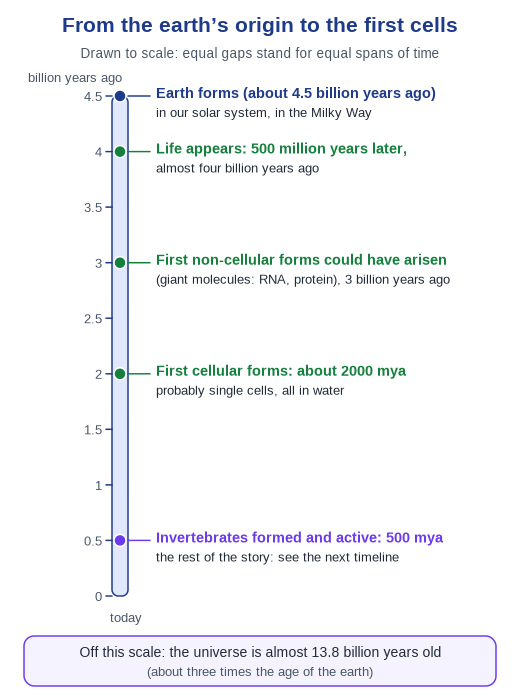
- The universe is almost 13.8 billion years old. The Big Bang theory tries to explain its origin as a single huge explosion. The universe expanded and cooled; hydrogen and helium formed later, and gases condensed under gravity into galaxies.
- The earth formed about 4.5 billion years ago, in our solar system within the Milky Way. At first there was no atmosphere. Water vapour, methane, carbon dioxide and ammonia came out of the molten mass. UV rays split water; the lighter hydrogen escaped, and the oxygen reacted with ammonia and methane, giving water, CO₂ and other compounds. The ozone layer formed, the vapour fell as rain and filled the oceans.
- Life appeared about 500 million years after the earth formed, that is, almost four billion years ago.
Which theories of the origin of life does the chapter discuss?
- Panspermia. Some scientists think life came from outer space. Early Greek thinkers held that units of life called spores moved between planets, including the earth. Some astronomers still favour this idea.
- Spontaneous generation. For a long time people believed life could arise from decaying and rotting matter such as straw or mud. Louis Pasteur disproved this. In flasks sterilised beforehand, no life arose from killed yeast; in a flask open to air, new organisms did appear. So living things arise only from other living things. This still left open how the very first life arose.
- Chemical evolution (Oparin and Haldane). Two scientists, Oparin in Russia and Haldane in England, suggested that the first life may have arisen from non-living organic molecules already present, such as RNA and protein, and that chemical evolution came first: diverse organic molecules formed from inorganic ones. Early earth had a high temperature, volcanic storms and a reducing atmosphere with CH₄, NH₃ and other gases.
What did Miller’s experiment show?
In 1953, the American scientist S.L. Miller recreated such conditions on a laboratory scale. He sealed CH₄, H₂, NH₃ and water vapour in a flask and sparked an electric discharge through the mixture (the book gives 800 °C). He found that amino acids had formed.
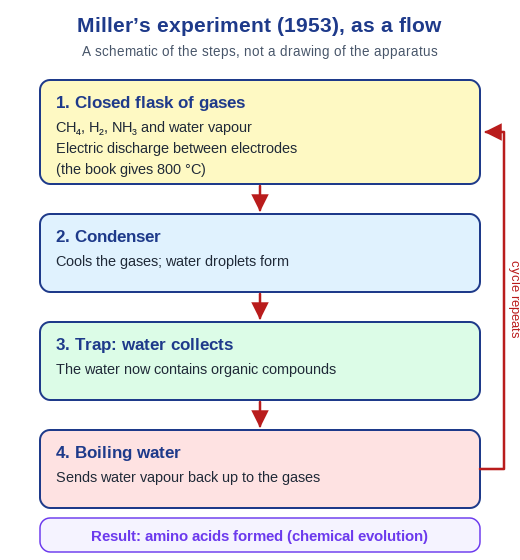
Similar experiments by others gave sugars, nitrogen bases, pigments and fats. Meteorites were found to contain similar compounds, suggesting such processes also occur elsewhere in space. On this limited evidence, chemical evolution was more or less accepted.
Nobody knows how the first unit that could copy itself and run its own metabolism came about. The first non-cellular forms could have arisen about 3 billion years ago as giant molecules (RNA, protein, polysaccharides and so on). The first cellular forms probably did not arise until about 2000 million years ago; they were probably single cells, all living in water. Most scientists accept this account of life arising slowly from non-living molecules.
What is Darwin’s theory of evolution?
The chapter first describes the theory of special creation, which it attributes to conventional religious literature. As the book sets it out, it has three parts: all living organisms were created as they are today; diversity has always been the same and will stay so; and the earth is about 4000 years old. The book records that these ideas were strongly challenged in the nineteenth century by scientific observation.
Charles Darwin sailed round the world on the ship H.M.S. Beagle. From his observations he concluded:
- Living forms share similarities, to varying degrees, among themselves and with life forms of millions of years ago. Many of those forms no longer exist; extinctions happened, and new forms arose at different times.
- Every population has built-in variation. Individuals whose characters suit them better to their natural conditions (climate, food, physical factors) leave more offspring.
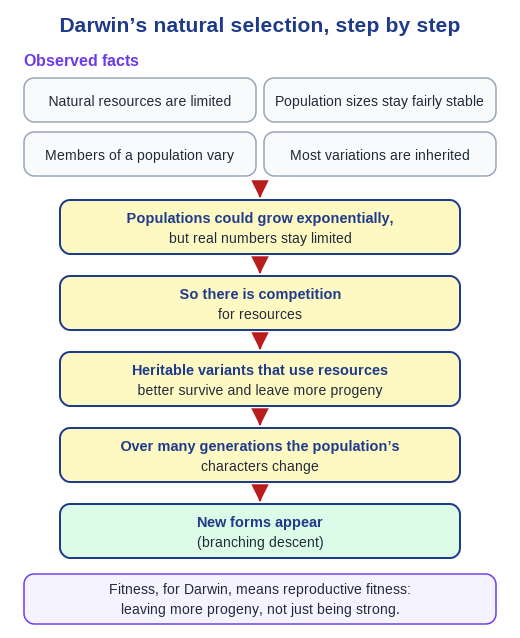
- Fitness, for Darwin, means reproductive fitness. Those better fit leave more progeny, survive more and are “selected by nature”. He called this natural selection and saw it as a mechanism of evolution.
Alfred Wallace, a naturalist working in the Malay Archipelago, reached similar conclusions at about the same time. The geological history of the earth matches its biological history, and the earth is billions of years old, not thousands.
What are the evidences for evolution?
- Palaeontological evidence. Fossils are the preserved hard parts of past organisms, found in rock. Rock layers of different ages hold fossils of different life forms, some extinct, such as dinosaurs. Life forms changed over time, and new ones arose at different times.
- Embryological support. Ernst Haeckel (spelt Heckel in the book) proposed that all vertebrate embryos, including humans, show a row of vestigial gill slits behind the head, which work as gills only in fish. Karl Ernst von Baer disapproved this on careful study: an embryo does not go through the adult forms of other animals.
- Comparative anatomy. Homologous organs have the same basic plan but different jobs (divergent evolution); analogous organs do the same job with different structures (convergent evolution).
- Biochemical similarities in proteins and genes among diverse organisms point to shared ancestry.
- Artificial selection. Breeders created distinct breeds, such as dog breeds, within hundreds of years. Over millions of years, nature could achieve the same.
- Industrial melanism. In England, dark-winged moths became commoner than white-winged moths after industrialisation darkened tree trunks.
- Resistance. Heavy use of herbicides, pesticides, antibiotics and drugs selects resistant varieties within months or years.
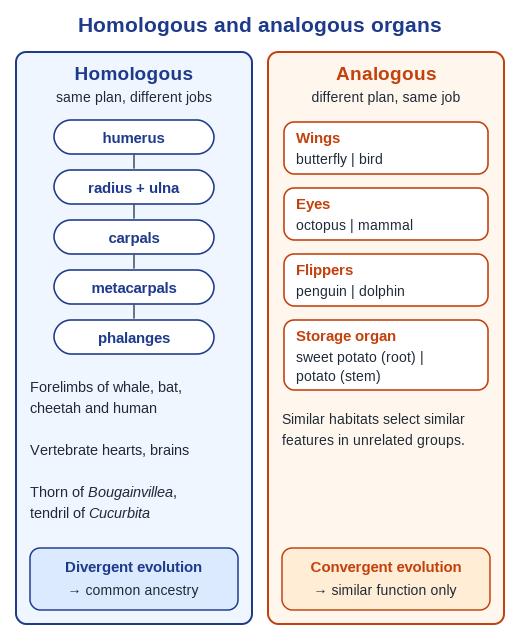
The book adds that evolution has no fixed, predetermined direction: it is stochastic, driven by chance happenings in nature and chance mutations in organisms. All of these evidences are worked through in evidences for evolution.
What is adaptive radiation?
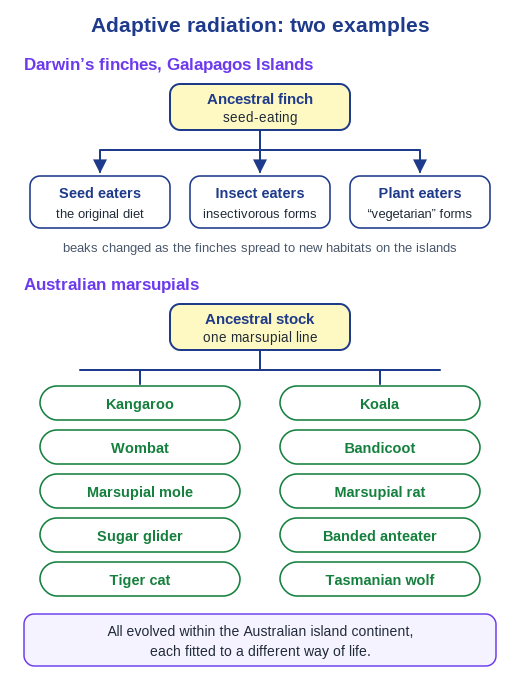
On the Galapagos Islands Darwin found many varieties of small black birds, later called Darwin’s finches. He reasoned that all of them evolved on the islands: from the original seed-eating form, others with altered beaks arose, becoming insectivorous and “vegetarian” finches. The evolution of different species in one geographical area, starting from a point and radiating into other habitats, is adaptive radiation.
The Australian marsupials are another example: many different marsupials evolved from one ancestral stock, all inside Australia. If an isolated area sees more than one adaptive radiation, the result can be called convergent evolution: placental mammals in Australia also radiated, and each type resembles a matching marsupial, such as the placental wolf and the Tasmanian wolf.
What is biological evolution?
Evolution by natural selection, in the true sense, would have started once cellular life forms with differences in metabolic capability appeared.
- The rate depends on the life span. A bacterial colony (A) has built-in variation in using a food component. If the medium changes, only the part (B) that can live in the new conditions grows, and within days it outgrows the rest and appears as a new form. In fish or fowl, with life spans of years, the same would take millions of years. Here B is fitter than A under the new conditions.
- Fitness has a genetic basis. Only inherited characters can be selected. The ability to adapt is inherited, and fitness is what results when an organism adapts and so gets selected.
- Darwin’s theory rests on two key ideas: branching descent and natural selection.
- Lamarck, a French naturalist before Darwin, said evolution was driven by the use and disuse of organs; giraffes stretching for leaves passed on longer necks. The book notes that nobody accepts this idea any more.
Darwin may have been influenced by Thomas Malthus’s work on populations. Resources are limited, populations stay fairly stable, members vary, and most variations are inherited. A population could grow exponentially but does not, so there must be competition. Darwin’s insight was that heritable variations that make resource use better let only those individuals reproduce and leave more progeny; over generations the population changes, and new forms appear.
What is the mechanism of evolution?
Mendel had spoken of inheritable “factors”, but Darwin did not take up these observations. In the first decade of the twentieth century, Hugo de Vries, working on the evening primrose, proposed that mutations, large differences arising suddenly in a population, cause evolution.
| Darwin | Hugo de Vries | |
|---|---|---|
| Source of change | Small, heritable variations | Mutations |
| Nature | Directional | Random and directionless |
| Pace | Gradual | Single-step large change: saltation |
Later studies in population genetics brought more clarity.
What is the Hardy–Weinberg principle?
The frequencies of the alleles of a gene in a population stay constant from generation to generation, and the gene pool (all the genes of a population with all their alleles) stays the same. This is genetic equilibrium. If p and q are the frequencies of alleles A and a:
p² + 2pq + q² = 1, the binomial expansion of (p + q)², where p² = frequency of AA, 2pq = frequency of Aa and q² = frequency of aa.
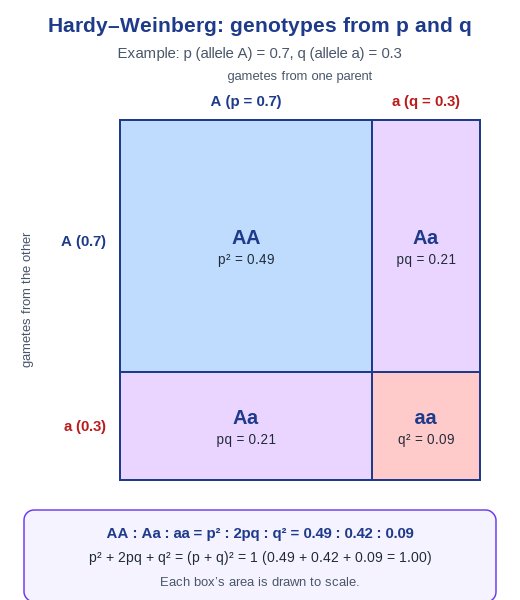
When measured frequencies differ from the expected ones, the difference shows the extent of evolutionary change. Five factors affect the equilibrium: gene migration or gene flow, genetic drift, mutation, genetic recombination and natural selection. Natural selection can be stabilising, directional or disruptive.
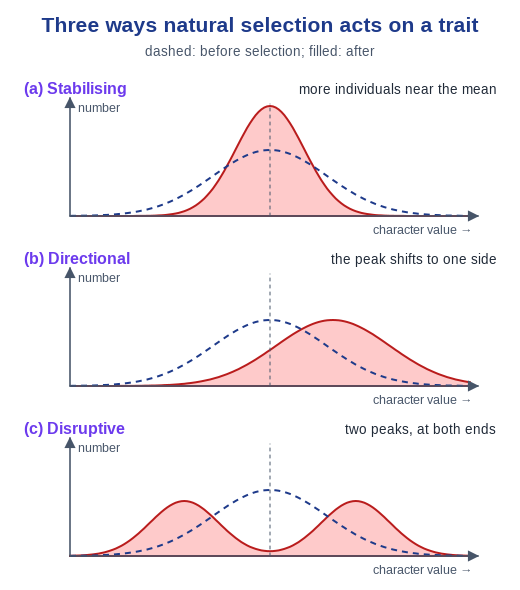
The worked examples and all five factors are in natural selection and the Hardy–Weinberg principle.
What is the brief account of evolution?
As the book gives it:
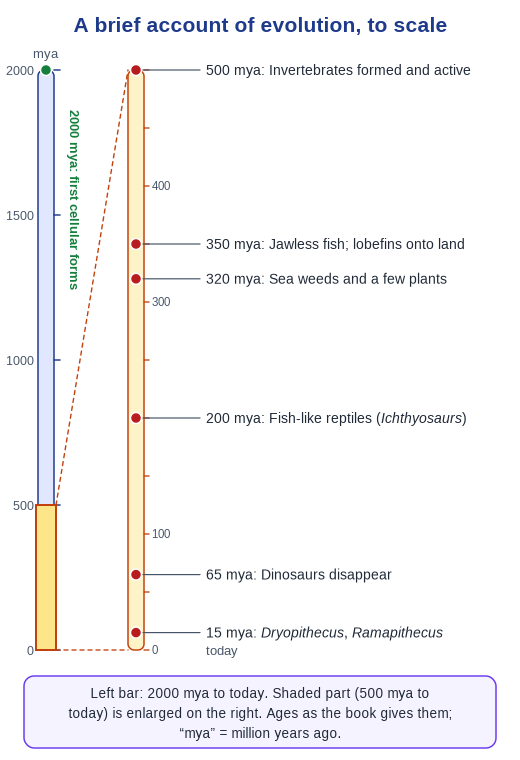
- About 2000 mya: the first cellular forms appeared. How giant macromolecules became membrane-bound cells is not known. Some cells could release O₂, perhaps by a reaction like the light reaction of photosynthesis. Single-celled forms slowly became multicellular.
- By 500 mya: invertebrates were formed and active.
- About 350 mya: jawless fish probably evolved. Fish with stout, strong fins could move onto land and go back to water. In 1938, a Coelacanth, a fish believed to be extinct, was caught in South Africa. These lobefins evolved into the first amphibians, ancestors of frogs and salamanders.
- About 320 mya: sea weeds and a few plants existed. Plants were the first organisms to invade land, and were widespread when animals followed.
- Reptiles evolved from amphibians. Their thick-shelled eggs do not dry up in the sun. Turtles, tortoises and crocodiles are their modern descendants. Reptiles dominated for about the next 200 million years. Giant ferns (pteridophytes) fell to form coal deposits.
- About 200 mya: some land reptiles returned to water as fish-like reptiles (Ichthyosaurs). The land reptiles were the dinosaurs; the biggest, Tyrannosaurus rex, was about 20 feet high.
- About 65 mya: the dinosaurs suddenly disappeared. The true reason is not known; the book notes that some blame climatic change while others think most of them became birds, and suggests the truth may lie in between.
- Mammals: the first were like shrews. They were viviparous and protected the unborn young inside the mother. In South America, mammals resembling the horse, hippopotamus, bear and rabbit were overridden by North American fauna when the two continents joined by continental drift; Australia’s pouched mammals survived because they had no competition from other mammals. Whales, dolphins, seals and sea cows live wholly in water.
How did man evolve?
The book’s account, with its dates:
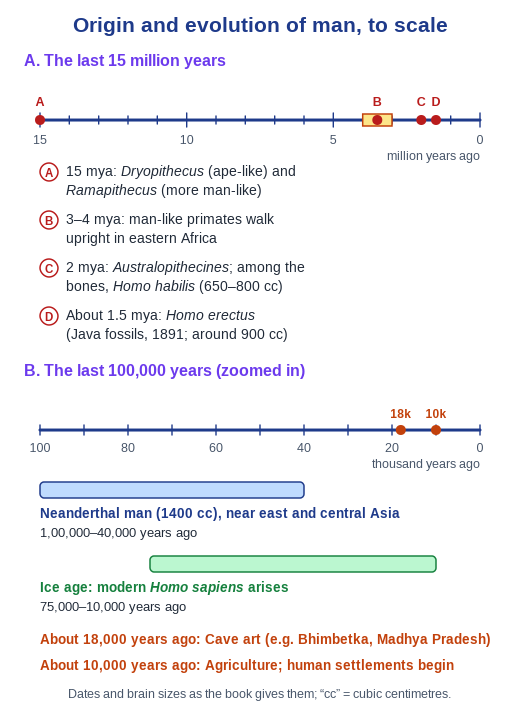
- About 15 mya: primates called Dryopithecus (more ape-like) and Ramapithecus (more man-like). Both were hairy and moved about the way gorillas and chimpanzees do.
- About 3–4 mya: fossils of man-like bones from Ethiopia and Tanzania show that man-like primates, probably not taller than 4 feet, walked upright in eastern Africa.
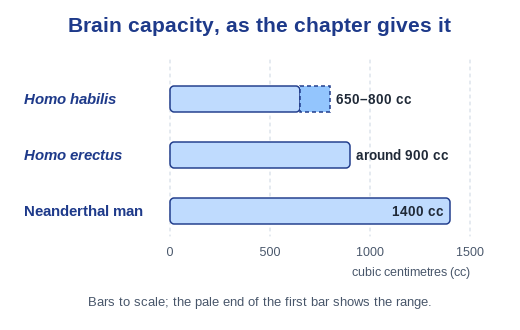
- About 2 mya: Australopithecines probably lived on the grasslands of East Africa; they hunted with stone weapons but mainly ate fruit. Some of the bones found were different: this was Homo habilis, the first human-like being (hominid), with a brain capacity of 650–800 cc, which probably did not eat meat.
- About 1.5 mya: Homo erectus, from fossils found in Java in 1891, had a large brain of around 900 cc and probably ate meat.
- 1,00,000–40,000 years ago: the Neanderthal man, brain size 1400 cc, lived in the near east and central Asia, used hides to protect the body and buried the dead.
- Homo sapiens originated in Africa and spread across the continents. Modern Homo sapiens appeared during the ice age (75,000–10,000 years ago).
- About 18,000 years ago: prehistoric cave art developed; such paintings can be seen at the Bhimbetka rock shelter in Raisen district, Madhya Pradesh.
- About 10,000 years ago: agriculture began, and human settlements started.
The book also compares the skulls of an adult human, a baby chimpanzee and an adult chimpanzee: the baby chimpanzee’s skull is more like the adult human skull than the adult chimpanzee’s.
Before we move on
This chapter closes Unit VII. It builds on Chapter 4, Principles of Inheritance and Variation (alleles and mutation) and on Chapter 5, Molecular Basis of Inheritance. Learn the dates and brain sizes as the book gives them, practise drawing the homologous forelimb plan and the three selection curves, and be able to write p² + 2pq + q² = 1 with what each term means. All 10 exercises are answered in the NCERT solutions for Chapter 6.
Key terms
| Term | Meaning |
|---|---|
| Chemical evolution | The making of many kinds of organic molecules out of inorganic substances. Oparin and Haldane proposed that this happened before the first life arose. |
| Spontaneous generation | The old idea that life arises from decaying and rotting matter such as straw and mud. Louis Pasteur's experiments with killed yeast showed that living things arise only from other living things. |
| Natural selection | Darwin's mechanism of evolution: individuals with heritable characters that help them survive and reproduce leave more progeny, so those characters become more common. |
| Fitness | For Darwin, fitness means reproductive fitness: individuals better suited to their surroundings produce more offspring. |
| Fossils | The preserved hard parts of past organisms, found in rock. Studying them (palaeontology) shows which life forms lived in which geological period. |
| Homologous organs | Organs with the same basic structure that do different jobs, such as the forelimbs of whales, bats, cheetahs and humans. They result from divergent evolution and point to common ancestry. |
| Analogous organs | Organs that do the same job but are not anatomically similar, such as the wings of a butterfly and a bird. They result from convergent evolution. |
| Adaptive radiation | Many species evolving within one region from a single starting point and spreading out into different habitats, as in Darwin's finches and Australian marsupials. |
| Saltation | Hugo de Vries's idea of a single-step large mutation that causes speciation. |
| Gene pool | All the genes of a population, together with all their alleles. |
| Hardy–Weinberg equilibrium | The state in which allele frequencies in a population stay constant from generation to generation, so that p² + 2pq + q² = 1. |
| Genetic drift and founder effect | Genetic drift is a change in allele frequency that happens by chance. When a drifted group becomes so different that it forms a new species, the original drifted population are the founders: the founder effect. |
Topics in this chapter
Practice
-
Miller's experiment showed the formation of which of these from simple gases?
Show answer
Answer: (b) Amino acids
-
The wings of a butterfly and of a bird are an example of:
Show answer
Answer: (b) analogous organs
-
Darwin's finches of the Galapagos Islands are an example of:
Show answer
Answer: (c) adaptive radiation
-
In the Hardy–Weinberg equation, 2pq stands for the frequency of:
Show answer
Answer: (b) heterozygous individuals
-
Who proposed the idea of saltation?
Show answer
Answer: (c) Hugo de Vries
-
The brain capacity of Neanderthal man, as the chapter gives it, was:
Show answer
Answer: (c) 1400 cc
Questions students ask
What are the main topics of Class 12 Biology Chapter 6?
Origin of life, Darwin's theory of evolution, evidences for evolution, adaptive radiation, biological evolution, the mechanism of evolution, the Hardy–Weinberg principle, a brief account of evolution, and the origin and evolution of man.
Is Evolution in the 2026-27 NCERT Class 12 Biology book?
Yes. It is Chapter 6, the last chapter of Unit VII, Genetics and Evolution, in the Class 12 Biology textbook marked Reprint 2026-27, on pages 110 to 126. It has 10 end-of-chapter exercises.
What is the difference between Darwin's and de Vries's ideas?
Darwin saw evolution as gradual, driven by small heritable variations that are directional. De Vries, working on evening primrose, said that large, sudden mutations cause evolution; mutations are random and directionless, and a single-step large mutation (saltation) can cause speciation.
Which numbers should I remember from this chapter?
The ages: universe almost 13.8 billion years, earth about 4.5 billion years, first cells about 2000 mya, dinosaurs gone about 65 mya. Miller's experiment in 1953. Brain sizes: Homo habilis 650–800 cc, Homo erectus around 900 cc, Neanderthal man 1400 cc. And the equation p² + 2pq + q² = 1.
Stuck on a question?
Take a photo and Lagnever AI explains it step by step. Try it for 7 days for ₹2.
Get it on Google Play Open in browser
For parents: after the trial, the plan renews monthly by UPI or card autopay. You can cancel anytime in the app.