
What are the evidences for evolution?
Answer in short
Evidence for evolution comes from many sources. Fossils in rock layers of different ages show that life forms changed over time. Homologous organs show common ancestry through divergent evolution; analogous organs show convergent evolution. Similar proteins and genes, artificial selection, industrial melanism, resistance to pesticides and antibiotics, and adaptive radiation add further support.
Stuck on a question? Take a photo and Lagnever AI explains it step by step. Try it for 7 days for ₹2. Get it on Google Play
What do fossils tell us?
Fossils are the preserved hard parts of past organisms, found in rock. Sediments settle into rock layers, and a slice through the earth’s crust shows these layers stacked over a long history.
- Rock layers of different ages contain fossils of different life forms, which probably died while that layer was forming.
- Some fossils look like modern organisms; others are of extinct ones, such as dinosaurs. The book shows a family tree linking dinosaurs to their living counterparts, the crocodiles and birds.
- Certain life forms are found only in certain geological time spans. So new forms arose at different times in the earth’s history.
All of this is palaeontological evidence. The age of a fossil is found by radioactive dating, which the book asks you to recall.
What did embryology suggest?
Ernst Haeckel (spelt Heckel in the book) proposed embryological support for evolution. Some features are common to the embryos of all vertebrates but absent in the adults. For example, all vertebrate embryos, including the human embryo, develop a row of vestigial gill slits just behind the head, yet these work as gills only in fish.
Karl Ernst von Baer disapproved this proposal after careful study. His point was that an embryo does not go through the adult forms of other animals.
What are homologous organs?
Comparative anatomy looks at similarities and differences among organisms, living and extinct, to judge whether they shared ancestors.
The forelimbs of whales, bats, cheetahs and humans (all mammals) do very different jobs: swimming, flying, running and grasping. Yet all have the same set of bones: humerus, radius, ulna, carpals, metacarpals and phalanges. One structure was modified in different directions as each animal adapted to its own way of life. This is divergent evolution, and such structures are homologous. Homology indicates common ancestry.
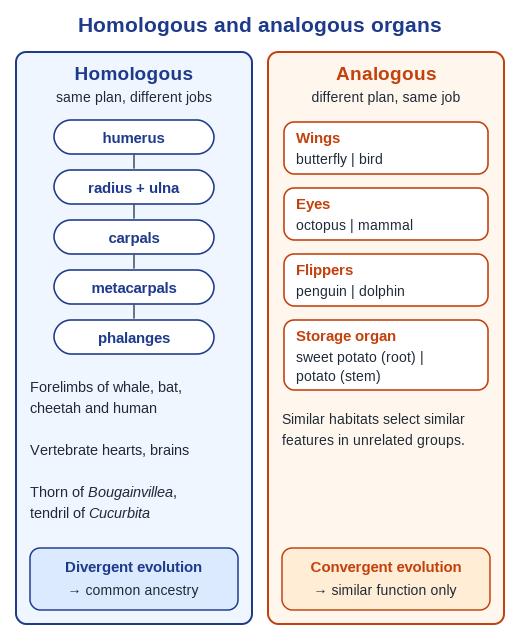
Other examples:
- Vertebrate hearts and vertebrate brains.
- In plants, the thorn of Bougainvillea and the tendril of Cucurbita.
What are analogous organs?
Analogy is the opposite situation. The wings of a butterfly and of a bird look alike and do the same job, but they are not anatomically similar. Different structures evolved for the same function, so analogous structures are the result of convergent evolution.
| Analogous pair | Shared function |
|---|---|
| Wings of butterfly and bird | Flight |
| Eye of octopus and of mammals | Vision |
| Flippers of penguins and dolphins | Swimming |
| Sweet potato (root modification) and potato (stem modification) | Food storage |
Similar habitats have favoured similar adaptations in unrelated groups, all serving the same function.
| Homologous organs | Analogous organs | |
|---|---|---|
| Structure | Same basic plan | Different |
| Function | Different | Same |
| Type of evolution | Divergent | Convergent |
| Shows | Common ancestry | Similar adaptation to similar habitats |
What other evidence is there?
- Biochemical similarity. Similar proteins and genes performing a given function in diverse organisms suggest shared ancestry, just as structural similarities do.
- Artificial selection. People have selectively bred plants and animals for farming, gardening, sport and security. Breeds of dogs, for example, differ from one another yet remain one group. If people could create new breeds in hundreds of years, nature could achieve the same over millions of years.
What is industrial melanism?
In England, a collection of moths made in the 1850s, before industrialisation, showed that white-winged moths outnumbered dark-winged (melanised) ones on trees. A collection from the same area in 1920, after industrialisation, showed the dark-winged moths in the majority: the proportion had reversed.
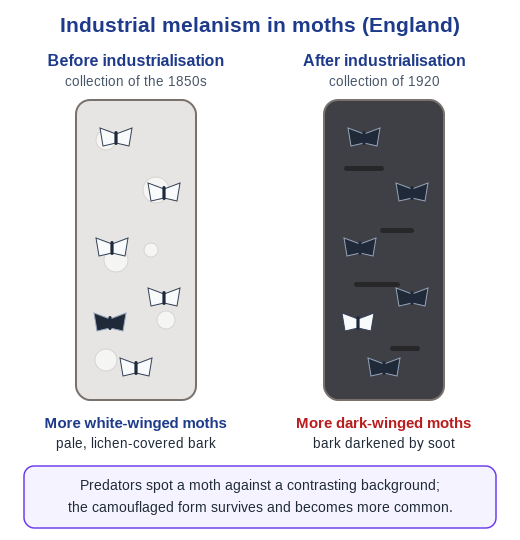
The explanation: predators spot a moth against a contrasting background.
- Before industrialisation, thick, almost white lichens covered the trunks. White-winged moths were camouflaged; dark ones were picked out.
- Lichens do not grow in polluted areas; they can serve as indicators of industrial pollution. After industrialisation, smoke and soot darkened the trunks, and the dark moths were camouflaged instead.
- In rural areas without industry, the count of dark moths stayed low.
So in a mixed population, the forms that are better adapted survive and increase. No variant is wiped out completely.
How do pesticides and antibiotics show evolution?
Excess use of herbicides and pesticides has selected resistant varieties of pests, and the use of antibiotics or drugs has selected resistant microbes and cells. These appear within months or years, not centuries. The book calls these examples of evolution by anthropogenic (human) action.
They also show that evolution is not a directed, predetermined process. It is stochastic: it depends on chance events in nature and chance mutations in organisms.
What is adaptive radiation?
During his voyage, Darwin visited the Galapagos Islands and found many varieties of small black birds, now called Darwin’s finches, on the same island. He reasoned that all of them evolved there. From the original seed-eating form, others with altered beaks arose and became insectivorous or “vegetarian” finches.
When many species evolve within one region from a single starting point and spread out into different habitats, the process is adaptive radiation. Darwin’s finches are a classic example.
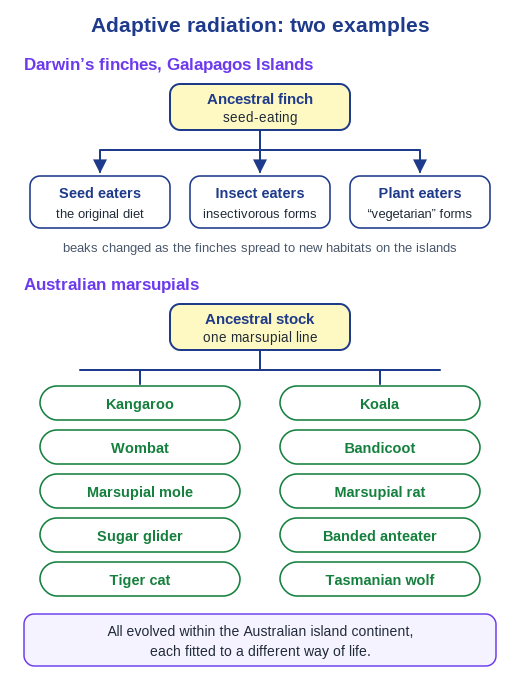
The Australian marsupials are another: many different marsupials evolved from one ancestral stock, all within the Australian island continent.
When does adaptive radiation become convergent evolution?
When more than one adaptive radiation appears to have occurred in an isolated area, the book calls it convergent evolution. Placental mammals in Australia also radiated, and each type looks similar to a matching marsupial:
| Placental mammal | Look-alike Australian marsupial |
|---|---|
| Mole | Marsupial mole |
| Anteater | Numbat (anteater) |
| Mouse | Marsupial mouse |
| Lemur | Spotted cuscus |
| Flying squirrel | Flying phalanger |
| Bobcat | Tasmanian tiger cat |
| Wolf | Tasmanian wolf |
Next: natural selection and the Hardy–Weinberg principle. Back to the Chapter 6 notes.
Practice
-
The forelimbs of a whale and a bat are:
Show answer
Answer: (b) homologous organs
-
Sweet potato and potato are an example of analogy because:
Show answer
Answer: (c) one is a root and one is a stem, with the same function
-
Which scientist disapproved the embryological proposal on careful study?
Show answer
Answer: (b) Karl Ernst von Baer
-
Why were lichens important in the moth story?
Show answer
Answer: Before industrialisation, pale lichens covered the tree trunks, so white-winged moths were camouflaged and dark ones were picked out by predators. Lichens do not grow where the air is polluted, so after industrialisation the trunks were bare and soot-darkened, and the dark moths were camouflaged instead.
-
What is convergent evolution in the Australian example?
Show answer
Answer: Placental mammals in Australia also radiated, and each type looks similar to a matching marsupial, such as the placental wolf and the Tasmanian wolf. Different groups evolved similar forms because they adapted to similar ways of life.
Questions students ask
What is the difference between homologous and analogous organs?
Homologous organs have the same basic anatomical structure but perform different functions, because they developed in different directions from a common ancestor. Analogous organs perform the same function but are not anatomically similar; similar habitats selected similar features in different groups.
How do fossils show that evolution has happened?
Rock layers formed one over another through the earth's history (Extra: in undisturbed rock, lower layers are generally older). Different layers contain fossils of different life forms, and some forms are found only in certain time spans. This shows that life forms changed over time and new forms arose at different times.
Why is industrial melanism called evidence for natural selection?
Within one area, the proportion of white-winged and dark-winged moths reversed between the 1850s and 1920 as the background changed. The better camouflaged form survived predators and became more common, which is natural selection seen within a human lifetime. In rural areas without industry the count of dark moths stayed low.
Is adaptive radiation the same as convergent evolution?
No. Adaptive radiation is many forms evolving from one ancestor in one area into different habitats. The chapter calls it convergent evolution when more than one adaptive radiation in an isolated area produces similar-looking forms, as with Australian marsupials and placental mammals.
Stuck on a question?
Take a photo and Lagnever AI explains it step by step. Try it for 7 days for ₹2.
Get it on Google Play Open in browser
For parents: after the trial, the plan renews monthly by UPI or card autopay. You can cancel anytime in the app.