
What is the Hardy–Weinberg principle?
Answer in short
By the Hardy–Weinberg principle, allele frequencies in a population do not change between generations, so the gene pool stays constant. If p and q are the frequencies of alleles A and a, p² + 2pq + q² = 1. Gene flow, genetic drift, mutation, recombination and natural selection disturb this equilibrium; that change is evolution.
Stuck on a question? Take a photo and Lagnever AI explains it step by step. Try it for 7 days for ₹2. Get it on Google Play
When did biological evolution begin?
Natural selection in the full sense could begin only once there were cells that differed in their metabolic abilities. The essence of Darwin’s theory is natural selection.
The rate depends on the life span. Suppose a colony of bacteria (call it A) grows on a medium and varies in its ability to use one food component. If the medium changes, only the part of the population that can survive the new conditions (B) grows. In time B outgrows the rest and appears as a new form, within days. For a fish or a fowl, whose life spans are in years, the same change would take millions of years. B is fitter than A in the changed conditions; what nature selects is fitness.
Fitness has a genetic basis. Only inherited characters can be selected. Fitness is what results when an organism can adapt and so gets selected by nature.
The two key concepts of Darwin’s theory are branching descent and natural selection.
How did Darwin reason, and why was Lamarck set aside?
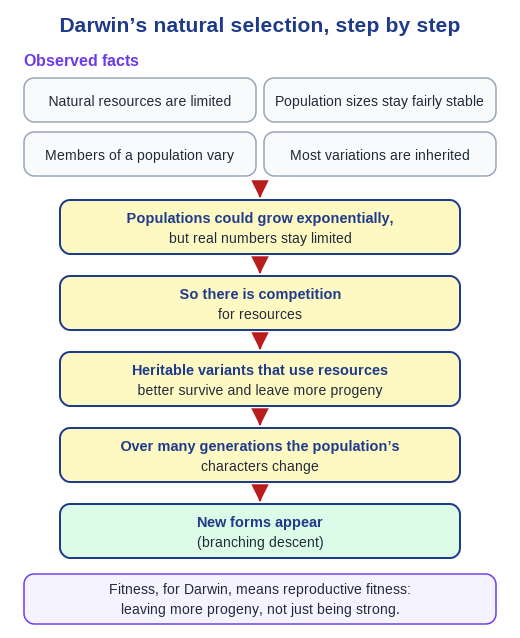
Darwin may have been influenced by Thomas Malthus’s work on populations. Resources are limited, populations stay fairly stable, members vary, and most variations are inherited. A population could grow exponentially but does not, so there is competition; heritable variations that make resource use better let their bearers leave more progeny, and over many generations new forms appear.
Before Darwin, the French naturalist Lamarck said evolution is driven by the use and disuse of organs: giraffes stretching for leaves passed on longer necks. The book says nobody believes this conjecture any more.
What did de Vries add?
Mendel had described inheritable “factors”, but Darwin did not take these up. In the first decade of the twentieth century, Hugo de Vries, working on the evening primrose, put forward mutations: large differences that arise suddenly in a population.
| Darwin | Hugo de Vries | |
|---|---|---|
| Cause of evolution | Small heritable variations | Mutations |
| Nature of change | Directional | Random, directionless |
| Speed | Gradual | Saltation: single-step large mutation causing speciation |
Later, population genetics brought more clarity.
What does the Hardy–Weinberg principle say?
In a population we can find the frequency of the alleles of a gene. The Hardy–Weinberg principle states that these allele frequencies stay stable, the same in every generation. The gene pool, meaning all the genes of a population with all their alleles, does not change. This is genetic equilibrium.
The frequencies of all the alleles add up to 1. In a diploid, let p be the frequency of allele A and q the frequency of allele a:
- The chance that both chromosomes carry A is p × p, so the frequency of AA = p².
- Similarly, aa = q².
- Aa = 2pq, because A can come from either parent.
Adding them up:
p² + 2pq + q² = 1, which is the binomial expansion of (p + q)².
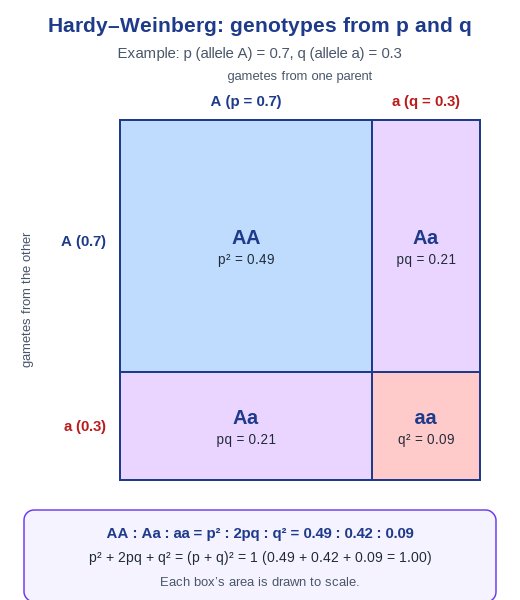
When the measured frequency differs from the expected value, the difference (and its direction) shows the extent of evolutionary change. A disturbance of Hardy–Weinberg equilibrium, that is, a change in allele frequencies, is interpreted as evolution.
How do we use the equation? (worked examples)
Extra: the chapter states the equation but gives no numerical example. These examples are ours; every value was computed by script.
Example 1. Is this population in equilibrium? 1000 individuals: 490 AA, 420 Aa, 90 aa.
- Alleles: 2 × 1000 = 2000. A alleles = 2 × 490 + 420 = 1400, so p = 1400 / 2000 = 0.7; q = 1 − 0.7 = 0.3.
- Expected: AA = 0.49 × 1000 = 490; Aa = 2 × 0.7 × 0.3 × 1000 = 420; aa = 0.09 × 1000 = 90.
- Observed = expected, so the population is in equilibrium for this gene.
Example 2. Carriers from a recessive trait. In a population at equilibrium, 16 per cent show a recessive trait (aa).
- q² = 0.16, so q = √0.16 = 0.4, and p = 0.6.
- AA = 0.36, Aa = 2 × 0.6 × 0.4 = 0.48, aa = 0.16. Check: 0.36 + 0.48 + 0.16 = 1.
- So 48 per cent of the population are heterozygous carriers.
What disturbs the equilibrium?
The book lists five factors:
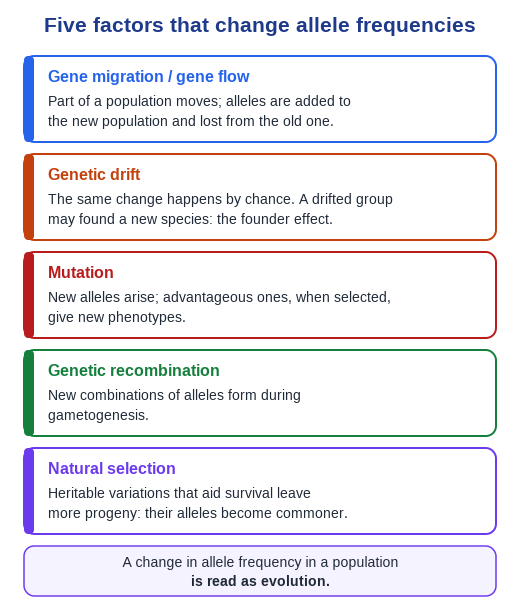
- Gene migration or gene flow. When part of a population moves to another place and population, gene frequencies change in both. The new population gains alleles that the old one loses. If this migration happens many times, there is gene flow.
- Genetic drift. If the same change happens by chance, it is genetic drift. Sometimes the change in the new sample is so large that it becomes a different species; the original drifted population are the founders, and this is the founder effect.
- Mutation. Experiments with microbes show that when advantageous mutations already present are selected, new phenotypes appear; over a few generations this can result in speciation.
- Genetic recombination during gametogenesis.
- Natural selection. Heritable variations that help survival let their carriers reproduce and leave more offspring.
Variation from mutation, recombination, gene flow or genetic drift changes the frequency of genes and alleles in later generations. Coupled with greater reproductive success, natural selection then makes the population look different.
What are the three types of natural selection?
Picture a trait, such as body size, plotted as a bell-shaped curve: number of individuals against the character value.
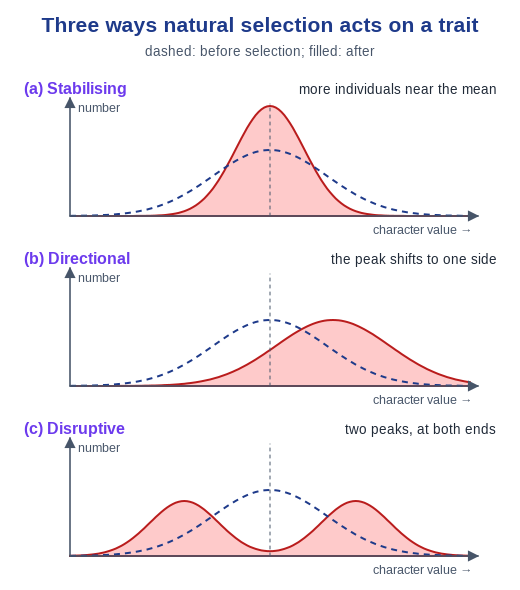
| Type | What happens | Shape of the curve |
|---|---|---|
| Stabilising | More individuals acquire the mean character value | The peak gets higher and narrower |
| Directional | More individuals acquire a value other than the mean | The peak shifts in one direction |
| Disruptive | More individuals acquire values at both ends | Two peaks form |
Next: Chapter 6 NCERT solutions. Back to the Chapter 6 notes, or see evidences for evolution.
Practice
-
If the frequency of allele A is 0.8, the frequency of heterozygotes at equilibrium is:
Show answer
Answer: (b) 0.32
-
Which of these is not one of the five factors that affect Hardy–Weinberg equilibrium?
Show answer
Answer: (c) Use and disuse of organs
-
More individuals acquire values at both ends of the distribution curve in:
Show answer
Answer: (c) disruptive selection
-
In a population at equilibrium, 9 per cent of individuals show a recessive trait. Find p and q.
Show answer
Answer: aa = q² = 0.09, so q = 0.3 and p = 1 − 0.3 = 0.7. Then AA = 0.49 and Aa = 2 × 0.7 × 0.3 = 0.42.
-
Why does a bacterial population show new forms in days while a fish needs millions of years?
Show answer
Answer: The rate at which new forms appear is linked to the life span. Bacteria divide fast and become millions within hours, so selection acts over many generations in days. Fish and fowl have life spans of years, so the same number of generations takes millions of years.
Questions students ask
What is genetic equilibrium?
It is the state in which the allele frequencies of a population, and so its gene pool, stay constant from generation to generation. Hardy and Weinberg expressed it algebraically as p² + 2pq + q² = 1.
What is the difference between gene flow and genetic drift?
Gene flow is a change in allele frequencies when part of a population migrates and this happens many times: the new population gains alleles that the old one loses. Genetic drift is a change in allele frequency that happens purely by chance.
How did de Vries's idea differ from Darwin's?
Darwin thought evolution was gradual, through small, heritable, directional variations. Hugo de Vries, from his work on evening primrose, said mutations (large, sudden differences that are random and directionless) cause evolution, and that a single-step large mutation, saltation, can cause speciation.
Why was Lamarck's theory rejected?
Lamarck said organs change by use and disuse and the change is passed on, as in giraffes stretching their necks. But characters acquired during a lifetime are not inherited; only characters with a genetic basis can be selected. The book says nobody believes this conjecture any more.
Stuck on a question?
Take a photo and Lagnever AI explains it step by step. Try it for 7 days for ₹2.
Get it on Google Play Open in browser
For parents: after the trial, the plan renews monthly by UPI or card autopay. You can cancel anytime in the app.