
NCERT Solutions Class 12 Biology Chapter 6: Evolution
Answers to all 10 end-of-chapter exercises of Chapter 6, Evolution, of Biology, the Class 12 NCERT textbook. Page numbers follow the 2026-27 reprint (pages 110–126). The exercises are quoted from the book as printed; the answers are our own, built from the chapter. Several exercises ask you to search newspapers, libraries or the internet: for those we show how to answer, and every fact taken from outside the chapter is marked Extra. The questions the chapter text asks along the way are answered in short at the end. The book prints no answer key for this chapter. Short notes: Chapter 6 notes.
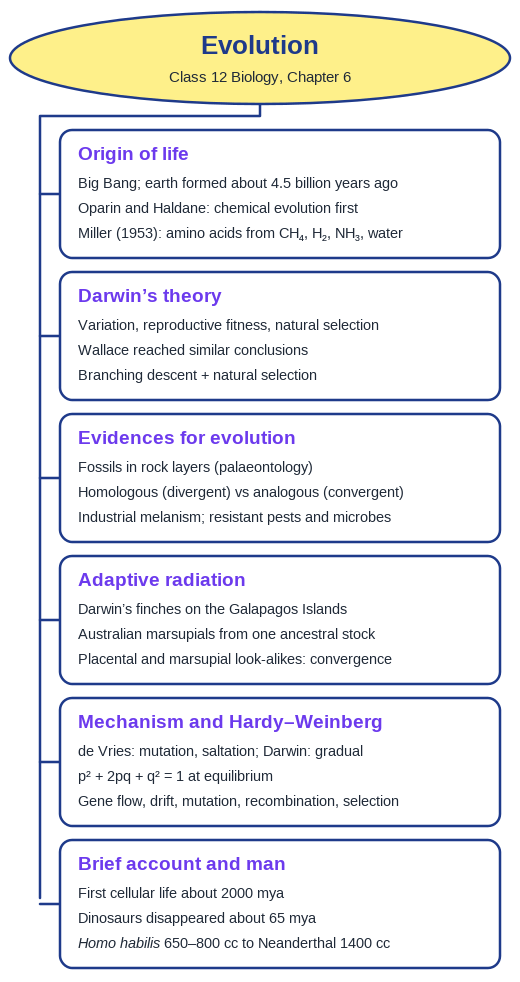
Exercises 1 to 3: selection, fossils and species
1. “Explain antibiotic resistance observed in bacteria in light of Darwinian selection theory.”
Darwin’s theory rests on three points: members of a population vary, much of this variation is inherited, and individuals whose variations suit the environment leave more progeny. Antibiotic resistance follows the same steps.
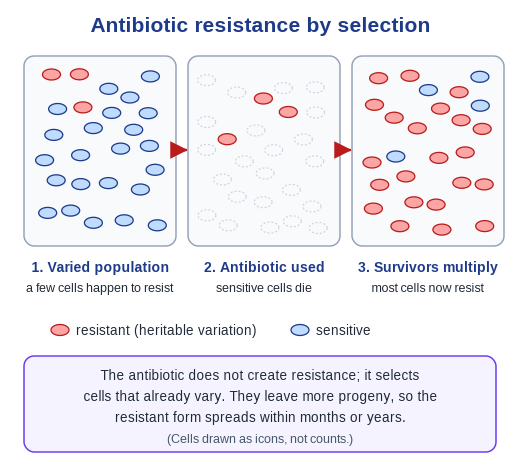
- Variation. A large bacterial population has built-in variation. By chance mutation, a few cells can survive a particular antibiotic.
- Selection. When the antibiotic is used, the sensitive cells die. The resistant cells survive, because they are fitter in this new environment.
- Inheritance and more progeny. The survivors divide and pass on resistance to their progeny. Generation after generation, the resistant type becomes more common, until most of the population is resistant.
- Result. The antibiotic does not create resistance; it selects a variant already present. The chapter calls this evolution by anthropogenic action, seen within months or years rather than centuries, and an example that evolution is a stochastic process based on chance mutation.
So misuse or overuse of antibiotics speeds up the selection of resistant strains.
2. “Find out from newspapers and popular science articles any new fossil discoveries or controversies about evolution.”
This is a project. Our answer cannot report a particular news item, because news changes; here is how to do it and what the chapter already offers.
How to do it:
- Collect three or four reports of fossil finds from newspapers or science magazines. For each, note the date, the place, the organism, its estimated age and why it matters.
- Check whether the report names the scientists or the research journal. Prefer reports that do.
- Fit each find into the time scale of the chapter (for example, before or after the dinosaurs disappeared about 65 mya).
Examples from the chapter itself:
- Fossil finds: the Coelacanth, a lobefin thought to be extinct, was caught alive off South Africa in 1938; Homo erectus fossils were found in Java in 1891; man-like bones were found in Ethiopia and Tanzania.
- Debates: Haeckel’s embryological proposal was disapproved by Karl Ernst von Baer; the reason the dinosaurs disappeared is not known (climatic change, or most of them evolving into birds, or something in between); Darwin’s gradual change compared with de Vries’s saltation.
3. “Attempt giving a clear definition of the term species.”
The chapter uses the word without defining it. A commonly used definition is given here (Extra):
A species is a group of natural populations whose members can actually or potentially interbreed to produce fertile offspring, and which is reproductively isolated from other such groups.
Points to add:
- Members share a common gene pool.
- Members of one species resemble one another more than members of other species, though no two individuals are exactly alike.
- This links to the chapter: when a population’s allele frequencies change enough (for example through genetic drift and the founder effect), it can become a new species.
Exercises 4 to 6: human evolution and fossils
4. “Try to trace the various components of human evolution (hint: brain size and function, skeletal structure, dietary preference, etc.)”
From the chapter:
| Stage | Time (as printed) | Brain | Body and skeleton | Diet and culture |
|---|---|---|---|---|
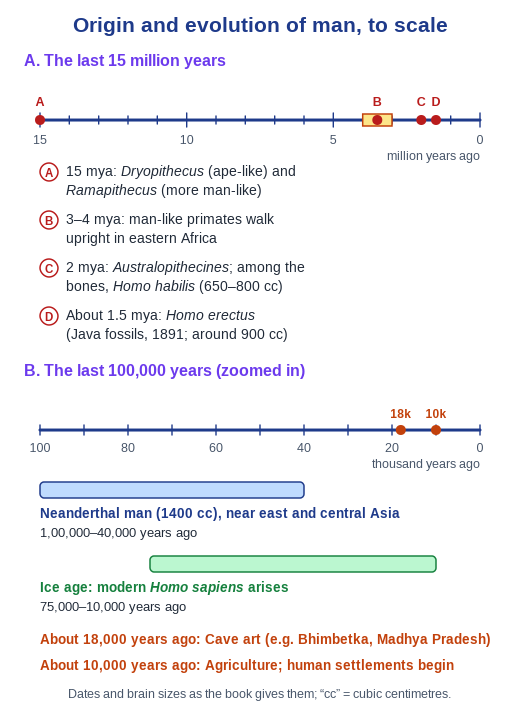
| Dryopithecus and Ramapithecus | About 15 mya | — | Hairy; walked like gorillas and chimpanzees. Ramapithecus more man-like, Dryopithecus more ape-like | — |
| Man-like primates (Ethiopia, Tanzania) | About 3–4 mya | — | Probably not taller than 4 feet; walked upright | — |
| Australopithecines | About 2 mya | — | Lived in East African grasslands | Hunted with stone weapons, but ate mainly fruit |
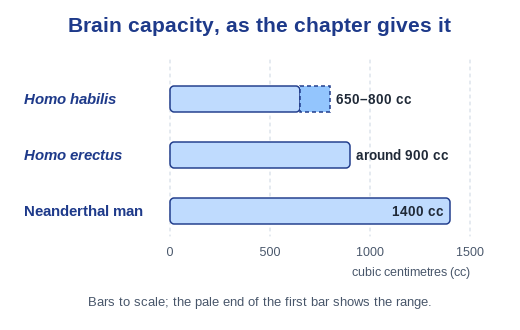
| Homo habilis | (among those bones) | 650–800 cc | The first human-like being, a hominid | Probably did not eat meat |
| Homo erectus | About 1.5 mya | Around 900 cc | Fossils from Java, 1891 | Probably ate meat |
| Neanderthal man | 1,00,000–40,000 years ago | 1400 cc | Near east and central Asia | Used hides for the body; buried the dead |
| Modern Homo sapiens | Arose during the ice age, 75,000–10,000 years ago | — | Arose in Africa and moved across continents | Cave art about 18,000 years ago; agriculture and settlements about 10,000 years ago |
Trends that come out of the table:
- Brain size increased: 650–800 cc, then about 900 cc, then 1400 cc. The chapter’s summary links the evolution of modern man with the evolution of the human brain and language.
- Skeleton: an upright, two-legged walk appeared early (3–4 mya). The book’s comparison of skulls shows that the skull of a baby chimpanzee is more like the adult human skull than the adult chimpanzee’s.
- Diet: from mainly fruit (Australopithecines) and no meat (Homo habilis) to meat (Homo erectus), and much later to agriculture.
- Culture: stone weapons, hides, burial of the dead, cave art (for example at Bhimbetka, Madhya Pradesh), then settlements.
5. “Find out through internet and popular science articles whether animals other than man has self-consciousness.”
This is a research question; the chapter only says that man evolved with language skills and self-consciousness. A summary of what science articles commonly report (Extra):
- Scientists often use the mirror test: a mark is placed where an animal can see it only in a mirror. If the animal uses the mirror to touch or examine the mark on its own body, it is taken as a sign of self-recognition.
- Animals reported to pass versions of this test include great apes such as chimpanzees, as well as dolphins and elephants, and some birds.
- Scientists still debate what such results mean. Passing or failing one test does not settle whether an animal has self-consciousness, and the test suits animals that rely on sight.
Conclude in your own words: there is some evidence of self-recognition in a few animals, but whether any animal other than man has self-consciousness like ours is still an open question.
6. “List 10 modern-day animals and using the internet resources link it to a corresponding ancient fossil. Name both.”
A “corresponding” fossil here means an extinct form related to the modern animal, not necessarily its direct ancestor. Pairs 1 to 5 come from the chapter and its figures; pairs 6 to 10 are Extra, from common textbook knowledge.
| Modern animal | Ancient fossil form | Source | |
|---|---|---|---|
| 1 | Crocodile | Dinosaurs and crocodilian fossils | Chapter (family tree of dinosaurs and crocodiles) |
| 2 | Birds, such as the pigeon | Archaeopteryx | Chapter figure |
| 3 | Coelacanth | Fossil lobefin fish | Chapter |
| 4 | Mammals, such as the dog | Therapsids | Chapter figure |
| 5 | Human | Homo erectus (Java) | Chapter |
| 6 | Horse | Eohippus | Extra |
| 7 | Elephant | Moeritherium | Extra |
| 8 | Whale | Pakicetus | Extra |
| 9 | Frog | Ichthyostega, an early four-legged vertebrate | Extra |
| 10 | Chimpanzee | Dryopithecus (ape-like; named in the chapter) | Chapter, link Extra |
Exercises 7 to 10: drawing, adaptive radiation and the horse
7. “Practise drawing various animals and plants.”
This is a skill exercise. Tips:
- Draw large, in pencil, with clean single lines; label with straight horizontal lines and no arrowheads touching the label.
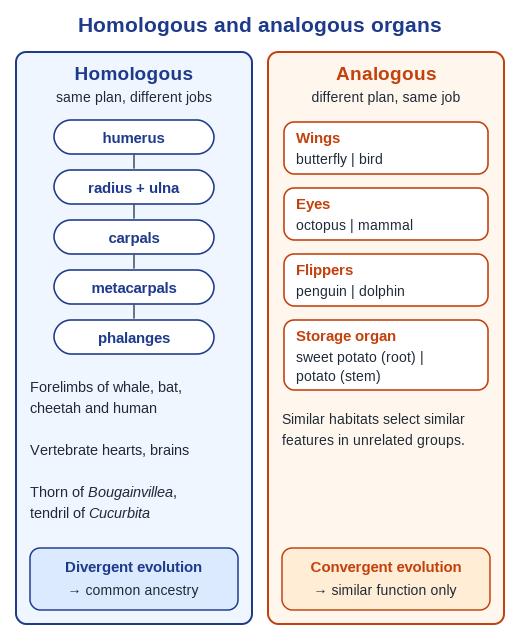
- For this chapter, practise: the forelimb bones (humerus, radius and ulna, carpals, metacarpals, phalanges) of a human, a bat, a whale and a cheetah to show homology; the wing of a butterfly and of a bird to show analogy; the thorn of Bougainvillea and the tendril of Cucurbita; the three selection curves; and the steps of Miller’s experiment.
8. “Describe one example of adaptive radiation.”
Darwin’s finches of the Galapagos Islands. Adaptive radiation is the evolution of different species in one geographical area, starting from a point and radiating into different habitats.
- On his voyage, Darwin found many varieties of small black birds, later called Darwin’s finches, on the same island.
- He reasoned that all of them evolved on the islands from one ancestral form, which was seed-eating.
- From it, forms with altered beaks arose. Some became insectivorous and others “vegetarian”, each fitted to a different food and habitat.
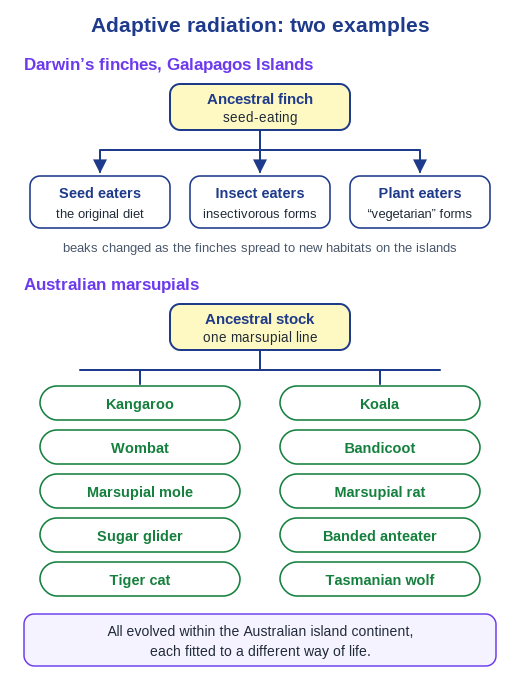
(Another example from the chapter: the Australian marsupials, such as the kangaroo, koala, wombat, sugar glider and Tasmanian wolf, all evolved from one ancestral stock within Australia.)
9. “Can we call human evolution as adaptive radiation?”
No, not in the sense the chapter uses.
- Adaptive radiation means many different species arising from one ancestor in one geographical area at about the same time, each spreading into a different habitat, as in Darwin’s finches or the Australian marsupials.
- Human evolution, as the chapter describes it, is mainly one line of change over time: from Dryopithecus and Ramapithecus, through man-like primates, Australopithecines, Homo habilis and Homo erectus, to Homo sapiens. The stages appear one after another in different periods and places (East Africa, Java, the near east and central Asia), and only one human species, Homo sapiens, exists today.
- So it is better described as a lineage of gradual evolution in one direction, with some side branches such as the Neanderthal man, than as an adaptive radiation into many habitats.
10. “Using various resources such as your school Library or the internet and discussions with your teacher, trace the evolutionary stages of any one animal, say horse.”
The chapter says only that the evolution of the horse is a special story you will learn in higher classes. The usual textbook outline is (Extra, check with your teacher):
| Stage | Size | Toes on the forefoot | Teeth and food |
|---|---|---|---|
| Eohippus | About the size of a fox | 4 | Low-crowned teeth; browsed on soft leaves in forests |
| Mesohippus | Larger | 3 | Browser |
| Merychippus | Larger still | 3, the middle one bearing the weight | Higher-crowned teeth; grazed on grass |
| Pliohippus | Larger again | 1 (side toes reduced) | Grazer |
| Equus (modern horse) | Large | 1 (hoof) | Grazer with high-crowned grinding teeth |
Trends: increase in body size, reduction of toes to a single hoof for running on open grassland, longer legs, and teeth suited to grinding grass. This fits the chapter’s idea of natural selection acting on heritable variation as the habitat changed from forest to grassland.
Questions asked inside the chapter
These are not quoted; each is restated briefly with its page.
Page 111: did life come from outer space? Some scientists think so: early Greek thinkers spoke of units of life called spores moving between planets, and “panspermia” is still favoured by some astronomers. The view most scientists accept, the chapter says, is that the first life arose slowly from non-living molecules through chemical evolution.
Page 113: how are the ages of fossils found? By radioactive dating. Extra: radioactive isotopes in a rock or in remains decay at a fixed, known rate (their half-life). Measuring how much of the original isotope is left, compared with what it has turned into, gives the age. Carbon-14 suits remains up to some tens of thousands of years; isotopes with long half-lives, such as uranium, are used for old rocks.
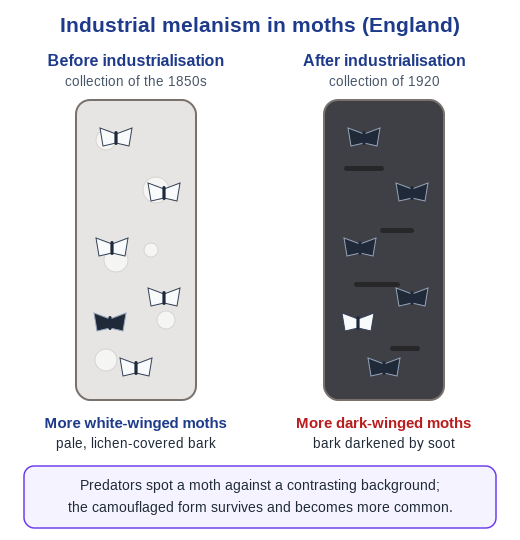
Page 116: lichens as pollution indicators. Yes: lichens do not grow in polluted areas, so their absence on trees points to air pollution. This is why the trunks lost their pale lichen cover after industrialisation, as shown in the moth story.
Page 119: process, or the outcome of one? Both views are used. When we tell the history of the world, evolution is a process. When we tell how life on earth came to be, evolution is the outcome of a process, natural selection. The chapter admits that it is still not very clear which way to regard evolution and natural selection.
Practice
-
Homologous organs are the result of:
Show answer
Answer: (b) divergent evolution
-
Which gases did Miller place in his closed flask?
Show answer
Answer: (b) CH₄, H₂, NH₃ and water vapour
-
Fossils of Homo erectus, as the chapter says, were discovered in Java in:
Show answer
Answer: (b) 1891
-
In a population at Hardy–Weinberg equilibrium, q = 0.2. What fraction is heterozygous?
Show answer
Answer: p = 1 − 0.2 = 0.8, so the heterozygotes are 2pq = 2 × 0.8 × 0.2 = 0.32, that is, 32 per cent.
-
Why is the Tasmanian wolf compared with the placental wolf?
Show answer
Answer: They belong to different groups (a marsupial and a placental mammal) but evolved a similar form in similar ways of life. The chapter uses such pairs from Australia as an example of convergent evolution.
Stuck on a question?
Take a photo and Lagnever AI explains it step by step. Try it for 7 days for ₹2.
Get it on Google Play Open in browser
For parents: after the trial, the plan renews monthly by UPI or card autopay. You can cancel anytime in the app.