
Class 12 Biology Chapter 6 NCERT Solutions Hinglish mein: Evolution
Biology, Class 12 ki NCERT textbook, ke Chapter 6, Evolution, ki saari 10 end-of-chapter exercises ke jawab. Page numbers 2026-27 reprint ke hain (pages 110–126). Questions book se liye gaye hain aur yahan Hinglish mein diye gaye hain; jawab hamare apne hain, chapter ke aadhar par. Kai exercises newspapers, library ya internet se dhoondhne ko kehti hain: unke liye hum tareeka batate hain, aur chapter ke bahar ka har fact Extra mark kiya gaya hai. Chapter ka text beech-beech mein jo sawaal poochhta hai, unke short jawab end mein hain. Book mein is chapter ki koi answer key nahi chhapi hai. Short notes: Chapter 6 ke notes.
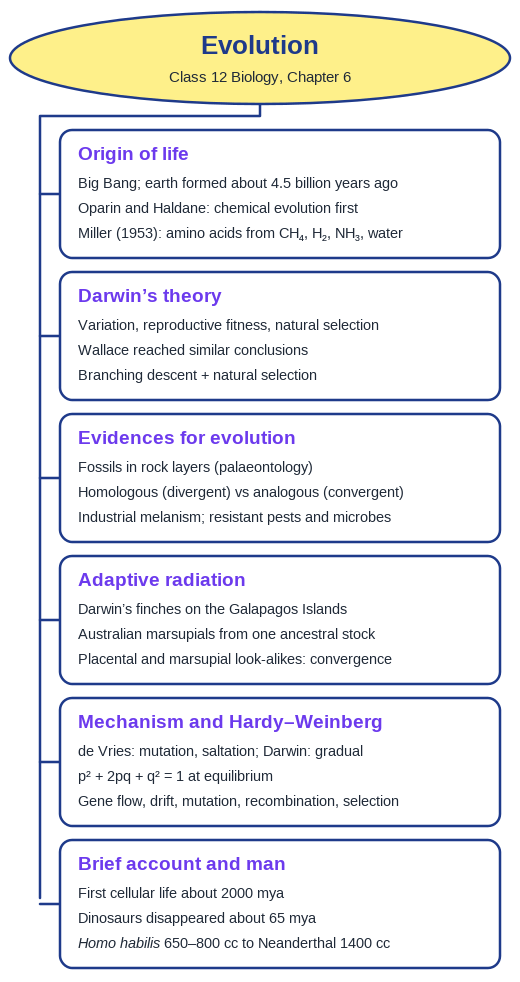
Exercises 1 se 3: selection, fossils aur species
1. Bacteria mein dikhne wale antibiotic resistance ko Darwin ki selection theory ki roshni mein samjhao.
Darwin ki theory teen baaton par tiki hai: population ke members mein variation hota hai, ye variation zyadatar inherited hota hai, aur jinke variations environment ke liye sahi hain wo zyada progeny chhodte hain. Antibiotic resistance bhi inhi steps se aata hai.
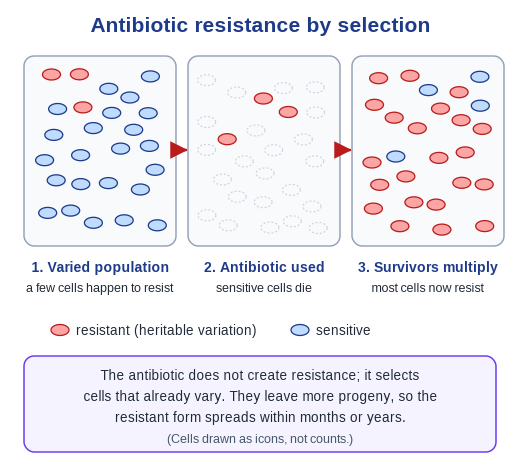
- Variation. Badi bacterial population mein built-in variation hota hai. Chance mutation se kuch cells kisi antibiotic ko jhel sakti hain.
- Selection. Antibiotic dene par sensitive cells mar jaati hain. Resistant cells bach jaati hain, kyunki is naye environment mein wo zyada fit hain.
- Inheritance aur zyada progeny. Bachi cells divide hokar resistance apni progeny ko deti hain. Har generation ke saath resistant type zyada common hota jaata hai, jab tak population ka zyadatar hissa resistant na ho jaaye.
- Result. Antibiotic resistance banata nahi; wo pehle se maujood variant ko select karta hai. Chapter ise anthropogenic action se evolution kehta hai, jo centuries nahi, months ya years mein dikhta hai, aur ye bhi dikhata hai ki evolution chance mutation par tika stochastic process hai.
Isliye antibiotics ka galat ya zyada use resistant strains ke selection ko tez karta hai.
2. Newspapers aur popular science articles se koi nayi fossil discoveries ya evolution ke baare mein controversies dhoondho.
Ye ek project hai. Hamara jawab koi khaas news item nahi bata sakta, kyunki news badalti rehti hai; yahan tareeka hai aur wo jo chapter pehle se deta hai.
Kaise karein:
- Newspapers ya science magazines se fossil finds ki teen-chaar reports jama karo. Har ek ke liye date, jagah, organism, uski andaazi umar aur uski importance likho.
- Dekho report scientists ya research journal ka naam deti hai ya nahi. Aisi reports ko prefer karo.
- Har find ko chapter ke time scale mein rakho (jaise lagbhag 65 mya dinosaurs ke gayab hone se pehle ya baad).
Chapter ke apne examples:
- Fossil finds: Coelacanth, ek lobefin jise extinct maana jaata tha, 1938 mein South Africa ke paas zinda pakdi gayi; Homo erectus ke fossils 1891 mein Java mein mile; Ethiopia aur Tanzania mein insaan jaisi haddiyan mili.
- Debates: Haeckel ke embryological proposal ko Karl Ernst von Baer ne disapprove kiya; dinosaurs ke gayab hone ka kaaran pata nahi (climatic change, ya zyadatar ka birds mein evolve hona, ya dono ke beech kuch); Darwin ka gradual badlav banaam de Vries ka saltation.
3. Species shabd ki saaf definition dene ki koshish karo.
Chapter is shabd ko use karta hai par define nahi karta. Yahan aam taur par di jaane wali definition hai (Extra):
Species natural populations ka aisa group hai jiske members aapas mein actually ya potentially interbreed karke fertile offspring paida kar sakte hain, aur jo doosre aise groups se reproductively isolated hai.
Saath mein likho:
- Members ka gene pool common hota hai.
- Ek species ke members doosri species ke members se zyada ek-doosre jaise hote hain, haalanki koi do individuals bilkul same nahi hote.
- Chapter se jodo: jab population ki allele frequencies kaafi badal jaayein (jaise genetic drift aur founder effect se), to wo nayi species ban sakti hai.
Exercises 4 se 6: human evolution aur fossils
4. Human evolution ke alag-alag components ko trace karne ki koshish karo (hint: brain size aur function, skeletal structure, dietary preference, etc.)
Chapter se:
| Stage | Samay (book jaisa) | Brain | Sharir aur skeleton | Khana aur culture |
|---|---|---|---|---|
| Dryopithecus aur Ramapithecus | Lagbhag 15 mya | — | Baalon wale; gorillas aur chimpanzees ki tarah chalte. Ramapithecus zyada insaan jaisa, Dryopithecus zyada ape jaisa | — |
| Insaan jaise primates (Ethiopia, Tanzania) | Lagbhag 3–4 mya | — | Shayad 4 feet se lambe nahi; seedhe khade hokar chalte | — |
| Australopithecines | Lagbhag 2 mya | — | East African grasslands mein | Stone weapons se shikaar, par mainly fruit |
| Homo habilis | (unhi haddiyon mein) | 650–800 cc | Pehla human-like being, hominid | Shayad meat nahi khaata tha |
| Homo erectus | Lagbhag 1.5 mya | Around 900 cc | Java ke fossils, 1891 | Shayad meat khaata tha |
| Neanderthal man | 1,00,000–40,000 years pehle | 1400 cc | Near east aur central Asia | Sharir ke liye hides; mrit logon ko dafnaya |
| Modern Homo sapiens | Ice age mein, 75,000–10,000 years pehle | — | Africa mein aaye aur continents mein phaile | Cave art lagbhag 18,000 years pehle; agriculture aur settlements lagbhag 10,000 years pehle |
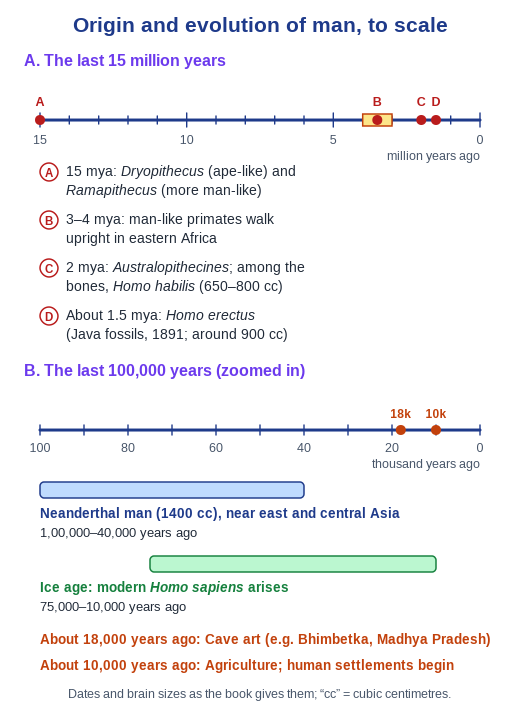
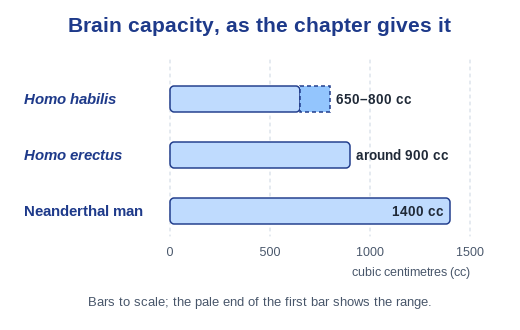
Table se nikalne wale trends:
- Brain size badha: 650–800 cc, phir lagbhag 900 cc, phir 1400 cc. Chapter ka summary modern man ke evolution ko human brain aur language ke evolution se jodta hai.
- Skeleton: seedha, do pairon par chalna jaldi (3–4 mya) aaya. Book ki skulls ki comparison dikhati hai ki baby chimpanzee ki skull adult chimpanzee se zyada adult insaan ki skull jaisi hai.
- Diet: mainly fruit (Australopithecines) aur no meat (Homo habilis) se meat (Homo erectus) tak, aur bahut baad mein agriculture.
- Culture: stone weapons, hides, mrit logon ko dafnana, cave art (jaise Bhimbetka, Madhya Pradesh), phir settlements.
5. Internet aur popular science articles se pata karo ki kya insaan ke alawa doosre animals mein self-consciousness hai.
Ye research question hai; chapter sirf itna kehta hai ki insaan language skills aur self-consciousness ke saath evolve hua. Science articles aam taur par jo batate hain uska saar (Extra):
- Scientists aksar mirror test use karte hain: animal par aisi jagah mark lagaya jaata hai jo sirf mirror mein dikhe. Agar animal mirror dekhkar apne sharir par wo mark chhue ya jaanche, to ise self-recognition ka sign maana jaata hai.
- Jin animals ke is test ke versions pass karne ki reports hain, unmein chimpanzees jaise great apes, dolphins, elephants aur kuch birds hain.
- Scientists abhi bhi bahas karte hain ki in results ka matlab kya hai. Ek test pass ya fail karne se ye tay nahi hota ki animal mein self-consciousness hai, aur ye test un animals ke liye theek hai jo dekhne par zyada depend karte hain.
Apne shabdon mein nishkarsh likho: kuch animals mein self-recognition ke kuch saboot hain, par kya kisi animal mein hamari jaisi self-consciousness hai, ye abhi khula sawaal hai.
6. Das aaj ke animals ki list banao aur internet resources se har ek ko ek corresponding ancient fossil se jodo. Dono ke naam likho.
Yahan “corresponding” fossil ka matlab modern animal se juda extinct form hai, zaroori nahi ki direct ancestor ho. Pairs 1 se 5 chapter aur uske figures se hain; pairs 6 se 10 Extra hain, aam textbook knowledge se.
| Aaj ka animal | Ancient fossil form | Source | |
|---|---|---|---|
| 1 | Crocodile | Dinosaurs aur crocodilian fossils | Chapter (dinosaurs aur crocodiles ka family tree) |
| 2 | Birds, jaise pigeon | Archaeopteryx | Chapter figure |
| 3 | Coelacanth | Fossil lobefin fish | Chapter |
| 4 | Mammals, jaise dog | Therapsids | Chapter figure |
| 5 | Insaan | Homo erectus (Java) | Chapter |
| 6 | Horse | Eohippus | Extra |
| 7 | Elephant | Moeritherium | Extra |
| 8 | Whale | Pakicetus | Extra |
| 9 | Frog | Ichthyostega, ek early four-legged vertebrate | Extra |
| 10 | Chimpanzee | Dryopithecus (ape jaisa; chapter mein naam hai) | Chapter, jod Extra |
Exercises 7 se 10: drawing, adaptive radiation aur horse
7. Alag-alag animals aur plants draw karne ki practice karo.
Ye skill exercise hai. Tips:
- Bada aur pencil se, saaf single lines mein draw karo; labels ke liye seedhi horizontal lines, label ko chhoote arrowheads nahi.
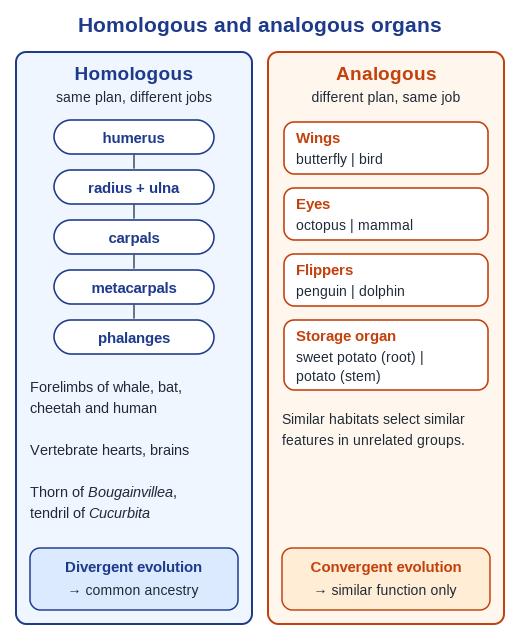
- Is chapter ke liye practice karo: homology dikhane ke liye insaan, bat, whale aur cheetah ke forelimb ki haddiyan (humerus, radius aur ulna, carpals, metacarpals, phalanges); analogy ke liye butterfly aur bird ke wings; Bougainvillea ka thorn aur Cucurbita ka tendril; teen selection curves; aur Miller ke experiment ke steps.
8. Adaptive radiation ka ek example samjhao.
Galapagos Islands ke Darwin’s finches. Adaptive radiation ek geographical area mein ek point se shuru hokar alag habitats mein phailte hue alag species ka evolve hona hai.
- Apni yatra mein Darwin ko ek hi island par chhoti kaali birds ki kai varieties mili, jinhe baad mein Darwin’s finches kaha gaya.
- Unka tark tha ki ye sab islands par ek ancestral form se evolve hui, jo seed-eating tha.
- Usse badli hui beaks wale forms bane. Kuch insectivorous bane aur kuch “vegetarian”, har ek alag khane aur habitat ke liye fit.
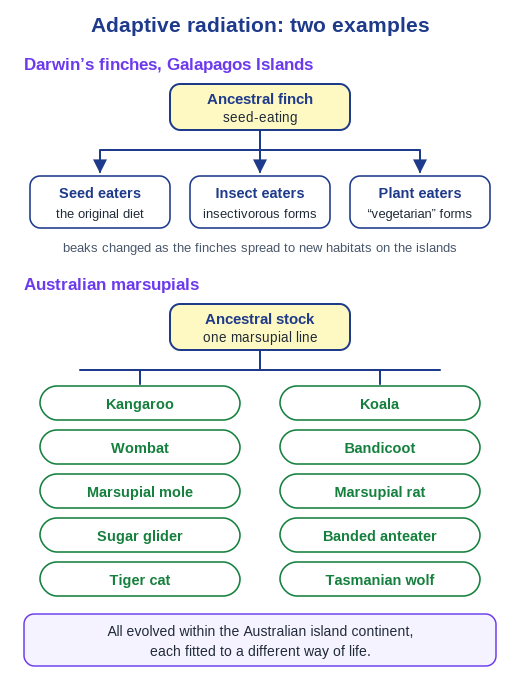
(Chapter ka doosra example: Australian marsupials, jaise kangaroo, koala, wombat, sugar glider aur Tasmanian wolf, sab Australia ke andar ek ancestral stock se evolve hue.)
9. Kya hum human evolution ko adaptive radiation keh sakte hain?
Nahi, us sense mein nahi jismein chapter ye shabd use karta hai.
- Adaptive radiation ka matlab hai ek ancestor se ek geographical area mein lagbhag ek hi samay par kai alag species banna, har ek alag habitat mein phailti hui, jaise Darwin’s finches ya Australian marsupials.
- Chapter ke anusaar human evolution mainly samay ke saath badlav ki ek line hai: Dryopithecus aur Ramapithecus se, insaan jaise primates, Australopithecines, Homo habilis aur Homo erectus ke raaste Homo sapiens tak. Stages alag periods aur jagahon (East Africa, Java, near east aur central Asia) mein ek ke baad ek aate hain, aur aaj sirf ek human species, Homo sapiens, hai.
- Isliye ise kai habitats mein adaptive radiation ki jagah ek direction mein gradual evolution ki lineage kehna behtar hai, jismein Neanderthal man jaisi kuch side branches bhi hain.
10. School Library ya internet jaise resources aur teacher se baat karke kisi ek animal, jaise horse, ke evolutionary stages trace karo.
Chapter sirf itna kehta hai ki horse ka evolution ek khaas kahani hai jo aage ki classes mein padhoge. Aam textbook outline ye hai (Extra, teacher se check karo):
| Stage | Size | Forefoot par toes | Daant aur khana |
|---|---|---|---|
| Eohippus | Lagbhag fox jitna | 4 | Neeche crown wale daant; jungle mein naram patte |
| Mesohippus | Bada | 3 | Browser |
| Merychippus | Aur bada | 3, beech wala wazan uthata | Oonche crown wale daant; ghaas charta |
| Pliohippus | Aur bada | 1 (side toes chhote) | Grazer |
| Equus (aaj ka horse) | Bada | 1 (hoof) | Ghaas peesne wale oonche crown ke daant |
Trends: body size badhna, khule grassland par daudne ke liye toes ka ek hoof tak ghatna, lambi taangein, aur ghaas peesne layak daant. Ye chapter ke idea se match karta hai ki habitat jungle se grassland bana to heritable variation par natural selection ne kaam kiya.
Chapter ke andar poochhe gaye sawaal
Ye quote nahi kiye gaye; har ek ko page ke saath short mein likha gaya hai.
Page 111: kya life outer space se aayi? Kuch scientists aisa maante hain: early Greek thinkers ne planets ke beech jaane wale spores ki baat ki, aur “panspermia” ko kuch astronomers aaj bhi pasand karte hain. Chapter ke anusaar zyadatar scientists maante hain ki pehli life chemical evolution se non-living molecules se dheere-dheere aayi.
Page 113: fossils ki umar kaise nikalti hai? Radioactive dating se. Extra: rock ya remains mein radioactive isotopes ek tay, jaani hui speed (half-life) se decay hote hain. Original isotope kitna bacha hai, aur wo kis cheez mein badla hai, ye naapkar umar nikalti hai. Carbon-14 kuch das hazaar saal tak ke remains ke liye theek hai; purani rocks ke liye uranium jaise lambi half-life wale isotopes use hote hain.
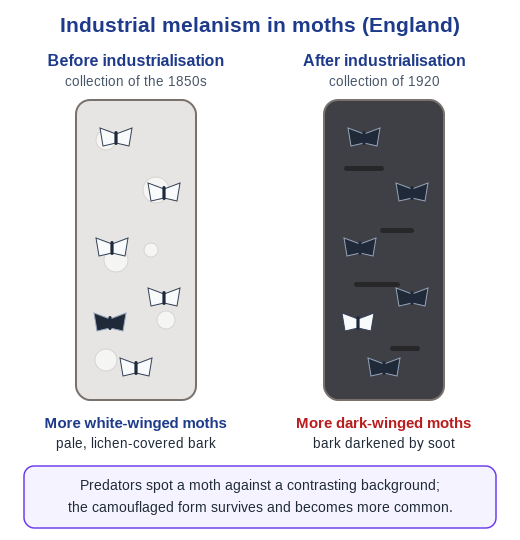
Page 116: lichens pollution indicators ki tarah. Haan: lichens polluted areas mein nahi ugte, isliye trees par unka na hona hawa ke pollution ki taraf ishara karta hai. Isi liye industrialisation ke baad trunks se halki lichen cover hat gayi, jaisa moth ki kahani mein dikhta hai.
Page 119: evolution process hai ya kisi process ka result? Dono views use hote hain. Duniya ki kahani batate samay hum evolution ko process maante hain. Earth par life ki kahani batate samay hum ise ek process, natural selection, ka result maante hain. Chapter maanta hai ki abhi ye saaf nahi hai ki evolution aur natural selection ko kis tarah dekha jaaye.
Practice karo
-
Homologous organs kiska result hain?
Jawab dekho
Jawab: (b) divergent evolution
-
Miller ne apne closed flask mein kaun si gases rakhi?
Jawab dekho
Jawab: (b) CH₄, H₂, NH₃ aur water vapour
-
Chapter ke anusaar Homo erectus ke fossils Java mein kab mile?
Jawab dekho
Jawab: (b) 1891
-
Hardy–Weinberg equilibrium wali population mein q = 0.2 hai. Kitna hissa heterozygous hai?
Jawab dekho
Jawab: p = 1 − 0.2 = 0.8, isliye heterozygotes 2pq = 2 × 0.8 × 0.2 = 0.32, yaani 32 per cent.
-
Tasmanian wolf ko placental wolf se compare kyun kiya jaata hai?
Jawab dekho
Jawab: Dono alag groups (marsupial aur placental mammal) ke hain par milte-julte jeevan ke tareeke mein milta-julta form evolve hua. Chapter Australia ke aise pairs ko convergent evolution ka example banata hai.
Koi sawal atak gaya?
Photo lo, Lagnever AI step-by-step samjhayega. 7 din ka trial sirf ₹2.
Google Play se app lo Browser mein kholo
Parents ke liye: trial ke baad plan har mahine UPI ya card autopay se renew hota hai. App mein kabhi bhi cancel kar sakte hain.