
What are the interactions between populations?
Answer in short
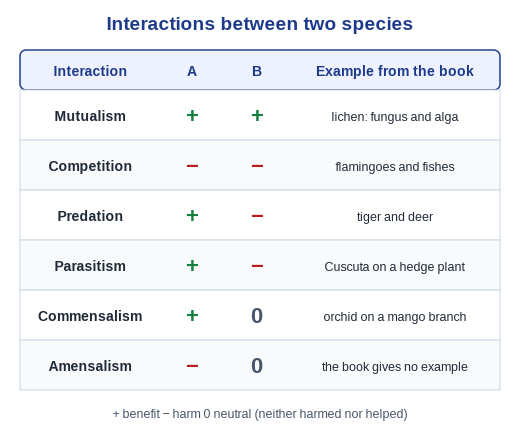
Two species can affect each other in six ways: mutualism (both gain, + +), competition (both lose, − −), predation and parasitism (one gains, one is harmed, + −), commensalism (one gains, the other is unaffected, + 0) and amensalism (one is harmed, the other unaffected, − 0). Predators also control prey, and competitors may co-exist by partitioning resources.
Stuck on a question? Take a photo and Lagnever AI explains it step by step. Try it for 7 days for ₹2. Get it on Google Play
This page covers section 11.1.4 of the chapter. Back to the Chapter 11 notes.
Why do species interact at all?
No natural habitat holds a single species. Any species needs at least one other to feed on. Even a green plant depends on soil microbes to return nutrients from dead matter, and often on an animal to pollinate it. So plants, animals and microbes form a biological community full of links, some of them hard to see.
Interactions between two different species are interspecific. Give each partner + for a benefit, − for harm and 0 for no effect:
Predation (+ −)
Predation moves the energy fixed by plants to higher trophic levels. A tiger hunting deer is the obvious picture, but a sparrow eating seeds is also a predator, and herbivores are broadly like predators of plants. Predators matter in three more ways:
- They control prey numbers. The prickly pear cactus reached Australia in the early 1920s and overran millions of hectares, because no natural enemy lived there. It was checked only when a moth that eats the cactus was brought in from its home range. Biological control of crop pests uses the same idea.
- They maintain species diversity by lowering competition among prey. When the starfish Pisaster was removed from an enclosed intertidal area on the American Pacific coast, more than 10 invertebrate species died out within a year through competition.
- They are ‘prudent’: wiping out the prey would also wipe out the predator.
Prey defences. Some insects and frogs are camouflaged (cryptically coloured). Some are poisonous: the Monarch butterfly tastes bad to birds because of a chemical it takes in as a caterpillar from a poisonous weed.
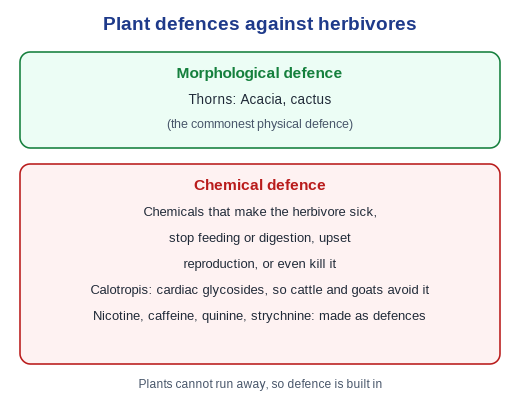
Plant defences. About 25 per cent of insects are phytophagous (they feed on plants), and plants cannot run away.
Competition (− −)
Darwin saw interspecific competition as a strong force in evolution. Two corrections to the common view:
- Unrelated species compete too: flamingoes and resident fishes compete for zooplankton in some shallow South American lakes.
- Resources need not be scarce: in interference competition one species reduces the other’s feeding efficiency simply by being there.
So competition is defined by its effect: the fitness (r) of one species is significantly lower when the other is present. Evidence from nature:
- The Abingdon tortoise of the Galapagos died out within ten years of goats arriving, apparently because goats browse more efficiently.
- Competitive release: in Connell’s experiments on Scottish rocky coasts, the larger barnacle Balanus keeps a smaller barnacle out of the intertidal zone; remove the stronger rival and the weaker one spreads.
Gause’s competitive exclusion principle: if two closely related species need the same limited resource, they cannot co-exist indefinitely, and the weaker one is eliminated. Later studies show species may instead evolve ways to co-exist, such as resource partitioning. MacArthur found five closely related warblers living on the same tree that avoided competition by foraging differently.
Parasitism (+ −)
The parasite gets shelter and food. Many parasites are host-specific and co-evolve with the host: each defence of the host is met by a counter-move of the parasite. Typical adaptations are loss of unneeded sense organs, suckers or adhesive organs, loss of the digestive system and very high reproduction. Life cycles can involve intermediate hosts: the human liver fluke needs a snail and a fish, and the malarial parasite spreads through a mosquito vector.
- Ectoparasites live on the surface: lice on humans, ticks on dogs, copepods on marine fish, and Cuscuta, a plant without chlorophyll or leaves that draws food from hedge plants.
- Endoparasites live inside (liver, kidney, lungs, red blood cells); their bodies are simplified and their reproduction is emphasised.
- Brood parasites: the koel lays eggs resembling the crow’s in the crow’s nest.
Commensalism (+ 0) and amensalism (− 0)
In commensalism one partner gains and the other is not affected: an orchid as an epiphyte on a mango branch, barnacles on a whale’s back, the cattle egret catching insects flushed out by grazing cattle, and the clown fish protected among a sea anemone’s stinging tentacles. In amensalism one is harmed and the other unaffected; the chapter names it without an example.
Mutualism (+ +)
- Lichens: a fungus with photosynthetic algae or cyanobacteria.
- Mycorrhizae: fungi help plant roots absorb nutrients and receive carbohydrates.
- Fig and wasp: in many fig species a single wasp species pollinates the flowers while looking for places to lay eggs; its larvae eat some developing seeds.
- Orchid Ophrys and a bee: a petal mimics a female bee, so the male carries pollen from flower to flower. Plants must also guard against ‘cheaters’ that take nectar without pollinating.
Practise the signs with the NCERT solutions for Chapter 11.
Practice
-
The cattle egret and grazing cattle show:
Show answer
Answer: (b) commensalism
-
In the fig and wasp relationship, the wasp's larvae feed on:
Show answer
Answer: (b) some of the developing seeds
-
When starfish Pisaster were removed from an intertidal area, more than 10 invertebrate species:
Show answer
Answer: (b) became extinct within a year
-
How does the Monarch butterfly protect itself from birds?
Show answer
Answer: Its body contains a special chemical that makes it highly distasteful to birds. It gets this chemical as a caterpillar by feeding on a poisonous weed.
-
What is brood parasitism? Give the example from the chapter.
Show answer
Answer: The parasitic bird leaves its eggs in a host bird's nest, and the host incubates them. The parasite's eggs have evolved to look like the host's eggs in size and colour. The cuckoo (koel) does this with the crow.
Questions students ask
What is competitive release?
A species kept in a small area by a stronger competitor spreads over a much larger area when the competitor is removed in an experiment. It is evidence that competition happens in nature.
Why are predators described as 'prudent'?
If a predator were too efficient and wiped out its prey, it would then die out itself for lack of food. So predators in nature do not overexploit their prey.
Why does the Ophrys orchid show co-evolution?
One petal of the Ophrys flower looks like a female bee, so male bees try to mate with it and carry pollen. If the female bee's colour pattern changed during evolution, the orchid's petal would have to change too, or pollination would fall.
Stuck on a question?
Take a photo and Lagnever AI explains it step by step. Try it for 7 days for ₹2.
Get it on Google Play Open in browser
For parents: after the trial, the plan renews monthly by UPI or card autopay. You can cancel anytime in the app.