
Class 12 Maths Chapter 8 NCERT Solutions Hinglish mein: Application of Integrals
Class 12 ki NCERT textbook Mathematics Part II ke Chapter 8, Application of Integrals, ki Exercise 8.1 aur Miscellaneous Exercise ke har sawal ke jawab, aur saare 4 worked examples. Page numbers 2026-27 reprint ke hisaab se hain (pages 292–299). Exercises ke sawal Hinglish mein diye hain; examples chhote mein apne shabdon mein, number aur page ke saath likhe hain. Har example aur sawal ka apna graph hai, jo asli function se plot kiya gaya hai aur jisme region compute kiye gaye crossing points ke beech shade hai. Neeche ka har area script se do baar jaancha gaya, ek baar exact symbolic integration se aur ek baar numerically, aur sab book ki answer key se milte hain. Chhote notes: Chapter 8 ke notes.
Is page par maths kaise likha hai. ∫(a→b) f(x) dx a se b tak ka definite integral hai, aur [F(x)] (a→b) matlab F(b) − F(a). Fractions slash se likhe hain, to (b/a)√(a² − x²) matlab b bata a, guna √(a² − x²). sin⁻¹ inverse sine hai. Area square units mein hain. Sawal bhi isi layout mein likhe hain.
Har jawab teen baaton par chalta hai:
- Vertical strips: y = f(x) (axis ke upar), x-axis, x = a aur x = b ke beech ka area ∫(a→b) f(x) dx hai. Horizontal strips: x = g(y), y-axis, y = c aur y = d ke beech ka area ∫(c→d) g(y) dy hai.
- x-axis ke neeche integral negative hota hai; area uski absolute value hai. Curve axis cross kare to wahan split karo aur sizes jodo.
- ∫√(a² − x²) dx = (x/2)√(a² − x²) + (a²/2) sin⁻¹(x/a) + C, to ∫(0→a) √(a² − x²) dx = πa²/4.
Examples 1 aur 2: circle aur ellipse (pages 294–296)
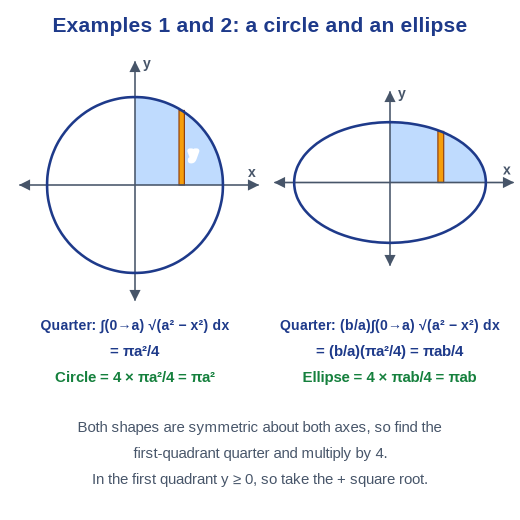
Example 1 (page 294): circle x² + y² = a² se ghira area.
Circle dono axes ke baare mein symmetric hai, to iska area arc, x-axis aur ordinates x = 0, x = a se ghire first quadrant wale region ka 4 guna hai. x² + y² = a² se y = ±√(a² − x²); first quadrant mein y > 0, to y = √(a² − x²).
Area = 4∫(0→a) y dx = 4∫(0→a) √(a² − x²) dx = 4[(x/2)√(a² − x²) + (a²/2) sin⁻¹(x/a)] (0→a) = 4 × (a²/2)(π/2) = πa².
Book horizontal strips ke baare mein bhi poochhti hai (“Why?”). First quadrant mein x = √(a² − y²), aur region y = 0 se y = a tak hai, to Area = 4∫(0→a) x dy = 4∫(0→a) √(a² − y²) dy. Ye wahi integral hai, bas x ki jagah y, to jawab phir se πa² hai.
Example 2 (page 295): ellipse x²/a² + y²/b² = 1 se ghira area.
Phir se first quadrant wale hisse ka 4 guna. Equation se y = ±(b/a)√(a² − x²); first quadrant mein y = (b/a)√(a² − x²).
Area = 4(b/a)∫(0→a) √(a² − x²) dx = 4(b/a)[(x/2)√(a² − x²) + (a²/2) sin⁻¹(x/a)] (0→a) = 4(b/a)(a²/2)(π/2) = πab.
Yahan ka “Why?” upar wala standard integral hai, limits daal kar: x = a par (a/2)(0) + (a²/2) sin⁻¹ 1 = πa²/4, aur x = 0 par 0.
Horizontal strips se (page 296): first quadrant mein x = (a/b)√(b² − y²), to Area = 4(a/b)∫(0→b) √(b² − y²) dy = 4(a/b)(b²/2)(π/2) = πab, wahi jawab.
Exercise 8.1 (page 296)
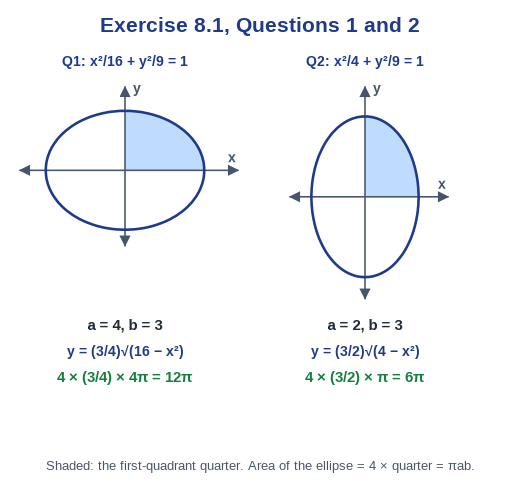
1. Ellipse x²/16 + y²/9 = 1 se ghire region ka area nikaalo.
Yahan a = 4 aur b = 3. First quadrant mein y = (3/4)√(16 − x²). Symmetry se,
Area = 4∫(0→4) (3/4)√(16 − x²) dx = 3[(x/2)√(16 − x²) + 8 sin⁻¹(x/4)] (0→4) = 3(8 × π/2) = 12π square units.
(Check: πab = π(4)(3) = 12π.)
2. Ellipse x²/4 + y²/9 = 1 se ghire region ka area nikaalo.
Yahan a = 2 aur b = 3, to ellipse chaudaai se zyada lamba hai. First quadrant mein y = (3/2)√(4 − x²).
Area = 4∫(0→2) (3/2)√(4 − x²) dx = 6[(x/2)√(4 − x²) + 2 sin⁻¹(x/2)] (0→2) = 6(2 × π/2) = 6π square units.
(Check: πab = π(2)(3) = 6π.)
Questions 3 aur 4 ke liye book ka nirdesh: Neeche ke Exercises 3 aur 4 mein sahi jawab chuno.
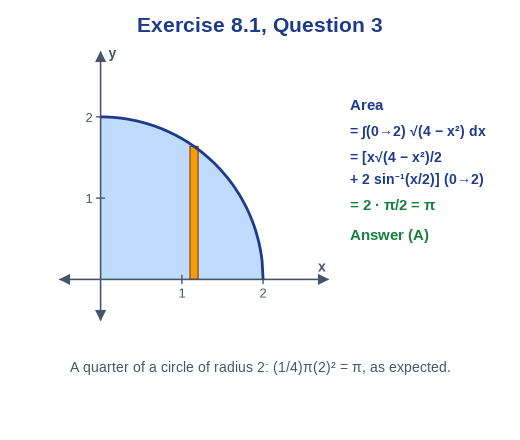
3. First quadrant mein, circle x² + y² = 4 aur lines x = 0 aur x = 2 se ghira area hai (A) π (B) π/2 (C) π/3 (D) π/4
First quadrant mein x = 0 se x = 2 tak y = √(4 − x²):
Area = ∫(0→2) √(4 − x²) dx = [(x/2)√(4 − x²) + 2 sin⁻¹(x/2)] (0→2) = 0 + 2(π/2) − 0 = π.
Ye radius 2 ke circle ka chauthai hai, (1/4)π(2)² = π. Jawab (A).
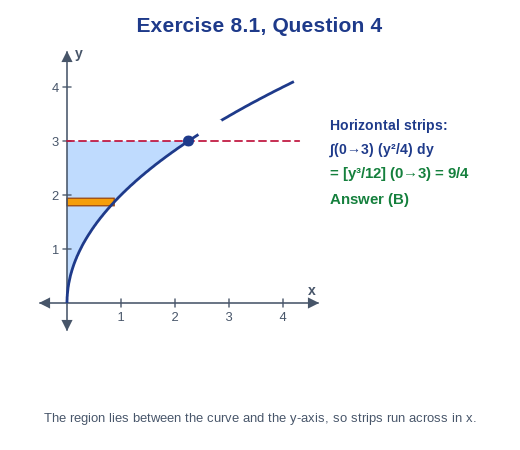
4. Curve y² = 4x, y-axis aur line y = 3 se ghire region ka area hai (A) 2 (B) 9/4 (C) 9/3 (D) 9/2
Region y-axis se band hai, to horizontal strips lo. Curve par x = y²/4. Line y = 3 parabola se x = 9/4 par milti hai, point (9/4, 3) par, aur region y = 0 se y = 3 tak hai.
Area = ∫(0→3) x dy = ∫(0→3) (y²/4) dy = [y³/12] (0→3) = 27/12 = 9/4.
(Vertical strips se bhi yahi: 0 ≤ x ≤ 9/4 ke liye region y = 2√x aur y = 3 ke beech hai, aur ∫(0→9/4) (3 − 2√x) dx = 27/4 − 9/2 = 9/4.) Jawab (B).
Miscellaneous Examples 3 aur 4 (pages 296–297)
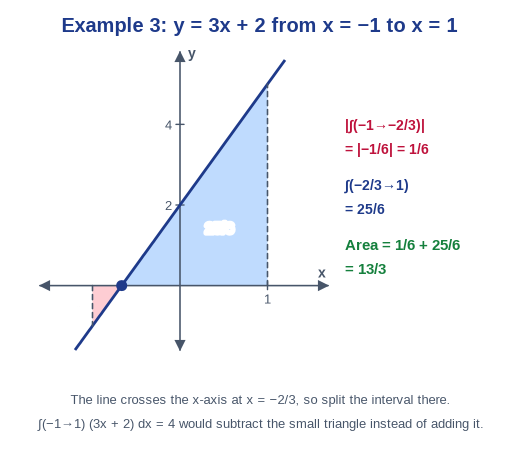
Example 3 (page 296): line y = 3x + 2, x-axis aur ordinates x = −1, x = 1 se ghira area.
(Ordinate yahan ek khadi line x = constant hai, to region x = −1 aur x = 1 ke beech hai.) Line x-axis se wahan milti hai jahan 3x + 2 = 0, yaani x = −2/3 par. −1 < x < −2/3 ke liye ye axis ke neeche hai aur −2/3 < x < 1 ke liye upar, to wahan split karo:
∫(−1→−2/3) (3x + 2) dx = [3x²/2 + 2x] (−1→−2/3) = (2/3 − 4/3) − (3/2 − 2) = −2/3 + 1/2 = −1/6
∫(−2/3→1) (3x + 2) dx = (3/2 + 2) − (−2/3) = 7/2 + 2/3 = 25/6
Area = |−1/6| + 25/6 = 26/6 = 13/3 square units. (−1 se 1 tak seedha integrate karne par 4 aata hai, jo chhote triangle ko jodne ki jagah ghata deta hai.)
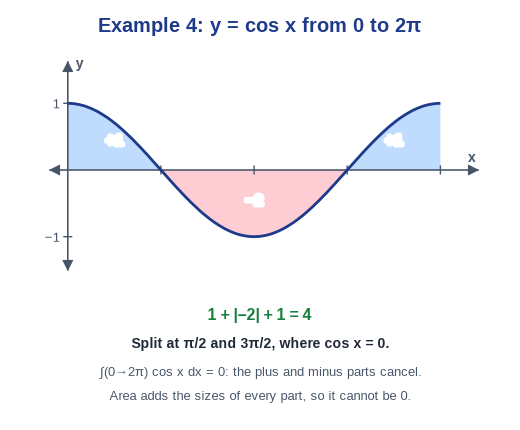
Example 4 (page 297): x = 0 aur x = 2π ke beech y = cos x se ghira area.
cos x = 0 hai x = π/2 aur 3π/2 par. Curve [0, π/2] par axis ke upar, [π/2, 3π/2] par neeche aur [3π/2, 2π] par upar hai:
∫(0→π/2) cos x dx = [sin x] (0→π/2) = 1 ∫(π/2→3π/2) cos x dx = [sin x] (π/2→3π/2) = −1 − 1 = −2 ∫(3π/2→2π) cos x dx = [sin x] (3π/2→2π) = 0 − (−1) = 1
Area = 1 + |−2| + 1 = 4 square units.
Chapter 8 ki Miscellaneous Exercise (page 298)
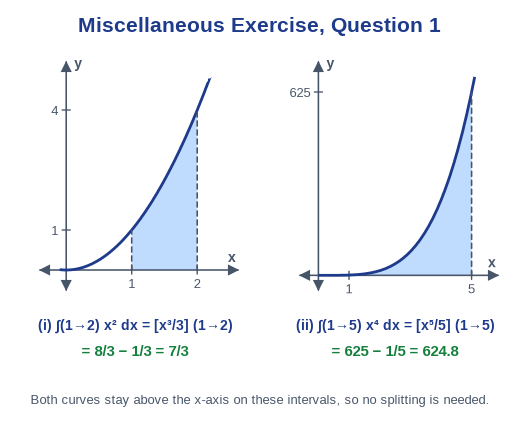
1. Diye gaye curves aur di gayi lines ke neeche ka area nikaalo: (i) y = x², x = 1, x = 2 aur x-axis (ii) y = x⁴, x = 1, x = 5 aur x-axis
Dono curves in intervals par x-axis ke upar hain, to area seedha integral hai.
(i) Area = ∫(1→2) x² dx = [x³/3] (1→2) = 8/3 − 1/3 = 7/3 square units.
(ii) Area = ∫(1→5) x⁴ dx = [x⁵/5] (1→5) = 3125/5 − 1/5 = 3124/5 = 624.8 square units.
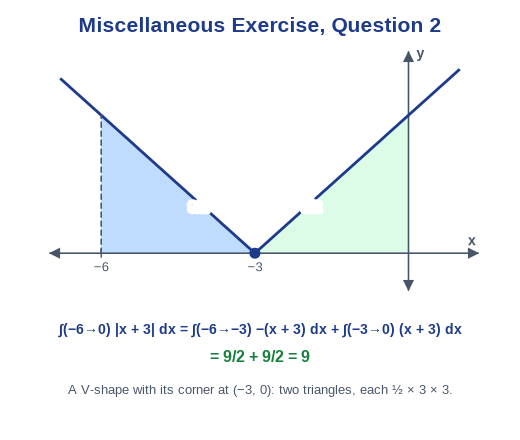
2. y = |x + 3| ka graph banao aur ∫(−6→0) |x + 3| dx nikaalo.
Sketch. x ≥ −3 par |x + 3| = x + 3 aur x < −3 par −(x + 3). Graph ek V hai jiska kona (−3, 0) par hai. Ye (−6, 3) aur (0, 3) se guzarta hai, aur kabhi x-axis ke neeche nahi jaata.
Integral. x = −3 par split karo:
∫(−6→0) |x + 3| dx = ∫(−6→−3) −(x + 3) dx + ∫(−3→0) (x + 3) dx = [−x²/2 − 3x] (−6→−3) + [x²/2 + 3x] (−3→0) = (−9/2 + 9) − (−18 + 18) + 0 − (9/2 − 9) = 9/2 + 9/2 = 9.
Check: region do right triangles hain jinki legs 3 aur 3 hain, har ek ka area ½ × 3 × 3 = 9/2.
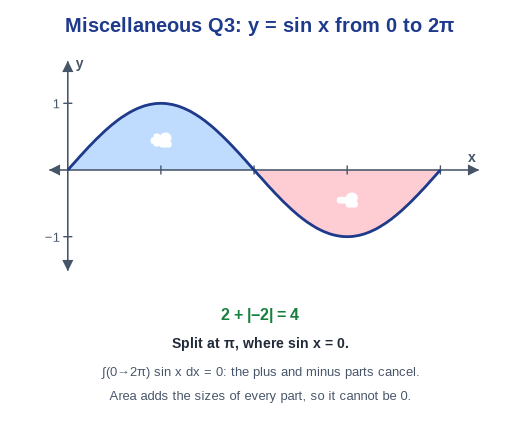
3. x = 0 aur x = 2π ke beech curve y = sin x se ghira area nikaalo.
sin x = 0 hai x = π par. Ye [0, π] par axis ke upar aur [π, 2π] par neeche hai:
∫(0→π) sin x dx = [−cos x] (0→π) = 1 + 1 = 2 ∫(π→2π) sin x dx = [−cos x] (π→2π) = −1 − 1 = −2
Area = 2 + |−2| = 4 square units. (0 se 2π tak seedha integral 0 hai, kyunki dono arches cancel ho jaate hain.)
Questions 4 aur 5 ke liye book ka nirdesh: Neeche ke Exercises 4 se 5 mein sahi jawab chuno.
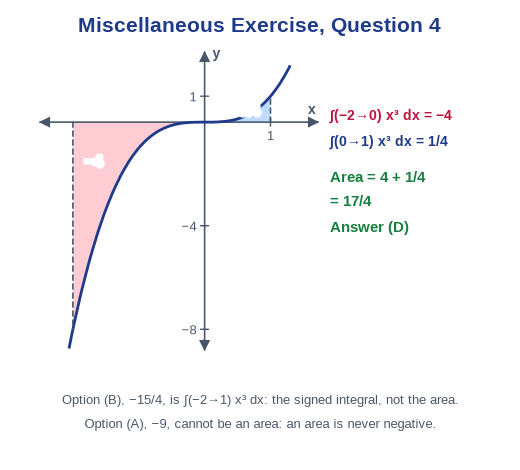
4. Curve y = x³, x-axis aur ordinates x = −2 aur x = 1 se ghira area hai (A) −9 (B) −15/4 (C) 15/4 (D) 17/4
x < 0 par x³ < 0 aur x > 0 par x³ > 0, to x = 0 par split karo:
∫(−2→0) x³ dx = [x⁴/4] (−2→0) = 0 − 4 = −4 ∫(0→1) x³ dx = [x⁴/4] (0→1) = 1/4
Area = |−4| + 1/4 = 17/4. Jawab (D).
Option (B), −15/4, seedha integral ∫(−2→1) x³ dx hai, jisme dono hisse cancel hote hain; option (A) sahi ho hi nahi sakta kyunki area kabhi negative nahi hota.
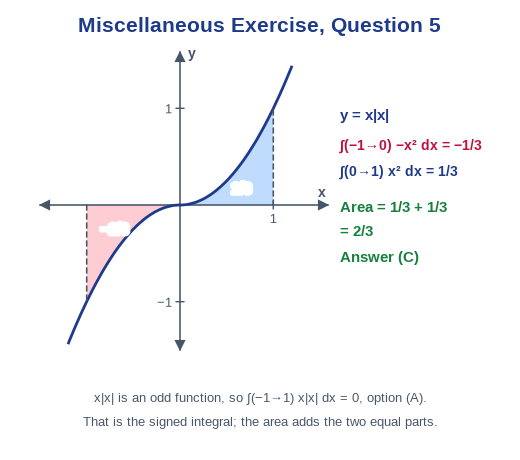
5. Curve y = x |x|, x-axis aur ordinates x = −1 aur x = 1 se ghira area hai (A) 0 (B) 1/3 (C) 2/3 (D) 4/3 [Hint: x > 0 par y = x² aur x < 0 par y = −x²].
Hint se, curve [−1, 0] par y = −x² (axis ke neeche) aur [0, 1] par y = x² (upar) hai:
∫(−1→0) (−x²) dx = [−x³/3] (−1→0) = 0 − 1/3 = −1/3 ∫(0→1) x² dx = [x³/3] (0→1) = 1/3
Area = 1/3 + 1/3 = 2/3. Jawab (C).
Option (A), 0, seedha integral hai. x|x| ek odd function hai (yaani f(−x) = −f(x), to left ka hissa right ke hisse ka ulta hai). Isliye [−1, 1] par uska integral 0 hai, par area 0 nahi hai.
Book ke baare mein notes
- Saare jawab key se milte hain. Exercise 8.1: 12π, 6π, (A), (B). Miscellaneous Exercise: 7/3, 624.8, 9, 4, (D), (C).
- Introduction (page 292) kehta hai ki pichhle chapter ne definite integral as the limit of a sum se area nikaala tha, aur ye chapter lines aur arcs ke beech ka area aur aise curves se ghira area cover karta hai. 2026-27 ki books mein dono mein se koi topic nahi padhaya jaata: Chapter 7 ab definite integral sirf define karta hai aur fundamental theorem se nikaalta hai, aur Chapter 8 mein do curves ke beech ke area par koi section ya exercise nahi hai. Is page ke kisi jawab ko inki zaroorat nahi.
- Miscellaneous Question 2 area nahi, integral poochhta hai, par |x + 3| kabhi negative nahi hota, to yahan dono same hain.
Practice karo
-
y = x², x-axis, x = 0 aur x = 2 ke beech ka area hai:
Jawab dekho
Jawab: (b) 8/3
-
Ellipse x²/36 + y²/16 = 1 se ghira area hai:
Jawab dekho
Jawab: (a) 24π
-
x = 0 se x = π/2 tak y = cos x aur x-axis se ghira area hai:
Jawab dekho
Jawab: (b) 1
-
y = x³, x-axis aur lines x = 0, x = 2 ke beech ka area nikaalo.
Jawab dekho
Jawab: [0, 2] par x³ ≥ 0, to A = ∫(0→2) x³ dx = [x⁴/4] (0→2) = 16/4 = 4 square units.
-
y = x − 2, x-axis aur lines x = 0, x = 3 ke beech ka area nikaalo.
Jawab dekho
Jawab: Line axis se x = 2 par milti hai. ∫(0→2) (x − 2) dx = [x²/2 − 2x] (0→2) = −2 aur ∫(2→3) (x − 2) dx = 1/2. Area = 2 + 1/2 = 5/2 square units.
Koi sawal atak gaya?
Photo lo, Lagnever AI step-by-step samjhayega. 7 din ka trial sirf ₹2.
Google Play se app lo Browser mein kholo
Parents ke liye: trial ke baad plan har mahine UPI ya card autopay se renew hota hai. App mein kabhi bhi cancel kar sakte hain.