
NCERT Solutions Class 12 Maths Chapter 8: Application of Integrals
Answers to every question of Exercise 8.1 and the Miscellaneous Exercise, and to all 4 worked examples, of Chapter 8, Application of Integrals, of Mathematics Part II, the Class 12 NCERT textbook. Page numbers follow the 2026-27 reprint (pages 292–299). The exercise questions are quoted from the book; the examples are restated in short and labelled by number and page. Every example and question has its own graph, plotted from the real function with the region shaded between the computed crossing points. Every area below was checked twice by script, once by exact symbolic integration and once numerically, and all of them agree with the book’s answer key. Short notes: Chapter 8 notes.
How the maths is typed here. ∫(a→b) f(x) dx is the definite integral from a to b, and [F(x)] (a→b) means F(b) − F(a). Fractions are written with a slash, so (b/a)√(a² − x²) means b over a, times √(a² − x²). sin⁻¹ is the inverse sine. Areas are in square units. The quoted questions use the same layout.
Three facts carry every answer:
- Vertical strips: area between y = f(x) (above the axis), the x-axis, x = a and x = b is ∫(a→b) f(x) dx. Horizontal strips: area between x = g(y), the y-axis, y = c and y = d is ∫(c→d) g(y) dy.
- Below the x-axis an integral is negative; area is its absolute value. If the curve crosses the axis, split there and add the sizes.
- ∫√(a² − x²) dx = (x/2)√(a² − x²) + (a²/2) sin⁻¹(x/a) + C, so ∫(0→a) √(a² − x²) dx = πa²/4.
Examples 1 and 2: circle and ellipse (pages 294–296)
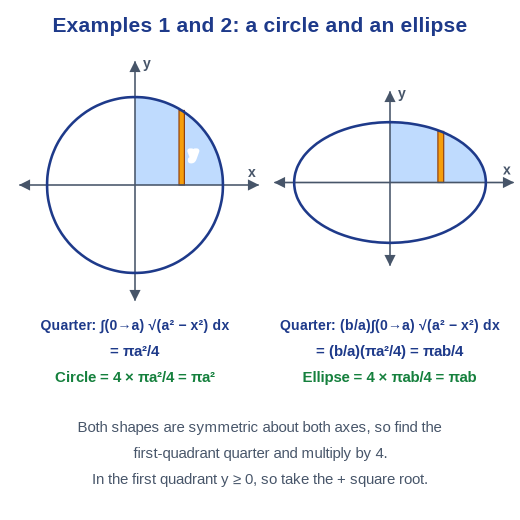
Example 1 (page 294): the area enclosed by the circle x² + y² = a².
The circle is symmetric about both axes, so its area is 4 times the first-quadrant region bounded by the arc, the x-axis and the ordinates x = 0 and x = a. From x² + y² = a², y = ±√(a² − x²); in the first quadrant y > 0, so y = √(a² − x²).
Area = 4∫(0→a) y dx = 4∫(0→a) √(a² − x²) dx = 4[(x/2)√(a² − x²) + (a²/2) sin⁻¹(x/a)] (0→a) = 4 × (a²/2)(π/2) = πa².
The book also asks (“Why?”) about doing it with horizontal strips. In the first quadrant x = √(a² − y²), and the region runs from y = 0 to y = a, so Area = 4∫(0→a) x dy = 4∫(0→a) √(a² − y²) dy. This is the same integral with y in place of x, so it is again πa².
Example 2 (page 295): the area enclosed by the ellipse x²/a² + y²/b² = 1.
Again 4 times the first-quadrant part. From the equation, y = ±(b/a)√(a² − x²); in the first quadrant y = (b/a)√(a² − x²).
Area = 4(b/a)∫(0→a) √(a² − x²) dx = 4(b/a)[(x/2)√(a² − x²) + (a²/2) sin⁻¹(x/a)] (0→a) = 4(b/a)(a²/2)(π/2) = πab.
The “Why?” here is the standard integral above with the limits put in: at x = a it gives (a/2)(0) + (a²/2) sin⁻¹ 1 = πa²/4, and at x = 0 it gives 0.
With horizontal strips (page 296): in the first quadrant x = (a/b)√(b² − y²), so Area = 4(a/b)∫(0→b) √(b² − y²) dy = 4(a/b)(b²/2)(π/2) = πab, the same answer.
Exercise 8.1 (page 296)
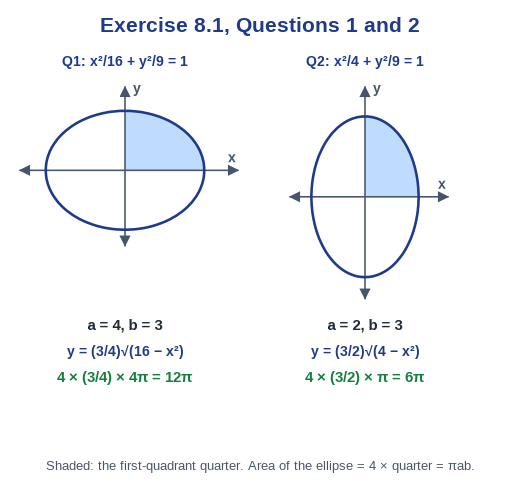
1. “Find the area of the region bounded by the ellipse x²/16 + y²/9 = 1.”
Here a = 4 and b = 3. In the first quadrant y = (3/4)√(16 − x²). By symmetry,
Area = 4∫(0→4) (3/4)√(16 − x²) dx = 3[(x/2)√(16 − x²) + 8 sin⁻¹(x/4)] (0→4) = 3(8 × π/2) = 12π square units.
(Check: πab = π(4)(3) = 12π.)
2. “Find the area of the region bounded by the ellipse x²/4 + y²/9 = 1.”
Here a = 2 and b = 3, so the ellipse is taller than it is wide. In the first quadrant y = (3/2)√(4 − x²).
Area = 4∫(0→2) (3/2)√(4 − x²) dx = 6[(x/2)√(4 − x²) + 2 sin⁻¹(x/2)] (0→2) = 6(2 × π/2) = 6π square units.
(Check: πab = π(2)(3) = 6π.)
The book’s instruction for Questions 3 and 4: “Choose the correct answer in the following Exercises 3 and 4.”
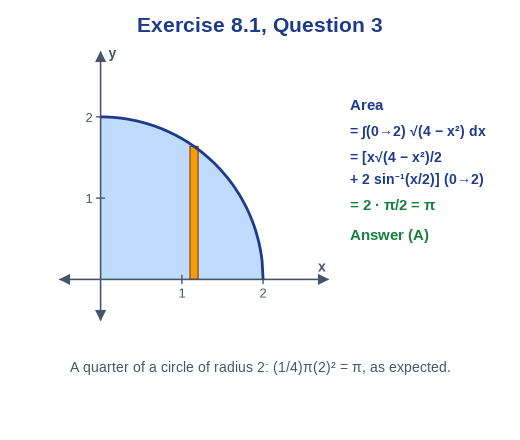
3. “Area lying in the first quadrant and bounded by the circle x² + y² = 4 and the lines x = 0 and x = 2 is (A) π (B) π/2 (C) π/3 (D) π/4”
In the first quadrant y = √(4 − x²), from x = 0 to x = 2:
Area = ∫(0→2) √(4 − x²) dx = [(x/2)√(4 − x²) + 2 sin⁻¹(x/2)] (0→2) = 0 + 2(π/2) − 0 = π.
This is a quarter of the circle of radius 2, (1/4)π(2)² = π. Answer (A).
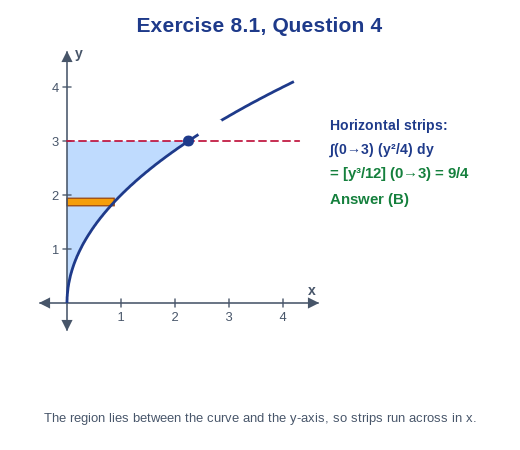
4. “Area of the region bounded by the curve y² = 4x, y-axis and the line y = 3 is (A) 2 (B) 9/4 (C) 9/3 (D) 9/2”
The region is closed by the y-axis, so use horizontal strips. On the curve, x = y²/4. The line y = 3 meets the parabola at x = 9/4, the point (9/4, 3), and the region runs from y = 0 to y = 3.
Area = ∫(0→3) x dy = ∫(0→3) (y²/4) dy = [y³/12] (0→3) = 27/12 = 9/4.
(Vertical strips give the same: the region lies between y = 2√x and y = 3 for 0 ≤ x ≤ 9/4, and ∫(0→9/4) (3 − 2√x) dx = 27/4 − 9/2 = 9/4.) Answer (B).
Miscellaneous Examples 3 and 4 (pages 296–297)
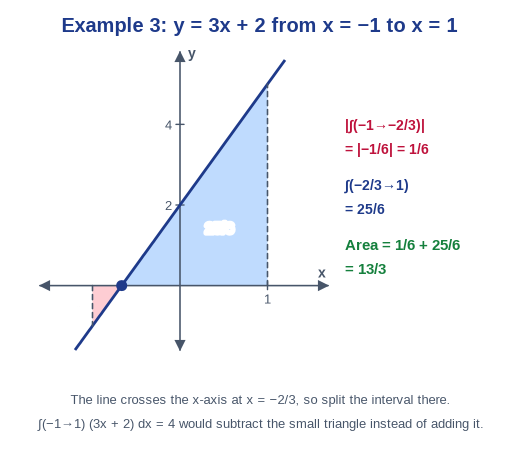
Example 3 (page 296): the area bounded by the line y = 3x + 2, the x-axis and the ordinates x = −1 and x = 1.
(An ordinate here is a vertical line x = constant, so the region lies between x = −1 and x = 1.) The line meets the x-axis where 3x + 2 = 0, at x = −2/3. It is below the axis for −1 < x < −2/3 and above it for −2/3 < x < 1, so split there:
∫(−1→−2/3) (3x + 2) dx = [3x²/2 + 2x] (−1→−2/3) = (2/3 − 4/3) − (3/2 − 2) = −2/3 + 1/2 = −1/6
∫(−2/3→1) (3x + 2) dx = (3/2 + 2) − (−2/3) = 7/2 + 2/3 = 25/6
Area = |−1/6| + 25/6 = 26/6 = 13/3 square units. (Integrating straight from −1 to 1 gives 4, which subtracts the small triangle instead of adding it.)
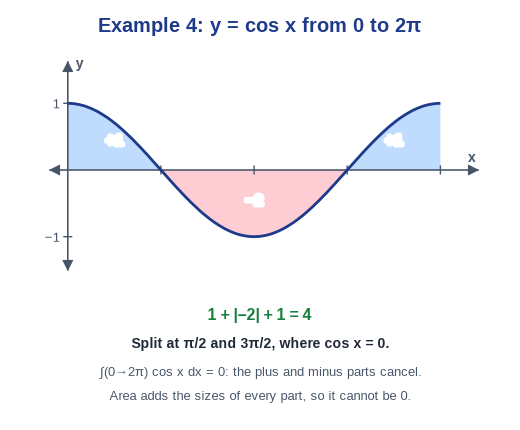
Example 4 (page 297): the area bounded by y = cos x between x = 0 and x = 2π.
cos x = 0 at x = π/2 and 3π/2. The curve is above the axis on [0, π/2], below on [π/2, 3π/2] and above on [3π/2, 2π]:
∫(0→π/2) cos x dx = [sin x] (0→π/2) = 1 ∫(π/2→3π/2) cos x dx = [sin x] (π/2→3π/2) = −1 − 1 = −2 ∫(3π/2→2π) cos x dx = [sin x] (3π/2→2π) = 0 − (−1) = 1
Area = 1 + |−2| + 1 = 4 square units.
Miscellaneous Exercise on Chapter 8 (page 298)
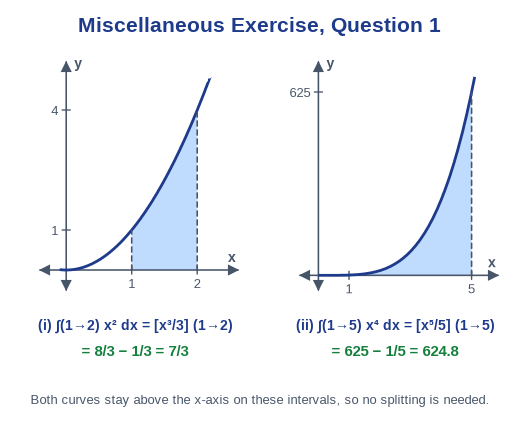
1. “Find the area under the given curves and given lines: (i) y = x², x = 1, x = 2 and x-axis (ii) y = x⁴, x = 1, x = 5 and x-axis”
Both curves are above the x-axis on these intervals, so the area is the plain integral.
(i) Area = ∫(1→2) x² dx = [x³/3] (1→2) = 8/3 − 1/3 = 7/3 square units.
(ii) Area = ∫(1→5) x⁴ dx = [x⁵/5] (1→5) = 3125/5 − 1/5 = 3124/5 = 624.8 square units.
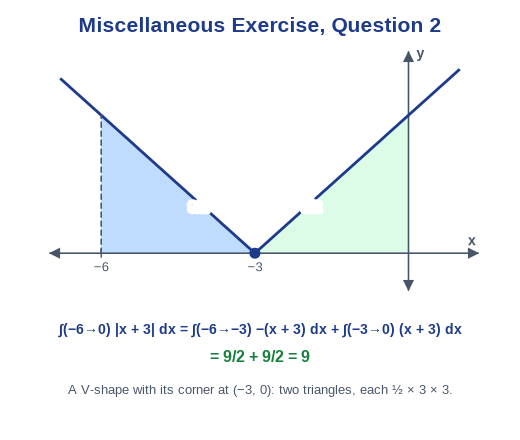
2. “Sketch the graph of y = |x + 3| and evaluate ∫(−6→0) |x + 3| dx.”
Sketch. |x + 3| = x + 3 when x ≥ −3 and −(x + 3) when x < −3. The graph is a V with its corner at (−3, 0). It passes through (−6, 3) and (0, 3), and it never goes below the x-axis.
Integral. Split at x = −3:
∫(−6→0) |x + 3| dx = ∫(−6→−3) −(x + 3) dx + ∫(−3→0) (x + 3) dx = [−x²/2 − 3x] (−6→−3) + [x²/2 + 3x] (−3→0) = (−9/2 + 9) − (−18 + 18) + 0 − (9/2 − 9) = 9/2 + 9/2 = 9.
As a check, the region is two right triangles with legs 3 and 3, each of area ½ × 3 × 3 = 9/2.
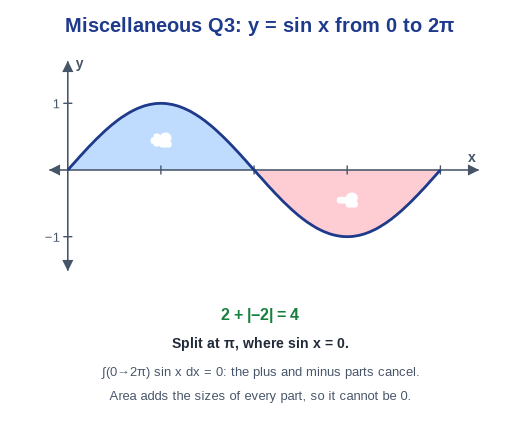
3. “Find the area bounded by the curve y = sin x between x = 0 and x = 2π.”
sin x = 0 at x = π. It is above the axis on [0, π] and below on [π, 2π]:
∫(0→π) sin x dx = [−cos x] (0→π) = 1 + 1 = 2 ∫(π→2π) sin x dx = [−cos x] (π→2π) = −1 − 1 = −2
Area = 2 + |−2| = 4 square units. (The plain integral from 0 to 2π is 0, because the two arches cancel.)
The book’s instruction for Questions 4 and 5: “Choose the correct answer in the following Exercises from 4 to 5.”
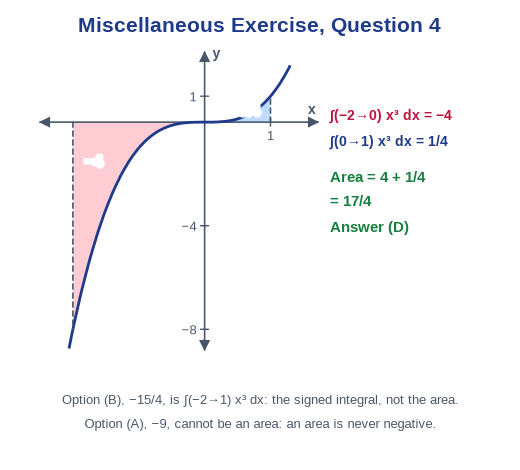
4. “Area bounded by the curve y = x³, the x-axis and the ordinates x = – 2 and x = 1 is (A) – 9 (B) −15/4 (C) 15/4 (D) 17/4”
x³ < 0 for x < 0 and x³ > 0 for x > 0, so split at x = 0:
∫(−2→0) x³ dx = [x⁴/4] (−2→0) = 0 − 4 = −4 ∫(0→1) x³ dx = [x⁴/4] (0→1) = 1/4
Area = |−4| + 1/4 = 17/4. Answer (D).
Option (B), −15/4, is the plain integral ∫(−2→1) x³ dx, which lets the two parts cancel; option (A) cannot be right because an area is never negative.
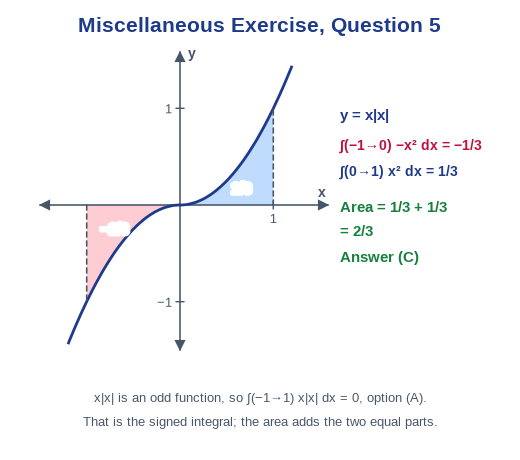
5. “The area bounded by the curve y = x |x|, x-axis and the ordinates x = – 1 and x = 1 is given by (A) 0 (B) 1/3 (C) 2/3 (D) 4/3 [Hint : y = x² if x > 0 and y = – x² if x < 0].”
Using the hint, the curve is y = −x² on [−1, 0] (below the axis) and y = x² on [0, 1] (above):
∫(−1→0) (−x²) dx = [−x³/3] (−1→0) = 0 − 1/3 = −1/3 ∫(0→1) x² dx = [x³/3] (0→1) = 1/3
Area = 1/3 + 1/3 = 2/3. Answer (C).
Option (A), 0, is the plain integral. x|x| is an odd function (f(−x) = −f(x), so the left half is the right half turned upside down). That is why its integral over [−1, 1] is 0, but its area is not 0.
Notes on the book
- All answers match the key. Exercise 8.1: 12π, 6π, (A), (B). Miscellaneous Exercise: 7/3, 624.8, 9, 4, (D), (C).
- The introduction (page 292) says the previous chapter found areas through the definite integral as the limit of a sum, and that this chapter covers the area between lines and arcs and the area bounded by such curves. In the 2026-27 books neither topic is taught: Chapter 7 now only defines the definite integral and evaluates it by the fundamental theorem, and Chapter 8 has no section or exercise on the area between two curves. Nothing on this page needs them.
- Miscellaneous Question 2 asks for an integral, not an area, but |x + 3| is never negative, so here the two are the same.
Practice
-
The area between y = x², the x-axis, x = 0 and x = 2 is:
Show answer
Answer: (b) 8/3
-
The area enclosed by the ellipse x²/36 + y²/16 = 1 is:
Show answer
Answer: (a) 24π
-
The area bounded by y = cos x and the x-axis between x = 0 and x = π/2 is:
Show answer
Answer: (b) 1
-
Find the area between y = x³, the x-axis and the lines x = 0 and x = 2.
Show answer
Answer: x³ ≥ 0 on [0, 2], so A = ∫(0→2) x³ dx = [x⁴/4] (0→2) = 16/4 = 4 square units.
-
Find the area between y = x − 2, the x-axis and the lines x = 0 and x = 3.
Show answer
Answer: The line meets the axis at x = 2. ∫(0→2) (x − 2) dx = [x²/2 − 2x] (0→2) = −2 and ∫(2→3) (x − 2) dx = 1/2. Area = 2 + 1/2 = 5/2 square units.
Stuck on a question?
Take a photo and Lagnever AI explains it step by step. Try it for 7 days for ₹2.
Get it on Google Play Open in browser
For parents: after the trial, the plan renews monthly by UPI or card autopay. You can cancel anytime in the app.