
Class 12 Maths Chapter 8: Application of Integrals Notes
This chapter in five lines
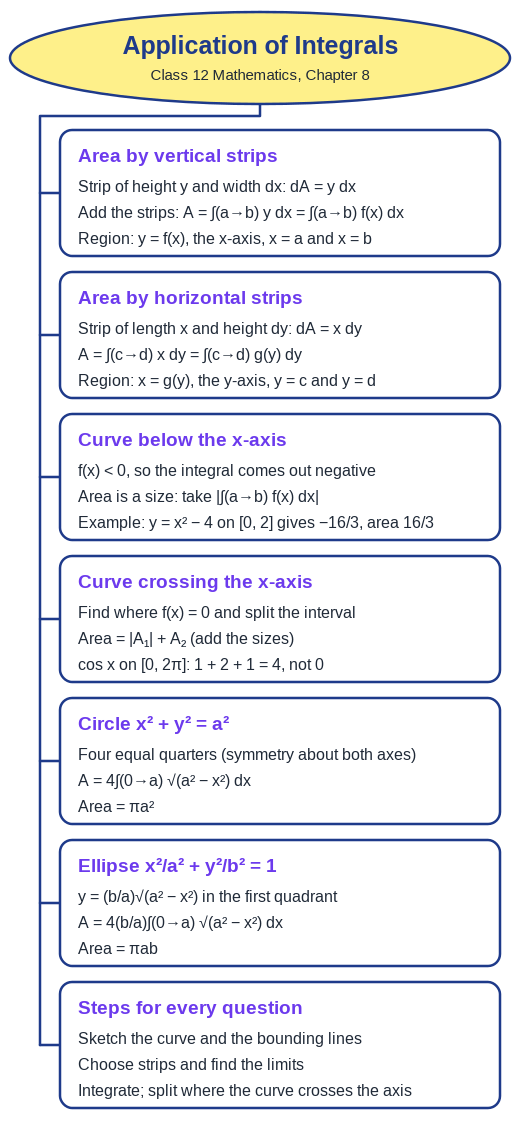
The area between y = f(x), the x-axis and the lines x = a and x = b is ∫(a→b) f(x) dx when the curve is above the axis. Where the curve is below the axis, take the absolute value; where it crosses, split at the crossing and add the sizes. A circle of radius a has area πa² and an ellipse πab.
What is this chapter about?
School geometry gives formulas for the areas of triangles, rectangles, trapeziums and circles. Those formulas stop working once a side of the region is a curve, such as a parabola. Chapter 7, Integrals, ended with the definite integral and the fundamental theorem of calculus. This short chapter uses that tool for its most direct job: measuring the area of a region bounded by a curve.
The chapter covers book pages 292–299. Its one teaching section is 8.2, Area under Simple Curves, with two worked examples on a circle and an ellipse, two Miscellaneous Examples, Exercise 8.1 and a Miscellaneous Exercise.
Area by vertical strips
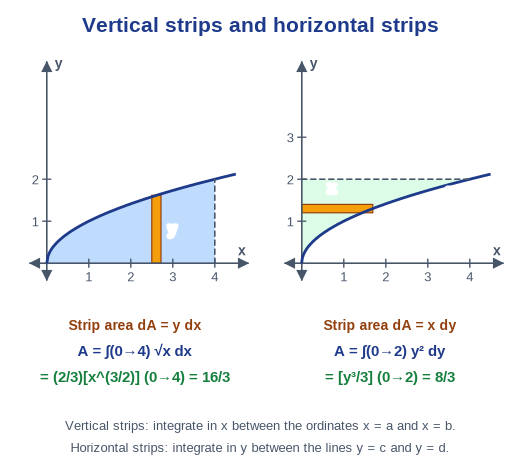
Cut the region under y = f(x) into a very large number of thin vertical strips. A strip at some x has height y = f(x) and width dx, so its elementary area is dA = y dx. Adding all the strips from x = a to x = b is exactly what a definite integral does:
A = ∫(a→b) dA = ∫(a→b) y dx = ∫(a→b) f(x) dx
This is the area of the region bounded by the curve, the x-axis and the ordinates x = a and x = b, when the curve is above the axis. For y = √x from x = 0 to 4, the area is (2/3)[x^(3/2)] (0→4) = 16/3 square units.
Area by horizontal strips
Some regions are closed by the y-axis instead. For a curve x = g(y), the y-axis and the lines y = c and y = d, take thin horizontal strips of length x and height dy. Then dA = x dy and
A = ∫(c→d) x dy = ∫(c→d) g(y) dy
For x = y² between y = 0 and y = 2, the area is [y³/3] (0→2) = 8/3 square units. Full method: area under simple curves.
When the curve goes below the x-axis
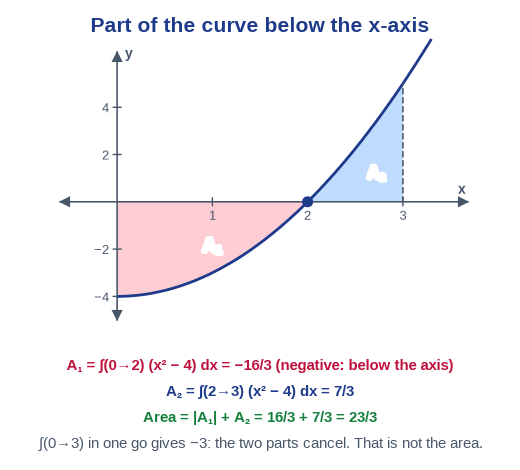
If f(x) < 0 between a and b, every strip has a negative height, so the integral comes out negative. Area is a size, so we take the numerical value: A = |∫(a→b) f(x) dx|.
If part of the curve is below the axis and part above, find where f(x) = 0, split the interval there, and add the sizes: A = |A₁| + A₂. For y = x² − 4 on [0, 3], the curve meets the axis at x = 2. The part from 0 to 2 gives −16/3 and the part from 2 to 3 gives 7/3, so the area is 16/3 + 7/3 = 23/3. The single integral from 0 to 3 is −3, which is not the area.
Area of a circle and an ellipse
A circle x² + y² = a² is symmetric about both axes, so its area is 4 times the first-quadrant part. There y ≥ 0, so y = √(a² − x²), and
Area = 4∫(0→a) √(a² − x²) dx = 4 × [(x/2)√(a² − x²) + (a²/2) sin⁻¹(x/a)] (0→a) = 4 × πa²/4 = πa²
For the ellipse x²/a² + y²/b² = 1, the first-quadrant part has y = (b/a)√(a² − x²), so the area is 4(b/a) × πa²/4 = πab. Horizontal strips give the same answers. Worked examples, including part of a circle: area of a circle and an ellipse by integration.
A plan for every area question
- Sketch the curve and every line in the question, and shade the region.
- Decide on vertical strips (integrate in x) or horizontal strips (integrate in y).
- Find the limits: the given lines, or the points where the curve meets an axis or a line.
- Use symmetry if the region has it, and split the interval wherever the curve crosses the axis.
- Integrate, add the sizes of the parts, and write the answer in square units.
Before we move on
This is the rationalised book (marked Reprint 2026-27). Its introduction still mentions the definite integral as the limit of a sum and areas between lines and arcs, but the chapter itself keeps only section 8.2, with Exercise 8.1 (4 questions), a Miscellaneous Exercise of 5 questions and 4 worked examples. Every example and exercise is worked out, each with its own figure, in the NCERT solutions for Chapter 8.
Key terms
| Term | Meaning |
|---|---|
| Elementary strip | A very thin rectangle inside the region. A vertical strip has height y and width dx, so its area is dA = y dx. |
| Elementary area | dA, the area of one thin strip at an arbitrary position in the region. Adding all of them with an integral gives the whole area. |
| Ordinates x = a and x = b | The vertical lines that close the region on the left and right when we use vertical strips. |
| Area under a curve | The area of the region bounded by y = f(x), the x-axis and the ordinates x = a and x = b: A = ∫(a→b) y dx = ∫(a→b) f(x) dx. |
| Horizontal strip | A thin strip of length x and height dy. For the region between x = g(y), the y-axis and the lines y = c and y = d, A = ∫(c→d) x dy = ∫(c→d) g(y) dy. |
| Signed integral | ∫(a→b) f(x) dx counts parts below the x-axis as negative. It equals the area only when the curve stays on or above the axis. |
| Area (numerical value) | Area is always taken as a positive size. A part below the axis contributes |∫ f(x) dx|, so A = |A₁| + A₂ when one part is below and one above. |
| Symmetry about the axes | A circle x² + y² = a² and an ellipse x²/a² + y²/b² = 1 are symmetric about both axes, so their area is 4 times the first-quadrant part. |
| Standard ellipse | x²/a² + y²/b² = 1, crossing the x-axis at ±a and the y-axis at ±b. Its area is πab. |
Topics in this chapter
Practice
-
The area between y = x², the x-axis, x = 0 and x = 3 is:
Show answer
Answer: (b) 9
-
The area enclosed by the circle x² + y² = 36 is:
Show answer
Answer: (c) 36π
-
The area enclosed by the ellipse x²/25 + y²/4 = 1 is:
Show answer
Answer: (a) 10π
-
∫(0→π) cos x dx = 0. The area between y = cos x and the x-axis from 0 to π is:
Show answer
Answer: (c) 2
-
The area between x = y², the y-axis, y = 0 and y = 3 is:
Show answer
Answer: (b) 9
Questions students ask
What are the main topics of Class 12 Maths Chapter 8?
Finding the area under simple curves with definite integrals: vertical strips between a curve, the x-axis and two ordinates; horizontal strips between a curve, the y-axis and two lines; curves below or crossing the x-axis; and the areas of a circle and an ellipse. It has Exercise 8.1 and a Miscellaneous Exercise.
Is the area between two curves in the 2026-27 book?
No. The rationalised chapter has only 8.1 Introduction and 8.2 Area under Simple Curves, with Exercise 8.1 (4 questions), two Miscellaneous Examples and a Miscellaneous Exercise (5 questions). No section or exercise is on the area between two curves, so these notes do not teach it.
Why is the area not just the definite integral?
A definite integral counts the part of the curve below the x-axis as negative. For y = sin x from 0 to 2π the two arches cancel and the integral is 0, but the area is 2 + 2 = 4. So split at the points where the curve meets the axis and add the sizes.
When should I use horizontal strips?
When the region is closed by the y-axis and two horizontal lines y = c and y = d, or when the curve is easier to write as x = g(y). For y² = 4x, the y-axis and y = 3, the strip length is x = y²/4 and the area is ∫(0→3) y²/4 dy = 9/4.
Stuck on a question?
Take a photo and Lagnever AI explains it step by step. Try it for 7 days for ₹2.
Get it on Google Play Open in browser
For parents: after the trial, the plan renews monthly by UPI or card autopay. You can cancel anytime in the app.