
How do you find the area under a curve by integration?
Answer in short
Sketch the region and slice it. With vertical strips, dA = y dx and the area between y = f(x), the x-axis, x = a and x = b is ∫(a→b) f(x) dx. With horizontal strips, A = ∫(c→d) x dy. Parts below the x-axis count as positive sizes: split where the curve crosses.
Stuck on a question? Take a photo and Lagnever AI explains it step by step. Try it for 7 days for ₹2. Get it on Google Play
What does “area under a curve” mean?
Take a curve y = f(x) that stays above the x-axis between x = a and x = b. The region we want is closed on four sides: the curve on top, the x-axis below, and the vertical lines (ordinates) x = a and x = b on the left and right. Its area cannot come from a geometry formula, because the top edge is curved.
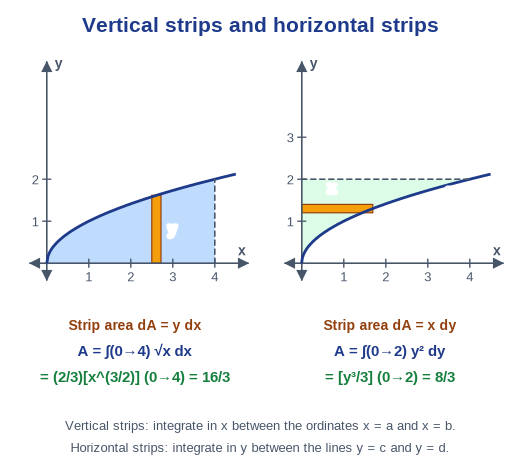
The idea is to slice the region. Cut it into a very large number of very thin vertical strips. Each strip is almost a rectangle: at some position x it has height y = f(x) and width dx. Its elementary area is dA = y dx. The total area is what you get by adding all these strips from x = a to x = b, and adding infinitely thin strips is exactly what a definite integral does:
A = ∫(a→b) y dx = ∫(a→b) f(x) dx
The value comes from the fundamental theorem of Chapter 7: find an anti derivative F and work out F(b) − F(a).
Worked example with vertical strips
Find the area between y = √x, the x-axis and the lines x = 0 and x = 4.
The curve starts at the origin and rises to (4, 2); it is above the axis throughout. A vertical strip has height √x and width dx, so
A = ∫(0→4) √x dx = (2/3)[x^(3/2)] (0→4) = (2/3)(8) = 16/3 square units.
Area by horizontal strips
Sometimes the region is closed by the y-axis and two horizontal lines y = c and y = d, with the curve written as x = g(y). Then slice it the other way. A horizontal strip at height y has length x = g(y) and thickness dy, so dA = x dy and
A = ∫(c→d) x dy = ∫(c→d) g(y) dy
The limits are now values of y.
Example. Find the area between x = y², the y-axis and the lines y = 0 and y = 2. A horizontal strip has length y², so A = ∫(0→2) y² dy = [y³/3] (0→2) = 8/3 square units.
What if the curve is below the x-axis?
If f(x) < 0 for every x between a and b, each strip has negative height, so ∫(a→b) f(x) dx comes out negative. The area itself is the numerical value:
A = |∫(a→b) f(x) dx|
For y = x² − 4 between x = 0 and x = 2, the integral is [x³/3 − 4x] (0→2) = 8/3 − 8 = −16/3, so the area is 16/3 square units.
What if the curve crosses the x-axis?
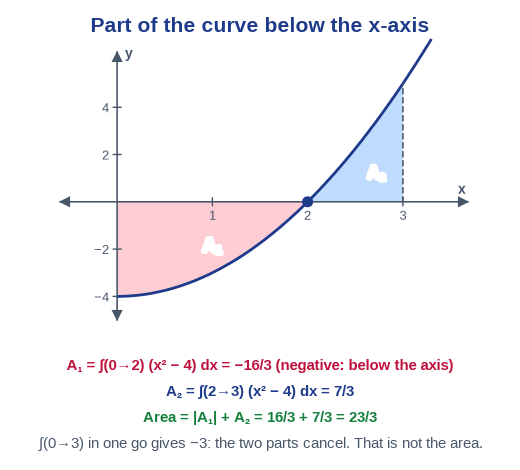
Then part of the region is below the axis (call its integral A₁, which is negative) and part above (A₂, positive). Adding them as they are would let the parts cancel. Instead:
- Solve f(x) = 0 to find where the curve meets the axis.
- Split the interval at those points.
- Integrate over each piece and add the sizes: A = |A₁| + A₂.
Example. Find the area between y = x² − 4, the x-axis, x = 0 and x = 3. The curve meets the axis at x = 2 (x = −2 is outside the interval).
- A₁ = ∫(0→2) (x² − 4) dx = −16/3
- A₂ = ∫(2→3) (x² − 4) dx = [x³/3 − 4x] (2→3) = (9 − 12) − (8/3 − 8) = 7/3
Area = 16/3 + 7/3 = 23/3 square units. The single integral from 0 to 3 is −3, which is wrong for area.
A quick checklist
- Draw the curve and the bounding lines, and shade the region.
- Choose strips: dx with the x-axis and lines x = a, x = b; dy with the y-axis and lines y = c, y = d.
- Find every point inside the limits where the curve crosses the axis.
- Integrate piece by piece, take absolute values, and add.
- Check the size against the sketch: an answer far bigger than a box around the region, or a negative one, means a slip.
Read next: area of a circle and an ellipse by integration, the Chapter 8 notes and the NCERT solutions for Exercise 8.1 and the Miscellaneous Exercise.
Practice
-
The area between y = 2x + 1, the x-axis, x = 0 and x = 2 is:
Show answer
Answer: (c) 6
-
The area between y = x³, the x-axis, x = −1 and x = 1 is:
Show answer
Answer: (c) 1/2
-
Find the area between y = x², the y-axis and the lines y = 1 and y = 4 in the first quadrant.
Show answer
Answer: In the first quadrant, y = x² gives x = √y. Using horizontal strips, A = ∫(1→4) √y dy = (2/3)[y^(3/2)] (1→4) = (2/3)(8 − 1) = 14/3 square units.
-
Find the area bounded by y = sin x and the x-axis between x = 0 and x = π.
Show answer
Answer: sin x ≥ 0 on [0, π], so A = ∫(0→π) sin x dx = [−cos x] (0→π) = 1 + 1 = 2 square units.
Questions students ask
What is an elementary strip?
A very thin rectangle inside the region, placed at an arbitrary position. A vertical one has height y and width dx, so its area is y dx. The integral adds up all such strips from one end of the region to the other.
How do I choose between vertical and horizontal strips?
Look at what closes the region. If it is the x-axis and two lines x = a and x = b, use vertical strips. If it is the y-axis and two lines y = c and y = d, use horizontal strips. Pick the one that keeps the strip length a single formula.
Why do we take the absolute value below the x-axis?
Below the axis the height y = f(x) is negative, so each strip y dx counts as negative and the integral is negative. Area is a size, so we keep only the numerical value. That is why a crossing curve must be split into parts.
Is the area ever the same as the plain integral?
Yes, whenever the curve stays on or above the x-axis between the limits, as for x² on [1, 2]. Then ∫(a→b) f(x) dx is already positive and equals the area.
Stuck on a question?
Take a photo and Lagnever AI explains it step by step. Try it for 7 days for ₹2.
Get it on Google Play Open in browser
For parents: after the trial, the plan renews monthly by UPI or card autopay. You can cancel anytime in the app.