
How do you find the area of a circle and an ellipse by integration?
Answer in short
Both shapes are symmetric about both axes, so find the first-quadrant part and multiply by 4. For x² + y² = a², y = √(a² − x²), giving 4∫(0→a) √(a² − x²) dx = πa². For x²/a² + y²/b² = 1, y = (b/a)√(a² − x²), giving πab.
Stuck on a question? Take a photo and Lagnever AI explains it step by step. Try it for 7 days for ₹2. Get it on Google Play
The one integral you need
Every circle and ellipse question in this chapter comes down to one standard integral from Chapter 7:
∫√(a² − x²) dx = (x/2)√(a² − x²) + (a²/2) sin⁻¹(x/a) + C
Between 0 and a it gives a neat value. At x = a the first term is 0 and sin⁻¹(1) = π/2; at x = 0 both terms are 0. So
∫(0→a) √(a² − x²) dx = (a²/2)(π/2) = πa²/4
That is a quarter of the area of a circle of radius a, which is a useful check.
Area of a circle
Take the circle x² + y² = a², centre O and radius a. It is symmetric about both axes, so its area is 4 times the area of the part in the first quadrant: the region bounded by the arc, the x-axis and the ordinates x = 0 and x = a.
Solving for y gives y = ±√(a² − x²). In the first quadrant y is positive, so the top edge of a vertical strip is y = √(a² − x²). Then
Area = 4∫(0→a) √(a² − x²) dx = 4 × πa²/4 = πa²
The formula from school geometry now has a proof.
Example. The circle x² + y² = 25 has a = 5, so its area is 4 × (25π/4) = 25π square units.
Area of an ellipse
For the ellipse x²/a² + y²/b² = 1, the curve meets the x-axis at ±a and the y-axis at ±b. It is again symmetric about both axes. Solving for y in the first quadrant gives
y = (b/a)√(a² − x²)
so the ellipse’s height at each x is the circle’s height scaled by b/a. Then
Area = 4(b/a)∫(0→a) √(a² − x²) dx = 4(b/a)(πa²/4) = πab
When b = a the ellipse is a circle, and πab becomes πa².
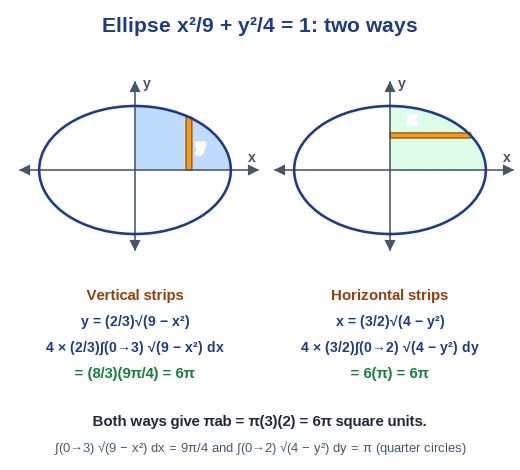
The same ellipse with horizontal strips
We can also slice sideways. In the first quadrant, x = (a/b)√(b² − y²), and a horizontal strip has length x and height dy:
Area = 4(a/b)∫(0→b) √(b² − y²) dy = 4(a/b)(πb²/4) = πab
Both ways must agree, and they do.
Example. For x²/9 + y²/4 = 1, a = 3 and b = 2.
- Vertical strips: 4 × (2/3)∫(0→3) √(9 − x²) dx = (8/3)(9π/4) = 6π.
- Horizontal strips: 4 × (3/2)∫(0→2) √(4 − y²) dy = 6 × π = 6π.
The area is 6π square units, equal to π(3)(2).
Area of part of a circle
The same integral, with other limits, gives pieces of a circle.
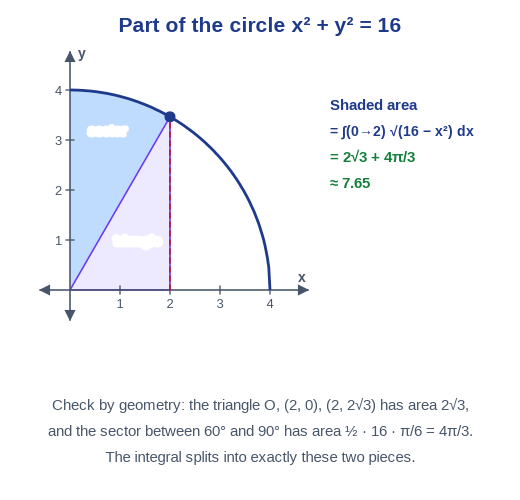
Example. Find the area of the region in the first quadrant bounded by the circle x² + y² = 16, the x-axis and the lines x = 0 and x = 2.
Here a = 4 and y = √(16 − x²):
A = ∫(0→2) √(16 − x²) dx = [(x/2)√(16 − x²) + 8 sin⁻¹(x/4)] (0→2) = (1)(√12) + 8 sin⁻¹(1/2) − 0 = 2√3 + 8(π/6) = 2√3 + 4π/3 ≈ 7.65 square units.
The answer splits into two familiar shapes. The line x = 2 meets the circle at (2, 2√3). The triangle with corners O, (2, 0) and (2, 2√3) has area ½ × 2 × 2√3 = 2√3, and the rest is a sector of the circle between 60° and 90°, with area ½ × 16 × π/6 = 4π/3.
Steps for these questions
- Write the curve in standard form and read off a (and b).
- Use symmetry: work in the first quadrant, where y ≥ 0.
- Write y (or x) from the equation with the positive square root.
- Integrate with the standard formula, put in the limits, and multiply by the number of equal parts.
- Check: a whole circle gives πa², a whole ellipse πab.
Read next: area under simple curves, the Chapter 8 notes and the NCERT solutions, where Examples 1 and 2 and Exercise 8.1 Questions 1–3 are solved.
Practice
-
The area enclosed by the circle x² + y² = 49 is:
Show answer
Answer: (c) 49π
-
The area enclosed by the ellipse x²/9 + y²/16 = 1 is:
Show answer
Answer: (a) 12π
-
Find the area of the part of x² + y² = 9 that lies above the x-axis.
Show answer
Answer: Above the axis, y = √(9 − x²) for −3 ≤ x ≤ 3. A = ∫(−3→3) √(9 − x²) dx = 2∫(0→3) √(9 − x²) dx = 2 × 9π/4 = 9π/2 square units, half of π(3)².
-
Find the area of the ellipse x²/25 + y²/16 = 1 in the first quadrant.
Show answer
Answer: In the first quadrant y = (4/5)√(25 − x²). A = (4/5)∫(0→5) √(25 − x²) dx = (4/5)(25π/4) = 5π square units, a quarter of π(5)(4) = 20π.
Questions students ask
Why do we multiply by 4?
The circle and the ellipse look the same when reflected in the x-axis and in the y-axis, so the four quadrants hold four equal pieces. Working in the first quadrant also lets us take the positive square root without any sign trouble.
Why is ∫(0→a) √(a² − x²) dx equal to πa²/4?
Put the limits into (x/2)√(a² − x²) + (a²/2) sin⁻¹(x/a). At x = a the first term is 0 and sin⁻¹(1) = π/2, giving πa²/4. At x = 0 both terms are 0. It is a quarter of the circle, as it should be.
Does πab work for a circle too?
Yes. A circle is the ellipse with b = a, and then πab becomes πa². So one formula covers both.
Which part of this is in the NCERT book?
Examples 1 and 2 of section 8.2 find the areas of the circle x² + y² = a² and the ellipse x²/a² + y²/b² = 1, each with vertical and with horizontal strips, and Exercise 8.1 has two ellipses and a quarter circle. The part-of-a-circle example below is our own practice.
Stuck on a question?
Take a photo and Lagnever AI explains it step by step. Try it for 7 days for ₹2.
Get it on Google Play Open in browser
For parents: after the trial, the plan renews monthly by UPI or card autopay. You can cancel anytime in the app.