
Class 12 Physics Chapter 11 NCERT Solutions Hinglish mein: Dual Nature of Radiation and Matter
Class 12 ki NCERT textbook Physics Part II ke Chapter 11, Dual Nature of Radiation and Matter, ki saari 11 exercises aur teeno worked examples ke jawab. Page numbers 2026-27 reprint ke hisaab se hain (pages 274–289). Pehle exercises hain, sawal Hinglish mein; uske baad examples, chhote mein dobara likhkar. Har number computer se bhi check kiya gaya hai. Chhote notes: Chapter 11 ke notes.
Ham book ke worked examples wale constants use karte hain: h = 6.63 × 10⁻³⁴ J s, e = 1.6 × 10⁻¹⁹ C, c = 3 × 10⁸ m/s, m_e = 9.11 × 10⁻³¹ kg, isliye 1 eV = 1.6 × 10⁻¹⁹ J aur h/e = 4.14 × 10⁻¹⁵ V s.
Safety: laser beam, ultraviolet lamp ya arc lamp mein kabhi mat dekho, aur laser kabhi kisi par mat chamkao. X-ray tubes aur photocell set-ups sirf trained log ya teacher ke saath hi chalate hain.
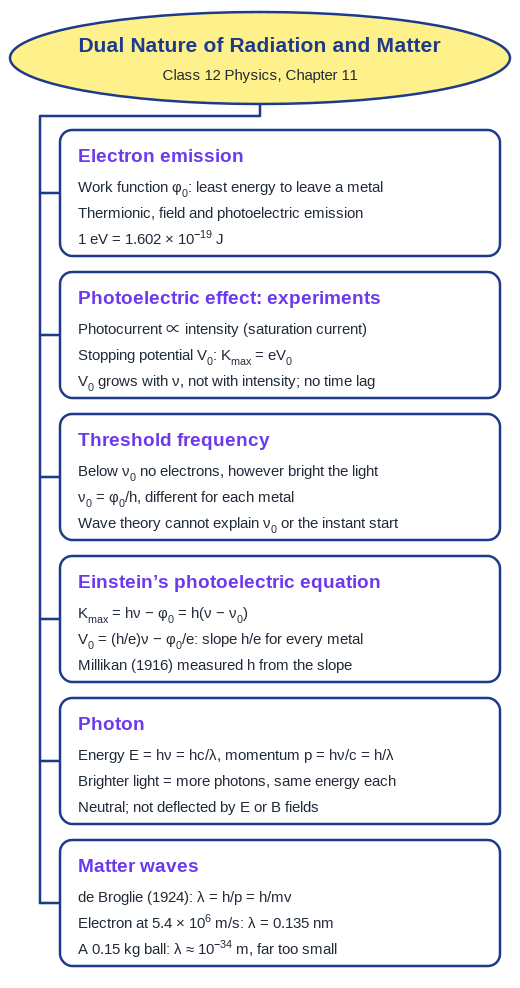
Exercises 11.1 se 11.4: photon ki energy aur momentum
11.1 30 kV electrons se bani X-rays ki (a) maximum frequency, aur (b) minimum wavelength nikalo.
(Idea, Extra kyunki 2026-27 chapter X-rays banne ki baat nahi karta: 30 kV se accelerate hua electron eV kinetic energy paata hai, aur sabse energetic X-ray photon jo wo bana sakta hai, wo poori energy le leta hai.)
eV = 1.6 × 10⁻¹⁹ C × 3.0 × 10⁴ V = 4.8 × 10⁻¹⁵ J
(a) hν_max = eV, isliye
ν_max = eV/h = 4.8 × 10⁻¹⁵/6.63 × 10⁻³⁴ = 7.24 × 10¹⁸ Hz
(b) λ_min = c/ν_max = 3 × 10⁸/7.24 × 10¹⁸ = 4.14 × 10⁻¹¹ m = 0.0414 nm (lagbhag 0.041 nm)
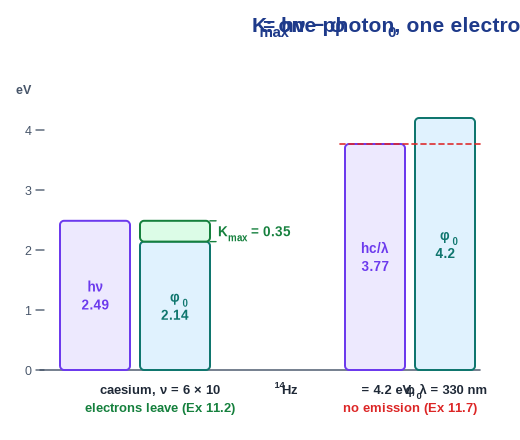
11.2 Caesium metal ka work function 2.14 eV hai. Jab 6 × 10¹⁴ Hz frequency ki light metal surface par padti hai, to electrons ka photoemission hota hai. (a) Nikle electrons ki maximum kinetic energy, (b) stopping potential, aur (c) nikle photoelectrons ki maximum speed kya hai?
Work function φ₀ wo sabse kam energy hai jo metal se ek electron bahar nikaalne ke liye chahiye.
- Photon energy: hν = 6.63 × 10⁻³⁴ × 6 × 10¹⁴ = 3.98 × 10⁻¹⁹ J. 1.6 × 10⁻¹⁹ J per eV se divide karke hν = 2.49 eV.
- (a) Photon ki energy pehle work function chukaati hai; baaki kinetic energy banti hai: K_max = hν − φ₀ = 2.49 − 2.14 = 0.35 eV = 0.35 × 1.6 × 10⁻¹⁹ J ≈ 5.5 × 10⁻²⁰ J.
- (b) Stopping potential V₀ wo reverse voltage hai jo sabse tez electrons ko bas rok deta hai, isliye eV₀ = K_max aur V₀ = 0.35 V.
- (c) ½mv²_max = K_max, isliye v_max = √(2K_max/m) = √(2 × 5.54 × 10⁻²⁰/9.11 × 10⁻³¹) = √(1.22 × 10¹¹) = 3.5 × 10⁵ m/s.
Answer: (a) 0.35 eV ≈ 5.5 × 10⁻²⁰ J, (b) 0.35 V, (c) 3.5 × 10⁵ m/s (lagbhag 349 km/s).
(Answer key 0.34 eV, 0.54 × 10⁻¹⁹ J, 0.34 V aur 344 km/s deti hai. Usne Appendix A3 ke zyada precise constants, h = 6.626 × 10⁻³⁴ J s aur e = 1.602 × 10⁻¹⁹ C, use kiye hain, jinse K_max = 0.342 eV aata hai. Key ki speed round kiye 0.54 × 10⁻¹⁹ J se aati hai. Ye sab values lagbhag 2% ke andar milti hain.)
11.3 Ek experiment mein photoelectric cut-off voltage 1.5 V hai. Nikle photoelectrons ki maximum kinetic energy kya hai?
K_max = eV₀ = 1.6 × 10⁻¹⁹ C × 1.5 V = 2.4 × 10⁻¹⁹ J = 1.5 eV
11.4 Helium-neon laser 632.8 nm wavelength ki monochromatic light banata hai. Emitted power 9.42 mW hai. (a) Light beam ke har photon ki energy aur momentum nikalo, (b) is beam se roshan target par average mein har second kitne photons pahunchte hain? (Maan lo beam ka cross-section uniform hai aur target area se chhota hai), aur (c) photon jitna momentum paane ke liye hydrogen atom ko kitni tez chalna hoga?
(a) Energy: E = hc/λ = (6.63 × 10⁻³⁴ × 3 × 10⁸)/(632.8 × 10⁻⁹) = 3.14 × 10⁻¹⁹ J (1.96 eV)
Momentum: p = h/λ = 6.63 × 10⁻³⁴/632.8 × 10⁻⁹ = 1.05 × 10⁻²⁷ kg m/s
(b) Poori beam target par padti hai, isliye har second pahunchne wale photons
N = P/E = 9.42 × 10⁻³ W/3.14 × 10⁻¹⁹ J = 3.0 × 10¹⁶ photons har second
(c) Hydrogen atom ka mass m_H ≈ 1.67 × 10⁻²⁷ kg (lagbhag proton ka mass, Appendix A3 mein 1.673 × 10⁻²⁷ kg). m_H v = p ke liye
v = p/m_H = 1.05 × 10⁻²⁷/1.67 × 10⁻²⁷ = 0.63 m/s
Ye paidal chalne se bhi dheema hai: photon ka momentum bahut chhota hai.
Exercises 11.5 se 11.9: Einstein ki photoelectric equation
11.5 Photoelectric effect ke ek experiment mein incident light ki frequency ke saath cut-off voltage ka slope 4.12 × 10⁻¹⁵ V s paaya gaya. Planck’s constant ki value nikalo.
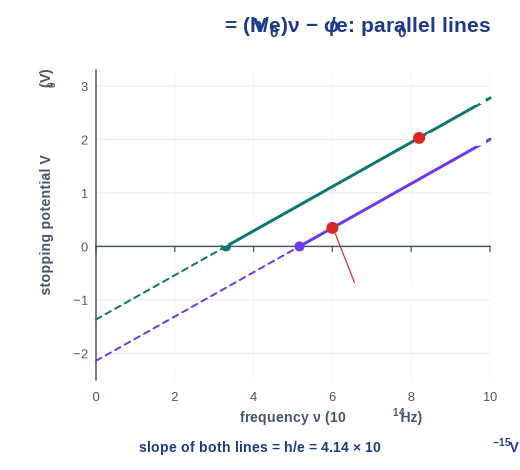
eV₀ = hν − φ₀ se V₀ = (h/e)ν − φ₀/e, isliye V₀–ν line ka slope h/e hai. To
h = e × slope = 1.6 × 10⁻¹⁹ C × 4.12 × 10⁻¹⁵ V s = 6.59 × 10⁻³⁴ J s
(Millikan ne isi tarah h nikaala tha.)
11.6 Ek metal ki threshold frequency 3.3 × 10¹⁴ Hz hai. Agar 8.2 × 10¹⁴ Hz frequency ki light metal par padti hai, to photoelectric emission ka cut-off voltage batao.
eV₀ = hν − hν₀ = h(ν − ν₀), isliye
V₀ = h(ν − ν₀)/e = 6.63 × 10⁻³⁴ × (8.2 − 3.3) × 10¹⁴/1.6 × 10⁻¹⁹ = 6.63 × 10⁻³⁴ × 4.9 × 10¹⁴/1.6 × 10⁻¹⁹ = 2.0 V (2.03 V)
11.7 Ek metal ka work function 4.2 eV hai. Kya ye metal 330 nm wavelength ki incident radiation se photoelectric emission degi?
Photon energy: hc/λ = (6.63 × 10⁻³⁴ × 3 × 10⁸)/(330 × 10⁻⁹) = 6.03 × 10⁻¹⁹ J = 6.03 × 10⁻¹⁹/1.6 × 10⁻¹⁹ eV = 3.77 eV
Ye work function, 4.2 eV, se kam hai, isliye nahi, koi photoelectric emission nahi hoga, radiation kitni bhi tez ho.
Doosra tareeka: ν = c/λ = 9.09 × 10¹⁴ Hz, jabki threshold ν₀ = φ₀/h = (4.2 × 1.6 × 10⁻¹⁹)/(6.63 × 10⁻³⁴) = 1.01 × 10¹⁵ Hz hai. ν < ν₀, isliye emission nahi. (Threshold wavelength hc/φ₀ = 296 nm hai; 330 nm usse lambi hai.)
11.8 7.21 × 10¹⁴ Hz frequency ki light ek metal surface par padti hai. Surface se 6.0 × 10⁵ m/s maximum speed wale electrons nikalte hain. Electrons ke photoemission ki threshold frequency kya hai?
K_max = ½mv²_max = ½ × 9.11 × 10⁻³¹ × (6.0 × 10⁵)² = 1.64 × 10⁻¹⁹ J
K_max = h(ν − ν₀) se
ν₀ = ν − K_max/h = 7.21 × 10¹⁴ − 1.64 × 10⁻¹⁹/6.63 × 10⁻³⁴ = 7.21 × 10¹⁴ − 2.47 × 10¹⁴ = 4.74 × 10¹⁴ Hz
(Key 4.73 × 10¹⁴ Hz deti hai; bina round kiye value 4.737 × 10¹⁴ Hz hai.)
11.9 Argon laser 488 nm wavelength ki light banata hai jo photoelectric effect mein use hoti hai. Jab is spectral line ki light emitter par padti hai, to photoelectrons ka stopping (cut-off) potential 0.38 V hai. Emitter jis material ka bana hai uska work function nikalo.
Photon energy: hc/λ = (6.63 × 10⁻³⁴ × 3 × 10⁸)/(488 × 10⁻⁹) = 4.08 × 10⁻¹⁹ J = 2.55 eV
φ₀ = hc/λ − eV₀ = 2.55 eV − 0.38 eV = 2.17 eV = 2.17 × 1.6 × 10⁻¹⁹ J = 3.47 × 10⁻¹⁹ J
(Key 2.16 eV = 3.46 × 10⁻¹⁹ J deti hai, jo Appendix A3 ke constants se aata hai; farq sirf rounding ka hai.)
Exercises 11.10 aur 11.11: de Broglie wavelength
11.10 In ki de Broglie wavelength kya hai: (a) 1.0 km/s speed se chalti 0.040 kg mass ki goli, (b) 1.0 m/s speed se chalti 0.060 kg mass ki ball, aur (c) 2.2 m/s speed se tairta 1.0 × 10⁻⁹ kg mass ka dhool ka kan?
Har case mein λ = h/mv.
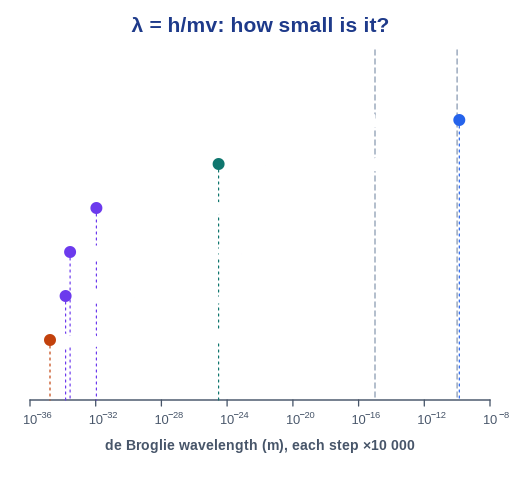
(a) v = 1.0 km/s = 1.0 × 10³ m/s, p = 0.040 × 1.0 × 10³ = 40 kg m/s, λ = 6.63 × 10⁻³⁴/40 = 1.7 × 10⁻³⁵ m
(b) p = 0.060 × 1.0 = 0.060 kg m/s, λ = 6.63 × 10⁻³⁴/0.060 = 1.1 × 10⁻³² m
(c) p = 1.0 × 10⁻⁹ × 2.2 = 2.2 × 10⁻⁹ kg m/s, λ = 6.63 × 10⁻³⁴/2.2 × 10⁻⁹ = 3.0 × 10⁻²⁵ m
(Answer key (c) ke liye 3.0 × 10⁻²³ m chhaapti hai; 6.63 × 10⁻³⁴/2.2 × 10⁻⁹ = 3.01 × 10⁻²⁵ m, isliye key ki power of ten misprint hai.) Teeno wavelengths dekhne ke liye bahut chhoti hain.
11.11 Dikhao ki electromagnetic radiation ki wavelength uske quantum (photon) ki de Broglie wavelength ke barabar hai.
ν frequency ki radiation ke photon ki energy E = hν aur momentum
p = E/c = hν/c
hai. Uski de Broglie wavelength
λ = h/p = h/(hν/c) = c/ν
Par c/ν hi ν frequency ki electromagnetic radiation ki wavelength hai (c = νλ se). Isliye photon ki de Broglie wavelength radiation ki wavelength ke barabar hai.
Worked examples 11.1 se 11.3
Example 11.1 (page 284): ek laser 2.0 × 10⁻³ W power par 6.0 × 10¹⁴ Hz ki light deta hai. Ek photon ki energy aur har second nikalne wale photons ki sankhya nikalo.
(a) E = hν = 6.63 × 10⁻³⁴ × 6.0 × 10¹⁴ = 3.98 × 10⁻¹⁹ J
(b) Power = har second N photons × har ek ki E, yaani P = NE, isliye N = P/E = 2.0 × 10⁻³/3.98 × 10⁻¹⁹ = 5.0 × 10¹⁵ photons har second.
Example 11.2 (page 284): caesium ka work function 2.14 eV hai. Uski threshold frequency, aur wo wavelength nikalo jiske liye stopping potential 0.60 V hai.
(a) Threshold par hν₀ = φ₀, isliye ν₀ = φ₀/h = (2.14 × 1.6 × 10⁻¹⁹ J)/(6.63 × 10⁻³⁴ J s) = 5.16 × 10¹⁴ Hz. Isse kam frequencies koi electron nahi nikaalti.
(b) eV₀ = hc/λ − φ₀, isliye λ = hc/(eV₀ + φ₀) = (6.63 × 10⁻³⁴ × 3 × 10⁸)/((0.60 + 2.14) × 1.6 × 10⁻¹⁹) = 19.89 × 10⁻²⁶/(4.38 × 10⁻¹⁹) m = 454 nm.
Example 11.3 (page 286): 5.4 × 10⁶ m/s par electron aur 30.0 m/s par 150 g ki ball ki de Broglie wavelength nikalo.
(a) p = 9.11 × 10⁻³¹ × 5.4 × 10⁶ = 4.92 × 10⁻²⁴ kg m/s, λ = 6.63 × 10⁻³⁴/4.92 × 10⁻²⁴ = 0.135 nm, X-ray wavelengths jitni.
(b) p = 0.150 × 30.0 = 4.50 kg m/s, λ = 6.63 × 10⁻³⁴/4.50 = 1.47 × 10⁻³⁴ m, measurement se bahut pare.
Check karne ke liye notes
- Answer key (page 351) Exercises 11.1, 11.3 se 11.7 aur 11.11, aur 11.10(a) aur (b) se milti hai.
- Key 11.10(c) 3.0 × 10⁻²³ m chhaapti hai; h/mv = 6.63 × 10⁻³⁴/(1.0 × 10⁻⁹ × 2.2) = 3.0 × 10⁻²⁵ m.
- Key 11.2: 0.34 eV aur 0.34 V zyada precise constants (h = 6.626 × 10⁻³⁴ J s, e = 1.602 × 10⁻¹⁹ C) se aate hain; book ke example constants 0.35 eV dete hain. Key ki 344 km/s uske round kiye 0.54 × 10⁻¹⁹ J se aati hai; bina rounding ke speed constants ke hisaab se 347–349 km/s hai.
- Key 11.8 4.73 × 10¹⁴ Hz aur key 11.9 2.16 eV chhaapti hai; oopar ki values, 4.74 × 10¹⁴ Hz aur 2.17 eV, sirf rounding se alag hain.
- Exercise 11.7 book mein “hotoelectric” chhapa hai (“photoelectric” ka ‘p’ chhoot gaya).
- Exercise 11.1 X-rays banne ke baare mein hai, jo 2026-27 chapter ab nahi samjhata; hal sirf energy conservation, eV = hν_max, use karta hai.
Practice karo
-
Ek experiment mein stopping potential 0.80 V hai. Photoelectrons ki maximum kinetic energy hai:
Jawab dekho
Jawab: (b) 0.80 eV
-
Same frequency par double intensity ki light photocell par padti hai. Stopping potential:
Jawab dekho
Jawab: (c) same rehta hai
-
Ek metal ki threshold frequency 5.0 × 10¹⁴ Hz hai. Uska work function lagbhag hai (h = 6.63 × 10⁻³⁴ J s):
Jawab dekho
Jawab: (b) 2.1 eV
-
400 nm wavelength ki light 2.0 eV work function wali metal par padti hai. Stopping potential nikalo (h = 6.63 × 10⁻³⁴ J s, c = 3 × 10⁸ m/s, e = 1.6 × 10⁻¹⁹ C).
Jawab dekho
Jawab: hc/λ = (6.63 × 10⁻³⁴ × 3 × 10⁸)/(400 × 10⁻⁹) = 4.97 × 10⁻¹⁹ J = 3.11 eV. K_max = 3.11 − 2.0 = 1.11 eV, isliye V₀ = 1.1 V.
-
5.0 m/s se chalti 0.20 kg ki ball ki de Broglie wavelength nikalo.
Jawab dekho
Jawab: p = mv = 0.20 × 5.0 = 1.0 kg m/s, isliye λ = h/p = 6.63 × 10⁻³⁴ m, dekhne ke liye bahut chhoti.
Koi sawal atak gaya?
Photo lo, Lagnever AI step-by-step samjhayega. 7 din ka trial sirf ₹2.
Google Play se app lo Browser mein kholo
Parents ke liye: trial ke baad plan har mahine UPI ya card autopay se renew hota hai. App mein kabhi bhi cancel kar sakte hain.