
NCERT Solutions Class 12 Physics Chapter 11: Dual Nature of Radiation and Matter
Answers to all 11 end-of-chapter exercises and the three worked examples of Chapter 11, Dual Nature of Radiation and Matter, of Physics Part II, the Class 12 NCERT textbook. Page numbers follow the 2026-27 reprint (pages 274–289). The exercises come first, quoted from the book; the examples follow, restated in short. Every number was also checked by computer. Short notes: Chapter 11 notes.
We use the constants of the book’s worked examples: h = 6.63 × 10⁻³⁴ J s, e = 1.6 × 10⁻¹⁹ C, c = 3 × 10⁸ m/s, m_e = 9.11 × 10⁻³¹ kg, so 1 eV = 1.6 × 10⁻¹⁹ J and h/e = 4.14 × 10⁻¹⁵ V s.
Safety: never look into a laser beam or at an ultraviolet or arc lamp, and never point a laser at anyone. X-ray tubes and photocell set-ups are handled only by trained people or with a teacher.
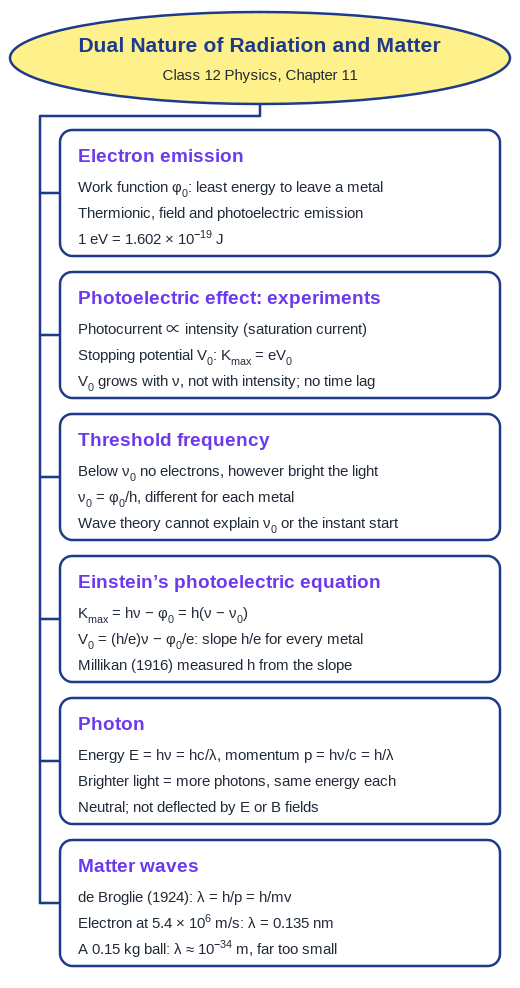
Exercises 11.1 to 11.4: photon energy and momentum
11.1 “Find the (a) maximum frequency, and (b) minimum wavelength of X-rays produced by 30 kV electrons.”
(The idea, Extra since the 2026-27 chapter does not discuss X-ray production: an electron accelerated through 30 kV gains kinetic energy eV, and the most energetic X-ray photon it can produce takes all of that energy.)
eV = 1.6 × 10⁻¹⁹ C × 3.0 × 10⁴ V = 4.8 × 10⁻¹⁵ J
(a) hν_max = eV, so
ν_max = eV/h = 4.8 × 10⁻¹⁵/6.63 × 10⁻³⁴ = 7.24 × 10¹⁸ Hz
(b) λ_min = c/ν_max = 3 × 10⁸/7.24 × 10¹⁸ = 4.14 × 10⁻¹¹ m = 0.0414 nm (about 0.041 nm)
11.2 “The work function of caesium metal is 2.14 eV. When light of frequency 6 × 10¹⁴ Hz is incident on the metal surface, photoemission of electrons occurs. What is the (a) maximum kinetic energy of the emitted electrons, (b) Stopping potential, and (c) maximum speed of the emitted photoelectrons?”
The work function φ₀ is the least energy needed to pull an electron out of the metal.
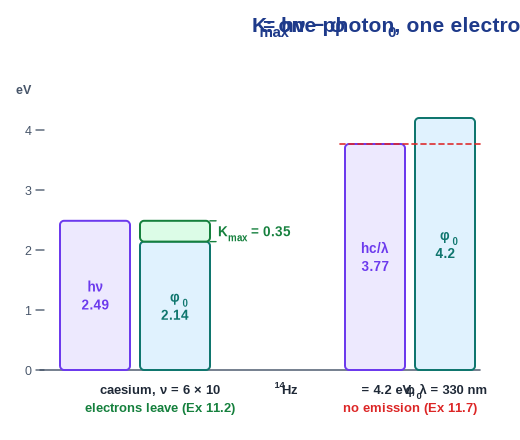
- Photon energy: hν = 6.63 × 10⁻³⁴ × 6 × 10¹⁴ = 3.98 × 10⁻¹⁹ J. Dividing by 1.6 × 10⁻¹⁹ J per eV, hν = 2.49 eV.
- (a) The photon’s energy pays the work function first; the rest is kinetic energy: K_max = hν − φ₀ = 2.49 − 2.14 = 0.35 eV = 0.35 × 1.6 × 10⁻¹⁹ J ≈ 5.5 × 10⁻²⁰ J.
- (b) The stopping potential V₀ is the reverse voltage that just stops the fastest electrons, so eV₀ = K_max and V₀ = 0.35 V.
- (c) ½mv²_max = K_max, so v_max = √(2K_max/m) = √(2 × 5.54 × 10⁻²⁰/9.11 × 10⁻³¹) = √(1.22 × 10¹¹) = 3.5 × 10⁵ m/s.
Answer: (a) 0.35 eV ≈ 5.5 × 10⁻²⁰ J, (b) 0.35 V, (c) 3.5 × 10⁵ m/s (about 349 km/s).
(The answer key gives 0.34 eV, 0.54 × 10⁻¹⁹ J, 0.34 V and 344 km/s. It used the more precise constants of Appendix A3, h = 6.626 × 10⁻³⁴ J s and e = 1.602 × 10⁻¹⁹ C, which give K_max = 0.342 eV. Its speed comes from the rounded 0.54 × 10⁻¹⁹ J. All these values agree to within about 2%.)
11.3 “The photoelectric cut-off voltage in a certain experiment is 1.5 V. What is the maximum kinetic energy of photoelectrons emitted?”
K_max = eV₀ = 1.6 × 10⁻¹⁹ C × 1.5 V = 2.4 × 10⁻¹⁹ J = 1.5 eV
11.4 “Monochromatic light of wavelength 632.8 nm is produced by a helium-neon laser. The power emitted is 9.42 mW. (a) Find the energy and momentum of each photon in the light beam, (b) How many photons per second, on the average, arrive at a target irradiated by this beam? (Assume the beam to have uniform cross-section which is less than the target area), and (c) How fast does a hydrogen atom have to travel in order to have the same momentum as that of the photon?”
(a) Energy: E = hc/λ = (6.63 × 10⁻³⁴ × 3 × 10⁸)/(632.8 × 10⁻⁹) = 3.14 × 10⁻¹⁹ J (1.96 eV)
Momentum: p = h/λ = 6.63 × 10⁻³⁴/632.8 × 10⁻⁹ = 1.05 × 10⁻²⁷ kg m/s
(b) The whole beam falls on the target, so the photons arriving per second are
N = P/E = 9.42 × 10⁻³ W/3.14 × 10⁻¹⁹ J = 3.0 × 10¹⁶ photons per second
(c) A hydrogen atom has mass m_H ≈ 1.67 × 10⁻²⁷ kg (practically the proton mass, 1.673 × 10⁻²⁷ kg in Appendix A3). For m_H v = p,
v = p/m_H = 1.05 × 10⁻²⁷/1.67 × 10⁻²⁷ = 0.63 m/s
That is slower than walking: a photon’s momentum is very small.
Exercises 11.5 to 11.9: Einstein’s photoelectric equation
11.5 “In an experiment on photoelectric effect, the slope of the cut-off voltage versus frequency of incident light is found to be 4.12 × 10⁻¹⁵ V s. Calculate the value of Planck’s constant.”
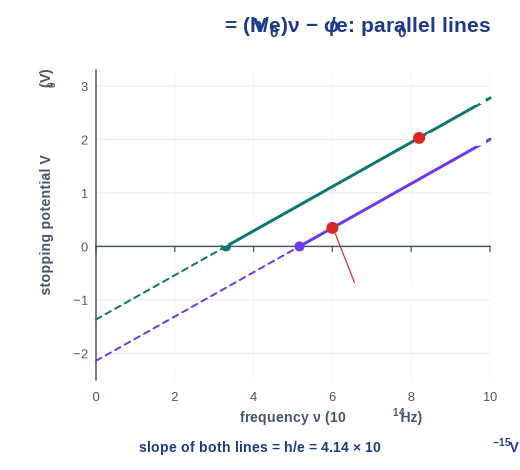
From eV₀ = hν − φ₀, V₀ = (h/e)ν − φ₀/e, so the slope of the V₀–ν line is h/e. Then
h = e × slope = 1.6 × 10⁻¹⁹ C × 4.12 × 10⁻¹⁵ V s = 6.59 × 10⁻³⁴ J s
(This is how Millikan found h.)
11.6 “The threshold frequency for a certain metal is 3.3 × 10¹⁴ Hz. If light of frequency 8.2 × 10¹⁴ Hz is incident on the metal, predict the cut-off voltage for the photoelectric emission.”
eV₀ = hν − hν₀ = h(ν − ν₀), so
V₀ = h(ν − ν₀)/e = 6.63 × 10⁻³⁴ × (8.2 − 3.3) × 10¹⁴/1.6 × 10⁻¹⁹ = 6.63 × 10⁻³⁴ × 4.9 × 10¹⁴/1.6 × 10⁻¹⁹ = 2.0 V (2.03 V)
11.7 “The work function for a certain metal is 4.2 eV. Will this metal give [p]hotoelectric emission for incident radiation of wavelength 330 nm?”
Photon energy: hc/λ = (6.63 × 10⁻³⁴ × 3 × 10⁸)/(330 × 10⁻⁹) = 6.03 × 10⁻¹⁹ J = 6.03 × 10⁻¹⁹/1.6 × 10⁻¹⁹ eV = 3.77 eV
This is less than the work function, 4.2 eV, so no, there is no photoelectric emission, however intense the radiation.
Another way: ν = c/λ = 9.09 × 10¹⁴ Hz, while the threshold is ν₀ = φ₀/h = (4.2 × 1.6 × 10⁻¹⁹)/(6.63 × 10⁻³⁴) = 1.01 × 10¹⁵ Hz. Since ν < ν₀, no emission. (The threshold wavelength is hc/φ₀ = 296 nm; 330 nm is longer.)
11.8 “Light of frequency 7.21 × 10¹⁴ Hz is incident on a metal surface. Electrons with a maximum speed of 6.0 × 10⁵ m/s are ejected from the surface. What is the threshold frequency for photoemission of electrons?”
K_max = ½mv²_max = ½ × 9.11 × 10⁻³¹ × (6.0 × 10⁵)² = 1.64 × 10⁻¹⁹ J
From K_max = h(ν − ν₀),
ν₀ = ν − K_max/h = 7.21 × 10¹⁴ − 1.64 × 10⁻¹⁹/6.63 × 10⁻³⁴ = 7.21 × 10¹⁴ − 2.47 × 10¹⁴ = 4.74 × 10¹⁴ Hz
(The key prints 4.73 × 10¹⁴ Hz; the unrounded value is 4.737 × 10¹⁴ Hz.)
11.9 “Light of wavelength 488 nm is produced by an argon laser which is used in the photoelectric effect. When light from this spectral line is incident on the emitter, the stopping (cut-off) potential of photoelectrons is 0.38 V. Find the work function of the material from which the emitter is made.”
Photon energy: hc/λ = (6.63 × 10⁻³⁴ × 3 × 10⁸)/(488 × 10⁻⁹) = 4.08 × 10⁻¹⁹ J = 2.55 eV
φ₀ = hc/λ − eV₀ = 2.55 eV − 0.38 eV = 2.17 eV = 2.17 × 1.6 × 10⁻¹⁹ J = 3.47 × 10⁻¹⁹ J
(The key gives 2.16 eV = 3.46 × 10⁻¹⁹ J, which is what the Appendix A3 constants give; the difference is only rounding.)
Exercises 11.10 and 11.11: de Broglie wavelength
11.10 “What is the de Broglie wavelength of (a) a bullet of mass 0.040 kg travelling at the speed of 1.0 km/s, (b) a ball of mass 0.060 kg moving at a speed of 1.0 m/s, and (c) a dust particle of mass 1.0 × 10⁻⁹ kg drifting with a speed of 2.2 m/s?”
λ = h/mv in each case.
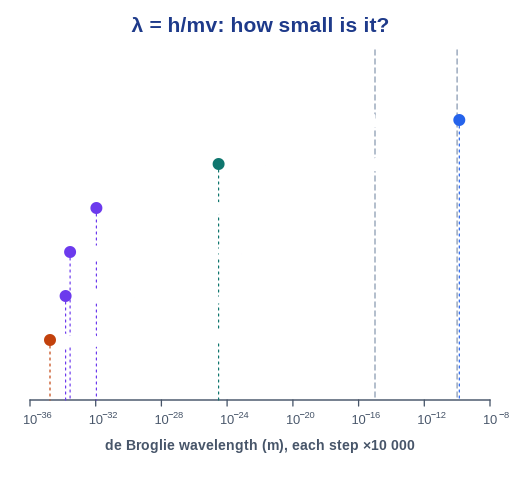
(a) v = 1.0 km/s = 1.0 × 10³ m/s, p = 0.040 × 1.0 × 10³ = 40 kg m/s, λ = 6.63 × 10⁻³⁴/40 = 1.7 × 10⁻³⁵ m
(b) p = 0.060 × 1.0 = 0.060 kg m/s, λ = 6.63 × 10⁻³⁴/0.060 = 1.1 × 10⁻³² m
(c) p = 1.0 × 10⁻⁹ × 2.2 = 2.2 × 10⁻⁹ kg m/s, λ = 6.63 × 10⁻³⁴/2.2 × 10⁻⁹ = 3.0 × 10⁻²⁵ m
(The answer key prints 3.0 × 10⁻²³ m for (c); 6.63 × 10⁻³⁴/2.2 × 10⁻⁹ = 3.01 × 10⁻²⁵ m, so the key’s power of ten is a misprint.) All three wavelengths are far too small to observe.
11.11 “Show that the wavelength of electromagnetic radiation is equal to the de Broglie wavelength of its quantum (photon).”
A photon of radiation of frequency ν has energy E = hν and momentum
p = E/c = hν/c
Its de Broglie wavelength is
λ = h/p = h/(hν/c) = c/ν
But c/ν is exactly the wavelength of electromagnetic radiation of frequency ν (from c = νλ). So the de Broglie wavelength of the photon equals the wavelength of the radiation.
Worked examples 11.1 to 11.3
Example 11.1 (page 284): a laser gives light of 6.0 × 10¹⁴ Hz with power 2.0 × 10⁻³ W. Find the energy of one photon and the number of photons emitted per second.
(a) E = hν = 6.63 × 10⁻³⁴ × 6.0 × 10¹⁴ = 3.98 × 10⁻¹⁹ J
(b) The power is N photons per second times E each, P = NE, so N = P/E = 2.0 × 10⁻³/3.98 × 10⁻¹⁹ = 5.0 × 10¹⁵ photons per second.
Example 11.2 (page 284): caesium has work function 2.14 eV. Find its threshold frequency, and the wavelength of light for which the stopping potential is 0.60 V.
(a) At threshold hν₀ = φ₀, so ν₀ = φ₀/h = (2.14 × 1.6 × 10⁻¹⁹ J)/(6.63 × 10⁻³⁴ J s) = 5.16 × 10¹⁴ Hz. Lower frequencies eject no electrons.
(b) eV₀ = hc/λ − φ₀, so λ = hc/(eV₀ + φ₀) = (6.63 × 10⁻³⁴ × 3 × 10⁸)/((0.60 + 2.14) × 1.6 × 10⁻¹⁹) = 19.89 × 10⁻²⁶/(4.38 × 10⁻¹⁹) m = 454 nm.
Example 11.3 (page 286): find the de Broglie wavelength of an electron at 5.4 × 10⁶ m/s and of a 150 g ball at 30.0 m/s.
(a) p = 9.11 × 10⁻³¹ × 5.4 × 10⁶ = 4.92 × 10⁻²⁴ kg m/s, λ = 6.63 × 10⁻³⁴/4.92 × 10⁻²⁴ = 0.135 nm, comparable with X-ray wavelengths.
(b) p = 0.150 × 30.0 = 4.50 kg m/s, λ = 6.63 × 10⁻³⁴/4.50 = 1.47 × 10⁻³⁴ m, far beyond measurement.
Notes for checking
- The answer key (page 351) agrees with Exercises 11.1, 11.3 to 11.7 and 11.11, and with 11.10(a) and (b).
- Key 11.10(c) prints 3.0 × 10⁻²³ m; h/mv = 6.63 × 10⁻³⁴/(1.0 × 10⁻⁹ × 2.2) = 3.0 × 10⁻²⁵ m.
- Key 11.2: 0.34 eV and 0.34 V come from the more precise constants (h = 6.626 × 10⁻³⁴ J s, e = 1.602 × 10⁻¹⁹ C); the book’s example constants give 0.35 eV. The key’s 344 km/s follows from its rounded 0.54 × 10⁻¹⁹ J; the unrounded speed is 347–349 km/s depending on the constants.
- Key 11.8 prints 4.73 × 10¹⁴ Hz and key 11.9 2.16 eV; the values above, 4.74 × 10¹⁴ Hz and 2.17 eV, differ only by rounding.
- Exercise 11.7 is printed “hotoelectric”; the quote above restores the missing letter in brackets.
- Exercise 11.1 is about X-ray production, which the 2026-27 chapter no longer explains; the solution uses only energy conservation, eV = hν_max.
Practice
-
The stopping potential in an experiment is 0.80 V. The maximum kinetic energy of the photoelectrons is:
Show answer
Answer: (b) 0.80 eV
-
Light of the same frequency but twice the intensity falls on a photocell. The stopping potential:
Show answer
Answer: (c) stays the same
-
A metal’s threshold frequency is 5.0 × 10¹⁴ Hz. Its work function is about (h = 6.63 × 10⁻³⁴ J s):
Show answer
Answer: (b) 2.1 eV
-
Light of wavelength 400 nm falls on a metal of work function 2.0 eV. Find the stopping potential (h = 6.63 × 10⁻³⁴ J s, c = 3 × 10⁸ m/s, e = 1.6 × 10⁻¹⁹ C).
Show answer
Answer: hc/λ = (6.63 × 10⁻³⁴ × 3 × 10⁸)/(400 × 10⁻⁹) = 4.97 × 10⁻¹⁹ J = 3.11 eV. K_max = 3.11 − 2.0 = 1.11 eV, so V₀ = 1.1 V.
-
Find the de Broglie wavelength of a 0.20 kg ball moving at 5.0 m/s.
Show answer
Answer: p = mv = 0.20 × 5.0 = 1.0 kg m/s, so λ = h/p = 6.63 × 10⁻³⁴ m, far too small to observe.
Stuck on a question?
Take a photo and Lagnever AI explains it step by step. Try it for 7 days for ₹2.
Get it on Google Play Open in browser
For parents: after the trial, the plan renews monthly by UPI or card autopay. You can cancel anytime in the app.