
Class 12 Physics Chapter 11: Dual Nature of Radiation and Matter Notes
This chapter in five lines
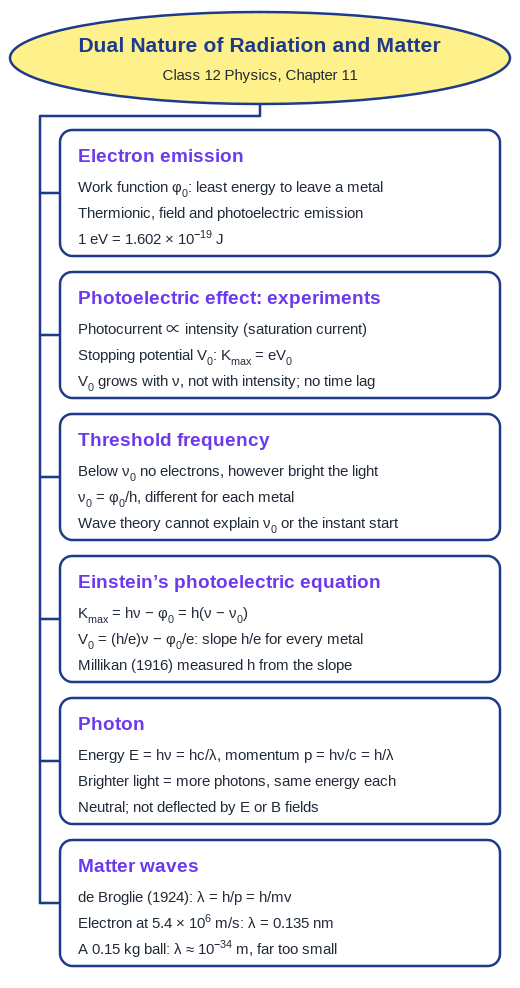
Light falling on a metal can knock out electrons (the photoelectric effect). The photocurrent grows with intensity, but the stopping potential, and so the maximum kinetic energy eV₀, depends only on the frequency, and below a threshold frequency ν₀ nothing comes out. The wave picture cannot explain this; Einstein’s photon picture can: K_max = hν − φ₀. A photon has energy hν and momentum h/λ. De Broglie proposed that moving matter also has a wavelength, λ = h/p = h/mv.
What is this chapter about?
By the end of the nineteenth century, Maxwell’s equations and Hertz’s experiments of 1887 had made it clear that light is an electromagnetic wave (Chapters 8 and 10). Yet in the same years, experiments on electricity passing through gases and on light falling on metals turned up results that waves could not explain. This chapter (book pages 274 to 289) follows that story: light sometimes acts as a stream of particles, the photons, and moving particles such as electrons have a wavelength. That is the dual nature of radiation and of matter.
The book starts with the electron itself:
- Electric discharge through a gas at very low pressure (about 0.001 mm of mercury) makes the glass opposite the cathode glow. William Crookes found these cathode rays in 1870 and suggested in 1879 that they were fast negative particles.
- J. J. Thomson used crossed electric and magnetic fields to measure their speed (between a tenth and a fifth of the speed of light) and their specific charge e/m, presently taken as 1.76 × 10¹¹ C/kg. The value was the same whatever the cathode metal or the gas, so the particles were universal. In 1897 he named them electrons, and he received the Nobel Prize in 1906.
- Particles given out by metals under ultraviolet light, or by hot metals, had the same e/m: they were electrons too.
- In 1913 R. A. Millikan’s oil-drop experiment showed that charge always comes in whole multiples of 1.602 × 10⁻¹⁹ C: charge is quantised. From e and e/m, the electron’s mass follows.
Safety: ultraviolet light harms the eyes and skin. Never look at an arc lamp, a UV lamp or the Sun, and never look into a laser beam. Photoelectric experiments use a low-voltage cell supply and are done only in a lab, with a teacher.
What is the work function?
A metal holds free electrons, which carry its current, but they cannot simply leave. If an electron starts to escape, the metal is left with a positive charge that pulls it back: the positive ions hold it in. To get out, an electron must be given some extra energy. The least energy that lets an electron escape from the surface is the work function φ₀ of the metal. It depends on the metal and on the nature of its surface.
Work functions are usually given in electron volts. One electron volt is the energy an electron gains in moving through a potential difference of 1 V:
1 eV = 1.602 × 10⁻¹⁹ J
The energy can be supplied in three ways:
- Thermionic emission: heat the metal enough and the electrons get the energy from heat.
- Field emission: an intense electric field, around 10⁸ V/m, pulls electrons out, as in a spark plug.
- Photoelectric emission: light of a suitable frequency falls on the metal and electrons come out. These are photoelectrons.
Because electrons inside a metal have a spread of energies, the energy needed to release one differs from electron to electron; the work function is the minimum, for the most energetic ones.
How was the photoelectric effect discovered?
Hertz (1887). While producing electromagnetic waves with a spark discharge, Heinrich Hertz noticed that the sparks across his detector loop grew stronger when the emitter plate was lit by ultraviolet light from an arc lamp. The light was helping charged particles (electrons, as we now know) escape from the metal.
Hallwachs and Lenard (1886–1902).
- Lenard shone ultraviolet light on the emitter plate inside an evacuated tube with two electrodes. A current flowed in the circuit, and it stopped the moment the light was cut off: electrons leaving the lit plate C were drawn across to the positive collector A.
- Hallwachs (1888) connected an electroscope to a zinc plate carrying negative charge. Under ultraviolet light it lost its charge. An uncharged zinc plate became positive, and a positive plate became more positive. So the light was knocking negative particles out of the zinc.
- They also found that below a certain minimum frequency, the threshold frequency, no electrons came out at all, and that this frequency depends on the emitter material.
Zinc, cadmium and magnesium respond only to ultraviolet light, of short wavelength. The alkali metals lithium, sodium, potassium, caesium and rubidium respond even to visible light. All such photosensitive materials give out photoelectrons, and the whole process is the photoelectric effect. Read the photoelectric effect.
How is the photoelectric effect studied?
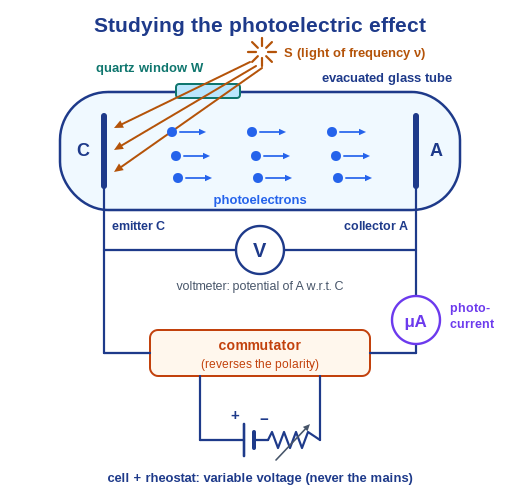
The arrangement is an evacuated glass or quartz tube holding a thin photosensitive plate C (the emitter) and a metal plate A (the collector). Monochromatic light of short enough wavelength from a source S enters through a quartz window W (quartz lets ultraviolet through) and falls on C. A cell with a rheostat keeps a variable potential difference between C and A; a commutator reverses it, so A can be made positive or negative with respect to C. A voltmeter reads the potential difference and a microammeter reads the photocurrent. Coloured filters change the frequency of the light, and moving the source nearer or farther changes its intensity.
Effect of intensity
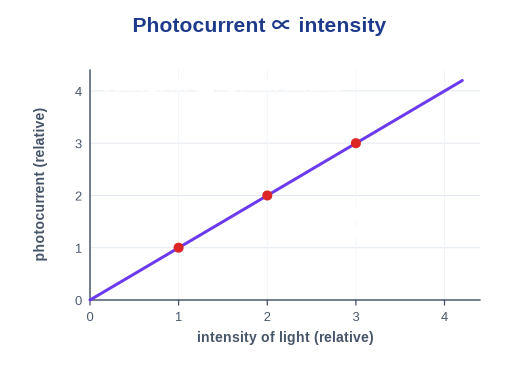
Keep the frequency and the (positive) collector potential fixed and vary only the intensity. The photocurrent rises in proportion to the intensity. Since the current counts electrons per second, the rate at which photoelectrons are emitted is proportional to the intensity of the light.
Effect of the collector potential
Now fix the frequency and the intensity and change the potential of A.
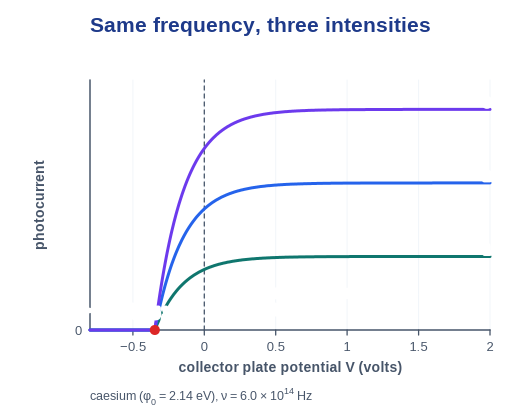
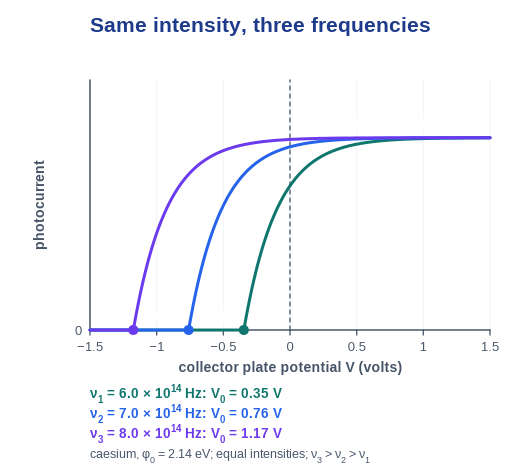
- A positive (accelerating): as the potential is raised, the current grows until every emitted electron reaches A. After that it stays at its largest value, the saturation current, however much more the potential is raised.
- A negative (retarding): the electrons are pushed back, and only the faster ones reach A. The current falls quickly and becomes zero at a sharply defined negative potential −V₀. This stopping (cut-off) potential V₀ is just enough to turn back even the most energetic electron, so
K_max = eV₀
The photoelectrons do not all have the same energy; V₀ measures the largest one.
Repeat with the same frequency but higher intensities I₂ and I₃: the saturation current rises in proportion, yet V₀ stays the same. So for a given frequency, the stopping potential, and with it K_max, does not depend on the intensity.
Effect of frequency
Adjust the light so that the intensity is the same at several frequencies. The saturation current is now the same for all, but the stopping potential is larger for higher frequency: if ν₃ > ν₂ > ν₁, then V₀₃ > V₀₂ > V₀₁. Higher frequency gives faster electrons.
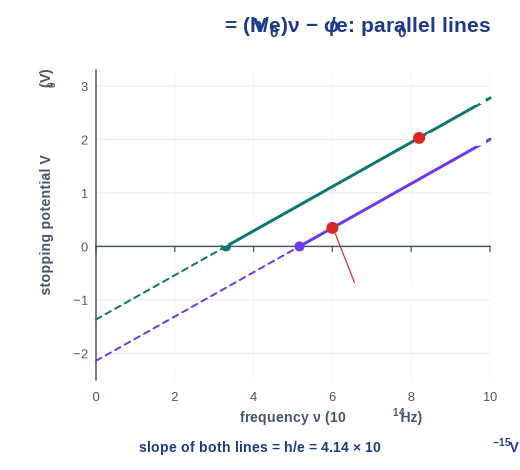
Plotting V₀ against ν for different metals gives straight lines. Each line meets the frequency axis at a cut-off frequency ν₀, where V₀ = 0. This tells us two things:
- K_max grows linearly with frequency and does not depend on intensity.
- Below ν₀, the threshold frequency, there is no emission at all, however intense the light. ν₀ differs from metal to metal.
Different materials respond differently: selenium responds more readily than zinc or copper, and copper gives photoelectrons with ultraviolet light but not with green or red light. Finally, whenever the frequency is above threshold, emission starts at once, within about 10⁻⁹ s, even in very dim light.
The four observations
- For a given material and frequency (above ν₀), the photocurrent is proportional to the intensity.
- The saturation current is proportional to the intensity; the stopping potential does not depend on it.
- Below a threshold frequency ν₀ there is no emission, however intense the light. Above it, V₀ (and K_max) rises linearly with ν and is independent of intensity.
- Emission is instantaneous (~10⁻⁹ s or less), even for very dim light.
Why does the wave theory fail?
In the wave picture, light is a continuous spread of electric and magnetic fields, and electrons at the surface soak up energy continuously. Then:
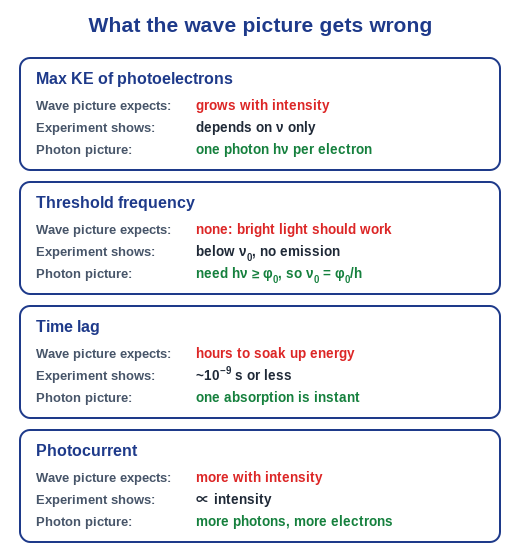
- a more intense beam has bigger fields, so each electron should get more energy, and K_max should grow with intensity (it does not: observation 2);
- light of any frequency, if intense enough and given enough time, should free electrons, so there should be no threshold (there is: observation 3);
- the energy is shared among the many electrons across the whole wavefront, so in dim light an electron would need hours to collect enough (emission is instant: observation 4).
The stopping-potential results, its independence of intensity and its dependence on frequency, are what really separate the two pictures.
What is Einstein’s photoelectric equation?
In 1905 Albert Einstein proposed that radiation energy comes in discrete packets, quanta, each of energy hν, where h is Planck’s constant and ν the frequency. An electron absorbs one whole quantum. If hν is more than the work function, the electron escapes, and the most loosely held electrons come out with
K_max = hν − φ₀
Electrons held more tightly come out with less. Every observation now follows:
- K_max depends linearly on ν and not at all on intensity, because the basic event is one photon meeting one electron.
- Since K_max cannot be negative, emission needs hν > φ₀, that is ν > ν₀ = φ₀/h. A bigger work function means a higher threshold.
- Intensity is the number of quanta per unit area per unit time. More quanta means more electrons emitted, so the photocurrent is proportional to intensity (for ν > ν₀).
- Absorbing a quantum is a single, instant event, so even dim light causes emission at once; dimness only means fewer electrons.
Using K_max = eV₀:
eV₀ = hν − φ₀, so V₀ = (h/e)ν − φ₀/e (for ν ≥ ν₀)
The V₀–ν graph should therefore be a straight line of slope h/e for every metal, cutting the V₀ axis (when extended) at −φ₀/e. Millikan set out in 1906–1916 to disprove the equation. Measuring the slope for sodium and using the known e, he found h close to the value 6.626 × 10⁻³⁴ J s obtained in a completely different context. By 1916 he had confirmed Einstein’s equation, with great precision, for several alkali metals. Einstein received the 1921 Nobel Prize in Physics for his work in theoretical physics and on the photoelectric effect.
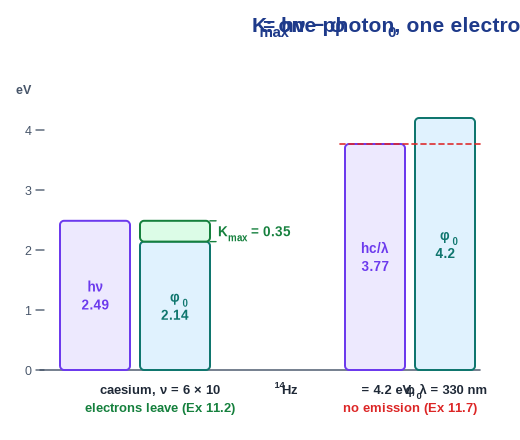
Example 11.2 (page 284): caesium has φ₀ = 2.14 eV, so its threshold frequency is ν₀ = φ₀/h = (2.14 × 1.6 × 10⁻¹⁹)/(6.63 × 10⁻³⁴) = 5.16 × 10¹⁴ Hz. If the stopping potential is 0.60 V, then hc/λ = eV₀ + φ₀ = 2.74 eV, which gives λ = 454 nm. Worked out in full in the NCERT solutions.
What is a photon?
The photoelectric effect shows that light, when it meets matter, behaves as if made of packets of energy hν. Einstein showed that such a quantum also carries momentum hν/c. A definite energy and a definite momentum suggest a particle, later called the photon. A. H. Compton’s experiment of 1924 on X-rays scattered by electrons confirmed this particle behaviour. (Millikan received the 1923 Nobel Prize for his work on the elementary charge and the photoelectric effect.)
The photon picture in short:
- When radiation interacts with matter, it behaves as if made of photons.
- Each photon has energy E = hν, momentum p = hν/c and speed c.
- All photons of one frequency ν (wavelength λ) have the same E = hν = hc/λ and p = h/λ. Brighter light of the same colour only means more photons per second through a given area.
- Photons have no charge, so electric and magnetic fields do not deflect them.
- In a photon–particle collision, total energy and total momentum are conserved, but the number of photons need not be: a photon can be absorbed or a new one created.
Example 11.1 (page 284): a laser gives 6.0 × 10¹⁴ Hz at 2.0 × 10⁻³ W. Each photon carries E = hν = 3.98 × 10⁻¹⁹ J, so the number emitted per second is N = P/E = 5.0 × 10¹⁵. Read de Broglie wavelength for photon momentum and matter waves.
What is the wave nature of matter?
Light shows wave behaviour (interference, diffraction, polarisation) and particle behaviour (photoelectric and Compton effects); which picture suits depends on the experiment. Even in seeing, both matter: the eye-lens gathers and focuses light as a wave, while the rods and cones of the retina absorb it as photons.
In 1924 Louis Victor de Broglie argued that nature should be symmetrical: if radiation has a dual character, so should matter. He proposed that a particle of momentum p has a wavelength
λ = h/p = h/mv
where m is the mass and v the speed. This is the de Broglie relation, and λ is the de Broglie wavelength. The left side (λ) is a wave property and the right side (p) a particle property; Planck’s constant links them. For a photon, p = hν/c, so h/p = c/ν, exactly the wavelength of the radiation.
Because h is so small, λ is tiny unless m is tiny:
- A ball of 0.12 kg at 20 m/s has p = 2.40 kg m/s and λ = 6.63 × 10⁻³⁴/2.40 = 2.76 × 10⁻³⁴ m, far too small to detect. That is why everyday objects show no wave behaviour.
- Example 11.3 (page 286): an electron at 5.4 × 10⁶ m/s has λ = 0.135 nm, comparable with X-ray wavelengths, while a 150 g ball at 30.0 m/s has λ = 1.47 × 10⁻³⁴ m.
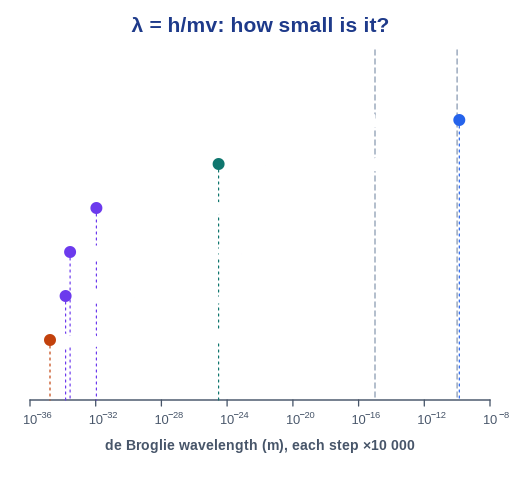
The de Broglie wavelength does not depend on the particle’s charge or nature, only on its momentum. It is measurable (about the spacing of atomic planes in crystals) only for sub-atomic particles like electrons and protons. The relation is a hypothesis that experiment must test. For matter waves, the wavelength and the group velocity (equal to the particle’s velocity) have physical meaning; the phase velocity does not.
Which quantities and units belong to this chapter?
| Quantity | Symbol | Unit | Relation |
|---|---|---|---|
| Planck’s constant | h | J s | E = hν |
| Stopping potential | V₀ | V | eV₀ = K_max |
| Work function | φ₀ | J or eV | K_max = hν − φ₀ |
| Threshold frequency | ν₀ | Hz | ν₀ = φ₀/h |
| de Broglie wavelength | λ | m | λ = h/p |
Handy values: h = 6.63 × 10⁻³⁴ J s (book’s examples), e = 1.6 × 10⁻¹⁹ C, c = 3 × 10⁸ m/s, m_e = 9.11 × 10⁻³¹ kg; h/e = 4.14 × 10⁻¹⁵ V s.
Before we move on
Light knocks electrons out of metals one photon at a time: brighter light means more electrons, higher frequency means faster ones, and below ν₀ = φ₀/h nothing happens. Einstein’s K_max = hν − φ₀ ties it together, and Millikan’s straight lines of slope h/e confirmed it. Turn the idea around and matter has a wavelength too, λ = h/mv, which only tiny particles make noticeable. All eleven exercises and the three worked examples are solved in the NCERT solutions for Chapter 11.
Key terms
| Term | Meaning |
|---|---|
| Work function (φ₀) | The least energy an electron needs to escape from the surface of a metal. It depends on the metal and on the state of its surface, and is usually given in electron volts. |
| Electron volt (eV) | The energy an electron gains when accelerated through a potential difference of 1 V: 1 eV = 1.602 × 10⁻¹⁹ J. |
| Photoelectric effect | The emission of electrons from a metal surface when light of high enough frequency falls on it. The electrons are called photoelectrons. |
| Saturation current | The largest photocurrent for a given light: it flows once the collector is positive enough to collect every electron emitted per second. |
| Stopping (cut-off) potential (V₀) | The smallest negative potential of the collector, relative to the emitter, at which the photocurrent becomes zero. It stops even the fastest photoelectrons, so K_max = eV₀. |
| Threshold frequency (ν₀) | The least frequency of light that can cause photoelectric emission from a given metal; ν₀ = φ₀/h. Below it there is no emission, however intense the light. |
| Einstein’s photoelectric equation | K_max = hν − φ₀: one photon of energy hν is absorbed by one electron, which spends at least φ₀ in leaving the metal. |
| Photon | A quantum of electromagnetic radiation, with energy E = hν, momentum p = hν/c = h/λ and speed c. It has no charge. |
| Planck’s constant (h) | The constant linking a photon’s energy to its frequency: h = 6.626 × 10⁻³⁴ J s (the book’s examples use 6.63 × 10⁻³⁴ J s). |
| de Broglie wavelength | The wavelength of the matter wave of a moving particle: λ = h/p = h/mv. |
Topics in this chapter
Practice
-
For a given metal and frequency, increasing the intensity of light increases:
Show answer
Answer: (c) the saturation current
-
The stopping potential for some light is 2.0 V. The maximum kinetic energy of the photoelectrons is:
Show answer
Answer: (b) 2.0 eV
-
The slope of the graph of stopping potential against frequency equals:
Show answer
Answer: (c) h/e
-
A metal has work function 2.0 eV. Its threshold frequency is about (h = 6.63 × 10⁻³⁴ J s):
Show answer
Answer: (b) 4.8 × 10¹⁴ Hz
-
The momentum of a photon of wavelength λ is:
Show answer
Answer: (b) h/λ
-
An electron and a proton have the same speed. Which has the longer de Broglie wavelength?
Show answer
Answer: (b) the electron
Questions students ask
What are the main topics of Class 12 Physics Chapter 11?
Electron emission and the work function, the photoelectric effect (Hertz, Hallwachs and Lenard), the experimental study of how photocurrent depends on intensity, potential and frequency, why the wave theory fails, Einstein’s photoelectric equation, the photon, and de Broglie’s matter waves. Examples 11.1–11.3 and eleven exercises close the chapter.
Are the Davisson–Germer experiment and the Compton effect in this chapter?
Not in the 2026-27 reprint. The book only mentions that Compton’s X-ray scattering (1924) confirmed the particle nature of light, and it states the de Broglie relation without the electron diffraction experiment.
Why does the stopping potential not depend on intensity?
In the photon picture each electron absorbs one photon. A brighter beam of the same frequency has more photons, so more electrons come out, but each photon still carries hν, so the fastest electrons are no faster. The stopping potential measures that top speed.
Which formulas should I remember from this chapter?
1 eV = 1.602 × 10⁻¹⁹ J; K_max = eV₀; K_max = hν − φ₀ = h(ν − ν₀); ν₀ = φ₀/h; V₀ = (h/e)ν − φ₀/e; E = hν = hc/λ; p = hν/c = h/λ; λ = h/p = h/mv.
Does light behave as a wave or as particles?
Both, depending on the experiment. Interference, diffraction and polarisation need the wave picture; the photoelectric effect needs photons. In seeing, the eye-lens focuses light as a wave, but the rods and cones of the retina absorb it as photons.
Stuck on a question?
Take a photo and Lagnever AI explains it step by step. Try it for 7 days for ₹2.
Get it on Google Play Open in browser
For parents: after the trial, the plan renews monthly by UPI or card autopay. You can cancel anytime in the app.