
What is the de Broglie wavelength?
Answer in short
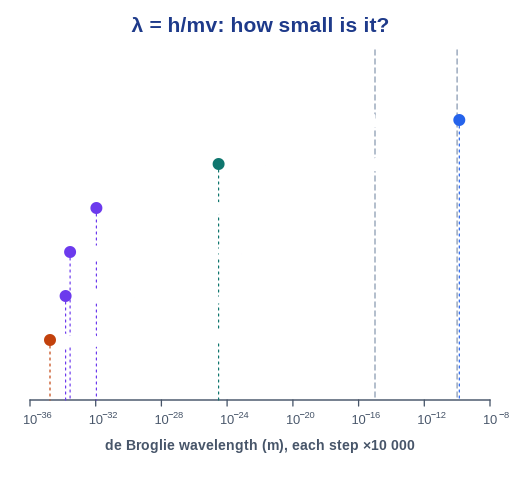
De Broglie (1924) proposed that a moving particle has a wavelength λ = h/p = h/mv, where p is its momentum. For a photon, p = hν/c, so the relation gives back λ = c/ν. Since h is tiny, λ shows up only for very light particles: a fast electron has λ near 0.1 nm, a ball about 10⁻³⁴ m.
Stuck on a question? Take a photo and Lagnever AI explains it step by step. Try it for 7 days for ₹2. Get it on Google Play
Light as particles: the photon
The photoelectric effect shows that light, when it interacts with matter, behaves as if it were made of packets of energy hν. Einstein showed that such a packet also carries momentum hν/c. Something with a definite energy and a definite momentum behaves like a particle, and it was named the photon. In 1924, A. H. Compton’s experiment on X-rays scattered from electrons confirmed this particle-like behaviour.
| Property | Photon of frequency ν (wavelength λ) |
|---|---|
| Energy | E = hν = hc/λ |
| Momentum | p = hν/c = h/λ |
| Speed | c |
| Charge | none: not deflected by electric or magnetic fields |
| Brighter light | more photons per second, each the same |
| In collisions | energy and momentum conserved; photons may be absorbed or created |
Example 11.1 (page 284): a laser of frequency 6.0 × 10¹⁴ Hz emits 2.0 × 10⁻³ W. Each photon has E = hν = 6.63 × 10⁻³⁴ × 6.0 × 10¹⁴ = 3.98 × 10⁻¹⁹ J, and since P = NE, the source emits N = P/E = 2.0 × 10⁻³/3.98 × 10⁻¹⁹ = 5.0 × 10¹⁵ photons per second.
Exercise 11.4 (in short): a 632.8 nm He-Ne laser photon has E = hc/λ = 3.14 × 10⁻¹⁹ J and p = h/λ = 1.05 × 10⁻²⁷ kg m/s. A hydrogen atom would need to move at only about 0.63 m/s to have that momentum.
Safety: never look into a laser beam, even a low-power one, and never point a laser at anyone’s eyes.
Waves and particles together
Light shows its wave side in interference, diffraction and polarisation, and its particle side in the photoelectric and Compton effects. Which description suits depends on the experiment. When you look at something, both are at work: the eye-lens gathers and focuses light as a wave, and the rods and cones of the retina absorb it as photons.
De Broglie’s idea
If radiation has a dual nature, might particles such as electrons and protons also behave as waves? Louis Victor de Broglie, a French physicist, answered yes in 1924. He argued that nature should be symmetrical, so matter, like radiation, should have both aspects. He proposed that a particle of mass m moving with speed v, and so momentum p = mv, has a wavelength
λ = h/p = h/mv
This is the de Broglie relation, and λ is the de Broglie wavelength of the matter wave. The left side, λ, is a wave idea; the right side, p, is a particle idea; Planck’s constant h connects them. De Broglie received the 1929 Nobel Prize for it, and Erwin Schrödinger built it into wave mechanics.
Check with a photon. For a photon, p = hν/c, so
λ = h/p = h/(hν/c) = c/ν
which is just the wavelength of the light. The relation works for photons too (this is Exercise 11.11).
How big is λ?
Since h = 6.63 × 10⁻³⁴ J s is so small, λ is noticeable only when p is small, which means a tiny mass.
A ball (page 285): m = 0.12 kg, v = 20 m/s, so p = 2.40 kg m/s and
λ = 6.63 × 10⁻³⁴/2.40 = 2.76 × 10⁻³⁴ m
That is far beyond any measurement, which is why ordinary objects never show wave behaviour.
Example 11.3 (page 286):
- (a) An electron, m = 9.11 × 10⁻³¹ kg, v = 5.4 × 10⁶ m/s: p = 4.92 × 10⁻²⁴ kg m/s and λ = 6.63 × 10⁻³⁴/4.92 × 10⁻²⁴ = 1.35 × 10⁻¹⁰ m = 0.135 nm, comparable with X-ray wavelengths.
- (b) A ball, m = 0.150 kg, v = 30.0 m/s: p = 4.50 kg m/s and λ = 1.47 × 10⁻³⁴ m, about 10⁻¹⁹ times the size of a proton.
What else to know
- λ depends only on momentum, not on the particle’s charge or kind.
- It is measurable, of the order of the spacing between atomic planes in a crystal, only for sub-atomic particles such as electrons and protons.
- For a matter wave the wavelength and the group velocity (which equals the particle’s velocity) have physical meaning; the phase velocity does not.
- The relation is a hypothesis: only experiment can test it.
All the exercises, including 11.10 (bullet, ball and dust particle) and 11.11, are solved in the NCERT solutions, and the rest of the chapter is in the Chapter 11 notes.
Practice
-
If the speed of a particle is doubled, its de Broglie wavelength becomes:
Show answer
Answer: (b) half
-
A photon of wavelength 600 nm has momentum (h = 6.63 × 10⁻³⁴ J s):
Show answer
Answer: (a) 1.1 × 10⁻²⁷ kg m/s
-
A proton and an electron have the same de Broglie wavelength. They have the same:
Show answer
Answer: (c) momentum
-
Find the de Broglie wavelength of an electron moving at 2.0 × 10⁶ m/s (m = 9.11 × 10⁻³¹ kg).
Show answer
Answer: p = mv = 9.11 × 10⁻³¹ × 2.0 × 10⁶ = 1.82 × 10⁻²⁴ kg m/s. λ = h/p = 6.63 × 10⁻³⁴/1.82 × 10⁻²⁴ = 3.6 × 10⁻¹⁰ m = 0.36 nm.
-
A laser gives 1.0 mW of light at 500 nm. How many photons does it emit per second?
Show answer
Answer: E = hc/λ = (6.63 × 10⁻³⁴ × 3 × 10⁸)/(500 × 10⁻⁹) = 3.98 × 10⁻¹⁹ J. N = P/E = 1.0 × 10⁻³/3.98 × 10⁻¹⁹ = 2.5 × 10¹⁵ photons per second.
Questions students ask
Has the wave nature of electrons been seen?
Extra: yes. Electron beams are diffracted by crystals, whose atomic spacing is close to the electrons’ de Broglie wavelength. The 2026-27 chapter states the de Broglie relation without describing this experiment.
Does light consist of particles, then?
The book is careful here: the photoelectric effect shows that light gives up energy to matter in units of hν. That is not quite the same as saying light simply is a stream of particles. Which description fits depends on the experiment.
Why do the matter waves of a cricket ball never show up?
Its mass makes p = mv huge compared with h, so λ = h/mv comes out around 10⁻³⁴ m, far smaller than a proton. No slit or crystal is anywhere near that small, so no diffraction can be seen.
Stuck on a question?
Take a photo and Lagnever AI explains it step by step. Try it for 7 days for ₹2.
Get it on Google Play Open in browser
For parents: after the trial, the plan renews monthly by UPI or card autopay. You can cancel anytime in the app.