
What is the photoelectric effect?
Answer in short
The photoelectric effect is the emission of electrons from a metal when light of high enough frequency falls on it. The photocurrent grows with intensity, but the stopping potential V₀ (K_max = eV₀) depends only on frequency, and below the threshold ν₀ = φ₀/h nothing comes out. Einstein explained it with photons: K_max = hν − φ₀.
Stuck on a question? Take a photo and Lagnever AI explains it step by step. Try it for 7 days for ₹2. Get it on Google Play
Getting electrons out of a metal
A metal is full of free electrons, but they stay inside: an escaping electron leaves the metal positive, and the positive ions pull it back. Some energy has to be supplied, and the least amount that lets an electron escape is the work function φ₀ (measured in eV; 1 eV = 1.602 × 10⁻¹⁹ J). Heat can supply it (thermionic emission), a very strong field can (field emission), and so can light. Electron emission caused by light is the photoelectric effect, and the electrons are photoelectrons.
Safety: ultraviolet lamps and arc lamps harm the eyes and skin. Never look at them, at the Sun or into a laser. Any photocell experiment is done only with a teacher, on a low-voltage cell supply.
Hertz, Hallwachs and Lenard
- 1887, Hertz: sparks in his detector loop got stronger when ultraviolet light from an arc lamp fell on the emitter plate.
- Lenard: with ultraviolet light on one plate of an evacuated two-plate tube, a current flowed; cut the light and the current stopped.
- 1888, Hallwachs: a negatively charged zinc plate on an electroscope lost its charge under ultraviolet light; a neutral plate turned positive; a positive plate grew more positive. Light was removing negative charges.
- Below a threshold frequency, which depends on the metal, nothing happened at all. Zinc, cadmium and magnesium need ultraviolet light; lithium, sodium, potassium, caesium and rubidium respond even to visible light.
The experiment
An evacuated tube holds the emitter C and the collector A. Light enters through a quartz window and falls on C. A cell and rheostat set the potential of A relative to C, and a commutator reverses it. A voltmeter reads that potential and a microammeter the current.
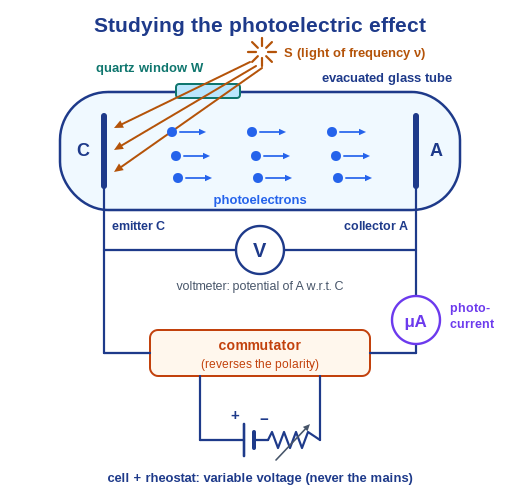
Three things can be changed: the intensity, the frequency and the potential of A.
| What is changed | What is kept fixed | Result |
|---|---|---|
| intensity | ν, positive potential of A | current ∝ intensity |
| potential of A | ν, intensity | current rises to saturation; falls to 0 at −V₀ |
| intensity | ν | saturation current ∝ intensity; V₀ unchanged |
| frequency | intensity | same saturation current; V₀ larger for larger ν |
Saturation current: with A positive enough, every electron that leaves C per second is collected; raising the potential further adds nothing.
Stopping potential: with A negative, electrons are turned back. At −V₀ even the fastest are stopped, so
K_max = eV₀
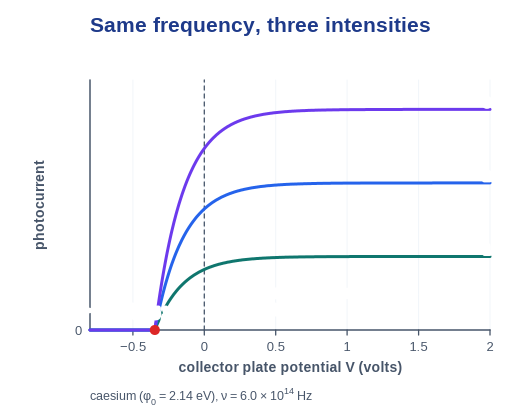
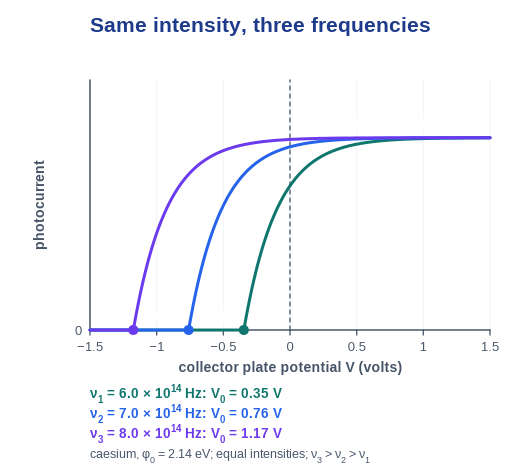
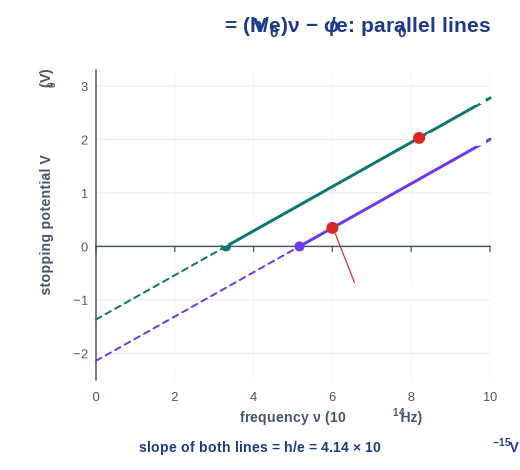
The stopping potentials in these two graphs are computed for caesium (φ₀ = 2.14 eV, the metal of Example 11.2) from Einstein’s equation below; the shape of each rise is only sketched.
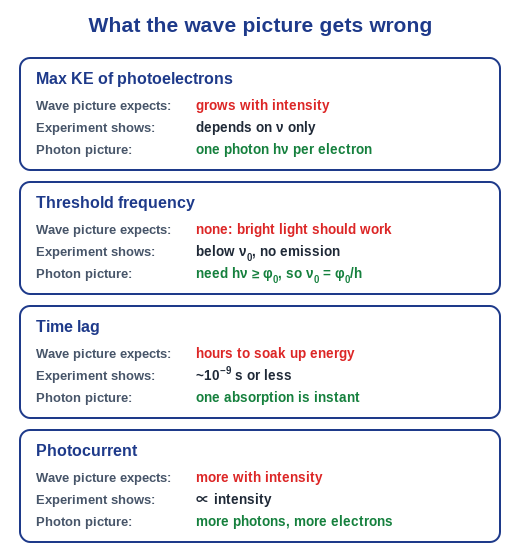
The four facts the wave theory cannot explain
- The photocurrent (and the saturation current) is proportional to intensity.
- V₀, and so K_max, does not depend on intensity.
- There is a threshold frequency ν₀; above it, V₀ rises linearly with ν.
- Emission starts within about 10⁻⁹ s, however dim the light.
A continuous wave would give more energy per electron in a brighter beam (against fact 2), would free electrons at any frequency given time (against fact 3), and in dim light would take hours to feed one electron enough energy (against fact 4).
Einstein’s photoelectric equation
Einstein (1905): light energy comes in quanta of hν, and one electron absorbs one quantum. Energy conservation then gives
K_max = hν − φ₀ = h(ν − ν₀), with ν₀ = φ₀/h
and, since K_max = eV₀,
V₀ = (h/e)ν − φ₀/e
- One photon per electron: K_max depends on ν, not on intensity.
- K_max ≥ 0 needs ν ≥ ν₀: the threshold.
- Intensity = number of photons per unit area per second: more photons, more electrons, more current.
- One absorption is a single, instant event: no time lag.
The V₀–ν line has slope h/e for every metal; only the intercept, −φ₀/e, changes. Millikan measured this slope for sodium and found h, confirming the equation by 1916.
Worked examples
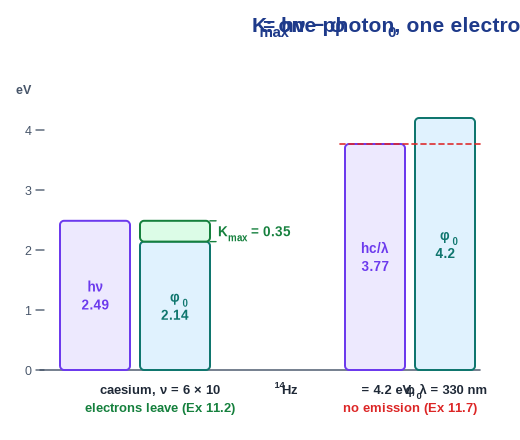
Exercise 11.2: caesium (φ₀ = 2.14 eV) with light of 6 × 10¹⁴ Hz. hν = 6.63 × 10⁻³⁴ × 6 × 10¹⁴ = 3.98 × 10⁻¹⁹ J = 2.49 eV, so K_max = 2.49 − 2.14 = 0.35 eV, and V₀ = 0.35 V.
Exercise 11.6: ν₀ = 3.3 × 10¹⁴ Hz and ν = 8.2 × 10¹⁴ Hz give V₀ = (h/e)(ν − ν₀) = 4.14 × 10⁻¹⁵ × 4.9 × 10¹⁴ = 2.0 V.
Exercise 11.7: a 330 nm photon has hc/λ = 3.77 eV, less than φ₀ = 4.2 eV, so there is no emission, however bright the light.
All eleven exercises are solved in the NCERT solutions, and the whole chapter is in the Chapter 11 notes.
Practice
-
If the frequency of the light is doubled (staying above ν₀), the maximum kinetic energy of the photoelectrons:
Show answer
Answer: (b) more than doubles
-
The threshold wavelength for a metal of work function 3.0 eV is about (hc = 1240 eV nm):
Show answer
Answer: (b) 413 nm
-
Making the collector more and more positive eventually makes the photocurrent:
Show answer
Answer: (c) reach a constant saturation value
-
Light of 5.0 × 10¹⁴ Hz falls on a metal of work function 1.5 eV. Find K_max and V₀ (h = 6.63 × 10⁻³⁴ J s, e = 1.6 × 10⁻¹⁹ C).
Show answer
Answer: hν = 6.63 × 10⁻³⁴ × 5.0 × 10¹⁴ = 3.32 × 10⁻¹⁹ J = 2.07 eV. K_max = 2.07 − 1.5 = 0.57 eV (9.2 × 10⁻²⁰ J), so V₀ = 0.57 V.
-
Why does a very bright red lamp fail to eject electrons from copper when weak ultraviolet light succeeds?
Show answer
Answer: A red photon’s energy hν is less than copper’s work function, and each electron absorbs only one photon, so no number of red photons frees one. An ultraviolet photon has more than φ₀, so even a few of them free electrons at once.
Questions students ask
Why is quartz used for the window of the tube?
Quartz lets ultraviolet light through, while ordinary glass absorbs much of it. Many metals need ultraviolet light for emission.
Why do photoelectrons come out with a range of energies?
Electrons inside the metal already have a spread of energies, and some are held more tightly than others. Each absorbs the same hν, but those held more tightly lose more in getting out, so only the most loosely held come out with K_max = hν − φ₀.
Is the photoelectric effect used in devices?
Extra (not in the 2026-27 chapter): yes, for example in photocells used as light sensors, where light falling on a photosensitive surface produces a current. The book itself does not discuss such devices.
Stuck on a question?
Take a photo and Lagnever AI explains it step by step. Try it for 7 days for ₹2.
Get it on Google Play Open in browser
For parents: after the trial, the plan renews monthly by UPI or card autopay. You can cancel anytime in the app.