
NCERT Solutions Class 10 Maths Chapter 9: Some Applications of Trigonometry
Answers to the questions inside Chapter 9, Some Applications of Trigonometry, all seven worked examples, and every question of Exercise 9.1, from Mathematics, the Class 10 NCERT textbook. Page numbers follow the 2026-27 reprint (pages 133–143). The exercise questions are quoted from the book; the examples and in-chapter questions are restated in short and labelled by number and page. The book’s figures are not copied: every figure here is our own drawing, made to scale from the data in the question, with the angles drawn true. Every answer was checked by exact calculation with √3 and as a decimal, and all of them match the answer key at the end of the book. Short notes: Chapter 9 notes.
Questions inside the chapter (pages 133–135)
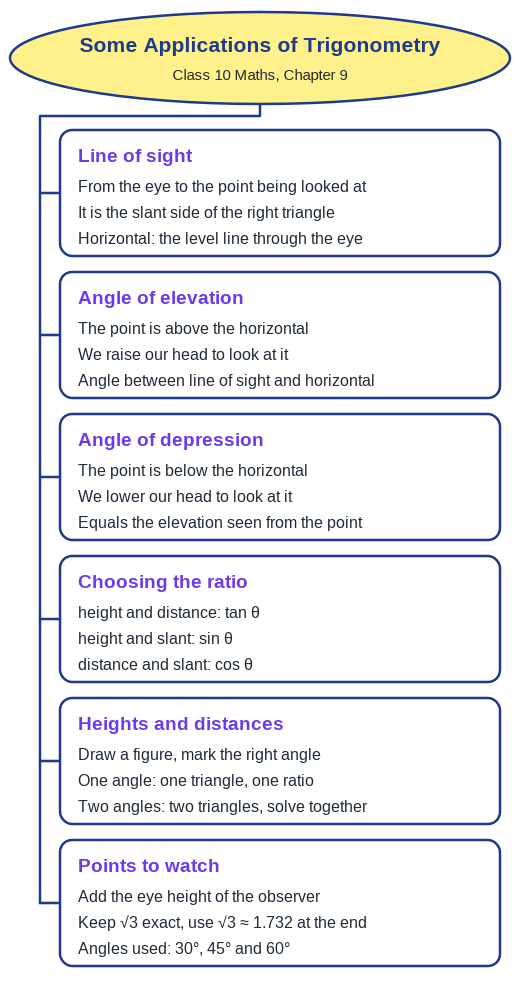
Page 134: identify the lines of sight and the angles in Fig. 8.3 of the previous chapter. Are they angles of elevation or of depression? In Fig. 8.3 a girl standing on the ground looks at a hot air balloon, first at A and later at B. The lines of sight go from her eye up to A and up to B. Both points are above the horizontal through her eye, so she raises her head, and both angles are angles of elevation. (The angle at B is smaller than the one at A, because B is farther away at the same height.)
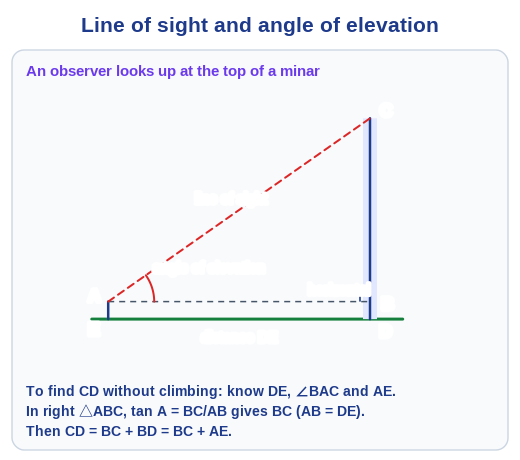
Page 135: to find the height CD of the minar in Fig. 9.1, what do you need, and which ratio should you use? You need the distance DE of the student from the foot of the minar, the angle of elevation ∠BAC, and the height AE of the student. In right △ABC, BC is opposite to the known ∠A and AB (= DE) is adjacent. The ratio that has both these sides is tan A = BC/AB (or cot A = AB/BC). It gives BC, and then CD = BC + BD = BC + AE.
Worked examples (pages 135–141)
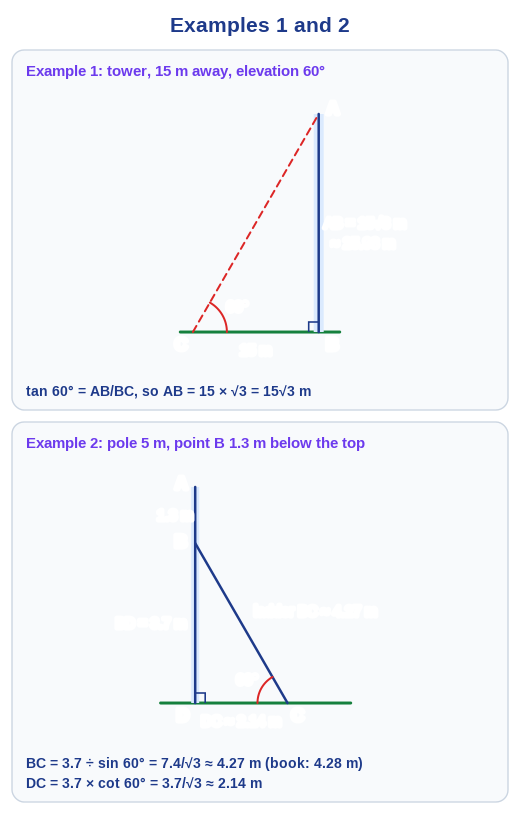
Example 1 (page 135): a point 15 m from the foot of a tower sees its top at 60°; find the height. Let AB be the tower and C the point, with the right angle at B. The height AB and the distance BC are involved, so use tan: tan 60° = AB/BC, that is √3 = AB/15, so AB = 15√3 m (about 25.98 m).
Example 2 (page 136): a pole is 5 m high; an electrician must reach B, 1.3 m below the top, with a ladder at 60° to the ground. Find the ladder’s length and the distance of its foot from the pole (√3 = 1.73). BD = 5 − 1.3 = 3.7 m. The book asks which ratio to use: the ladder BC is the hypotenuse and BD is opposite to the 60° angle, so it is sin 60°. sin 60° = BD/BC gives √3/2 = 3.7/BC, so BC = 7.4/√3 ≈ 4.28 m with √3 = 1.73 (4.27 m with more decimal places). For the foot, cot 60° = DC/BD gives DC = 3.7/√3 ≈ 2.14 m.
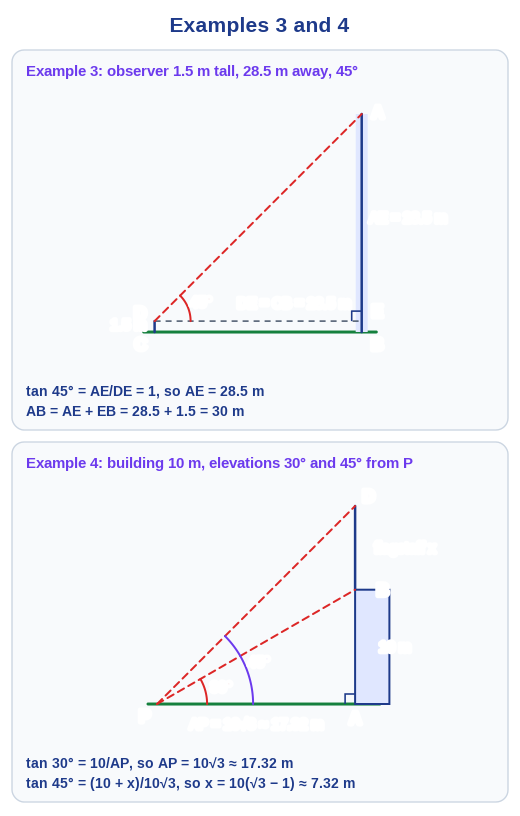
Example 3 (page 137): an observer 1.5 m tall, 28.5 m from a chimney, sees its top at 45°; find the chimney’s height. Let the chimney be AB and the observer CD, with her eye at D. The horizontal DE from her eye meets the chimney at E, so DE = CB = 28.5 m and BE = 1.5 m. tan 45° = AE/DE gives 1 = AE/28.5, so AE = 28.5 m, and AB = 28.5 + 1.5 = 30 m.
Example 4 (pages 137–138): from P, the top of a 10 m building is at 30° and the top of a flagstaff on it at 45°; find the flagstaff and the distance of P (√3 = 1.732). Let AB be the building and BD the flagstaff. In △PAB: tan 30° = AB/AP, so 1/√3 = 10/AP and AP = 10√3 m ≈ 17.32 m. Let BD = x. In △PAD: tan 45° = (10 + x)/(10√3), so 10 + x = 10√3 and x = 10(√3 − 1) ≈ 7.32 m.
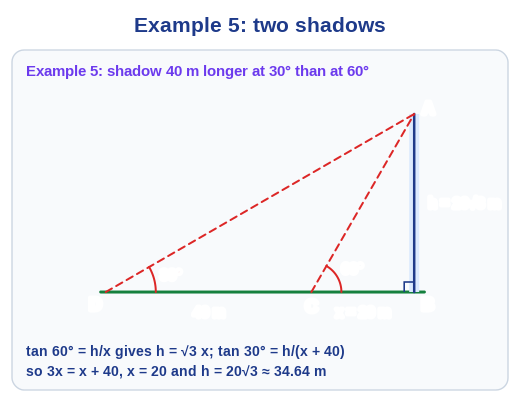
Example 5 (pages 138–139): a tower’s shadow is 40 m longer when the Sun’s altitude is 30° than when it is 60°; find the height. Let the tower AB be h m, the 60° shadow BC be x m, and the 30° shadow DB = (x + 40) m. In △ABC: tan 60° = h/x, so h = √3 x. …(1) In △ABD: tan 30° = h/(x + 40), so h = (x + 40)/√3. …(2) From (1) and (2): √3 x × √3 = x + 40, so 3x = x + 40 and x = 20. Then h = 20√3 m (about 34.64 m).
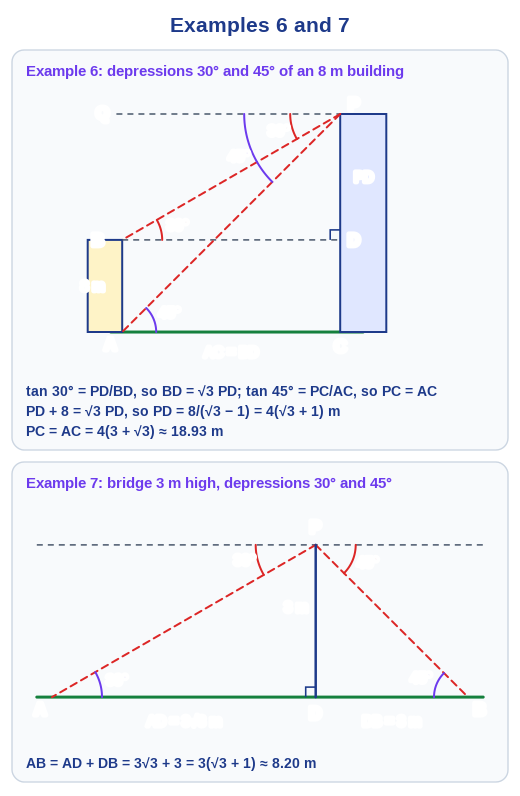
Example 6 (pages 139–140): from the top P of a multi-storeyed building, the angles of depression of the top and the bottom of an 8 m building are 30° and 45°; find the height of the multi-storeyed building and the gap between the buildings. Let PC be the tall building, AB the 8 m building, and BD the horizontal from B to PC. The horizontal through P is parallel to BD and to AC, so by alternate angles ∠PBD = 30° and ∠PAC = 45°. In △PBD: PD/BD = tan 30° = 1/√3, so BD = √3 PD. In △PAC: PC/AC = tan 45° = 1, so PC = AC. The book’s “(Why?)”: PC = PD + DC with DC = AB = 8 m, and AC = BD (opposite sides of the rectangle ABDC). So PD + 8 = AC = BD = √3 PD. Then PD = 8/(√3 − 1) = 8(√3 + 1)/((√3 + 1)(√3 − 1)) = 8(√3 + 1)/2 = 4(√3 + 1) m. So PC = 4(√3 + 1) + 8 = 4(3 + √3) m (about 18.93 m), and the distance AC = 4(3 + √3) m as well.
Example 7 (pages 140–141): from a point P on a bridge 3 m above the banks, the angles of depression of the banks on opposite sides are 30° and 45°; find the width of the river. Let A and B be the banks and D the point on AB just below P, so PD = 3 m. By alternate angles, ∠A = 30° and ∠B = 45°. In △APD: tan 30° = PD/AD, so 1/√3 = 3/AD and AD = 3√3 m. In △PBD: tan 45° = 1, so BD = PD = 3 m. AB = 3√3 + 3 = 3(√3 + 1) m (about 8.20 m).
Exercise 9.1 (pages 141–143)
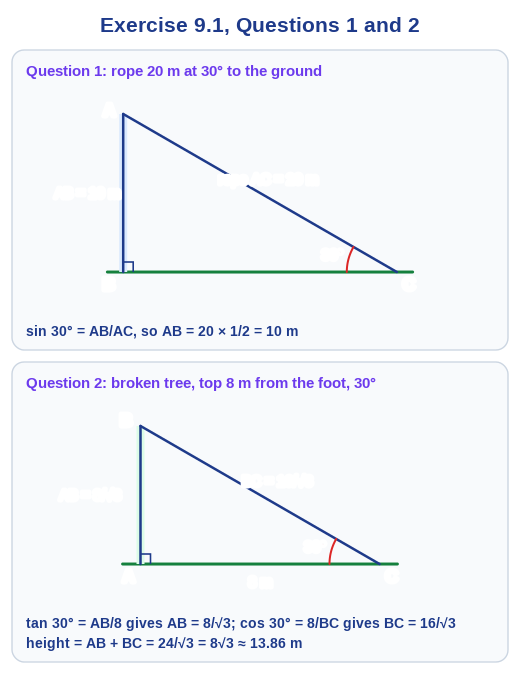
1. “A circus artist is climbing a 20 m long rope, which is tightly stretched and tied from the top of a vertical pole to the ground. Find the height of the pole, if the angle made by the rope with the ground level is 30° (see Fig. 9.11).”
Given: rope AC = 20 m, angle with the ground ∠ACB = 30°.
To find: the height AB of the pole.
- Let AB be the pole and AC the rope, with C on the ground and ∠B = 90°.
- The rope is the hypotenuse, and AB is opposite to the 30° angle. The ratio with opposite and hypotenuse is sin.
- sin 30° = AB/AC, so 1/2 = AB/20.
- AB = 20 × 1/2 = 10 m.
Answer: The pole is 10 m high.
2. “A tree breaks due to storm and the broken part bends so that the top of the tree touches the ground making an angle 30° with it. The distance between the foot of the tree to the point where the top touches the ground is 8 m. Find the height of the tree.”
Given: the top touches the ground 8 m from the foot, at an angle of 30°.
To find: the height of the tree before it broke.
- Let A be the foot of the tree, B the point where it broke, and C the point where the top touches the ground. So AC = 8 m, ∠A = 90° and ∠ACB = 30°.
- The tree’s height = AB (the standing part) + BC (the broken part).
- tan 30° = AB/AC, so 1/√3 = AB/8 and AB = 8/√3 m.
- cos 30° = AC/BC, so √3/2 = 8/BC and BC = 16/√3 m.
- Height = 8/√3 + 16/√3 = 24/√3 = 24√3/3 = 8√3 m.
Answer: The tree was 8√3 m tall (about 13.86 m).
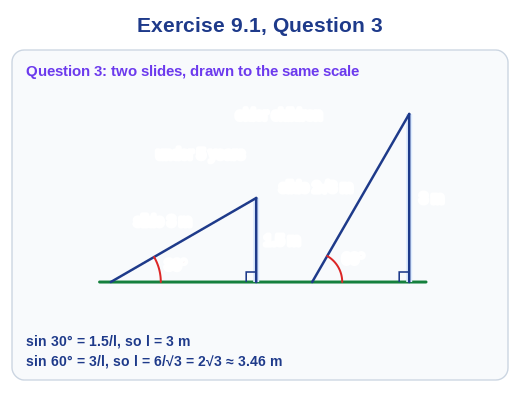
3. “A contractor plans to install two slides for the children to play in a park. For the children below the age of 5 years, she prefers to have a slide whose top is at a height of 1.5 m, and is inclined at an angle of 30° to the ground, whereas for elder children, she wants to have a steep slide at a height of 3m, and inclined at an angle of 60° to the ground. What should be the length of the slide in each case?”
Given: slide 1: top 1.5 m high at 30°; slide 2: top 3 m high at 60°.
To find: the length l of each slide.
- Each slide is the hypotenuse of a right triangle. Its top height is opposite to the angle, so use sin.
- First slide: sin 30° = 1.5/l, so 1/2 = 1.5/l and l = 3 m.
- Second slide: sin 60° = 3/l, so √3/2 = 3/l and l = 6/√3 = 6√3/3 = 2√3 m.
Answer: The slides should be 3 m and 2√3 m (about 3.46 m) long.
4. “The angle of elevation of the top of a tower from a point on the ground, which is 30 m away from the foot of the tower, is 30°. Find the height of the tower.”
Given: distance from the foot PB = 30 m, angle of elevation 30°.
To find: the height AB of the tower.
- AB is opposite to the 30° angle and PB is adjacent, so use tan.
- tan 30° = AB/PB, so 1/√3 = AB/30.
- AB = 30/√3 = 30√3/3 = 10√3 m.
Answer: The tower is 10√3 m high (about 17.32 m).
5. “A kite is flying at a height of 60 m above the ground. The string attached to the kite is temporarily tied to a point on the ground. The inclination of the string with the ground is 60°. Find the length of the string, assuming that there is no slack in the string.”
Given: height of the kite AB = 60 m, angle of the string with the ground 60°.
To find: the length of the string AC.
- Let A be the kite, C the point on the ground where the string is tied, and B the point on the ground just below A. So AB = 60 m and ∠B = 90°.
- The string AC is the hypotenuse and AB is opposite to the 60° angle, so use sin.
- sin 60° = AB/AC, so √3/2 = 60/AC.
- AC = 120/√3 = 120√3/3 = 40√3 m.
Answer: The string is 40√3 m long (about 69.28 m).
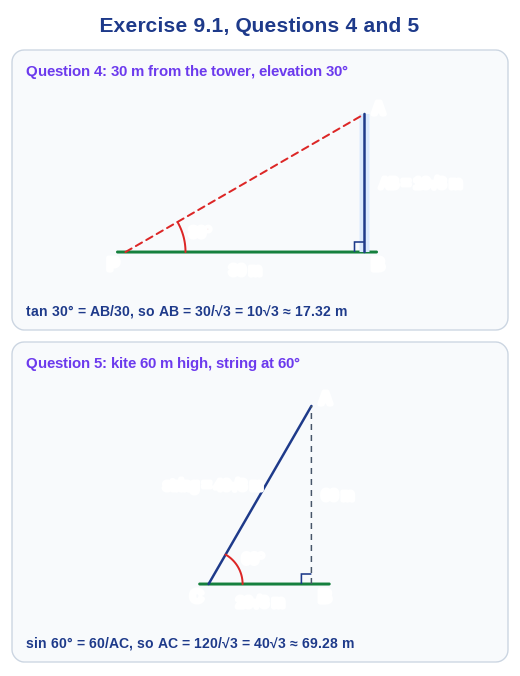
6. “A 1.5 m tall boy is standing at some distance from a 30 m tall building. The angle of elevation from his eyes to the top of the building increases from 30° to 60° as he walks towards the building. Find the distance he walked towards the building.”
Given: boy 1.5 m tall, building 30 m tall, angle of elevation changes from 30° to 60°.
To find: the distance PQ he walked.
- His eyes are 1.5 m above the ground, so draw the horizontal line at eye level. It meets the building at M. The top A is AM = 30 − 1.5 = 28.5 m above it.
- Let P and Q be his eye positions at first and later.
- In △AMP: tan 30° = AM/PM, so 1/√3 = 28.5/PM and PM = 28.5√3 m.
- In △AMQ: tan 60° = AM/QM, so √3 = 28.5/QM and QM = 28.5/√3 m.
- Distance walked = PM − QM = 28.5(√3 − 1/√3) = 28.5 × 2/√3 = 57/√3 = 19√3 m.
Answer: He walked 19√3 m (about 32.91 m) towards the building.
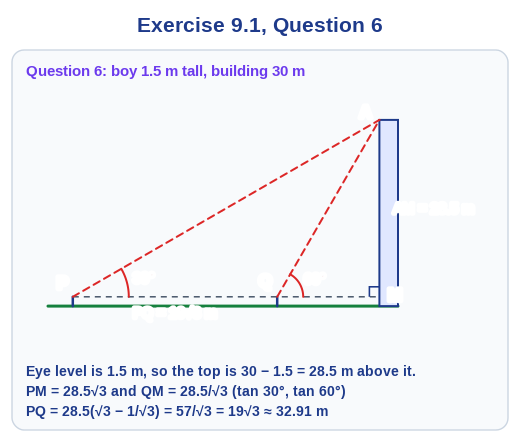
7. “From a point on the ground, the angles of elevation of the bottom and the top of a transmission tower fixed at the top of a 20 m high building are 45° and 60° respectively. Find the height of the tower.”
Given: building BC = 20 m; from P, the bottom C of the tower is at 45° and its top D at 60°.
To find: the height CD of the tower.
- In △PBC: tan 45° = BC/PB, so 1 = 20/PB and PB = 20 m.
- In △PBD: tan 60° = BD/PB, so √3 = BD/20 and BD = 20√3 m.
- Tower CD = BD − BC = 20√3 − 20 = 20(√3 − 1) m.
Answer: The tower is 20(√3 − 1) m high (about 14.64 m).
8. “A statue, 1.6 m tall, stands on the top of a pedestal. From a point on the ground, the angle of elevation of the top of the statue is 60° and from the same point the angle of elevation of the top of the pedestal is 45°. Find the height of the pedestal.”
Given: statue CD = 1.6 m on a pedestal BC; from P, the top of the statue is at 60° and the top of the pedestal at 45°.
To find: the height h of the pedestal.
- Let BC = h m.
- In △PBC: tan 45° = h/PB, so 1 = h/PB and PB = h.
- In △PBD: tan 60° = BD/PB = (h + 1.6)/h, so √3 h = h + 1.6.
- h(√3 − 1) = 1.6, so h = 1.6/(√3 − 1).
- Multiply the top and the bottom by (√3 + 1) to remove the root from the bottom: h = 1.6(√3 + 1)/(3 − 1) = 0.8(√3 + 1) m.
Answer: The pedestal is 0.8(√3 + 1) m high (about 2.19 m).
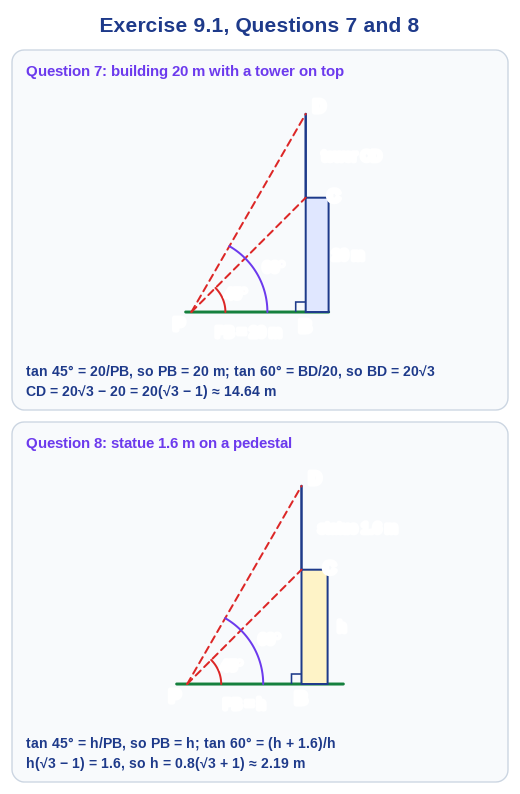
9. “The angle of elevation of the top of a building from the foot of the tower is 30° and the angle of elevation of the top of the tower from the foot of the building is 60°. If the tower is 50 m high, find the height of the building.”
Given: tower BD = 50 m; from the foot A of the building, the tower top is at 60°; from the foot B of the tower, the building top is at 30°.
To find: the height AC of the building.
- Let AB be the distance between their feet on level ground.
- In △ABD: tan 60° = BD/AB, so √3 = 50/AB and AB = 50/√3 m.
- In △BAC: tan 30° = AC/AB, so AC = AB × 1/√3 = (50/√3) × (1/√3) = 50/3 m.
Answer: The building is 50/3 m = 16⅔ m tall.
10. “Two poles of equal heights are standing opposite each other on either side of the road, which is 80 m wide. From a point between them on the road, the angles of elevation of the top of the poles are 60° and 30°, respectively. Find the height of the poles and the distances of the point from the poles.”
Given: road width BD = 80 m; two poles AB and CD of equal height h; from P on the road, the tops are at 60° and 30°.
To find: h, and the distances of P from the poles.
- Let PB = x m. Then PD = (80 − x) m.
- In △ABP: tan 60° = h/x, so h = √3 x. …(1)
- In △CDP: tan 30° = h/(80 − x), so h = (80 − x)/√3. …(2)
- From (1) and (2): √3 x = (80 − x)/√3. Multiply by √3: 3x = 80 − x, so 4x = 80 and x = 20.
- h = √3 × 20 = 20√3 m, and PD = 80 − 20 = 60 m.
Answer: The poles are 20√3 m high (about 34.64 m). The point is 20 m from the pole seen at 60° and 60 m from the pole seen at 30°.
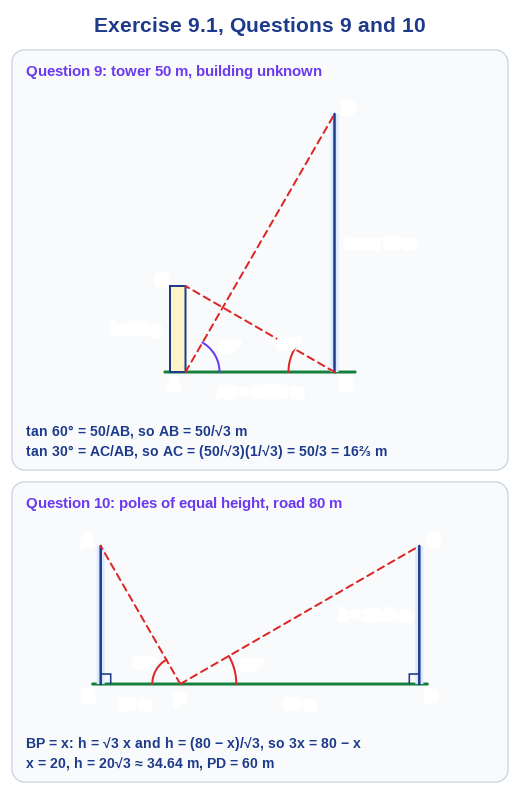
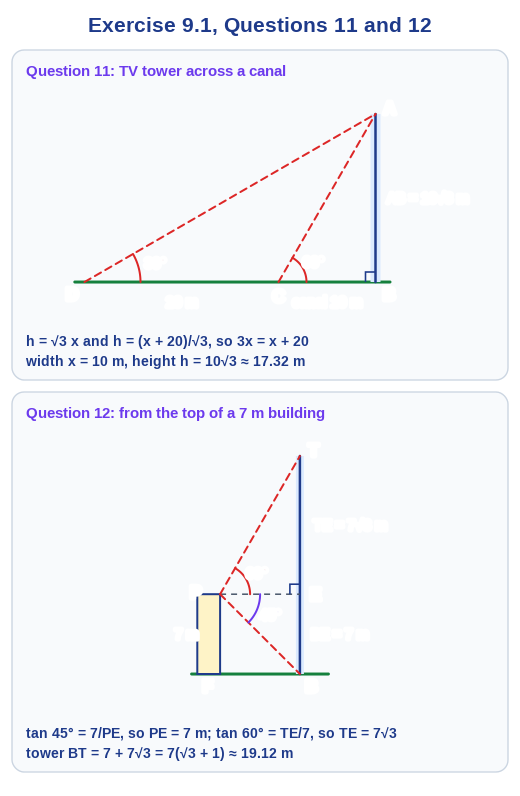
11. “A TV tower stands vertically on a bank of a canal. From a point on the other bank directly opposite the tower, the angle of elevation of the top of the tower is 60°. From another point 20 m away from this point on the line joing this point to the foot of the tower, the angle of elevation of the top of the tower is 30° (see Fig. 9.12). Find the height of the tower and the width of the canal.”
(The book prints “joing” for “joining”.)
Given: from C (on the other bank) the top is at 60°; from D, 20 m farther back, it is at 30°.
To find: the height h of the tower AB and the width x of the canal BC.
- Let BC = x m. Then DB = (x + 20) m.
- In △ABC: tan 60° = h/x, so h = √3 x. …(1)
- In △ABD: tan 30° = h/(x + 20), so h = (x + 20)/√3. …(2)
- From (1) and (2): √3 x = (x + 20)/√3, so 3x = x + 20 and x = 10.
- h = √3 × 10 = 10√3 m.
Answer: The tower is 10√3 m high (about 17.32 m) and the canal is 10 m wide.
12. “From the top of a 7 m high building, the angle of elevation of the top of a cable tower is 60° and the angle of depression of its foot is 45°. Determine the height of the tower.”
Given: building FP = 7 m; from P, the top T of the tower is at 60° above the horizontal and its foot B at 45° below it.
To find: the height BT of the tower.
- Draw the horizontal PE from P to the tower. Then BE = FP = 7 m, and PE is the distance between the building and the tower.
- Angle of depression 45° (looking down at B): tan 45° = BE/PE, so 1 = 7/PE and PE = 7 m.
- Angle of elevation 60° (looking up at T): tan 60° = TE/PE, so √3 = TE/7 and TE = 7√3 m.
- Tower BT = BE + TE = 7 + 7√3 = 7(√3 + 1) m.
Answer: The tower is 7(√3 + 1) m high (about 19.12 m).
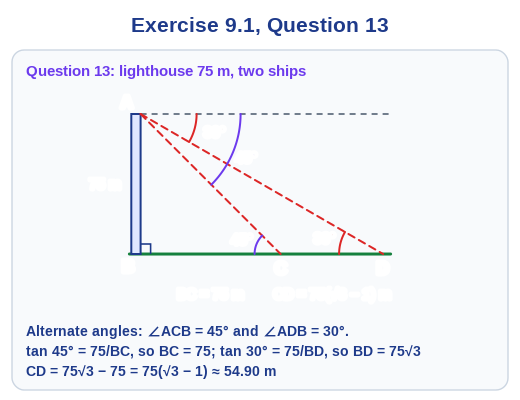
13. “As observed from the top of a 75 m high lighthouse from the sea-level, the angles of depression of two ships are 30° and 45°. If one ship is exactly behind the other on the same side of the lighthouse, find the distance between the two ships.”
Given: lighthouse AB = 75 m; angles of depression of the ships are 45° (nearer ship C) and 30° (farther ship D).
To find: the distance CD between the ships.
- The angle of depression from A equals the angle of elevation at the ship (alternate angles, because the horizontal at A is parallel to the sea). So ∠ACB = 45° and ∠ADB = 30°.
- In △ABC: tan 45° = AB/BC, so 1 = 75/BC and BC = 75 m.
- In △ABD: tan 30° = AB/BD, so 1/√3 = 75/BD and BD = 75√3 m.
- CD = BD − BC = 75√3 − 75 = 75(√3 − 1) m.
Answer: The ships are 75(√3 − 1) m apart (about 54.90 m).
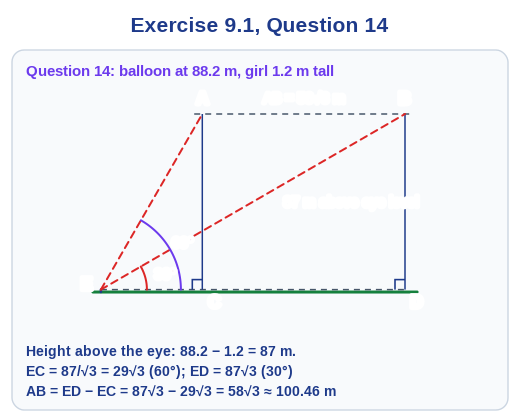
14. “A 1.2 m tall girl spots a balloon moving with the wind in a horizontal line at a height of 88.2 m from the ground. The angle of elevation of the balloon from the eyes of the girl at any instant is 60°. After some time, the angle of elevation reduces to 30° (see Fig. 9.13). Find the distance travelled by the balloon during the interval.”
Given: girl 1.2 m tall; balloon 88.2 m above the ground; angle of elevation changes from 60° to 30°.
To find: the distance AB travelled by the balloon.
- Let E be the girl’s eye. The balloon is 88.2 − 1.2 = 87 m above her eye level.
- Let A and B be the two positions of the balloon, and C and D the points at her eye level just below them. So AC = BD = 87 m.
- In △ACE: tan 60° = 87/EC, so EC = 87/√3 = 29√3 m.
- In △BDE: tan 30° = 87/ED, so ED = 87√3 m.
- The balloon moves on a horizontal line, so AB = CD = ED − EC = 87√3 − 29√3 = 58√3 m.
Answer: The balloon travelled 58√3 m (about 100.46 m).
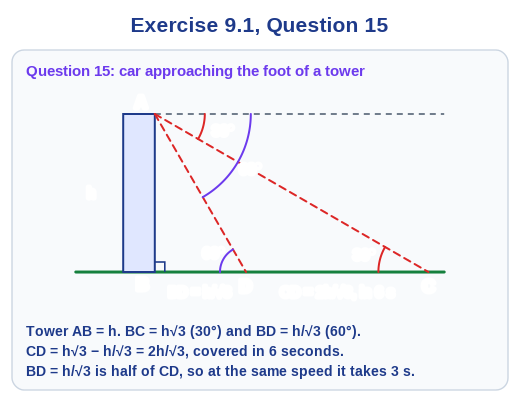
15. “A straight highway leads to the foot of a tower. A man standing at the top of the tower observes a car at an angle of depression of 30°, which is approaching the foot of the tower with a uniform speed. Six seconds later, the angle of depression of the car is found to be 60°. Find the time taken by the car to reach the foot of the tower from this point.”
Given: angle of depression of the car is 30° at first (at C) and 60° six seconds later (at D); the speed is uniform.
To find: the time to go from D to the foot B of the tower.
- Let the tower AB have height h. By alternate angles, ∠ACB = 30° and ∠ADB = 60°.
- In △ABC: tan 30° = h/BC, so BC = √3 h.
- In △ABD: tan 60° = h/BD, so BD = h/√3.
- In 6 seconds the car covers CD = BC − BD = √3 h − h/√3 = (3h − h)/√3 = 2h/√3.
- The rest of the way is BD = h/√3, which is half of CD.
- At a uniform speed, half the distance takes half the time: 6 ÷ 2 = 3 seconds.
Answer: The car takes 3 seconds more to reach the foot of the tower.
The summary of the chapter (page 143)
The book’s summary has two points: the definitions of the line of sight, the angle of elevation and the angle of depression; and the fact that heights, lengths and distances between distant objects can be found with trigonometric ratios. Both are covered above and in the chapter notes, with the method on the heights and distances page.
Practice
-
The top of a tower is seen at 30° from a point 60 m from its foot. The height of the tower is:
Show answer
Answer: (b) 20√3 m
-
A kite string 100 m long makes 30° with the ground. The height of the kite is:
Show answer
Answer: (c) 50 m
-
From the top of a 20 m building, the angle of depression of a car is 45°. The car is at a distance of:
Show answer
Answer: (a) 20 m
-
A tree 12 m tall casts a shadow 4√3 m long. Find the Sun's altitude.
Show answer
Answer: tan θ = height/shadow = 12/(4√3) = 3/√3 = √3, so θ = 60°.
-
From a point on the ground, the angles of elevation of the bottom and the top of a 10 m flagstaff on a building are 30° and 45°. Find the height of the building.
Show answer
Answer: Let the building be h m tall and the point d m from its foot. From 30°, d = √3 h. From 45°, d = h + 10. So √3 h = h + 10, h = 10/(√3 − 1) = 5(√3 + 1) m, about 13.66 m.
Stuck on a question?
Take a photo and Lagnever AI explains it step by step. Try it for 7 days for ₹2.
Get it on Google Play Open in browser
For parents: after the trial, the plan renews monthly by UPI or card autopay. You can cancel anytime in the app.