
Class 10 Maths Chapter 9: Some Applications of Trigonometry Notes
This chapter in five lines
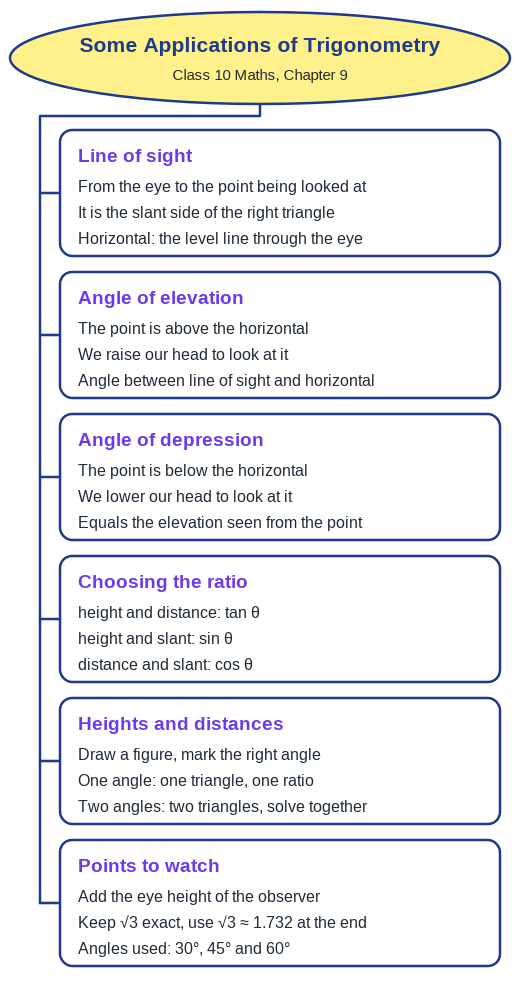
Chapter 9 uses the trigonometric ratios of Chapter 8 to find heights and distances that are hard to measure directly. The line of sight joins the observer's eye to the point being looked at. Its angle with the horizontal is the angle of elevation when the point is above the eye and the angle of depression when it is below. A right triangle is drawn, and tan, sin or cos of 30°, 45° or 60° links the known side to the unknown one.
What is this chapter about?
Chapter 8 began with a question: can a student find the height of a minar without climbing it? This chapter answers it. It is short, 11 pages with one section, 9.1 Heights and Distances, and one exercise. Every problem is the same idea used in a new setting: draw a right triangle, mark the angle you know, and use one trigonometric ratio to get the side you want.
What is the line of sight?
The line of sight is the line from the eye of an observer to the point of the object being looked at. Through the eye we also imagine a horizontal line, parallel to the ground. The angle between these two lines tells us how far up or down the observer is looking.
What are the angles of elevation and depression?
- Angle of elevation: the point being viewed is above the horizontal level, so we raise our head. It is the angle the line of sight makes with the horizontal, going up.
- Angle of depression: the point being viewed is below the horizontal level, so we lower our head. It is the angle the line of sight makes with the horizontal, going down.
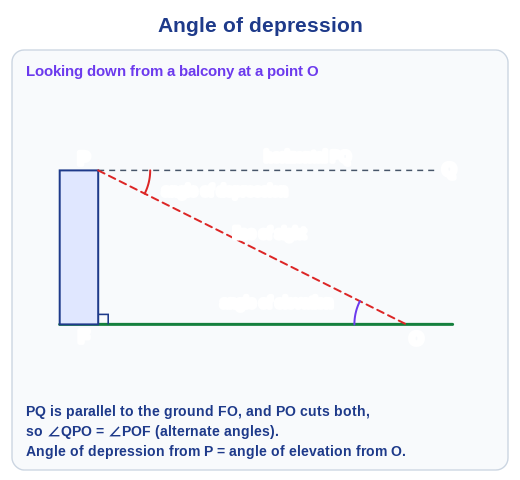
Both are measured from the horizontal through the eye. A useful fact follows from parallel lines: the horizontal through the observer is parallel to the ground, and the line of sight cuts both. So the angle of depression of a point O seen from P equals the angle of elevation of P seen from O (alternate angles). Details on the angles of elevation and depression page.
How do you find a height without measuring it?
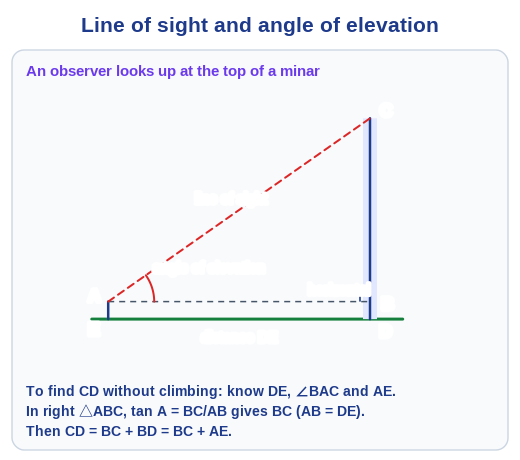
To find the height CD of the minar in our figure, you need three things: the distance DE of the student from the foot, the angle of elevation ∠BAC, and the height AE of the student’s eye. In right △ABC, BC is opposite to ∠A and AB (equal to DE) is adjacent, so tan A = BC/AB gives BC. Then CD = BC + BD, and BD = AE.
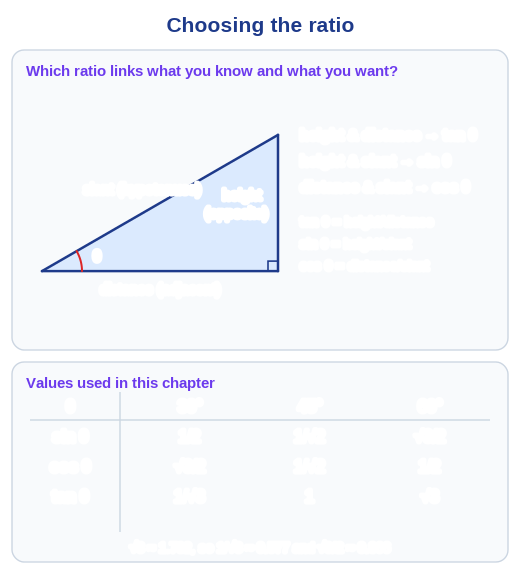
The choice of ratio depends on which two sides are involved, the known one and the wanted one:
| You know and want | Use |
|---|---|
| height and horizontal distance | tan θ = height/distance |
| height and slant length | sin θ = height/slant |
| horizontal distance and slant length | cos θ = distance/slant |
For example, from a point 15 m from the foot of a tower, the top is seen at 60°. Here the distance is known and the height is wanted, so tan 60° = height/15 and the height is 15√3 m, about 25.98 m (Example 1 of the book).
What about problems with two angles?
Many problems give two angles: the top of a tower seen from two points on a line, two ships seen from one lighthouse, or the top and foot of one building seen from another. Each angle gives its own right triangle. Write one equation from each, using a letter for the unknown length, and solve them together. For example, if the shadow of a tower is 40 m longer when the Sun’s altitude is 30° than when it is 60°, then h = √3 x and h = (x + 40)/√3, which give x = 20 m and h = 20√3 m. The method, with common traps, is on the heights and distances page.
Before we move on
This chapter needs the values of tan, sin and cos for 30°, 45° and 60° from Chapter 8, and the fact about alternate angles from earlier classes. The book’s summary keeps it to two points: the three definitions, and that heights and distances can be found with trigonometric ratios. Every example and all 15 exercise questions are solved, each with its own figure, in the NCERT solutions for Chapter 9.
Key terms
| Term | Meaning |
|---|---|
| Line of sight | The line drawn from the eye of an observer to the point of the object being viewed. |
| Horizontal level | The level line through the observer's eye, parallel to the ground. Angles of elevation and depression are measured from it. |
| Angle of elevation | The angle between the line of sight and the horizontal when the point viewed is above the horizontal level, so the observer raises the head. |
| Angle of depression | The angle between the line of sight and the horizontal when the point viewed is below the horizontal level, so the observer lowers the head. |
| Heights and distances | Problems in which the height of an object, or the distance between two objects, is found with trigonometric ratios instead of being measured. |
| Sun's altitude | The angle of elevation of the Sun. The tip of a shadow, the top of the object and its foot form a right triangle with this angle at the tip. |
| Slant length | The length of a slanted object such as a ladder, rope, kite string or slide. In the right triangle it is the hypotenuse. |
| Alternate angles | Equal angles made by a transversal on opposite sides between two parallel lines. They show that an angle of depression equals the matching angle of elevation. |
Topics in this chapter
Practice
-
The angle formed by the line of sight with the horizontal, when the object is below the horizontal level, is called the:
Show answer
Answer: (b) angle of depression
-
From a point 20 m away from the foot of a tower, the angle of elevation of its top is 45°. The height of the tower is:
Show answer
Answer: (c) 20 m
-
A ladder makes an angle of 60° with the ground and reaches 6√3 m up a wall. The length of the ladder is:
Show answer
Answer: (b) 12 m
-
The angle of depression of a boat from the top of a cliff is 30°. The angle of elevation of the top of the cliff from the boat is:
Show answer
Answer: (b) 30°
-
A pole casts a shadow equal to its own height. The Sun's altitude is:
Show answer
Answer: (c) 45°
Questions students ask
What are the main topics of Class 10 Maths Chapter 9?
The chapter has one section, 9.1 Heights and Distances. It defines the line of sight, the angle of elevation and the angle of depression, then works seven examples on towers, ladders, chimneys, flagstaffs, shadows, buildings and a river. Exercise 9.1 has 15 questions, and the chapter ends with a two-point summary.
How many exercises does Chapter 9 have?
Only one, Exercise 9.1, with 15 word problems. All of them, with the seven examples, are worked out with figures on the NCERT solutions page.
Which angles are used in the chapter?
Only 30°, 45° and 60°, whose ratios are known exactly from Chapter 8. That is why the answers come out in forms like 10√3 m or 20(√3 − 1) m.
Is the angle of elevation measured from the ground or from the eye?
From the horizontal line through the eye. If the observer's height is given, the right triangle starts at eye level, and the eye height is added at the end. Example 3, and Questions 6 and 14 of the exercise, work this way.
Stuck on a question?
Take a photo and Lagnever AI explains it step by step. Try it for 7 days for ₹2.
Get it on Google Play Open in browser
For parents: after the trial, the plan renews monthly by UPI or card autopay. You can cancel anytime in the app.