
What are the angles of elevation and depression?
Answer in short
The angle of elevation is the angle between the line of sight and the horizontal when you look up at a point above eye level. The angle of depression is the same angle when you look down at a point below eye level. The angle of depression of B from A equals the angle of elevation of A from B.
Stuck on a question? Take a photo and Lagnever AI explains it step by step. Try it for 7 days for ₹2. Get it on Google Play
What is the line of sight?
When you look at something, imagine a straight line from your eye to the point you are looking at. That is the line of sight. Now imagine a second line through your eye, level and parallel to the ground: the horizontal. Everything in this chapter is measured between these two lines.
What is the angle of elevation?
If the point is above your eye, you raise your head. The angle between the line of sight and the horizontal is then the angle of elevation of the point.
In our figure, a student’s eye is at A, at height AE above the ground, and she looks at the top C of a minar. The horizontal from A meets the minar at B, so ∠BAC is the angle of elevation of C. Triangle ABC has its right angle at B.
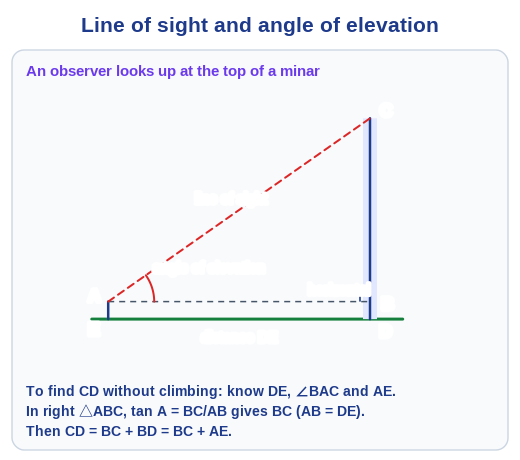
The Sun’s altitude in shadow problems is also an angle of elevation: it is the angle at which the Sun is seen above the horizon. The tip of the shadow, the top of the object and its foot make a right triangle with this angle at the tip of the shadow.
What is the angle of depression?
If the point is below your eye, you lower your head. The angle between the line of sight and the horizontal is then the angle of depression. It is measured downward from the horizontal, not from the wall below you.
Why are the two angles equal?
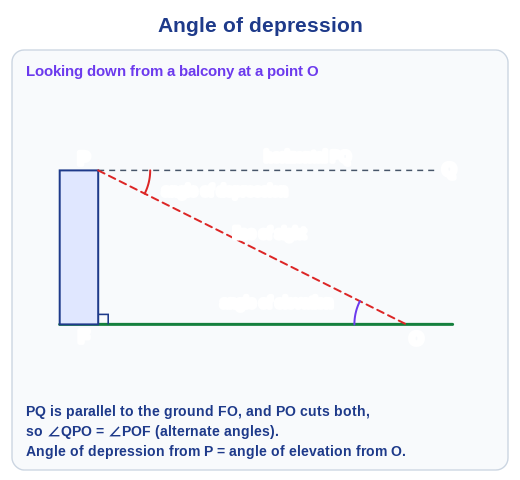
In the figure, PQ is the horizontal through the observer P, and FO is the ground. These two lines are parallel, and the line of sight PO cuts both of them. So ∠QPO and ∠POF are alternate angles, and they are equal.
This means: the angle of depression of O seen from P equals the angle of elevation of P seen from O. In practice, when a problem gives an angle of depression from the top of a tower or a cliff, copy the same angle to the point on the ground. That angle is inside the right triangle, at the end of the horizontal side, and you can use it in tan, sin or cos straight away.
How do you draw the figure for a problem?
- Draw the ground as a horizontal line and every tower, pole, building or person as a vertical line on it. Mark the right angle at the foot.
- Mark the observer’s eye. If the eye height is given, draw a dashed horizontal at eye level.
- Draw the line of sight to each point being viewed.
- Mark each angle between the line of sight and the horizontal: above it for elevation, below it for depression. Move an angle of depression to the ground point by alternate angles.
- Write the known lengths and a letter for the unknown one.
Each angle you mark now belongs to a right triangle, and the next step is to pick a ratio. That is covered on the heights and distances page. For the full set of book problems drawn this way, see the NCERT solutions, and for a quick overview, the chapter notes.
Practice
-
An observer looks at the top of a tower and has to raise her head. The angle her line of sight makes with the horizontal is the:
Show answer
Answer: (b) angle of elevation
-
From the top of a lighthouse, the angle of depression of a ship is 45°. The angle of elevation of the top of the lighthouse from the ship is:
Show answer
Answer: (a) 45°
-
From the top of a tower, the angle of depression of a car is 60°. The angle between the line of sight and the tower is:
Show answer
Answer: (b) 30°
-
As you walk towards a tall building, what happens to the angle of elevation of its top? Explain.
Show answer
Answer: It increases. The height stays the same while the horizontal distance d gets smaller, so tan θ = height/d gets larger, and for acute angles a larger tan means a larger angle. In Exercise 9.1, Question 6, the angle rises from 30° to 60° as the boy walks closer.
-
A girl on a balcony 6 m high sees a ball on the ground at an angle of depression of 30°. How far is the ball from the foot of the building?
Show answer
Answer: The angle of elevation of the girl from the ball is also 30° (alternate angles). In the right triangle, tan 30° = 6/d, so d = 6√3 m, about 10.39 m.
Questions students ask
Why is the angle of depression equal to the angle of elevation?
Take an observer P above a point O on the ground. The horizontal PQ through P is parallel to the ground, and the line of sight PO is a transversal cutting both. The angle of depression ∠QPO and the angle of elevation ∠POF at O are alternate angles, so they are equal. The book uses this step in Example 6.
Are the angles of elevation and depression always acute?
In this chapter, yes. The point viewed is above or below eye level but not straight overhead or underneath, so the angle is between 0° and 90°. All the problems use 30°, 45° or 60°.
Where should I mark the angle of depression in a figure?
Draw a dashed horizontal line through the observer's eye, away from the building. Mark the angle between this line and the line of sight, below the horizontal. Then mark the same angle at the point on the ground, between the ground and the line of sight. That second angle is inside the right triangle and is the one you use in the ratio.
Does the book define these angles for objects that move?
The definitions are the same. In Exercise 9.1, a balloon and a car move, and the angle changes as they move; each position gives its own right triangle with its own angle.
Stuck on a question?
Take a photo and Lagnever AI explains it step by step. Try it for 7 days for ₹2.
Get it on Google Play Open in browser
For parents: after the trial, the plan renews monthly by UPI or card autopay. You can cancel anytime in the app.