
How do you solve heights and distances problems?
Answer in short
Draw a right triangle with the vertical object, the ground and the line of sight. Mark the angle and lengths, and use the ratio that links the known side to the wanted one: tan for height and distance, sin for height and slant length, cos for distance and slant length. With two angles, solve one equation per triangle together.
Stuck on a question? Take a photo and Lagnever AI explains it step by step. Try it for 7 days for ₹2. Get it on Google Play
What is the method?
Every problem in this chapter follows the same four steps.
- Draw the figure. Ground horizontal, objects vertical, the right angle at the foot. Draw the line of sight and mark the angle of elevation or depression (an angle of depression is copied to the ground point, as explained on the angles of elevation and depression page).
- Spot the right triangle that contains the given angle, the known length and the wanted length.
- Choose the ratio that has the known and the wanted side in it.
- Solve and write the unit. Keep √3 exact and give a decimal at the end if it is asked for.
How do you choose the ratio?
From the given angle θ, the horizontal distance is the adjacent side, the height is the opposite side, and a slanted object (ladder, rope, kite string, slide or the line of sight itself) is the hypotenuse.
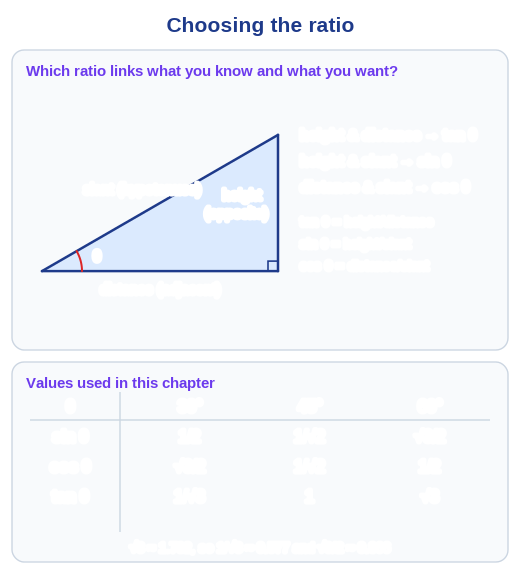
Three quick facts save time:
- At 45°, tan 45° = 1, so the height equals the distance.
- At 30°, the distance is √3 times the height.
- At 60°, the height is √3 times the distance.
One angle, one triangle
When there is one angle, one ratio gives the answer at once.
A tower. From 15 m away, the top is seen at 60°. tan 60° = h/15, so h = 15√3 m.
A ladder. An electrician needs to reach 3.7 m up a 5 m pole (1.3 m below its top) with a ladder at 60°. The height and the slant are involved, so sin 60° = 3.7/BC, and BC = 7.4/√3 ≈ 4.27 m. The distance of the foot is 3.7/√3 ≈ 2.14 m.
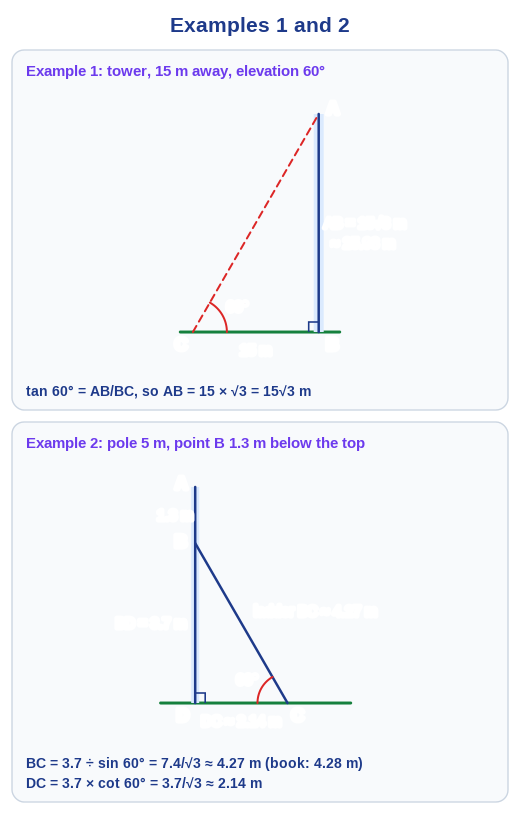
The observer’s height. If an observer 1.5 m tall stands 28.5 m from a chimney and sees its top at 45°, the right triangle starts at her eye. The height above her eye is 28.5 m, so the chimney is 28.5 + 1.5 = 30 m tall.
Two angles, two triangles
When two angles are given, there are two right triangles that share a side. The usual cases are:
- Two points on one line (a shadow at two times, an observer who walks, a car that moves): the height is shared, and the two distances differ by a given amount.
- Two points on one vertical line (a flagstaff on a building, a tower on a building, a statue on a pedestal): the distance is shared, and the two heights differ by the object on top.
- Two objects seen from one point (two ships from a lighthouse, two banks from a bridge): the height is shared, and the distances add or subtract.
Take the shadow problem. A tower’s shadow is 40 m longer when the Sun’s altitude is 30° than when it is 60°. Let the height be h and the shorter shadow x. From the 60° triangle, h = √3 x. From the 30° triangle, h = (x + 40)/√3. Putting the first into the second, 3x = x + 40, so x = 20 m and h = 20√3 m ≈ 34.64 m.
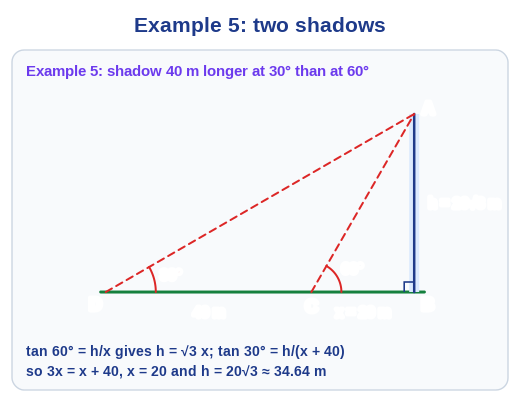
A neat result for this case (Extra, not in the book): if the top of an object of height h is seen at 30° and 60° from two points on the same side, the two points are 2h/√3 apart, and the nearer point is exactly half that distance from the foot. That is why the car in Exercise 9.1, Question 15, needs 3 more seconds after taking 6.
How do you check an answer?
- Lengths are positive, with units.
- The order makes sense: at a bigger angle of elevation, you are nearer the object.
- Substitute back: for 20√3 m and 20 m, tan 60° = 20√3/20 = √3, as it should be.
- For a decimal, use √3 ≈ 1.732 at the last step only.
All seven worked examples and the 15 exercise questions are solved with figures in the NCERT solutions. The chapter notes give the short version.
Practice
-
A 10 m long ladder leans against a wall and makes an angle of 60° with the ground. How high up the wall does it reach?
Show answer
Answer: (b) 5√3 m
-
The angle of elevation of the top of a 30 m tower from a point on the ground is 30°. The distance of the point from the foot is:
Show answer
Answer: (c) 30√3 m
-
From a point on the ground, the top of a tower is seen at 60°, and from a point 20 m farther away on the same line at 30°. The height of the tower is:
Show answer
Answer: (b) 10√3 m
-
A boy whose eyes are 1.5 m above the ground stands 20 m from a tree and sees its top at 45°. Find the height of the tree.
Show answer
Answer: The horizontal from his eye meets the tree 1.5 m above the ground. tan 45° = (height above eye)/20, so the height above eye level is 20 m. The tree is 20 + 1.5 = 21.5 m tall.
-
From the top of a cliff 50 m high, the angles of depression of two boats on the same side, in line with the foot of the cliff, are 45° and 30°. How far apart are the boats?
Show answer
Answer: By alternate angles, the boats see the top at 45° and 30°. The nearer boat is 50/tan 45° = 50 m from the foot, the farther one 50/tan 30° = 50√3 m. The distance between them is 50√3 − 50 = 50(√3 − 1) m, about 36.60 m.
Questions students ask
How do I know which trigonometric ratio to use?
Look at the two lengths involved: the one you know and the one you want. Height with horizontal distance needs tan (or cot). Height with a slanted length such as a ladder, rope, string or slide needs sin. Horizontal distance with a slanted length needs cos. Then the third side never has to be found.
What do I do when two angles are given?
Each angle gives its own right triangle. Use a letter for a length shared by both, such as the height h or a distance x. Write tan of each angle as a fraction with h and x, then solve the two equations. In Example 5 of the book, h = √3 x and h = (x + 40)/√3 give x = 20 and h = 20√3 m.
Can a heights and distances answer be negative or more than expected?
A length can never be negative, and an answer far from the scale of the problem is a sign of a slip. A quick check: at 30° the distance is longer than the height, at 60° it is shorter, and at 45° they are equal.
Do we need to know trigonometric ratios of other angles?
Not for this chapter. All problems in the book use 30°, 45° and 60°, so the answers can be written exactly with √3.
Stuck on a question?
Take a photo and Lagnever AI explains it step by step. Try it for 7 days for ₹2.
Get it on Google Play Open in browser
For parents: after the trial, the plan renews monthly by UPI or card autopay. You can cancel anytime in the app.