
NCERT Solutions Class 10 Geography Chapter 6: Manufacturing Industries
Answers to every question inside Chapter 6, Manufacturing Industries, of Contemporary India – II, the Class 10 Geography textbook, and to all the end-of-chapter exercises: Questions 1–3, the two word activities and the project work. Page numbers follow the 2026-27 reprint (pages 58–70). The exercises are quoted from the book; the in-text questions and activities are restated in short, in our own words. Short notes: Chapter 6 notes.
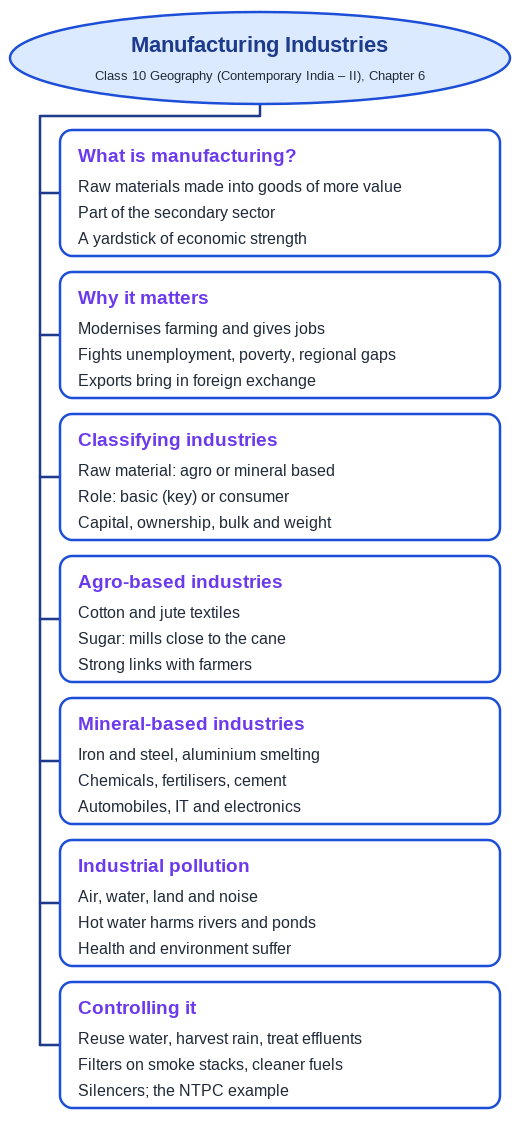
Questions inside the chapter (pages 58–66)
Page 58: Harish sees goods made by big industries, small industries and artisans at home. Do you have ideas about these industries? Yes. Large industries use machines to make goods in bulk, such as shoes, cloth and sugar. Small industries make goods like some utensils with smaller investment. Household or cottage industries are run by artisans with their own hands at home, such as potters who make diyas. All of them turn raw materials into goods of more value.
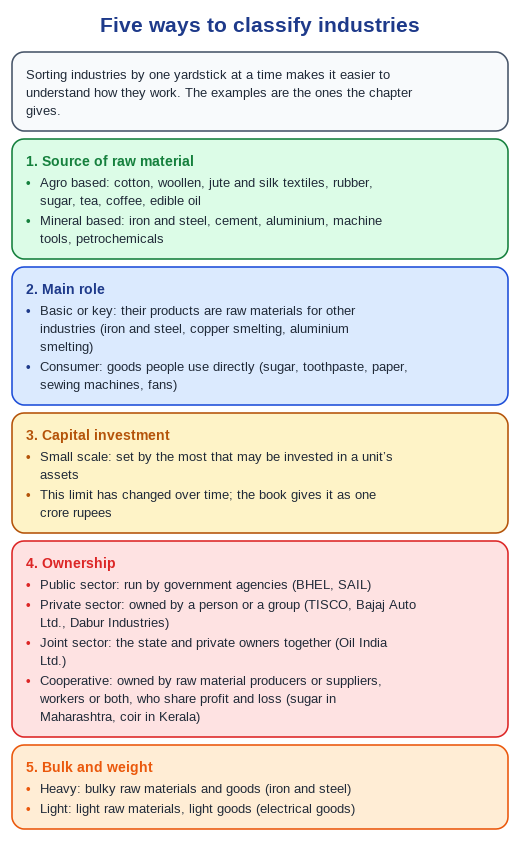
Page 59: list the manufactured goods you use daily, then think how industries can be grouped. Examples from the chapter’s own list: bulbs, vegetable oil, cement, glassware, petrol, matches, scooters, medicines. They can be grouped by raw material, role, capital, ownership, and bulk and weight; see how industries are classified.
Page 59: classify ten items into two groups by the bulk and weight of raw material and finished goods.
| Heavy (bulky materials or goods) | Light (light materials and goods) |
|---|---|
| (i) Oil | (ii) Knitting needles |
| (iii) Brassware | (iv) Fuse wires |
| (vi) Sewing machines | (v) Watches |
| (vii) Shipbuilding | (viii) Electric bulbs |
| (x) Automobiles | (ix) Paint brushes |
Shipbuilding, automobiles and oil involve very bulky inputs and products. Brassware and sewing machines use heavy metal parts, so they are usually placed with the heavy group; discuss borderline items with your teacher.
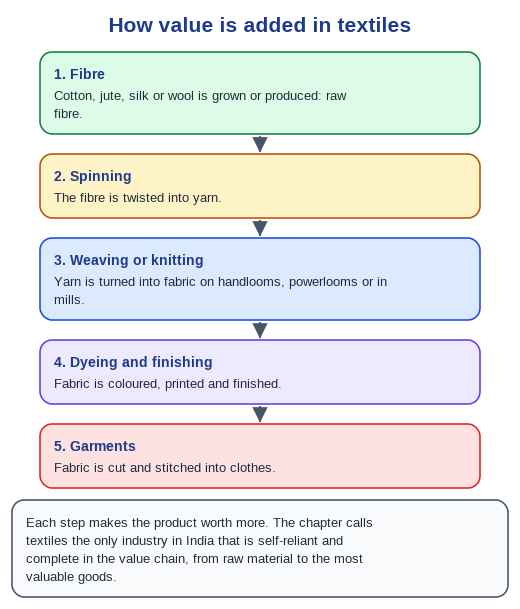
Page 60: why did Mahatma Gandhi stress spinning yarn and weaving khadi? The chapter notes that traditional Indian textiles were ruined in colonial times by mill cloth from England, and that handspun khadi gives large-scale work to weavers at home as a cottage industry. Spinning and weaving khadi meant self-reliance, work and income for villagers, and less dependence on foreign cloth. Extra: it was also part of the boycott of foreign goods during the national movement (see History Chapter 2, Nationalism in India).
Page 60: why should mill loomage be kept lower than powerloom and handloom? Handlooms and powerlooms are spread out in homes and small units, so they give work to far more people and keep traditional skills and designs (cotton, silk, zari, embroidery) alive. If big mills did most of the weaving, many weavers would lose their living.
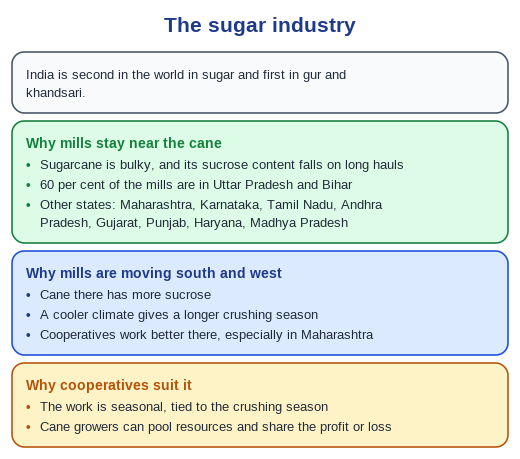
Page 62: why is the seasonal sugar industry suited to the cooperative sector? Mills work only during the cane-crushing season. In a cooperative, the cane growers themselves own the mill, pool their resources and share the profit or loss, so the cost of running it is shared and farmers get a fair return for their cane.
Page 62: name some mineral-based industries. Iron and steel, aluminium smelting, cement, chemicals, fertilisers, machine tools and petrochemicals.
Page 62 (Activity): list goods made of steel. Examples: utensils, buckets, almirahs, spoons, knives, bicycles, scooters, cars, railway lines and coaches, bridges, building rods, pipes, machines and tools, surgical instruments.
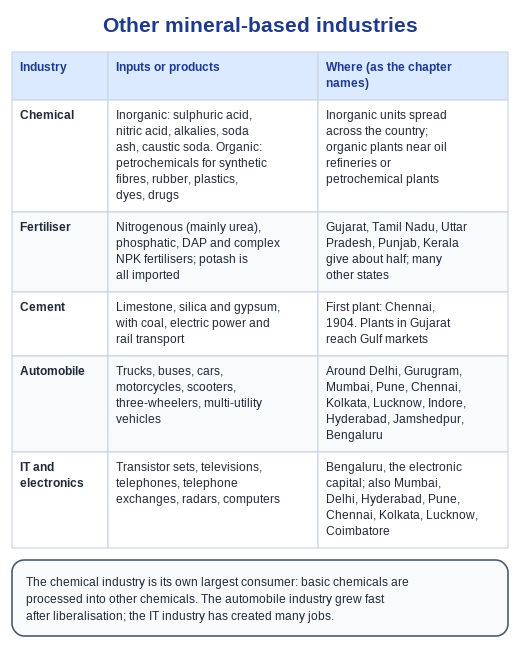
Page 62: where should steel plants ideally be located? Close to the heavy raw materials (iron ore, coking coal, limestone and manganese), to keep transport costs low, and with a good transport network to send the finished steel to markets and consumers. This is why the Chhotanagpur plateau has the most plants.
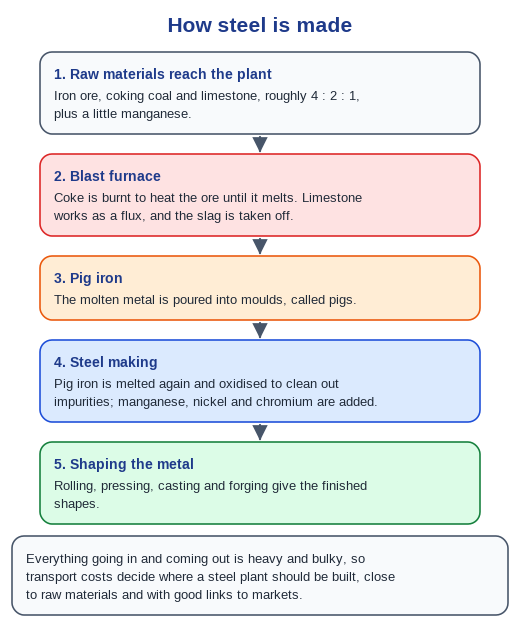
Page 64: why are inorganic chemical industries spread widely over the country? Their products, such as sulphuric acid, soda ash and caustic soda, are needed everywhere, by fertiliser, glass, soap and detergent, and paper makers. Extra: their raw materials are widely available, so units can be set up near the users.
Page 65: list chemical products you know. Examples: soaps and detergents, plastics, paints, dyes, fertilisers, insecticides, synthetic fibres, rubber goods, medicines, glass.
Page 65 (Activity): where would it be economical to set up cement plants? Near limestone deposits, because the raw materials (limestone, silica and gypsum) are bulky and heavy, with coal and electric power at hand and good rail links. The chapter adds that plants in Gujarat are well placed for markets in the Gulf countries.
Page 65 (Activity): find out where cement plants are located in other states, and their names. Extra, to research: use newspapers, your atlas or company and government websites to list cement plants in your state, their places and the limestone areas near them.
Page 66: are you aware of the Bhopal gas tragedy? The chapter uses it to show how dangerous a toxic gas leak can be. Extra: in December 1984 a poisonous gas leaked from a pesticide factory in Bhopal, Madhya Pradesh, killing thousands and harming many more for years.
Page 66: what would thermal pollution do to aquatic life? Extra, as usually taught: warm water holds less dissolved oxygen, so fish and other water creatures struggle to breathe and may die; the heat can also disturb their breeding and growth.
Page 66: how can factories pollute less fresh water? The chapter itself answers: reuse and recycle water in two or more stages, harvest rainwater, and clean hot water and effluents in primary, secondary and tertiary stages before they are let out.
1. Multiple choice questions (page 68)
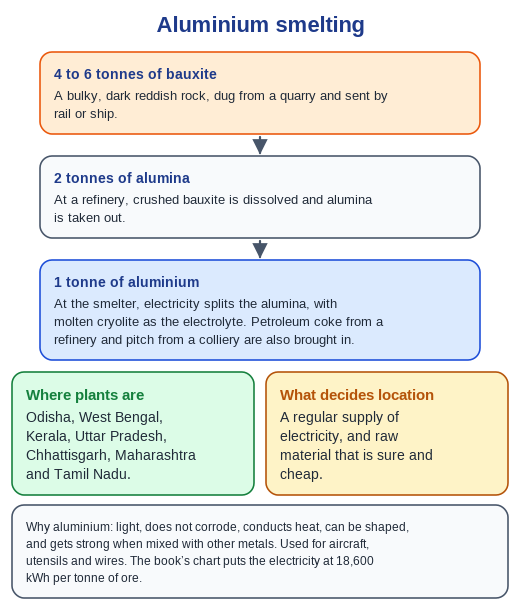
(i) “Which one of the following industries uses bauxite as a raw material? (a) Aluminium Smelting (b) Cement (c) Paper (d) Steel”
(a) Aluminium Smelting. Bauxite is refined into alumina, which is smelted into aluminium.
(ii) “Which one of the following industries manufactures telephones, computer, etc. (a) Steel (b) Electronic (c) Aluminium Smelting (d) Information Technology”
(b) Electronic. The chapter says the electronics industry makes products from transistor sets to televisions, telephones, radars and computers.
2. Answer in not more than 30 words (page 68)
(i) “What is manufacturing?” Manufacturing is producing goods in large quantities by processing raw materials into more valuable products, such as sugar from sugarcane or aluminium from bauxite. It is a secondary activity.
(ii) “What are basic industries? Give an example.” Basic or key industries supply their products as raw materials for making other goods. Example: the iron and steel industry, whose steel all other industries need.
3. Answer in about 120 words (page 69)
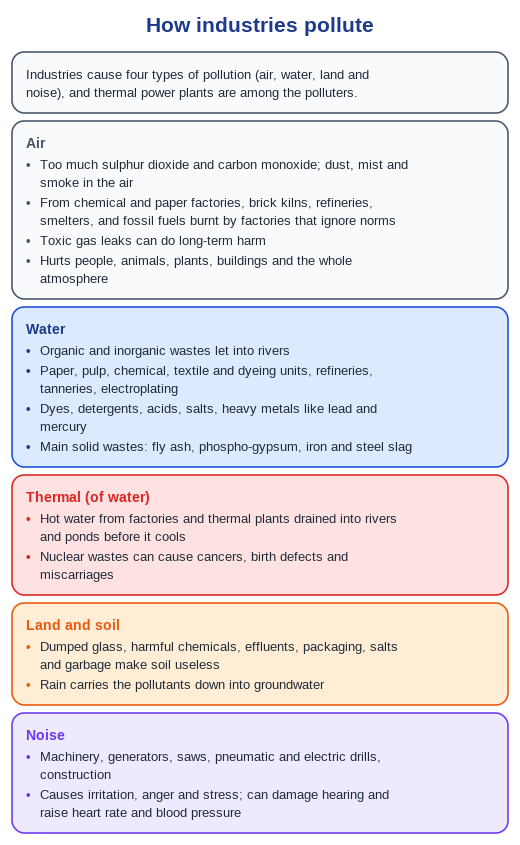
(i) “How do industries pollute the environment?”
Answer: Industries cause four kinds of pollution: air, water, land and noise.
- Air pollution: chemical and paper factories, brick kilns, refineries and smelting plants give out smoke and dust. They also release harmful gases such as sulphur dioxide and carbon monoxide. A toxic gas leak, as in the Bhopal gas tragedy, can be very dangerous for a long time.
- Water pollution: paper, pulp, chemical, textile and dyeing units, refineries, tanneries and electroplating units let out dyes, detergents, acids, salts and heavy metals such as lead and mercury into rivers and ponds.
- Thermal pollution: hot water from factories and thermal plants is drained into rivers and ponds before it cools. This harms water life. Wastes from nuclear plants can cause cancers, birth defects and miscarriages.
- Land pollution: dumped glass, harmful chemicals, effluents, packaging, salts and garbage make the soil useless. Rainwater carries these pollutants down into the groundwater.
- Noise pollution: machines, generators, saws and drills cause irritation, stress, hearing loss, a faster heart rate and higher blood pressure.
Polluted air, water and soil harm people, animals, plants and buildings.
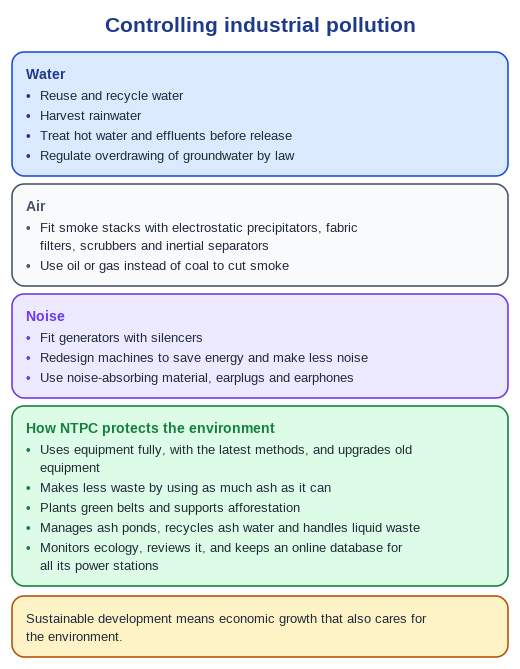
(ii) “Discuss the steps to be taken to minimise environmental degradation by industry?”
Answer:
- Save water: reuse and recycle water in two or more stages, and harvest rainwater.
- Treat waste water: treat hot water and effluents before letting them into rivers and ponds. Treatment has three stages: primary (mechanical: screening, grinding, settling), secondary (biological) and tertiary (biological, chemical and physical, including recycling).
- Protect groundwater: control by law how much groundwater industries draw.
- Clean the air: fit chimneys (smoke stacks) with electrostatic precipitators, fabric filters, scrubbers and inertial separators to catch dust. Use oil or gas instead of coal to cut smoke.
- Cut noise: fit silencers on generators, redesign machines to save energy and make less noise, use noise-absorbing materials, and give workers earplugs.
- Learn from good examples like NTPC: use the latest equipment well, use ash instead of dumping it, grow green belts, manage ash ponds and liquid waste, and keep checking the environment around each plant.
Economic growth must go together with care for the environment.
Activity: one word for each (page 69)
| Clue | Letters | Answer |
|---|---|---|
| (i) Used to drive machinery | 5 | POWER |
| (ii) People who work in a factory | 6 | WORKER |
| (iii) Where the product is sold | 6 | MARKET |
| (iv) A person who sells goods | 8 | RETAILER |
| (v) Thing produced | 7 | PRODUCT |
| (vi) To make or produce | 11 | MANUFACTURE |
| (vii) Land, Water and Air degraded | 9 | POLLUTION |
Each answer starts with the letter the book prints and has the number of letters it asks for. For (ii), WORKERS would need 7 letters, so the 6-letter answer is WORKER.
Project work (page 69)
Pick one agro-based industry (for example a sugar mill, cotton mill or oil mill) and one mineral-based industry (for example a cement, steel or brick unit) near you. For each, note (i) its raw materials, (ii) other inputs that need transport, such as fuel, power, water, packing material and labour, and the cost of moving the finished goods to market, and (iii) whether it follows environmental rules: smoke filters, effluent treatment, waste disposal and noise control.
Activity: word search (pages 69–70)
The answers hidden in the grid, read across or down:
| Clue | Answer | Where in the grid |
|---|---|---|
| 1. Industries that get raw materials from agriculture | AGROBASED (agro based) | Down, column 6, rows 1–9 |
| 2. Basic raw material for the sugar industry | SUGARCANE | Across, row 3 |
| 3. The ‘Golden Fibre’ | JUTE | Down, column 3, rows 2–5 |
| 4. Iron ore, coking coal and limestone are its chief raw materials | IRONSTEEL (iron and steel) | Across, row 7 |
| 5. A public sector steel plant in Chhattisgarh | BHILAI | Across, row 5 |
| 6. Railway diesel engines are made at this place in Uttar Pradesh | VARANASI | Across, row 1 |
We checked each answer letter by letter against the grid printed on page 70. On page 69 the list stops at clue 5; clue 6 is printed only with the grid on page 70.
Practice
-
Iron ore, coking coal and limestone are needed for steel in roughly which ratio?
Show answer
Answer: (b) 4 : 2 : 1
-
In which year was the first cement plant set up in Chennai?
Show answer
Answer: (c) 1904
-
Which industry is described as its own largest consumer?
Show answer
Answer: (b) Chemical
-
Why are cement plants in Gujarat well placed?
Show answer
Answer: They have easy access to markets in the Gulf countries.
-
What are the three stages of treating industrial effluents?
Show answer
Answer: Primary treatment by mechanical means, secondary treatment by a biological process, and tertiary treatment by biological, chemical and physical processes, which allows the water to be recycled.
Stuck on a question?
Take a photo and Lagnever AI explains it step by step. Try it for 7 days for ₹2.
Get it on Google Play Open in browser
For parents: after the trial, the plan renews monthly by UPI or card autopay. You can cancel anytime in the app.