
How are industries classified?
Answer in short
Industries are classified by source of raw material (agro or mineral based), main role (basic or consumer), capital investment (small scale or not), ownership (public, private, joint, cooperative) and bulk and weight (heavy or light). Textiles and sugar are agro based; iron and steel, aluminium, chemicals, fertilisers, cement, automobiles and electronics use minerals.
Stuck on a question? Take a photo and Lagnever AI explains it step by step. Try it for 7 days for ₹2. Get it on Google Play
Five ways to group industries
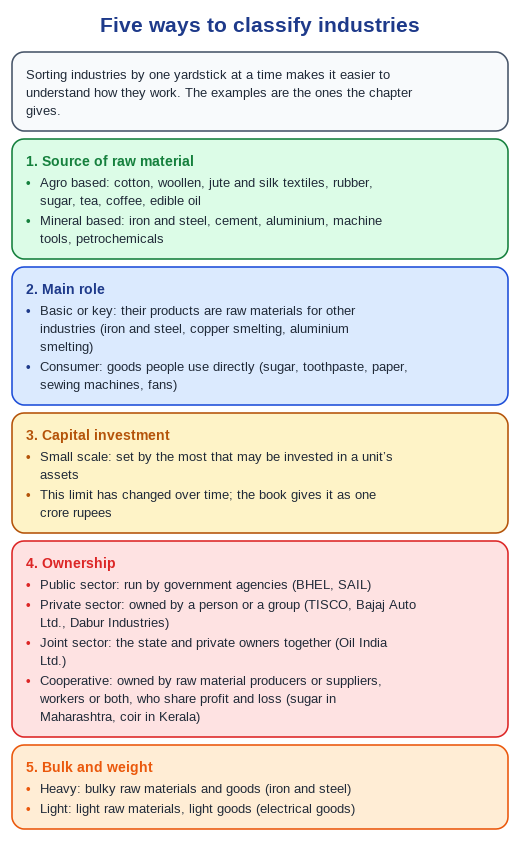
Think of the goods you use every day: bulbs, cooking oil, cement, glassware, petrol, matches, scooters, medicines. Grouping the industries that make them, one yardstick at a time, makes it easier to see how each works. The chapter uses five yardsticks.
- Source of raw material. Agro-based industries use farm produce: cotton, woollen, jute and silk textiles, rubber, sugar, tea, coffee and edible oil. Mineral-based industries use minerals and metals: iron and steel, cement, aluminium, machine tools and petrochemicals.
- Main role. Basic or key industries make products that other industries use as raw materials, such as iron and steel, copper smelting and aluminium smelting. Consumer industries make goods people use directly: sugar, toothpaste, paper, sewing machines, fans.
- Capital investment. A small scale industry is defined by the most that may be invested in the assets of one unit. The limit has changed over time; the book gives it as one crore rupees.
- Ownership. Public sector units are run by government agencies (BHEL, SAIL). Private sector units belong to a person or a group (TISCO, Bajaj Auto Ltd., Dabur Industries). Joint sector units are run by the state and private owners together (Oil India Ltd.). Cooperative sector units are owned by the producers or suppliers of raw materials, by workers or by both, who pool resources and share profit or loss (sugar in Maharashtra, coir in Kerala).
- Bulk and weight. Heavy industries, like iron and steel, handle bulky materials and goods; light industries, like electrical goods, use light materials and make light goods.
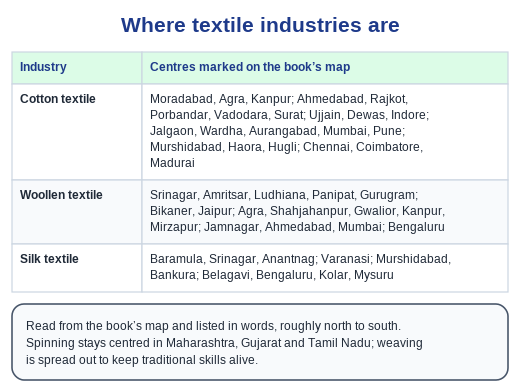
Agro-based industries: textiles
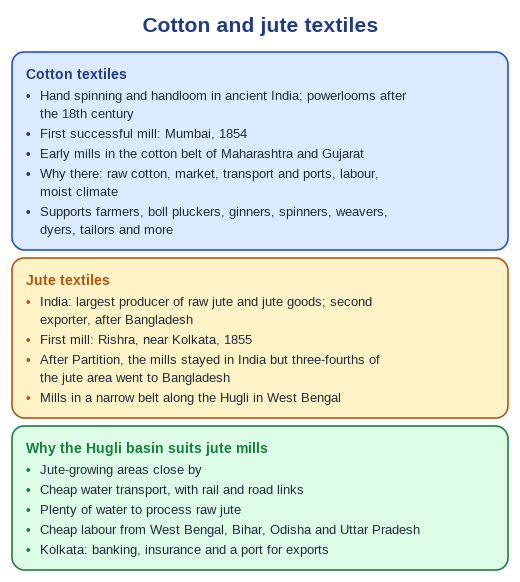
The textile industry adds a lot to industrial output, jobs and foreign exchange, and is the only one in India complete in its value chain, from raw fibre to garments. Cotton textiles moved from hand spinning and handlooms to powerlooms after the 18th century, and suffered under colonial rule when they could not compete with mill cloth from England. The first successful mill opened in Mumbai in 1854, and the demand for cloth during the two world wars boosted the industry. Early mills sat in the cotton belt of Maharashtra and Gujarat because of raw cotton, markets, transport and ports, labour and a moist climate. Spinning is still centred in Maharashtra, Gujarat and Tamil Nadu; weaving, by handloom, powerloom and mill, is spread out so that traditional skills survive. India spins yarn of world class, but much of the fabric woven is of low quality because weaving cannot use most of the high-quality yarn.
No country makes more raw jute and jute goods than India, and only Bangladesh exports more. The first jute mill came up at Rishra, near Kolkata, in 1855. At Partition the mills stayed in India, but three-fourths of the jute-growing land went to Bangladesh. The mills line a narrow belt along the Hugli for reasons shown below.
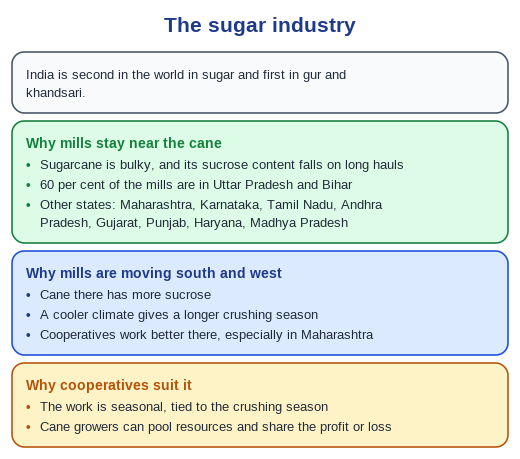
Agro-based industries: sugar
India is second in the world in sugar and first in gur and khandsari. Sugarcane is bulky and loses sucrose on long journeys, so mills are built near the fields; 60 per cent of them are in Uttar Pradesh and Bihar. Mills are now shifting to the south and west, especially Maharashtra, where cane is richer in sucrose, the cooler climate gives a longer crushing season, and cooperatives run better. Because the work is seasonal, the industry suits the cooperative sector.
Mineral-based industries
Iron and steel is the basic industry, since every other industry needs its machinery. Iron ore, coking coal and limestone go in at about 4 : 2 : 1, with some manganese to harden the steel. All of this is heavy and bulky, so the Chhotanagpur plateau, with cheap iron ore and high-grade raw materials close together, cheap labour and a large home market, has the most plants.
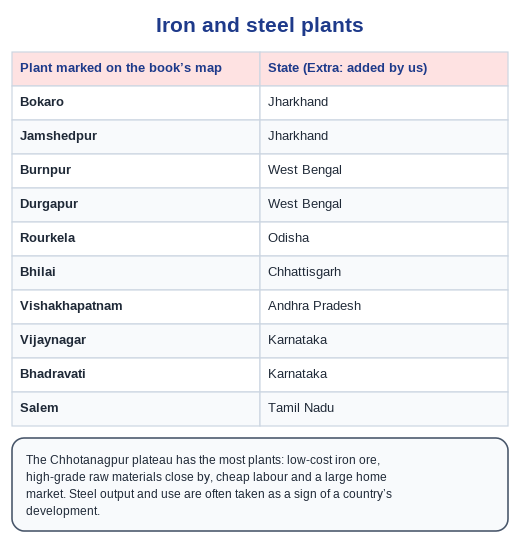
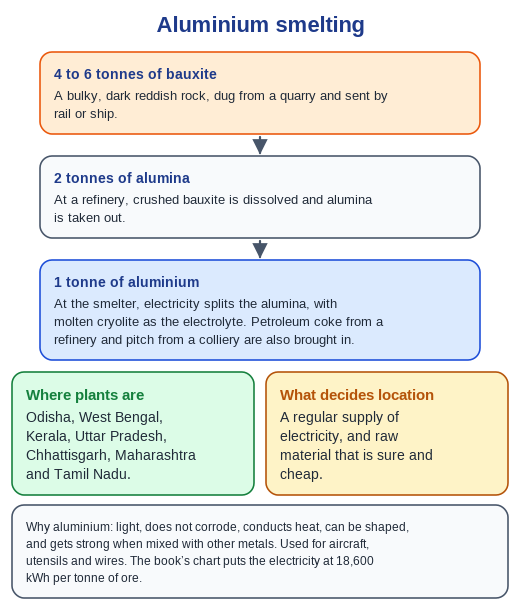
Among metallurgical industries, aluminium smelting ranks second in importance. Aluminium is light, resists corrosion, conducts heat, can be shaped and turns strong in alloys, so it replaces steel, copper, zinc and lead in many uses.
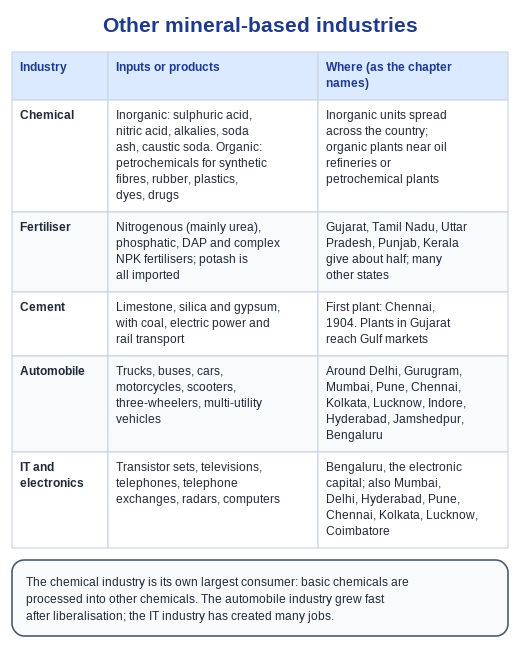
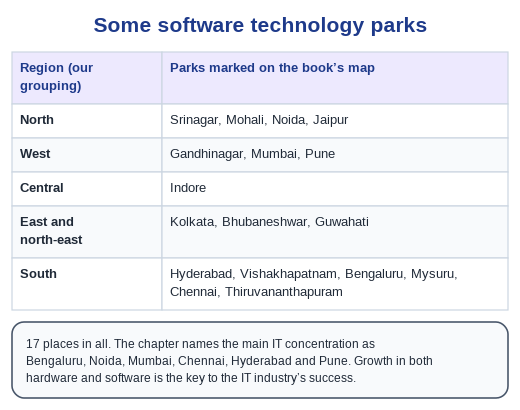
The chemical, fertiliser, cement, automobile and IT and electronics industries complete the list. The table gives what each uses or makes, and where the chapter places it.
Next, see industrial pollution and its control. Go back to the chapter notes or the NCERT solutions.
Practice
-
Oil India Ltd. is an example of which sector?
Show answer
Answer: (c) Joint sector
-
Which of these is a consumer industry?
Show answer
Answer: (d) Toothpaste
-
The first jute mill in India was set up in 1855 at:
Show answer
Answer: (a) Rishra
-
Why is the sugar industry suited to the cooperative sector?
Show answer
Answer: It is seasonal, working only in the cane-crushing season, so cane growers do well to pool their resources and share the profit or loss.
-
Name the two prime factors for locating an aluminium smelter.
Show answer
Answer: Electricity that never runs short, and bauxite that is sure to arrive and costs as little as possible.
Questions students ask
What is the difference between heavy and light industries?
Heavy industries use bulky raw materials and make bulky goods, like iron and steel. Light industries use light raw materials and make light goods, like electrical goods.
Why did jute mills grow along the Hugli?
Jute-growing areas were nearby, water transport was cheap and backed by rail and road, there was plenty of water to process jute, labour came cheaply from West Bengal and nearby states, and Kolkata offered banking, insurance and a port.
Why are sugar mills moving to the south and west?
Cane in states like Maharashtra has more sucrose, the cooler climate gives a longer crushing season, and cooperatives are more successful there.
Stuck on a question?
Take a photo and Lagnever AI explains it step by step. Try it for 7 days for ₹2.
Get it on Google Play Open in browser
For parents: after the trial, the plan renews monthly by UPI or card autopay. You can cancel anytime in the app.