
Class 10 Geography Chapter 6: Manufacturing Industries Notes
This chapter in five lines
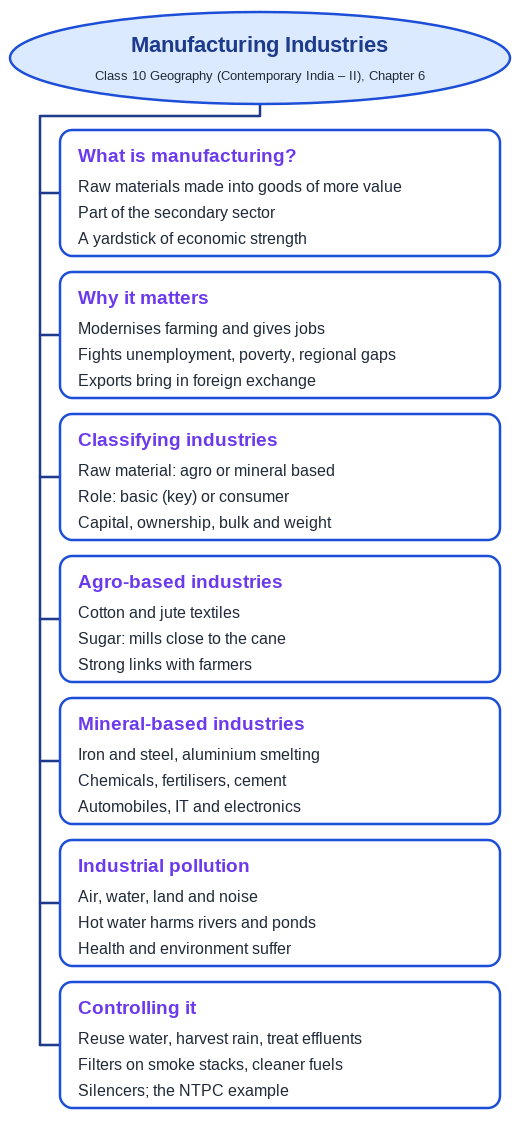
Manufacturing turns raw materials into goods of higher value and is the backbone of development. Industries are classified by raw material, role, capital, ownership and bulk. Agro-based ones include cotton, jute and sugar; mineral-based ones include iron and steel, aluminium, chemicals, fertilisers, cement, automobiles and electronics. Industries pollute air, water, land and soil, and must control it.
What is this chapter about?
The shirt you wear, the sugar in your tea, the steel spoon and the scooter outside all came out of factories. This chapter is about those factories: what they make, where they are, why they are there, and the harm they can do to air, water and land. It follows Chapter 5 of the book, Minerals and Energy Resources, because minerals and energy are what most factories run on. The chapter opens with a boy, Harish, at a Diwali market, wondering how so many goods are made; his father explains that some come from big industries, some from small ones and some, like diyas, from artisans at home.
What is manufacturing?
Manufacturing means producing goods in large quantities by processing raw materials into more valuable products: paper from wood, sugar from sugarcane, iron and steel from iron ore, aluminium from bauxite. Some products, such as yarn, are themselves raw materials for other goods, such as cloth. People who do this work belong to the secondary sector: workers in steel plants, car factories, textile mills and bakeries. The chapter says a country’s economic strength is measured by how far its manufacturing industries have developed.
Why is manufacturing so important?
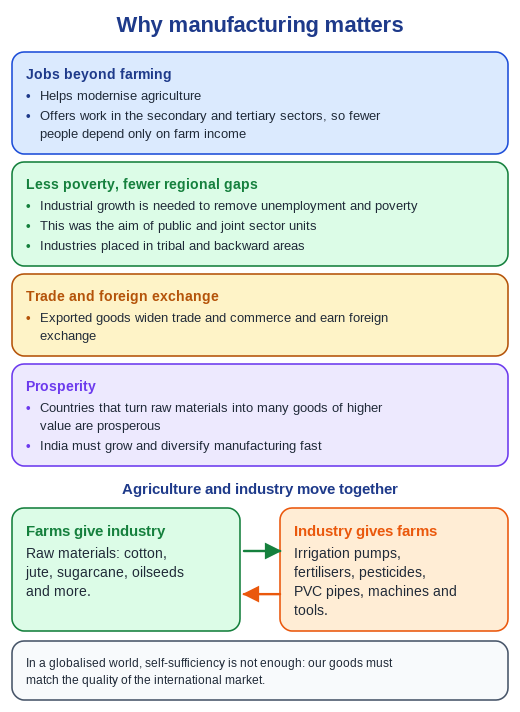
The chapter calls manufacturing the backbone of development, for four reasons. It helps modernise agriculture and gives people jobs in the secondary and tertiary sectors, so fewer depend only on farm income. Industrial growth is needed to remove unemployment and poverty; this was the idea behind public sector and joint sector industries, which were also set up in tribal and backward areas to reduce regional gaps. Exports of manufactured goods widen trade and bring in foreign exchange. And countries that turn raw materials into many kinds of goods of higher value are prosperous.
Agriculture and industry are not separate. Agro-industries buy farm produce, and they sell farmers irrigation pumps, fertilisers, pesticides, PVC pipes, machines and tools, which has made farming more productive and efficient. In today’s globalised world, being self-sufficient is not enough: Indian goods must match international quality to compete.
How are industries classified?
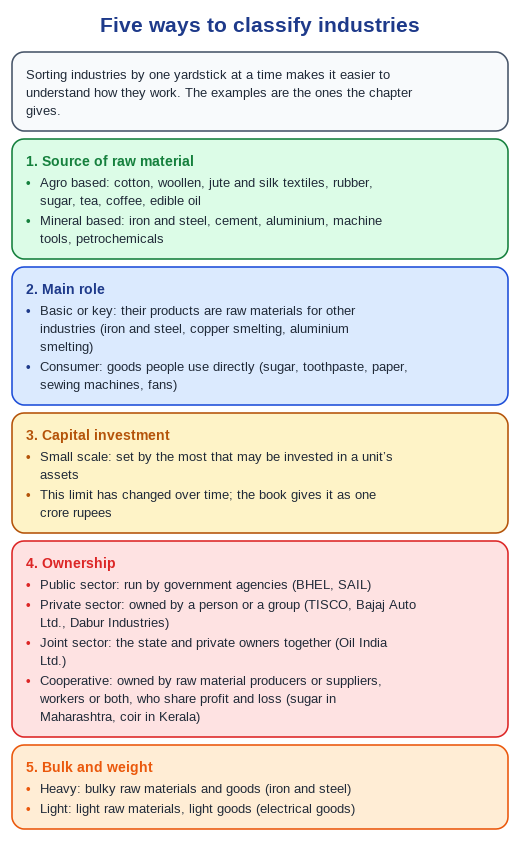
Industries can be grouped in five ways: by the source of raw material (agro based or mineral based), by their main role (basic or key industries that feed other industries, and consumer industries), by capital investment (small scale units have a set investment limit, which the book gives as one crore rupees), by ownership (public, private, joint and cooperative sector), and by the bulk and weight of raw materials and goods (heavy and light industries). Read How are industries classified?
Which are the main agro-based industries?
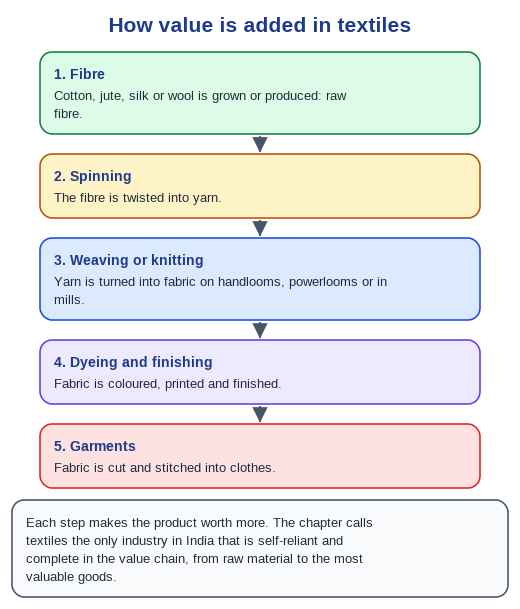
The textile industry has a unique place: it adds a great deal to industrial output, jobs and foreign exchange, and it is the only Indian industry that is self-reliant and complete in its value chain, from fibre to finished garments. Cotton textiles were once made by hand spinning and handloom; the first successful mill opened in Mumbai in 1854, and early mills clustered in the cotton belt of Maharashtra and Gujarat. Spinning is centred in Maharashtra, Gujarat and Tamil Nadu, while weaving is spread out, and handspun khadi employs many weavers at home. No country makes more raw jute and jute goods than India, though Bangladesh exports more; most jute mills line the Hugli in West Bengal. India is second in the world in sugar and first in gur and khandsari; mills stay close to the cane, which is bulky and loses sucrose in transport.
Which are the main mineral-based industries?
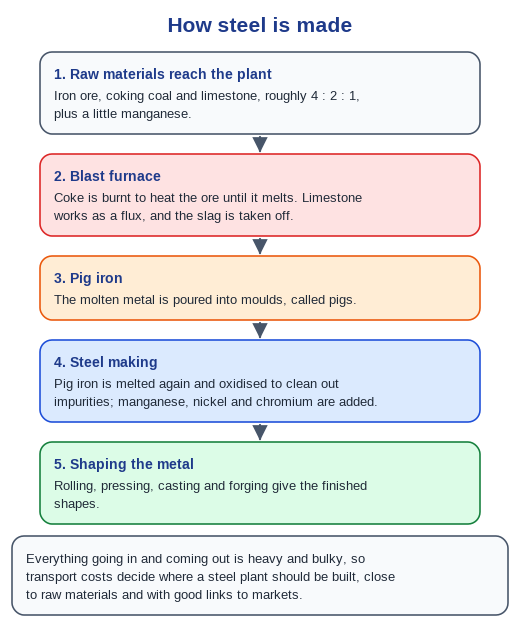
Iron and steel is the basic industry: all other industries depend on it for machinery, and steel use is often taken as a sign of development. Its raw materials and goods are heavy and bulky, so transport costs matter; the Chhotanagpur plateau has the most plants. Aluminium smelting ranks second among India’s metallurgical industries; it needs regular electricity and a cheap, sure supply of bauxite. The chemical industry is growing fast and is its own largest consumer. The fertiliser industry makes nitrogenous, phosphatic and complex fertilisers, but potash is all imported. Cement needs bulky limestone, silica and gypsum. The automobile industry grew quickly after liberalisation, and IT and electronics, led by Bengaluru, has created many jobs.
How do industries pollute the environment?
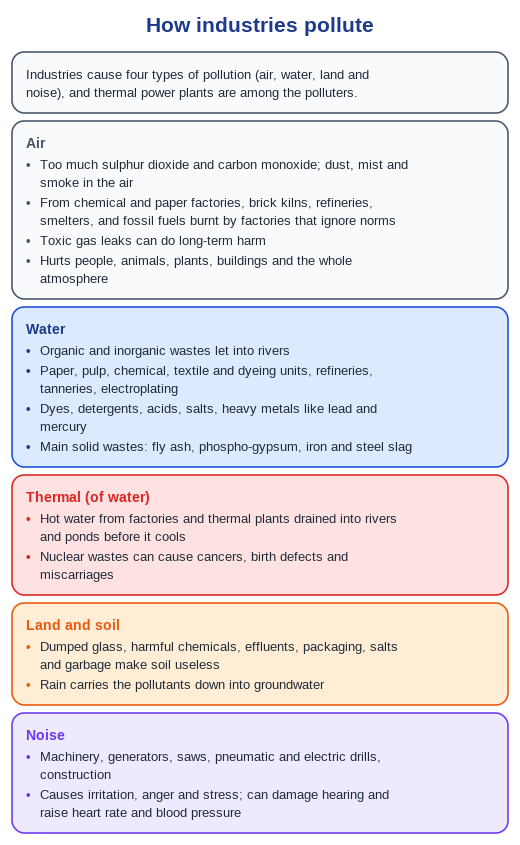
Industries add a lot to growth, but they also pollute air, water, land and soil, and cause noise, and thermal power plants are among the polluters. Smoke and harmful gases like carbon monoxide and sulphur dioxide foul the air; dyes, acids, heavy metals and other wastes poison rivers; hot water let out before cooling causes thermal pollution; dumped waste makes soil useless and seeps into groundwater; and the din of machines harms hearing and raises stress. Read Industrial pollution and its control
How can industrial pollution be controlled?
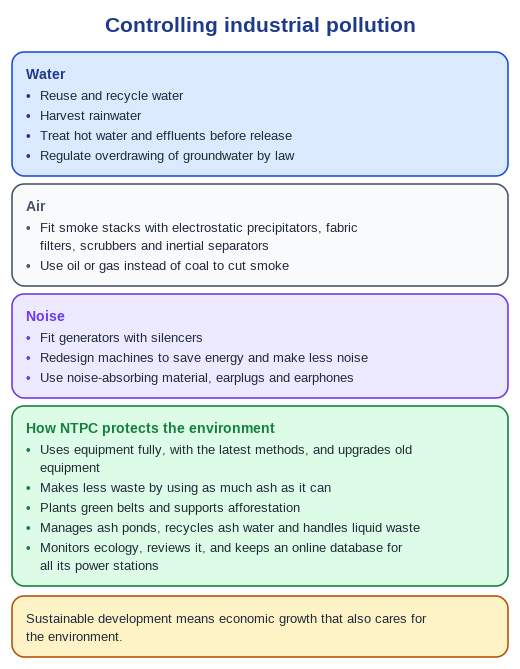
The chapter suggests reusing and recycling water, harvesting rainwater, and treating hot water and effluents in three stages before they reach rivers. Overdrawing groundwater should be controlled by law. Filters on smoke stacks cut particles in the air, and using oil or gas instead of coal cuts smoke. Silencers, quieter machines, noise-absorbing material and earplugs reduce noise. A box shows how NTPC, a major power corporation, looks after the environment at its plants.
Before we move on
The chapter’s message is that industry is needed for jobs, exports and a stronger economy, but growth must go hand in hand with care for the environment; that is what sustainable development means. The next chapter of the book, Lifelines of National Economy, looks at the transport and communication that move these goods. Answers to every in-text question and exercise are in the NCERT solutions for Chapter 6. Revise the raw materials behind these industries in the Chapter 5 notes on minerals and energy.
Key terms
| Term | Meaning |
|---|---|
| Manufacturing | Making goods in large quantities by processing raw materials into products of more value, such as sugar from sugarcane or aluminium from bauxite. |
| Secondary sector | The part of the economy where people turn primary materials into finished goods, as in steel plants, textile mills and bakeries. |
| Agro-based industry | An industry that uses farm produce as its raw material: cotton, jute, silk and woollen textiles, sugar, edible oil, tea, coffee, rubber. |
| Mineral-based industry | An industry that uses minerals and metals as raw materials: iron and steel, aluminium, cement, machine tools, petrochemicals. |
| Basic or key industry | An industry whose products are raw materials for other industries, such as iron and steel, copper smelting and aluminium smelting. |
| Consumer industry | An industry making goods that people use directly, such as sugar, toothpaste, paper, sewing machines and fans. |
| Joint sector | Industries run together by the state and private individuals or groups; the chapter’s example is Oil India Ltd. |
| Cooperative sector | Industries owned and run by the producers or suppliers of raw materials, by workers or by both, who pool resources and share profit or loss. |
| Value chain | The steps by which a raw material becomes a finished product, each step adding value; in textiles, fibre to yarn to fabric to garments. |
| Pig iron | Iron from the blast furnace, poured into moulds called pigs, which is then purified further to make steel. |
| Thermal pollution | Pollution of rivers and ponds when factories and thermal plants let out water that is still hot. |
| Effluents | Liquid industrial wastes; the chapter says they should be treated in primary, secondary and tertiary stages before release. |
Topics in this chapter
Practice
-
In which city was the first successful textile mill of India set up, in 1854?
Show answer
Answer: (c) Mumbai
-
Most jute mills of India are located along the banks of which river?
Show answer
Answer: (b) Hugli
-
Iron and steel is called a heavy industry because:
Show answer
Answer: (b) Its raw materials and finished goods are heavy and bulky
-
Which city has emerged as the electronic capital of India?
Show answer
Answer: (c) Bengaluru
-
Which fertiliser nutrient is entirely imported, according to the chapter?
Show answer
Answer: (c) Potash
-
Hot water from factories drained into rivers before cooling causes:
Show answer
Answer: (b) Thermal pollution
Questions students ask
What are the main topics of Class 10 Geography Chapter 6?
What manufacturing is and why it matters, how industries are classified, agro-based industries (cotton and jute textiles, sugar), mineral-based industries (iron and steel, aluminium, chemicals, fertilisers, cement, automobiles, IT and electronics), industrial pollution, and ways to control it.
Is Manufacturing Industries in the 2026-27 NCERT book?
Yes. It is Chapter 6 of Contemporary India – II, the Class 10 Geography textbook marked Reprint 2026-27, on pages 58 to 70. These notes follow the copy NCERT uploaded on 9 July 2026.
Why is the iron and steel industry called a basic industry?
Because every other industry, heavy, medium or light, depends on it for machinery. Steel also goes into engineering goods, buildings, defence, medical and scientific equipment and many consumer goods.
Why are organic chemical plants located near oil refineries?
Organic chemicals include petrochemicals, which come from refining petroleum. Setting the plants close to refineries or petrochemical plants keeps the raw material near at hand.
Stuck on a question?
Take a photo and Lagnever AI explains it step by step. Try it for 7 days for ₹2.
Get it on Google Play Open in browser
For parents: after the trial, the plan renews monthly by UPI or card autopay. You can cancel anytime in the app.