
How do industries pollute, and how can it be controlled?
Answer in short
Industries pollute air with gases and smoke, water with dyes, acids and heavy metals, rivers with hot water, soil with dumped waste, and surroundings with noise. Control means reusing water, harvesting rain, treating effluents in three stages, filtering smoke, using oil or gas instead of coal, and fitting silencers, as NTPC’s plants show.
Stuck on a question? Take a photo and Lagnever AI explains it step by step. Try it for 7 days for ₹2. Get it on Google Play
Growth with a cost
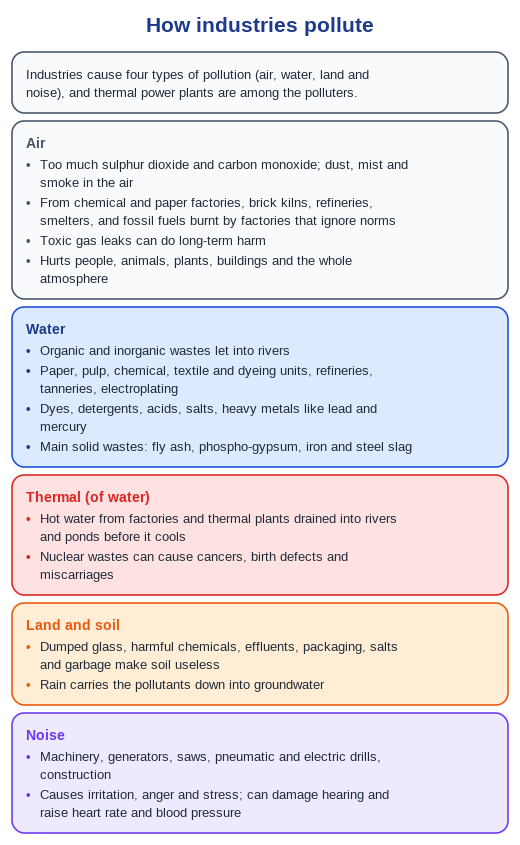
Industries add a great deal to India’s growth, but the pollution of land, water and air, the noise, and the damage to the environment that they cause cannot be ignored. The chapter names four types of industrial pollution: air, water, land and noise. Thermal power plants are counted among the polluting industries.
Air pollution
Air is polluted when it carries a high share of harmful gases, for example carbon monoxide and sulphur dioxide, along with floating particles, solid and liquid: dust, sprays, mist and smoke. Smoke pours out of refineries, smelters, brick kilns, and paper and chemical factories, and so do factories big and small that burn fossil fuels while ignoring pollution rules. Leaks of toxic gas are especially dangerous and their effects last for years; the chapter reminds us of the Bhopal gas tragedy. Dirty air harms people, animals and plants, damages buildings, and spoils the atmosphere in general.
Water and thermal pollution
Rivers are polluted when industries pour organic and inorganic wastes into them. The chief offenders are paper and pulp, chemical, textile and dyeing units, petroleum refineries, tanneries and electroplating units, which release dyes, detergents, acids, salts, heavy metals such as lead and mercury, pesticides, fertilisers, synthetic carbon compounds, plastics and rubber. India’s major solid wastes are fly ash, phospho-gypsum and iron and steel slag.
Thermal pollution happens when factories and thermal plants let their hot water flow into rivers and ponds without cooling it first. Wastes from nuclear power plants and from nuclear and weapon production can cause cancers, birth defects and miscarriages.
Land and soil, and noise
Soil and water pollution go together. Dumped glass, harmful chemicals, industrial effluents, packaging, salts and garbage make soil useless, and rainwater carries the pollutants down, so groundwater gets contaminated too.
Noise is unwanted sound. It causes irritation, anger and stress, and it can damage hearing and raise heart rate and blood pressure. Industry and construction, machinery, factory equipment, generators, saws, and pneumatic and electric drills are all noisy.
Controlling water pollution
Each litre of waste water an industry lets out pollutes eight times as much fresh water. The chapter suggests three remedies: use less water by reusing and recycling it over two or more stages; harvest rainwater; and treat hot water and effluents before they are let out. Effluents are treated in three phases.
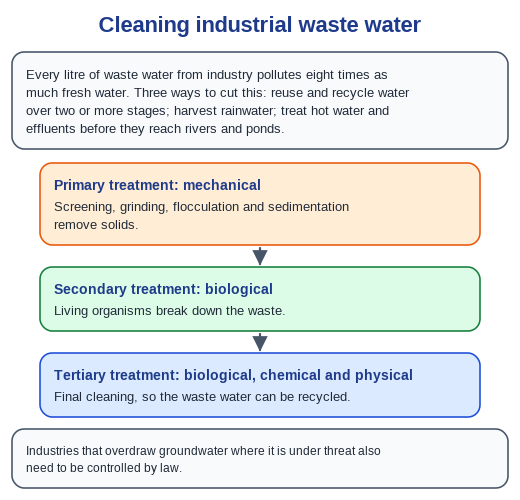
Where groundwater is under threat, industries that overdraw it must also be controlled by law.
Controlling air and noise pollution
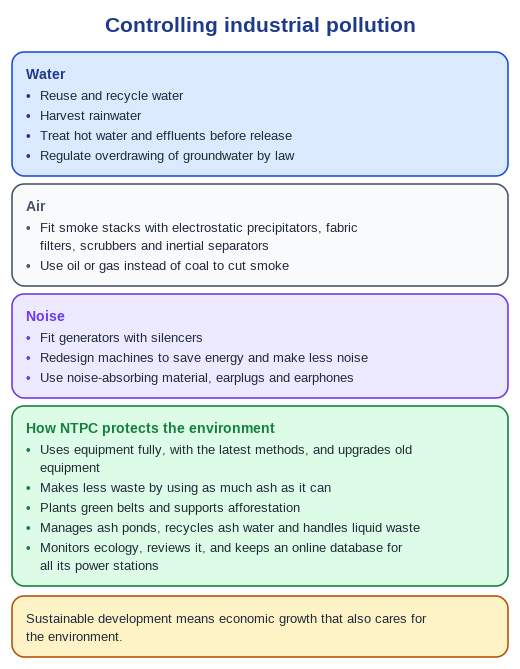
Particles in the air can be cut by fitting smoke stacks with electrostatic precipitators, fabric filters, scrubbers and inertial separators. Burning oil or gas instead of coal reduces smoke. For noise, generators should be fitted with silencers, nearly all machines can be redesigned to use less energy and make less noise, and noise-absorbing materials, earplugs and earphones help.
The NTPC example
A box in the chapter, “NTPC shows the way”, describes NTPC, a major power corporation with ISO 14001 certification for its Environment Management System. It tries to protect water, oil, gas, fuels and the natural surroundings where it builds power plants, by using equipment well and upgrading it, using as much ash as it can, planting green belts, managing ash ponds and liquid waste, and keeping watch on the ecology of all its power stations. The lesson is that sustainable development joins economic growth with care for the environment.
Go back to how industries are classified, the chapter notes or the NCERT solutions, where Question 3 asks about exactly this topic.
Practice
-
Which of these is NOT given in the chapter as a way to reduce particles in the air?
Show answer
Answer: (d) Earplugs
-
Primary treatment of effluents is done by:
Show answer
Answer: (b) Mechanical means
-
Fly ash, phospho-gypsum and slag are examples of:
Show answer
Answer: (b) Major solid wastes
-
Give two effects of noise pollution named in the chapter.
Show answer
Answer: Irritation and anger (stress), and it can damage hearing and raise heart rate and blood pressure.
-
How can smoke from factories be reduced?
Show answer
Answer: By using oil or gas instead of coal, and by fitting smoke stacks with electrostatic precipitators, fabric filters, scrubbers and inertial separators to trap particles.
Questions students ask
What would hot water do to aquatic life?
The chapter only asks the question. Extra, as usually taught: warm water holds less dissolved oxygen, so fish and other water life can suffocate or die, and the sudden heat can harm their breeding.
What is the Bhopal gas tragedy the chapter mentions?
The chapter uses it as an example of how dangerous toxic gas leaks from factories can be. Extra: in December 1984 a poisonous gas leaked from a pesticide factory in Bhopal, killing thousands of people and harming many more for years.
What does sustainable development mean here?
Growing the economy while caring for the environment at the same time: using equipment well, cutting waste, planting green belts, managing ash and liquid waste, and monitoring the ecology, as the NTPC box shows.
Stuck on a question?
Take a photo and Lagnever AI explains it step by step. Try it for 7 days for ₹2.
Get it on Google Play Open in browser
For parents: after the trial, the plan renews monthly by UPI or card autopay. You can cancel anytime in the app.