
NCERT Solutions Class 12 Biology Chapter 1: Sexual Reproduction in Flowering Plants
Answers to all 18 end-of-chapter exercises of Chapter 1, Sexual Reproduction in Flowering Plants, of Biology, the Class 12 NCERT textbook, and to the questions the chapter asks along the way. Page numbers follow the 2026-27 reprint (pages 3–25). The exercises come first, quoted from the book; the questions inside the chapter follow, restated in short. The book prints no answer key for this chapter. Short notes: Chapter 1 notes.
Stay safe. Do the activities with your teacher. Forceps, blades and needles are sharp, and some people are allergic to pollen. Castor seeds are poisonous (Extra): never eat them, and wash your hands after splitting them. Never taste seeds, chemicals or growth substances used in the lab.
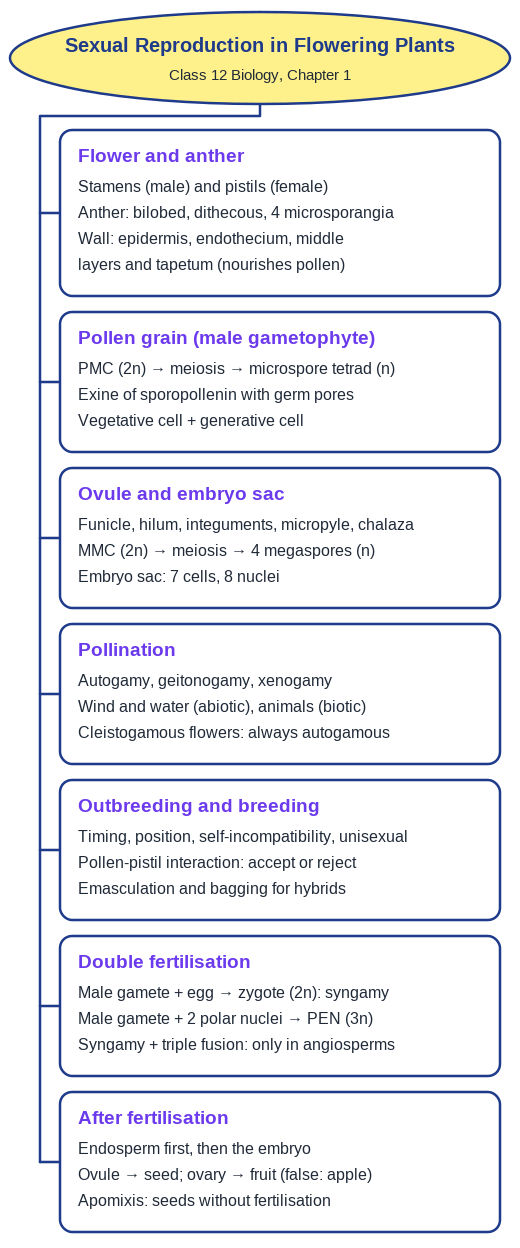
Exercises 1 to 6: anther, ovule and embryo sac
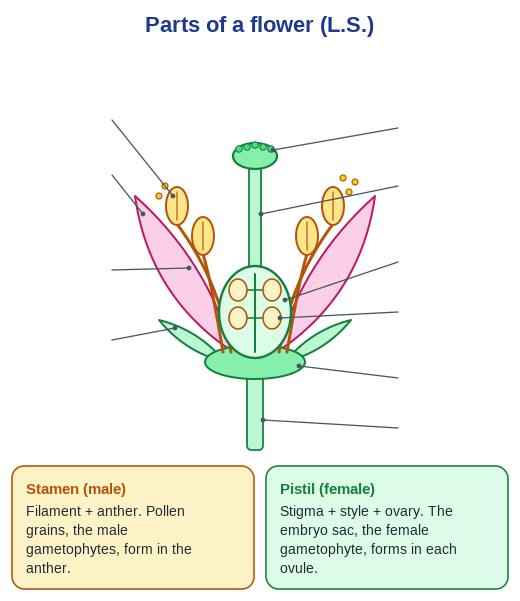
1. “Name the parts of an angiosperm flower in which development of male and female gametophyte take place.”
The male gametophyte, the pollen grain, develops in the anther of the stamen, inside its microsporangia (pollen sacs). The female gametophyte, the embryo sac, develops in the ovule, inside its nucellus; the ovules lie in the ovary of the pistil.
2. “Differentiate between microsporogenesis and megasporogenesis. Which type of cell division occurs during these events? Name the structures formed at the end of these two events.”
| Point | Microsporogenesis | Megasporogenesis |
|---|---|---|
| What it is | Meiosis of a pollen mother cell gives microspores | Meiosis of the megaspore mother cell gives megaspores |
| Where | Microsporangium (pollen sac) of the anther | Nucellus of the ovule, near the micropyle |
| Mother cells | Many: each sporogenous cell can act as a PMC | Usually a single MMC in an ovule |
| What becomes of the spores | All four microspores become pollen grains | Usually one megaspore survives; three degenerate |
Cell division: meiosis in both, so the diploid (2n) mother cell gives four haploid (n) spores.
Structures formed: microsporogenesis ends with microspore tetrads, clusters of four microspores, which separate and mature into pollen grains. Megasporogenesis ends with four megaspores; the functional one develops into the embryo sac.
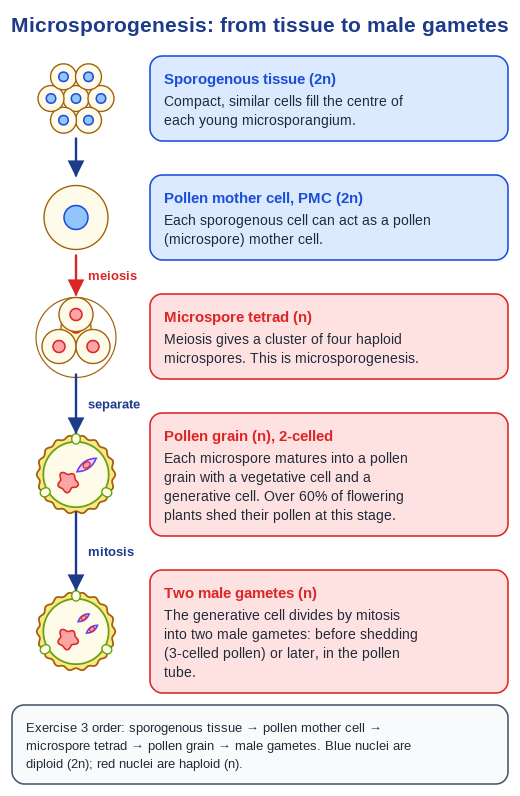
3. “Arrange the following terms in the correct developmental sequence: Pollen grain, sporogenous tissue, microspore tetrad, pollen mother cell, male gametes.”
Sporogenous tissue → pollen mother cell → microspore tetrad → pollen grain → male gametes.
- Sporogenous tissue: a compact mass of cells that fills a young microsporangium.
- Pollen mother cell (PMC, 2n): any cell of this tissue can act as a PMC.
- Microspore tetrad (n): each PMC divides by meiosis into a group of four microspores.
- Pollen grain: the microspores separate and mature. Each pollen grain has a vegetative cell and a generative cell.
- Male gametes: the generative cell divides by mitosis into two male gametes. This happens before the pollen is shed, or later inside the pollen tube.
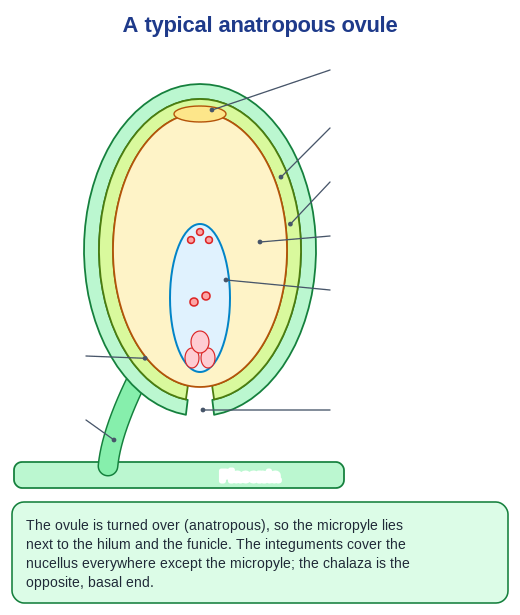
4. “With a neat, labelled diagram, describe the parts of a typical angiosperm ovule.”
The ovule (megasporangium) is a small body joined to the placenta inside the ovary. Its parts:
- Funicle: the stalk that attaches the ovule to the placenta.
- Hilum: the region where the body of the ovule joins the funicle.
- Integuments: one or two protective envelopes (outer and inner) around the ovule.
- Micropyle: a small opening left at the tip, where the integuments do not cover the nucellus.
- Chalaza: the basal part of the ovule, opposite the micropylar end.
- Nucellus: the mass of cells inside the integuments, with plenty of reserve food.
- Embryo sac (female gametophyte): lies in the nucellus; an ovule usually has one, formed from a single megaspore.
In the typical anatropous ovule shown, the body is turned over, so the micropyle lies beside the hilum.
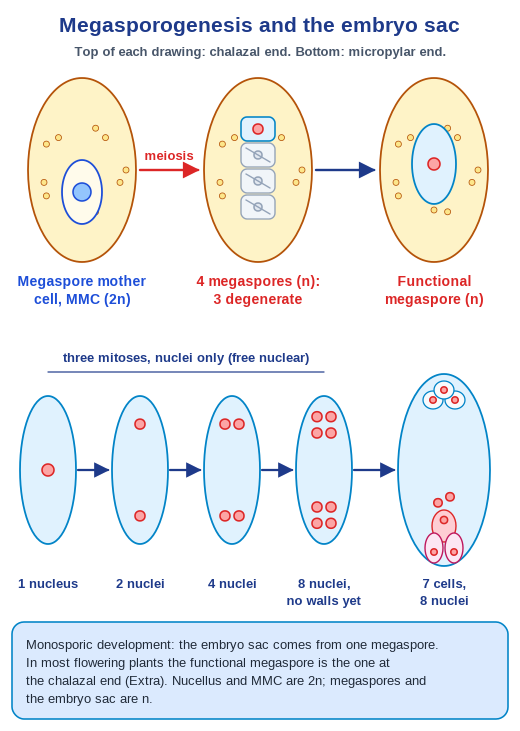
5. “What is meant by monosporic development of female gametophyte?”
The megaspore mother cell divides by meiosis into four megaspores. In most flowering plants only one of them is functional and the other three degenerate. The embryo sac, or female gametophyte, then develops from this single functional megaspore. Forming the female gametophyte from one megaspore is called monosporic development.
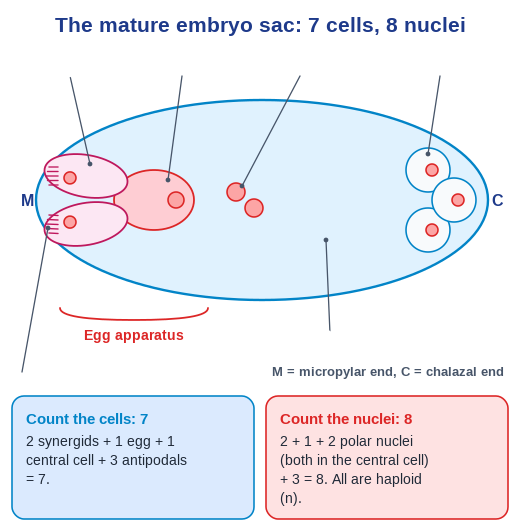
6. “With a neat diagram explain the 7-celled, 8-nucleate nature of the female gametophyte.”
The nucleus of the functional megaspore divides by mitosis into two nuclei, which move to opposite ends of the embryo sac. Two more mitoses give 4 and then 8 nuclei. These divisions are free nuclear: no walls form until the 8-nucleate stage. Then walls form around six of the nuclei:
- At the micropylar end, three cells make the egg apparatus: two synergids, which carry the filiform apparatus, and one egg cell.
- At the chalazal end, three cells are the antipodals.
- The remaining two nuclei, the polar nuclei, stay together in the large central cell, just below the egg apparatus.
Cells: 2 synergids + 1 egg + 3 antipodals + 1 central cell = 7. Nuclei: 2 + 1 + 3 + 2 polar nuclei = 8. So the mature embryo sac is 7-celled but 8-nucleate.
Exercises 7 to 10: pollination and plant breeding
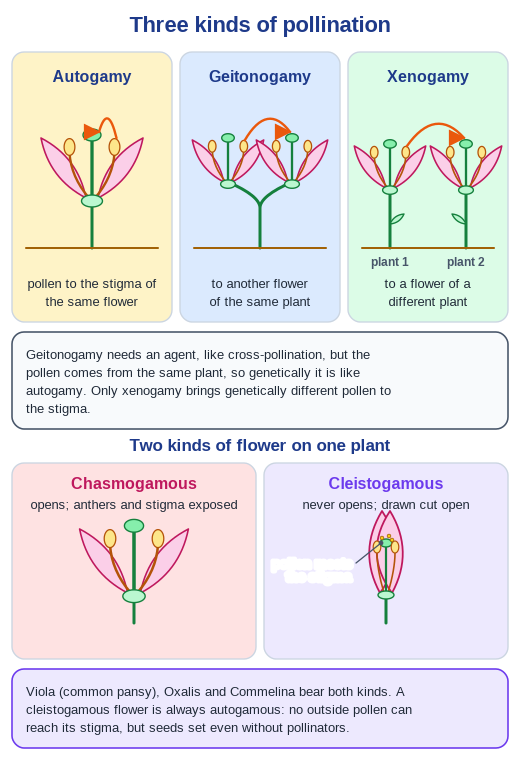
7. “What are chasmogamous flowers? Can cross-pollination occur in cleistogamous flowers? Give reasons for your answer.”
Chasmogamous flowers open normally, like the flowers of most species, so their anthers and stigma are exposed. Viola (common pansy), Oxalis and Commelina bear them alongside cleistogamous flowers.
No, cross-pollination cannot occur in cleistogamous flowers. They never open. Their anthers and stigma lie close together, and the anthers burst inside the closed bud, so their pollen falls on the stigma of the same flower. No pollen from another flower can reach the stigma. Cleistogamous flowers are therefore always autogamous, and they set seed even when no pollinators are around.
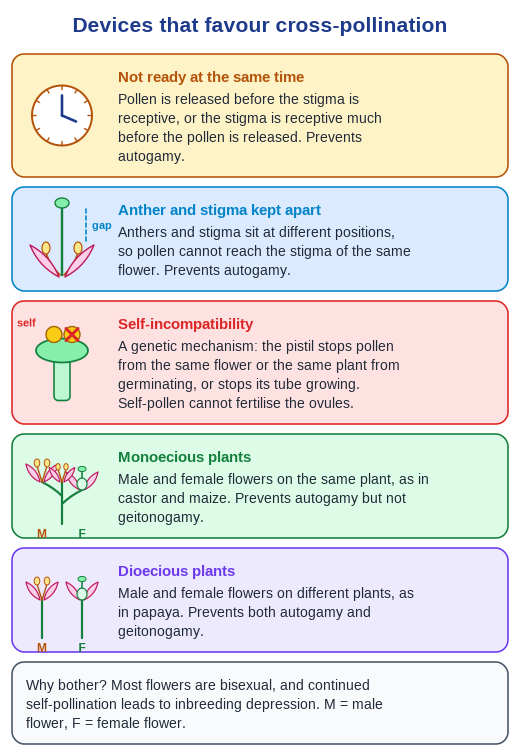
8. “Mention two strategies evolved to prevent self-pollination in flowers.”
- Different timing: the pollen is released and the stigma becomes receptive at different times. Either the pollen comes out before the stigma is ready, or the stigma is ready well before the pollen comes out, so a flower’s own pollen and stigma are not ready together.
- Different positions: the anthers and stigma are placed apart, so pollen cannot reach the stigma of the same flower.
Both prevent autogamy. Two other devices are self-incompatibility and unisexual flowers: dioecy, as in papaya, prevents both autogamy and geitonogamy.
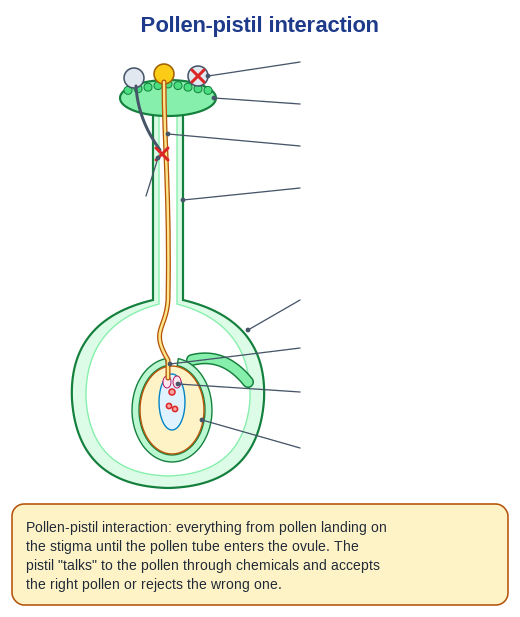
9. “What is self-incompatibility? Why does self-pollination not lead to seed formation in self-incompatible species?”
Self-incompatibility is a genetic mechanism that stops a plant’s own pollen, whether from the same flower or another flower on the same plant, from fertilising its ovules.
Why no seed forms after self-pollination:
- The pistil “talks” to the pollen through chemicals. It recognises its own pollen as the wrong type.
- It rejects that pollen. Either the pollen does not germinate on the stigma, or its pollen tube is stopped in the style.
- So the male gametes never reach the embryo sac, and there is no fertilisation.
- Without fertilisation, the ovules cannot develop into seeds.
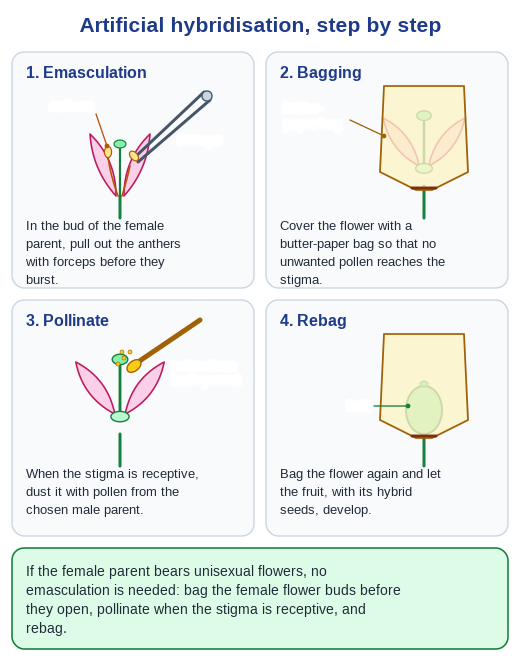
10. “What is bagging technique? How is it useful in a plant breeding programme?”
Bagging is covering a flower with a bag of suitable size, usually made of butter paper. It keeps unwanted pollen away from the stigma.
How it is done:
- A bisexual flower is first emasculated (its anthers are removed) and bagged at once. A unisexual female flower is simply bagged as a bud, before it opens.
- When the stigma becomes receptive (ready to accept pollen), pollen from the chosen male parent is dusted on it.
- The flower is bagged again.
Use in plant breeding:
- In artificial hybridisation, a breeder crosses chosen parents (different varieties, species or even genera) to combine their good characters in one variety.
- Bagging makes sure that only the chosen pollen reaches the stigma.
- So the breeder knows the exact parents of the hybrid seeds.
Exercises 11 to 18: fertilisation, seed and fruit
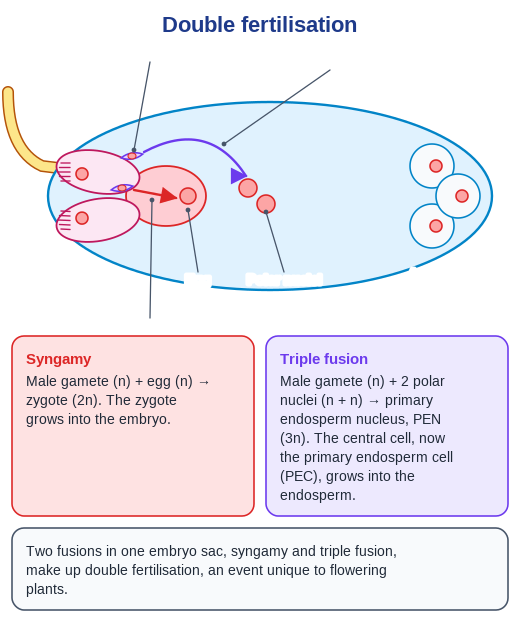
11. “What is triple fusion? Where and how does it take place? Name the nuclei involved in triple fusion.”
Triple fusion is the fusion of a male gamete with the two polar nuclei. Three haploid nuclei join, giving the triploid primary endosperm nucleus (PEN).
Where: in the central cell of the embryo sac, inside the ovule.
How: the pollen tube enters a synergid and releases two male gametes into its cytoplasm. One moves to the egg and fuses with it (syngamy). The other goes to the two polar nuclei of the central cell and fuses with both. The central cell then becomes the primary endosperm cell (PEC), which develops into the endosperm.
Nuclei involved: one male gamete nucleus and the two polar nuclei.
12. “Why do you think the zygote is dormant for sometime in a fertilised ovule?”
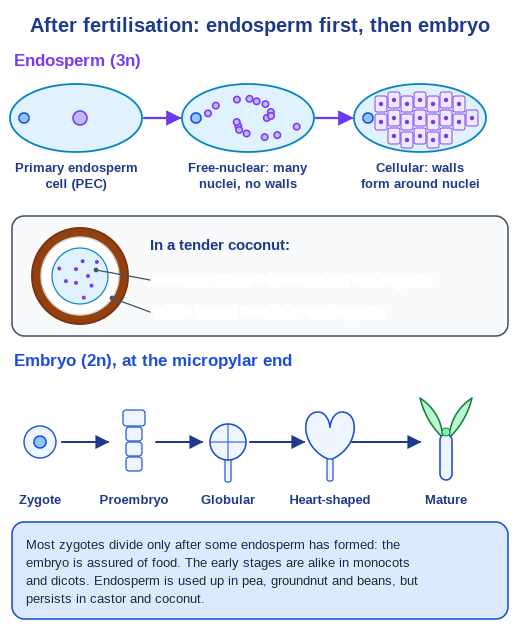
The embryo needs food as it grows, and that food is stored in the endosperm. So the endosperm develops first, and most zygotes divide only after a certain amount of endosperm has formed. This short rest of the zygote is an adaptation that assures nutrition to the developing embryo.
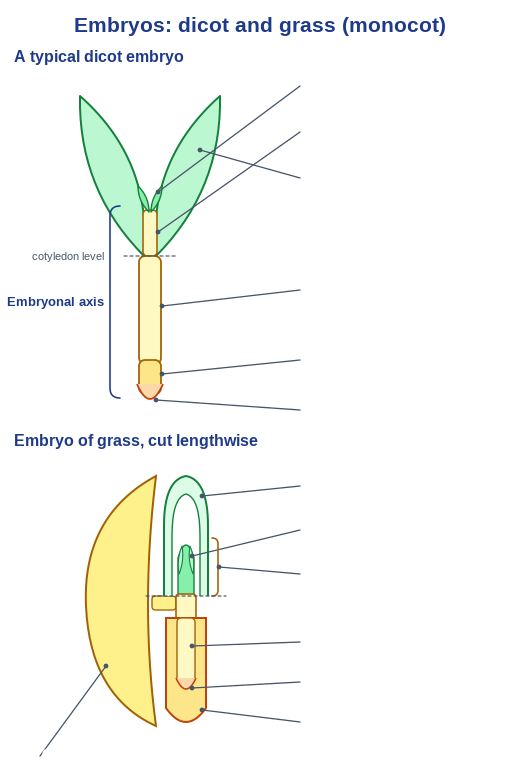
13. “Differentiate between: (a) hypocotyl and epicotyl; (b) coleoptile and coleorrhiza; (c) integument and testa; (d) perisperm and pericarp.”
(a) Hypocotyl: the cylindrical part of the embryonal axis below the level of the cotyledons; it ends in the radicle, or root tip. Epicotyl: the part of the embryonal axis above the cotyledons; it ends in the plumule, or stem tip. (In a grass embryo, the epicotyl is the part above the attachment of the scutellum.)
(b) Both are sheaths in a monocot (grass) embryo. Coleoptile: a hollow, leaf-like sheath at the upper end that encloses the shoot apex and a few leaf primordia. Coleorrhiza: an undifferentiated sheath at the lower end that encloses the radicle and root cap.
(c) Integument: a protective envelope of the ovule, one or two of them, present before fertilisation; it leaves the micropyle open. Testa: the outer seed coat of the seed, formed when the integument hardens after fertilisation. (Extra: the outer integument usually becomes the testa and the inner one the tegmen.)
(d) Perisperm: the leftover nucellus that persists inside a few seeds, for example black pepper and beet; it is part of the seed. Pericarp: the wall of the fruit, which develops from the wall of the ovary; it may be fleshy or dry.
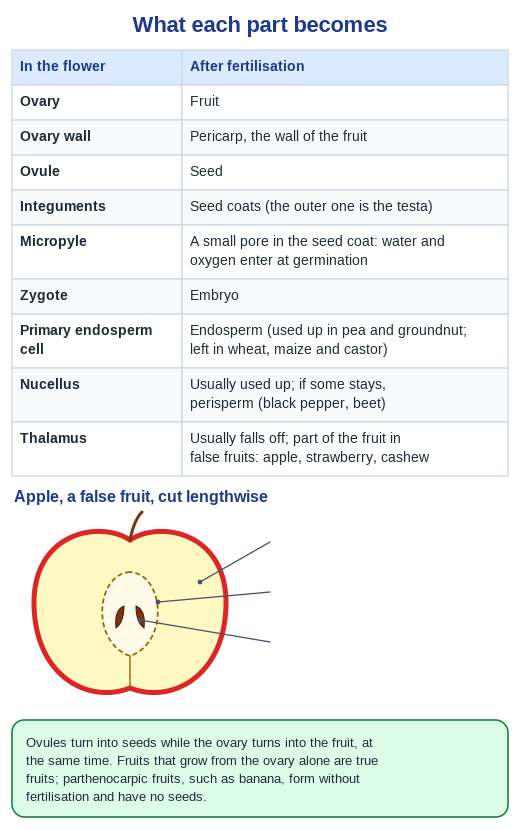
14. “Why is apple called a false fruit? Which part(s) of the flower forms the fruit?”
A true fruit develops from the ovary alone. In apple, the thalamus also grows and forms part of the fruit, so apple is called a false fruit. The fleshy part that we eat comes mainly from the thalamus, and the core with the seeds comes from the ovary. So the fruit is formed by the thalamus and the ovary. Strawberry and cashew are false fruits too.
15. “What is meant by emasculation? When and why does a plant breeder employ this technique?”
Emasculation is the removal of the anthers from a flower bud, with a pair of forceps, before the anthers burst (dehisce).
When: in artificial hybridisation, when the female parent bears bisexual flowers. It is done at the bud stage, before the pollen is shed. Unisexual female flowers have no anthers, so they need no emasculation.
Why: a bisexual flower could pollinate itself. Removing its anthers early prevents self-pollination, and after bagging, only pollen from the chosen male parent reaches the stigma. The breeder can then be sure the seeds are the intended hybrids.
16. “If one can induce parthenocarpy through the application of growth substances, which fruits would you select to induce parthenocarpy and why?”
Parthenocarpy is the development of a fruit without fertilisation, so the fruit has no seeds.
Fruits to choose: fruits in which only the flesh is eaten or used and the seeds are a nuisance, especially fruits with many or hard seeds. Examples (our own choices): watermelon, grapes, guava, papaya, orange, lemon and tomato. Banana is already parthenocarpic.
Why:
- Seedless fruits are easier to eat.
- They give more edible pulp.
- They suit juice, jam and canning better.
Not to choose: plants grown for their seeds, such as cereals, pulses or pomegranate (whose edible part comes from the seeds), or any crop whose seeds are needed to raise the next crop.
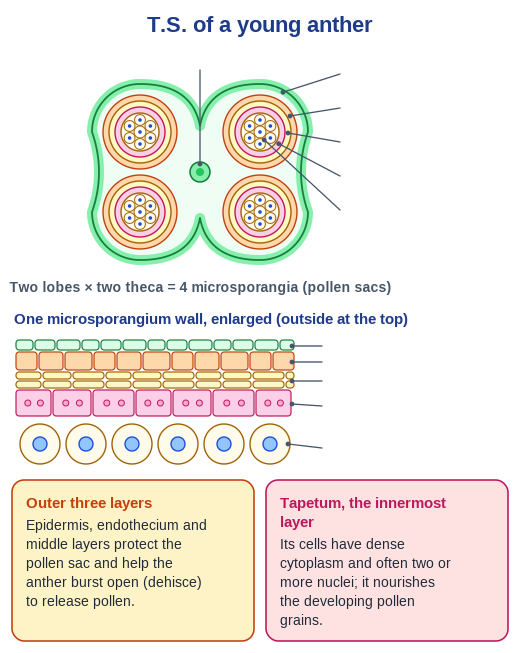
17. “Explain the role of tapetum in the formation of pollen-grain wall.”
The tapetum is the innermost of the four wall layers of the microsporangium, next to the developing pollen. Its cells have dense cytoplasm and generally more than one nucleus, signs of very active cells. Its main role, as the book says, is to nourish the developing pollen grains, and that includes supplying material for the pollen wall.
(Extra, beyond the book:) Tapetal cells secrete the precursors of sporopollenin, carried in small granules called Ubisch bodies, which are laid down on the microspores to build the hard exine. The tapetum also releases the enzyme callase, which frees the microspores from the tetrad, and in many insect-pollinated plants it coats the pollen with the sticky, oily pollenkitt. The thin intine, of cellulose and pectin, is laid down by the microspore itself.
18. “What is apomixis and what is its importance?”
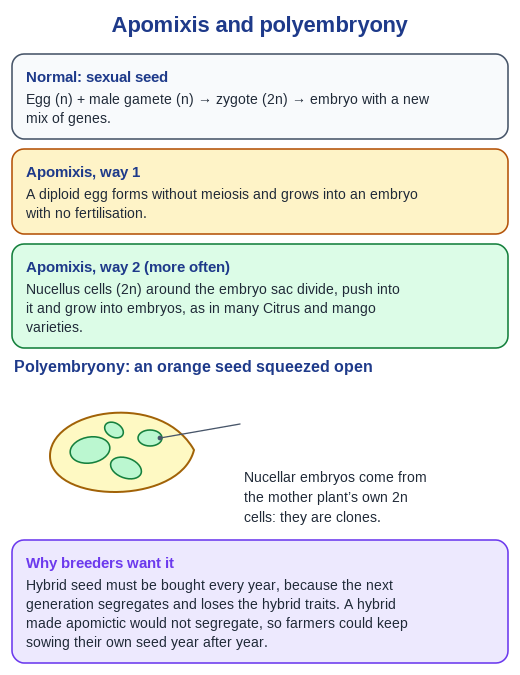
Apomixis is the production of seeds without fertilisation, seen in a small number of flowering plants, for example some species of Asteraceae and grasses. It is asexual reproduction that imitates the result of the sexual kind. The embryo may come from a diploid egg formed without meiosis, or, more often, from nucellus cells that grow into the embryo sac, as in many Citrus and mango varieties.
Importance:
- The problem with hybrids: hybrid varieties give high yields, but plants grown from a hybrid’s seeds segregate (their characters separate out), so the hybrid characters are lost. Farmers must buy new hybrid seed every year.
- What apomixis can do: if a hybrid is made apomictic, its seeds carry exactly the parent’s genes. There is no segregation.
- Benefit to farmers: they could sow their own hybrid seed year after year, so seed costs would fall.
- Research: this is why laboratories around the world study the genetics of apomixis and try to transfer apomictic genes into hybrid varieties.
- Horticulture: apomicts keep a good variety’s traits unchanged.
Questions inside the chapter, pages 3 to 11
Page 3–4: five ornamental flowers grown at home, five flowers used in celebrations, and floriculture. Ornamental flowers grown in homes and gardens include rose, marigold, jasmine, hibiscus, chrysanthemum, dahlia and bougainvillea. Flowers used in celebrations include marigold garlands, rose petals, jasmine (mogra) strings, lotus offered in worship and tuberose (rajnigandha) in wedding decorations; your family’s list may differ. Floriculture is the growing of flowering and ornamental plants for sale and use, for example as cut flowers, garden plants or for perfumes (Extra).
Page 4: the two parts in which the two key units of sexual reproduction develop. The anther, where pollen grains (carrying the male gametes) form, and the ovule inside the ovary, where the embryo sac with the egg forms.
Page 5: how could tapetal cells become binucleate? The nucleus of a tapetal cell divides, but the cell does not divide after it, because no new wall forms between the two nuclei. So one cell ends up with two nuclei: nuclear division (mitosis) without cell division.
Page 5: ploidy of the tetrad’s cells. Haploid (n). The tetrad forms when a diploid pollen mother cell divides by meiosis, which halves the chromosome number.
Page 7: why should the exine be hard, and what does a germ pore do? A pollen grain has to travel, by wind, water or animals, before it reaches a stigma. The hard exine of sporopollenin protects the cells inside from drying, heat, strong acids, alkalis and decay on the way. A germ pore is a gap in the exine where sporopollenin is absent; when the pollen germinates on the stigma, the pollen tube comes out through a germ pore.
Page 8: how long do pollen grains stay viable? It varies a lot and depends partly on temperature and humidity. Rice and wheat pollen loses viability within 30 minutes of release, while pollen of some members of Rosaceae, Leguminoseae and Solanaceae stays viable for months. Stored in liquid nitrogen at −196 °C, pollen of many species lasts for years.
Pages 8–9: placentation, recalled from Class 11 (Extra). Placentation is the arrangement of ovules inside the ovary. Its types are marginal (pea), axile (china rose, tomato, lemon), parietal (mustard, Argemone), basal (sunflower, marigold), and the kind in which ovules sit on a central axis with no partitions (Dianthus, Primrose).
Page 10: why does it matter that the MMC divides by meiosis? Meiosis halves the chromosome number, so the megaspores, the embryo sac and the egg are haploid. When a haploid male gamete fuses with the haploid egg, the diploid number is restored in the zygote, so it stays the same from one generation to the next. Meiosis also mixes the parent’s genes, adding to variation.
Page 10: the ploidy of the nucellus, the MMC, the functional megaspore and the female gametophyte. Nucellus: 2n. Megaspore mother cell: 2n. Functional megaspore: n. Female gametophyte (embryo sac): n.
Questions inside the chapter, pages 11 to 17
Page 11: possible external agents of pollination. Wind and water (abiotic agents), and animals (biotic agents): bees, butterflies, moths, flies, beetles, wasps, ants, birds such as sunbirds and hummingbirds, bats, and even some primates, tree-dwelling rodents and lizards.
Page 12: is cleistogamy an advantage or a disadvantage? Both. Advantage: seed-set is assured even when there are no pollinators, and little pollen is wasted. Disadvantage: every seed comes from self-pollination, so no new combinations of genes arise; over generations this reduces variation and can lead to inbreeding depression. That is why such plants also bear open, chasmogamous flowers.
Page 13: why are wind- and water-pollinated flowers not colourful, and why do they make no nectar? Colour, scent and nectar exist to attract animals and reward them. Wind and water do not need to be attracted, so making these would waste the plant’s food and energy. Instead, such flowers spend their resources on huge amounts of pollen.
Activity, page 15: watching which animals visit flowers. Watch each flower at different times of day over several days and note every visitor, the time, and whether it touches both the anthers and the stigma; only such visitors pollinate, and the rest are pollen or nectar robbers. Then compare the flowers with their visitors. As a general pattern (Extra), bright, scented flowers with nectar draw bees and butterflies, pale flowers that open or smell strongest in the evening draw moths, and large, sturdy flowers with plenty of nectar can draw birds and bats.
Activity, page 17: germinating pollen in sugar solution. In a drop of about 10% sugar solution, pollen of pea, chickpea, Crotalaria, balsam or Vinca grows pollen tubes within 15–30 minutes, seen under the low-power lens. The sugar solution acts like the moist, sugary surface of a receptive stigma (Extra).
Questions inside the chapter, pages 18 to 23
Page 18: why does endosperm develop before the embryo? The endosperm is the food store for the embryo. Building it first means food is ready before the embryo starts growing, which assures its nutrition. (See Exercise 12.)
Activity, page 19: looking for endosperm in seeds. In pea, beans and groundnut there is no separate endosperm: the embryo used it up and the food is stored in the thick cotyledons. Castor and coconut still have endosperm. In cereals such as wheat, rice and maize the endosperm persists: it is the starchy bulk of the grain, and the seeds are albuminous.
Activity, page 20: splitting soaked seeds. In pea, chickpea and groundnut you see two large cotyledons with a small embryonal axis between them, the plumule at one end and the radicle at the other. In wheat and maize you see a small embryo to one side of a large endosperm; under a lens the scutellum lies against the endosperm.
Page 20: classification of fruits and seed dispersal, recalled from earlier classes (Extra). Fruits may be fleshy or dry. Seeds and fruits are dispersed by wind (light, winged or hairy ones), by water (coconut), by animals (hooked fruits that stick to fur, and fleshy fruits that are eaten) or by fruits bursting open (balsam, castor).
Page 20: does the ovule count of an ovary relate to the seed count of its fruit? Yes. Each seed develops from one fertilised ovule, so a fruit can have at most as many seeds as its ovary had ovules. If every ovule is fertilised, the numbers match; if some are not, there are fewer seeds. A wheat or mango flower has one ovule, so the fruit has one seed; papaya and watermelon have many ovules and many seeds.
Page 22: could we have agriculture without seeds, or with seeds that sprout at once and cannot be stored? It would be very hard. Seeds store food, so grain can be kept and eaten all year, and they carry the crop to the next season. Seeds that sprouted at once could not be dried, stored or sown later, and every crop would have to be raised from cuttings or tubers. The dehydration and dormancy of mature seeds make storage possible.
Page 22: how long do seeds stay alive? From a few months in some species to several years in many, and hundreds of years in some. A lupine seed, Lupinus arcticus, dug from the Arctic tundra germinated and flowered after an estimated 10,000 years of dormancy, and a 2000-year-old date palm seed, Phoenix dactylifera, found in excavations at King Herod’s palace by the Dead Sea, was also viable.
Page 22: counting the reproductive capacity of a plant. An embryo sac has one egg. An ovule usually has one embryo sac. An ovary has one to many ovules (one in wheat, paddy and mango; many in papaya, water melon and orchids). A flower has one ovary in each pistil, and may have one pistil or many separate ones, as in Michelia. A tree may bear a very large number of flowers. Multiplying these shows how many seeds one plant can make.
Page 22: plants whose fruits hold very many seeds, and the tiny Ficus seed. Orchid fruits hold thousands of tiny seeds, and so do the fruits of the parasites Orobanche and Striga. A Ficus seed is tiny, yet it grows into a huge, long-lived tree, such as a banyan or peepal, that makes an enormous number of seeds. Another example of a tiny start giving a large body over the years: every large animal, such as an elephant, grows from a single fertilised egg cell.
Page 22: what is fruit formation without fertilisation called? Parthenocarpy. Banana is an example.
Activity, page 23: embryos in an orange seed, and the nature of apomictic embryos. Squeezing an orange seed shows several embryos of different sizes and shapes: polyembryony. Embryos formed by apomixis, from nucellus cells or from an unreduced diploid egg, arise without fertilisation from the mother plant’s own cells. They are genetically identical to the mother plant, so yes, they can be called clones.
Practice
-
Which of these is NOT a wall layer of the microsporangium?
Show answer
Answer: (c) integument
-
How many male gametes does one pollen tube release into the embryo sac?
Show answer
Answer: (b) two
-
Perisperm is the persistent remains of the:
Show answer
Answer: (b) nucellus
-
A flowering plant has 2n = 16 chromosomes. How many chromosomes are there in its egg, its zygote and its endosperm cells?
Show answer
Answer: Egg: n = 8. Zygote: 2n = 16. Endosperm: 3n = 24, because it comes from one male gamete and two polar nuclei.
-
Name a plant whose seeds show polyembryony, and say where the extra embryos come from.
Show answer
Answer: Citrus (such as orange) or mango. The extra embryos grow from nucellus cells around the embryo sac, without fertilisation.
Stuck on a question?
Take a photo and Lagnever AI explains it step by step. Try it for 7 days for ₹2.
Get it on Google Play Open in browser
For parents: after the trial, the plan renews monthly by UPI or card autopay. You can cancel anytime in the app.