
NCERT Solutions Class 12 Biology Chapter 1: Sexual Reproduction in Flowering Plants (Hinglish)
Class 12 ki NCERT textbook Biology ke Chapter 1, Sexual Reproduction in Flowering Plants, ki saari 18 end-of-chapter exercises ke jawab, aur chapter ke beech mein pooche gaye sawalon ke bhi. Page numbers 2026-27 reprint ke hisaab se hain (pages 3–25). Pehle exercises hain, sawal Hinglish mein; uske baad chapter ke andar ke sawal, chhote mein dobara likhkar. Book is chapter ke liye answer key nahi deti. Chhote notes: Chapter 1 ke notes.
Safe raho. Activities apne teacher ke saath karo. Forceps, blades aur needles nukeele hote hain, aur kuch logon ko pollen se allergy hoti hai. Castor ke beej zehreele hote hain (Extra): inhe kabhi mat khao, aur todne ke baad haath dho lo. Lab mein use hone wale beej, chemicals ya growth substances kabhi mat chakho.
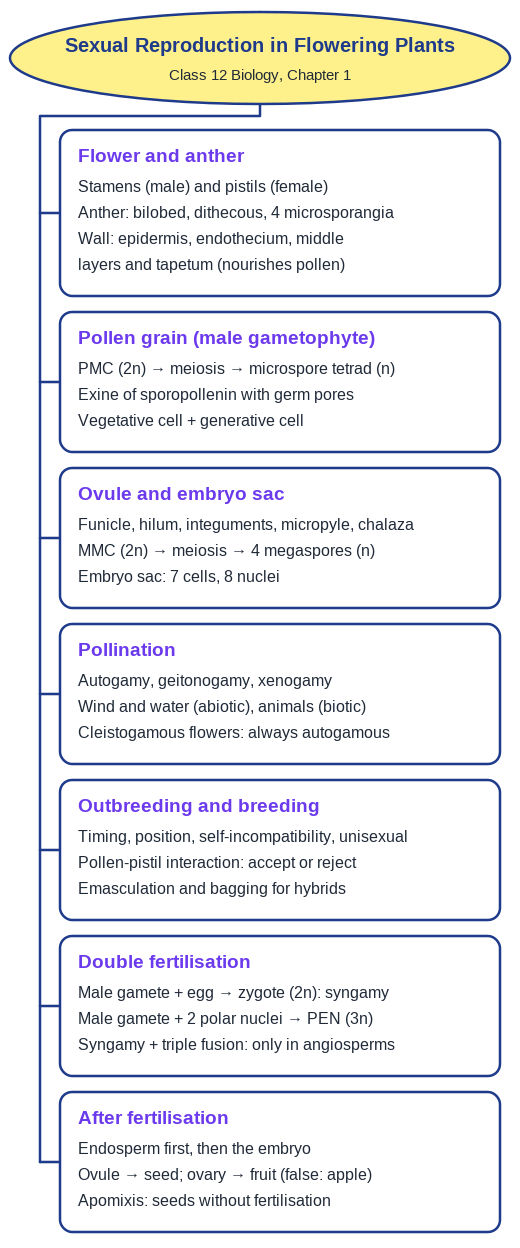
Exercises 1 se 6: anther, ovule aur embryo sac
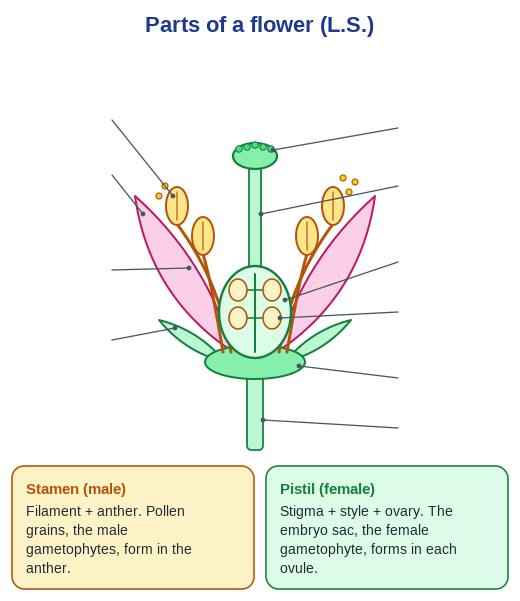
1. Angiosperm flower ke un hisson ke naam batao jinme male aur female gametophyte ka development hota hai.
Male gametophyte, yaani pollen grain, stamen ke anther mein, uske microsporangia (pollen sacs) ke andar banta hai. Female gametophyte, yaani embryo sac, ovule mein, uske nucellus ke andar banta hai; ovules pistil ki ovary mein hote hain.
2. Microsporogenesis aur megasporogenesis mein antar batao. In ghatnaon mein kaun sa cell division hota hai? In dono ke ant mein bane structures ke naam batao.
| Baat | Microsporogenesis | Megasporogenesis |
|---|---|---|
| Kya hai | Pollen mother cell se microspores banna | Megaspore mother cell se megaspores banna |
| Kahan | Anther ka microsporangium (pollen sac) | Ovule ka nucellus, micropyle ke paas |
| Mother cells | Kai: har sporogenous cell PMC ban sakti hai | Aam taur par ovule mein ek hi MMC |
| Spores ka kya hota hai | Chaaron microspores pollen grains bante hain | Aam taur par ek megaspore bachta hai; teen khatam |
Cell division: dono mein meiosis, isliye diploid (2n) mother cell se chaar haploid (n) spores bante hain.
Ant mein bane structures: microsporogenesis ke ant mein microspore tetrads, yaani chaar microspores ke jhund, bante hain, jo alag hokar pollen grains bante hain. Megasporogenesis ke ant mein chaar megaspores bante hain; functional megaspore embryo sac banata hai.
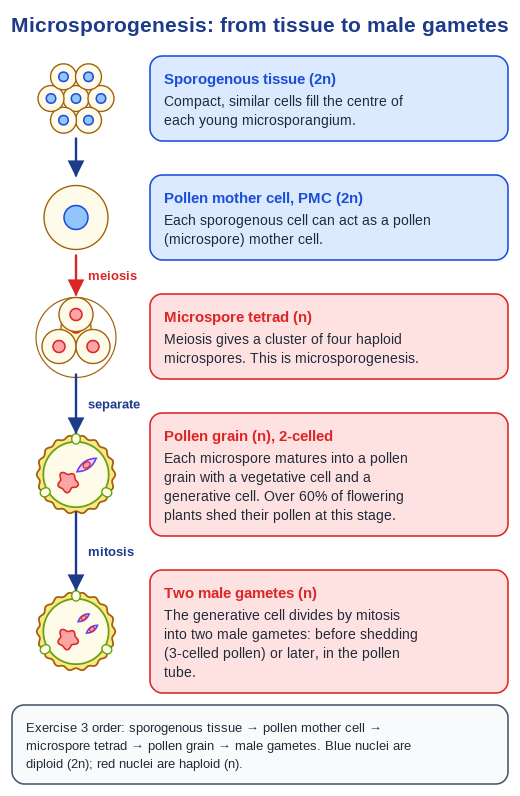
3. In terms ko sahi developmental kram mein lagao: pollen grain, sporogenous tissue, microspore tetrad, pollen mother cell, male gametes.
Sporogenous tissue → pollen mother cell → microspore tetrad → pollen grain → male gametes.
- Sporogenous tissue: cells ka kasa hua dher jo young microsporangium ko bharta hai.
- Pollen mother cell (PMC, 2n): is tissue ki koi bhi cell PMC ban sakti hai.
- Microspore tetrad (n): har PMC meiosis se chaar microspores ka group banati hai.
- Pollen grain: microspores alag hokar mature hote hain. Har pollen grain mein ek vegetative cell aur ek generative cell hoti hai.
- Male gametes: generative cell mitosis se do male gametes banati hai. Ye pollen girne se pehle hota hai, ya baad mein pollen tube ke andar.
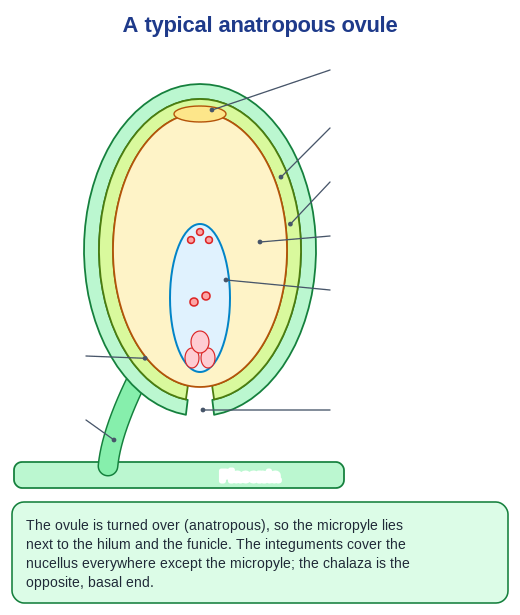
4. Saaf, labelled diagram ke saath typical angiosperm ovule ke hisson ka varnan karo.
Ovule (megasporangium) ek chhota structure hai jo ovary mein placenta se juda hota hai. Iske hisse:
- Funicle: dandi jo ovule ko placenta se jodti hai.
- Hilum: wo jagah jahan ovule ki body funicle se milti hai.
- Integuments: ovule ke chaaron taraf ek ya do suraksha parat (outer aur inner).
- Micropyle: sire par chhoda gaya chhota chhed, jahan integuments nucellus ko nahi dhakte.
- Chalaza: ovule ka neeche wala hissa, micropylar end ke ulta.
- Nucellus: integuments ke andar cells ka dher, jisme khana bharpoor jama hota hai.
- Embryo sac (female gametophyte): nucellus mein; ek ovule mein aam taur par ek, jo ek megaspore se banta hai.
Diagram ke typical anatropous ovule mein body ulti ho gayi hai, isliye micropyle hilum ke bagal mein hai.
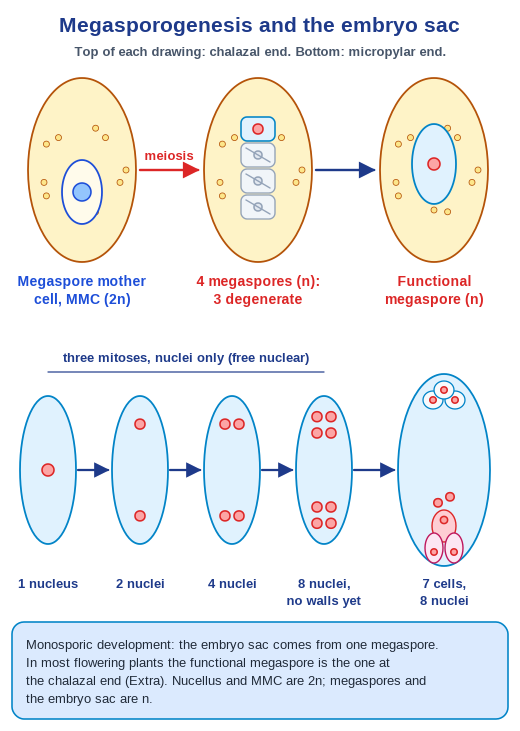
5. Female gametophyte ke monosporic development ka kya matlab hai?
Megaspore mother cell meiosis se chaar megaspores banati hai. Zyadatar flowering plants mein inme se sirf ek functional hota hai aur baaki teen khatam ho jaate hain. Phir embryo sac, yaani female gametophyte, isi ek functional megaspore se banta hai. Ek megaspore se female gametophyte banne ko monosporic development kehte hain.
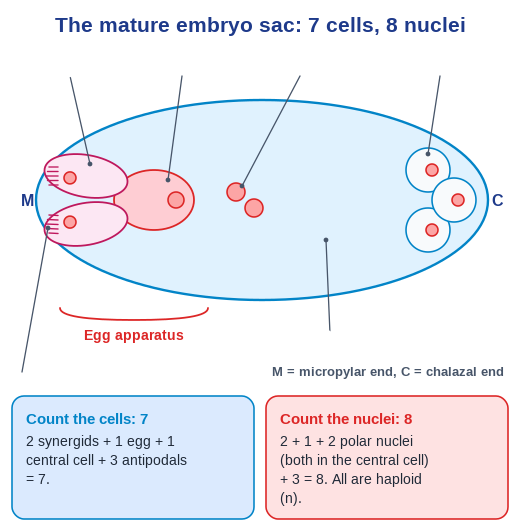
6. Saaf diagram ke saath female gametophyte ki 7-celled, 8-nucleate prakriti samjhao.
Functional megaspore ka nucleus mitosis se do nuclei banata hai, jo embryo sac ke ulte siron par chale jaate hain. Do aur mitosis se pehle 4 aur phir 8 nuclei bante hain. Ye divisions free nuclear hain: 8-nucleate stage tak koi wall nahi banti. Phir chhe nuclei ke chaaron taraf walls banti hain:
- Micropylar end par teen cells egg apparatus banati hain: do synergids, jin par filiform apparatus hota hai, aur ek egg cell.
- Chalazal end par teen cells antipodals hain.
- Bache do nuclei, polar nuclei, badi central cell mein egg apparatus ke theek neeche saath rehte hain.
Cells: 2 synergids + 1 egg + 3 antipodals + 1 central cell = 7. Nuclei: 2 + 1 + 3 + 2 polar nuclei = 8. Isliye mature embryo sac 7-celled lekin 8-nucleate hai.
Exercises 7 se 10: pollination aur plant breeding
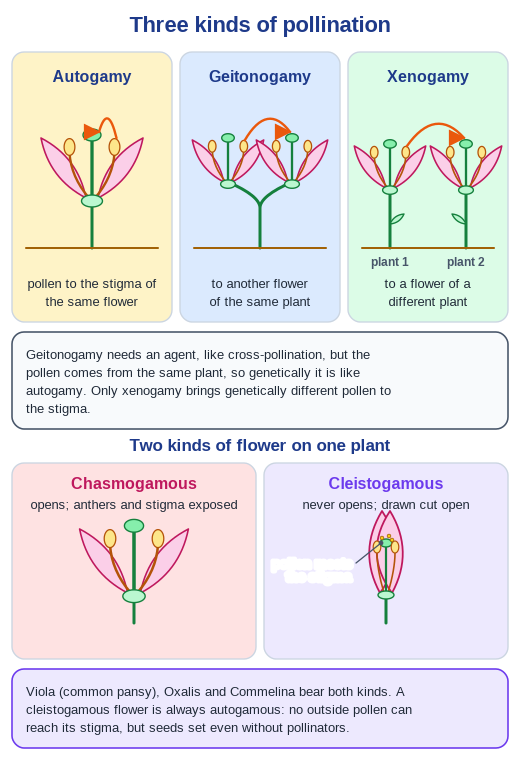
7. Chasmogamous flowers kya hote hain? Kya cleistogamous flowers mein cross-pollination ho sakta hai? Apne jawab ke kaaran do.
Chasmogamous flowers zyadatar species ke flowers ki tarah normal tareeke se khulte hain, isliye unke anthers aur stigma bahar dikhte hain. Viola (common pansy), Oxalis aur Commelina inhe cleistogamous flowers ke saath banate hain.
Nahi, cleistogamous flowers mein cross-pollination nahi ho sakta. Ye kabhi nahi khulte. Inke anthers aur stigma paas-paas hote hain, aur anthers band bud ke andar hi phat jaate hain, isliye pollen usi flower ke stigma par girta hai. Kisi doosre flower ka pollen stigma tak pahunch hi nahi sakta. Isliye cleistogamous flowers hamesha autogamous hote hain, aur pollinators na hon tab bhi seed banate hain.
8. Flowers mein self-pollination rokne ke liye viksit hui do strategies batao.
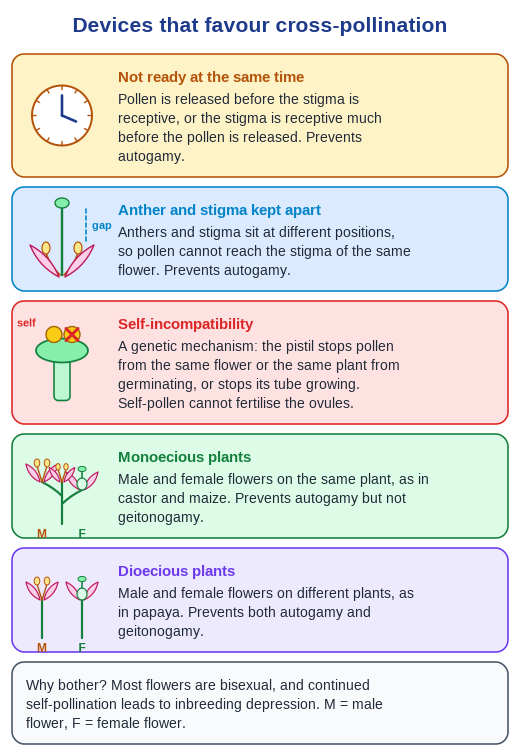
- Alag samay: pollen chhodna aur stigma ka receptive hona ek saath nahi hota. Ya to pollen stigma ke ready hone se pehle chhoot jaata hai, ya stigma pollen chhootne se kaafi pehle ready ho jaata hai, isliye flower ka apna pollen aur stigma ek saath taiyaar nahi hote.
- Alag position: anthers aur stigma door-door rakhe hote hain, isliye pollen usi flower ke stigma tak nahi pahunch paata.
Dono autogamy rokti hain. Do aur devices hain self-incompatibility aur unisexual flowers: papita jaisi dioecy autogamy aur geitonogamy dono rokti hai.
9. Self-incompatibility kya hai? Self-incompatible species mein self-pollination se seed kyun nahi banta?
Self-incompatibility ek genetic mechanism hai jo apne pollen ko, chahe usi flower ka ho ya usi plant ke doosre flowers ka, ovules fertilise karne se rokta hai.
Self-pollination ke baad seed kyun nahi banta:
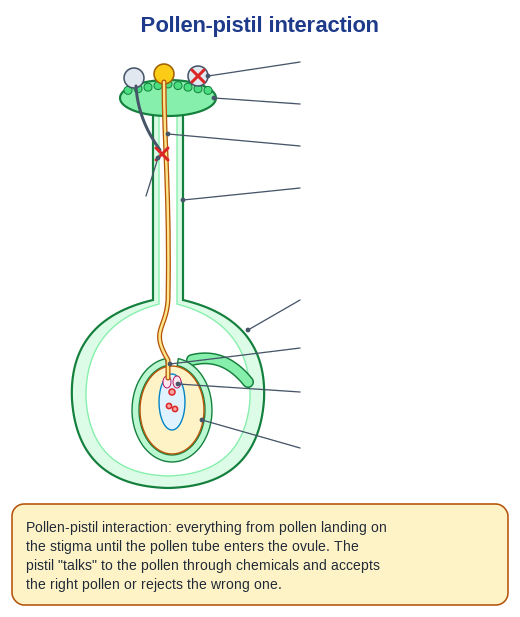
- Pistil chemicals ke zariye pollen se “baat” karta hai. Wo apne pollen ko galat type ka pehchaan leta hai.
- Wo us pollen ko reject kar deta hai. Ya to pollen stigma par ugta hi nahi, ya uski pollen tube style mein ruk jaati hai.
- Isliye male gametes embryo sac tak nahi pahunchte, aur fertilisation nahi hota.
- Bina fertilisation ke ovules seeds nahi ban sakte.
10. Bagging technique kya hai? Plant breeding programme mein ye kaise kaam aati hai?
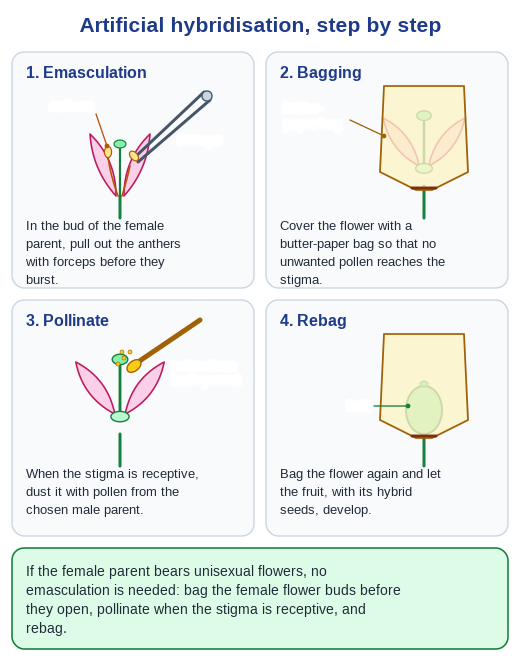
Bagging yaani flower ko sahi size ke bag, aam taur par butter paper ke bag, se dhakna. Isse anchaaha pollen stigma tak nahi pahunchta.
Kaise karte hain:
- Bisexual flower ko pehle emasculate karte hain (uske anthers nikaal dete hain) aur turant bag kar dete hain. Unisexual female flower ko bas khulne se pehle bud mein hi bag kar dete hain.
- Jab stigma receptive ho (pollen lene ko taiyaar), to chune hue male parent ka pollen us par daalte hain.
- Flower ko phir se bag kar dete hain.
Plant breeding mein faayda:
- Artificial hybridisation mein breeder chune hue parents (alag varieties, species ya genera tak) ko cross karta hai, taaki unke achhe gun ek variety mein aa jaayein.
- Bagging pakka karti hai ki sirf chuna hua pollen hi stigma tak pahunche.
- Isliye breeder ko hybrid seeds ke sahi parents pata rehte hain.
Exercises 11 se 18: fertilisation, seed aur fruit
11. Triple fusion kya hai? Ye kahan aur kaise hota hai? Triple fusion mein shaamil nuclei ke naam batao.
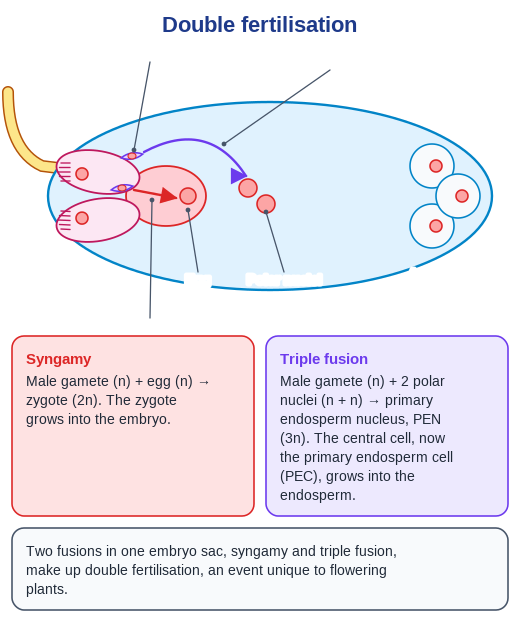
Triple fusion yaani ek male gamete ka do polar nuclei se judna. Teen haploid nuclei judte hain, aur triploid primary endosperm nucleus (PEN) banta hai.
Kahan: ovule ke andar, embryo sac ki central cell mein.
Kaise: pollen tube ek synergid mein ghuskar uske cytoplasm mein do male gametes chhodti hai. Ek egg ki taraf jaakar usse judta hai (syngamy). Doosra central cell ke do polar nuclei ki taraf jaakar unse judta hai. Phir central cell primary endosperm cell (PEC) ban jaati hai, jo endosperm banati hai.
Shaamil nuclei: ek male gamete ka nucleus aur do polar nuclei.
12. Tumhare hisaab se fertilised ovule mein zygote kuch samay tak dormant kyun rehta hai?
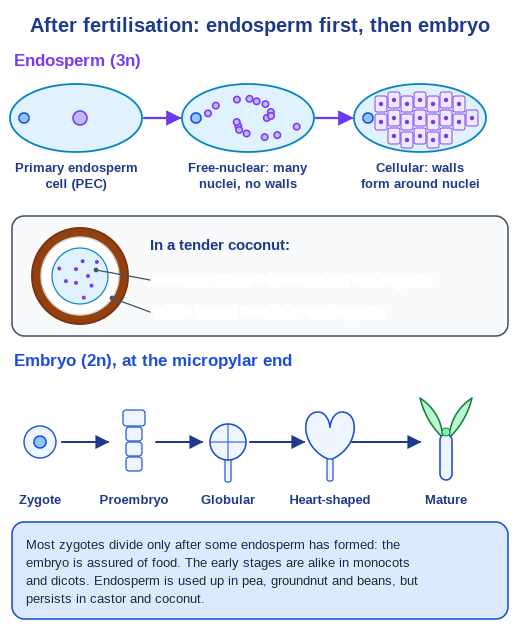
Badhte hue embryo ko khana chahiye, aur wo khana endosperm mein jama hota hai. Isliye endosperm pehle banta hai, aur zyadatar zygotes kuch endosperm banne ke baad hi batte hain. Zygote ka ye chhota sa aaraam ek adaptation hai jo bante hue embryo ko pakka poshan deta hai.
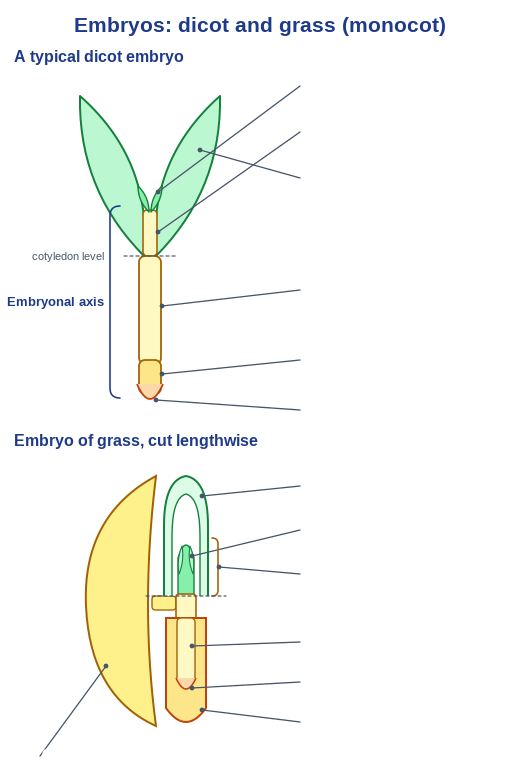
13. Inme antar batao: (a) hypocotyl aur epicotyl; (b) coleoptile aur coleorrhiza; (c) integument aur testa; (d) perisperm aur pericarp.
(a) Hypocotyl: embryonal axis ka cotyledons ke level se neeche wala belanaakaar hissa; ye radicle, yaani root tip, par khatam hota hai. Epicotyl: embryonal axis ka cotyledons se upar wala hissa; ye plumule, yaani stem tip, par khatam hota hai. (Grass embryo mein epicotyl scutellum ke judne ki jagah se upar ka hissa hai.)
(b) Dono monocot (grass) embryo ke sheaths hain. Coleoptile: upar wale sire par ek khokhla, patti jaisa sheath jo shoot apex aur kuch leaf primordia ko dhakta hai. Coleorrhiza: neeche wale sire par ek undifferentiated sheath jo radicle aur root cap ko dhakta hai.
(c) Integument: ovule ki suraksha parat, ek ya do, jo fertilisation se pehle hoti hai; ye micropyle khula chhodti hai. Testa: seed ka bahari seed coat, jo fertilisation ke baad integument ke sakht hone se banta hai. (Extra: aam taur par outer integument testa aur inner integument tegmen banta hai.)
(d) Perisperm: kuch seeds, jaise kaali mirch aur beet, mein bacha hua nucellus; ye seed ka hissa hai. Pericarp: fruit ki wall, jo ovary ki wall se banti hai; ye goodedaar ya sookhi ho sakti hai.
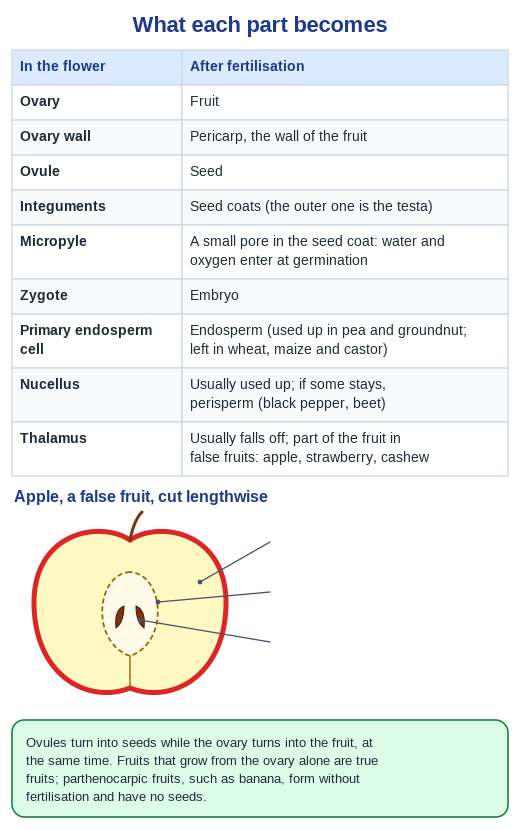
14. Apple ko false fruit kyun kehte hain? Flower ka kaunsa hissa (ya hisse) fruit banata hai?
True fruit sirf ovary se banta hai. Apple mein thalamus bhi badhkar fruit ka hissa ban jaata hai, isliye apple ko false fruit kehte hain. Jo goodedaar hissa hum khaate hain wo zyadatar thalamus se aata hai, aur beejon wala core ovary se. Isliye fruit thalamus aur ovary dono se banta hai. Strawberry aur kaju bhi false fruits hain.
15. Emasculation ka kya matlab hai? Plant breeder ye technique kab aur kyun use karta hai?
Emasculation yaani flower bud se anthers ko, unke phatne (dehisce) se pehle, forceps se nikaal dena.
Kab: artificial hybridisation mein, jab female parent ke flowers bisexual hon. Ye bud stage par, pollen chhootne se pehle, kiya jaata hai. Unisexual female flowers mein anthers hote hi nahi, isliye unhe emasculation ki zaroorat nahi.
Kyun: bisexual flower khud ko pollinate kar sakta hai. Anthers jaldi nikaalne se self-pollination rukta hai, aur bagging ke baad sirf chune hue male parent ka pollen hi stigma tak pahunchta hai. Tab breeder pakka jaanta hai ki seeds wahi hybrids hain jo use chahiye.
16. Agar growth substances lagakar parthenocarpy karwayi ja sake, to tum kaunse fruits chunoge aur kyun?
Parthenocarpy yaani bina fertilisation ke fruit banna, isliye fruit mein beej nahi hote.
Kaunse fruits chunein: wo fruits jinme sirf gooda khaaya ya use kiya jaata hai aur beej pareshaani hain, khaaskar bahut saare ya sakht beejon wale. Examples (hamari apni pasand): tarbooz, angoor, amrood, papita, santra, nimbu aur tamatar. Kela pehle se parthenocarpic hai.
Kyun:
- Beej-rahit fruits khaane mein aasaan hote hain.
- Inme zyada gooda milta hai.
- Ye juice, jam aur canning ke liye behtar hain.
Kaunse na chunein: beejon ke liye ugaaye jaane wale plants, jaise anaaj, daalein ya anaar (jiska khaane wala hissa beejon se aata hai), ya koi bhi fasal jiske beej agli fasal ke liye chahiye.
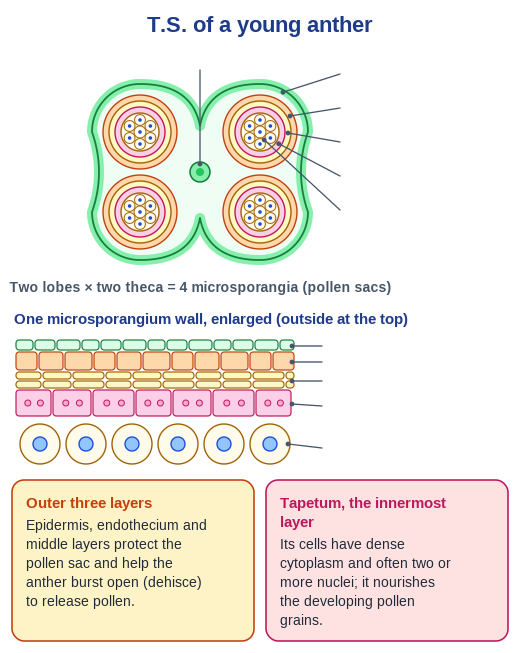
17. Pollen-grain wall banne mein tapetum ki bhoomika samjhao.
Tapetum microsporangium ki chaar wall layers mein sabse andar wali hai, bante hue pollen ke theek paas. Iski cells mein ghana cytoplasm aur aam taur par ek se zyada nucleus hote hain, jo bahut sakriya cells ki pehchaan hai. Book ke hisaab se iska main kaam hai bante hue pollen grains ko poshan dena, aur isme pollen wall ke liye material dena bhi shaamil hai.
(Extra, book se aage:) Tapetum ki cells sporopollenin ke precursors chhodti hain, jo Ubisch bodies naam ke chhote daano mein aate hain aur microspores par jamkar sakht exine banate hain. Tapetum callase enzyme bhi chhodti hai, jo microspores ko tetrad se alag karta hai, aur kai insect-pollinated plants mein pollen par chipchipi, tel jaisi pollenkitt ki parat chadhaati hai. Cellulose aur pectin ki patli intine microspore khud banata hai.
18. Apomixis kya hai aur iska kya mahatva hai?
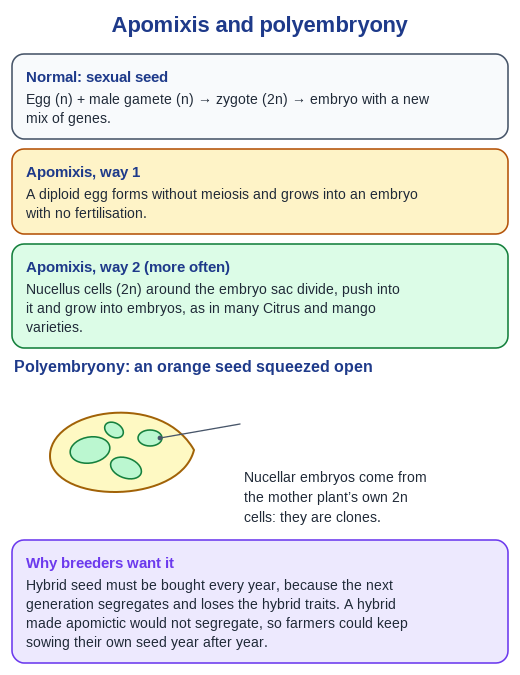
Apomixis yaani bina fertilisation ke seeds banna, jo kuch hi flowering plants, jaise Asteraceae aur grasses ki kuch species, mein milta hai. Ye asexual reproduction hai jo sexual reproduction ki nakal karta hai. Embryo bina meiosis ke bane diploid egg se aa sakta hai, ya zyada aksar nucellus ki cells se jo embryo sac mein ghuskar badhti hain, jaise Citrus aur aam ki kai varieties mein.
Mahatva:
- Hybrids ki problem: hybrid varieties zyada paidaavar deti hain, lekin hybrid ke beej se uge plants segregate karte hain (unke gun alag-alag ho jaate hain), isliye hybrid gun kho jaate hain. Kisaanon ko har saal naya hybrid beej khareedna padta hai.
- Apomixis kya kar sakta hai: agar hybrid ko apomictic bana diya jaaye, to uske seeds mein bilkul parent jaise genes honge. Segregation nahi hoga.
- Kisaanon ka faayda: wo apna hybrid beej saal-dar-saal bo sakenge, isliye beej ka kharcha ghatega.
- Research: isiliye duniya bhar ki labs apomixis ki genetics samajh rahi hain aur apomictic genes ko hybrid varieties mein daalne ki koshish kar rahi hain.
- Horticulture: apomicts achhi variety ke gun badalne nahi dete.
Chapter ke andar ke sawal, pages 3 se 11
Page 3–4: ghar mein ugne wale paanch sajaawati flowers, utsavon mein use hone wale paanch flowers, aur floriculture. Ghar aur bageechon mein ugne wale sajaawati flowers: gulaab, genda, chameli, gudhal (hibiscus), guldaudi (chrysanthemum), dahlia aur bougainvillea. Utsavon mein: genda ki maalaayein, gulaab ki pankhudiyaan, mogra ke gajre, pooja mein kamal, aur shaadi ki sajaavat mein rajnigandha; tumhare parivaar ki list alag ho sakti hai. Floriculture yaani bechne aur use ke liye flowering aur sajaawati plants ugaana, jaise cut flowers, bageeche ke plants ya perfumes ke liye (Extra).
Page 4: wo do hisse jinme sexual reproduction ki do sabse zaroori units banti hain. Anther, jahan pollen grains (male gametes ke saath) bante hain, aur ovary ke andar ovule, jahan egg wala embryo sac banta hai.
Page 5: tapetum ki cells binucleate kaise ho sakti hain? Tapetum cell ka nucleus batata hai, lekin uske baad cell nahi batti, kyunki do nuclei ke beech nayi wall nahi banti. Isliye ek cell mein do nuclei reh jaate hain: nucleus ka division (mitosis) bina cell division ke.
Page 5: tetrad ki cells ki ploidy. Haploid (n). Tetrad diploid pollen mother cell ke meiosis se banta hai, jo chromosome number aadha kar deta hai.
Page 7: exine sakht kyun honi chahiye, aur germ pore kya karta hai? Stigma tak pahunchne se pehle pollen ko wind, water ya animals ke saath safar karna padta hai. Sporopollenin ki sakht exine andar ki cells ko raaste mein sookhne, garmi, strong acids, alkalis aur sadne se bachaati hai. Germ pore exine ka wo chhed hai jahan sporopollenin nahi hota; stigma par pollen ugne par pollen tube germ pore se hi bahar nikalti hai.
Page 8: pollen grains kitni der viable rehte hain? Ye bahut alag-alag hai aur kuch had tak temperature aur nami par tikta hai. Chawal aur gehun ka pollen chhootne ke 30 minute ke andar viability kho deta hai, jabki Rosaceae, Leguminoseae aur Solanaceae ke kuch members ka pollen mahino tak viable rehta hai. Liquid nitrogen mein −196 °C par rakhne se kai species ka pollen saalon chalta hai.
Pages 8–9: placentation, Class 11 se yaad karo (Extra). Placentation yaani ovary ke andar ovules ki arrangement. Iske types: marginal (matar), axile (gudhal, tamatar, nimbu), parietal (sarson, Argemone), basal (surajmukhi, genda), aur wo type jisme ovules bina partitions ke ek central axis par hote hain (Dianthus, Primrose).
Page 10: MMC ka meiosis se batna kyun zaroori hai? Meiosis chromosome number aadha karta hai, isliye megaspores, embryo sac aur egg haploid hote hain. Jab haploid male gamete haploid egg se judta hai, to zygote mein diploid number wapas aa jaata hai, isliye ek generation se agli tak number same rehta hai. Meiosis parent ke genes ko milata bhi hai, jisse variation badhti hai.
Page 10: nucellus, MMC, functional megaspore aur female gametophyte ki ploidy. Nucellus: 2n. Megaspore mother cell: 2n. Functional megaspore: n. Female gametophyte (embryo sac): n.
Chapter ke andar ke sawal, pages 11 se 17
Page 11: pollination ke sambhav bahari agents. Wind aur water (abiotic agents), aur animals (biotic agents): madhumakkhi, titli, moths, makkhi, beetles, wasps, cheenti, sunbirds aur hummingbirds jaise birds, chamgaadad, aur kuch primates, pedon par rehne wale rodents aur chhipkali bhi.
Page 12: cleistogamy faayde ki hai ya nuksaan ki? Dono. Faayda: pollinators na hon tab bhi seed banna pakka hai, aur pollen kam bekaar jaata hai. Nuksaan: har seed self-pollination se banta hai, isliye genes ke naye combinations nahi bante; generations ke saath variation ghatti hai aur inbreeding depression aa sakta hai. Isiliye aise plants khule chasmogamous flowers bhi banate hain.
Page 13: wind aur water pollinated flowers rangeen kyun nahi hote, aur nectar kyun nahi banate? Rang, khushboo aur nectar animals ko bulaane aur inaam dene ke liye hain. Wind aur water ko bulaana nahi padta, isliye ye banana plant ke khaane aur energy ki barbaadi hogi. Iske badle aise flowers apne resources bahut saara pollen banane mein lagaate hain.
Activity, page 15: dekhna ki kaunse animals flowers par aate hain. Har flower ko kai din tak, din ke alag-alag samay dekho aur har mehmaan, samay, aur ye note karo ki wo anthers aur stigma dono ko chhoota hai ya nahi; sirf aise mehmaan pollinate karte hain, baaki pollen ya nectar robbers hain. Phir flowers aur unke mehmaanon ki tulna karo. Aam pattern (Extra): chamakdaar, khushboodaar, nectar wale flowers par madhumakkhi aur titli aati hain, shaam ko khulne ya mehakne wale halke rang ke flowers par moths, aur bade, mazboot, bahut nectar wale flowers par birds aur bats aa sakte hain.
Activity, page 17: sugar solution mein pollen ugaana. Lagbhag 10% sugar solution ki boond mein matar, chana, Crotalaria, balsam ya Vinca ka pollen 15–30 minute mein pollen tubes nikaal deta hai, jo low-power lens mein dikhti hain. Sugar solution receptive stigma ki nam, meethi sataha jaisa kaam karta hai (Extra).
Chapter ke andar ke sawal, pages 18 se 23
Page 18: endosperm embryo se pehle kyun banta hai? Endosperm embryo ka khana bhandaar hai. Ise pehle banane se embryo ke badhna shuru karne se pehle khana taiyaar rehta hai, jisse uska poshan pakka hota hai. (Exercise 12 dekho.)
Activity, page 19: seeds mein endosperm dhoondhna. Matar, beans aur moongphali mein alag se endosperm nahi dikhta: embryo ne use kha liya aur khana mote cotyledons mein jama hai. Castor aur nariyal mein endosperm abhi bhi hai. Gehun, chawal aur makka jaise anaajon mein endosperm bacha rehta hai: daane ka starch wala zyadatar hissa yahi hai, aur ye seeds albuminous hain.
Activity, page 20: bhigoye seeds todna. Matar, chana aur moongphali mein do bade cotyledons dikhte hain, aur unke beech chhota embryonal axis, ek sire par plumule aur doosre par radicle. Gehun aur makke mein bade endosperm ke ek taraf chhota embryo dikhta hai; lens se dekho to scutellum endosperm se sata hota hai.
Page 20: pichhli classes se fruits ki classification aur seed dispersal yaad karo (Extra). Fruits goodedaar ya sookhe ho sakte hain. Seeds aur fruits hawa se (halke, pankh wale ya rooyein wale), paani se (nariyal), animals se (fur mein atakne wale kaante wale fruits, aur khaaye jaane wale goodedaar fruits) ya fruit ke phatne se (balsam, castor) failte hain.
Page 20: kya ovary ke ovules ki sankhya aur fruit ke seeds ki sankhya mein koi rishta hai? Haan. Har seed ek fertilised ovule se banta hai, isliye fruit mein zyada se zyada utne seeds ho sakte hain jitne ovary mein ovules the. Agar har ovule fertilise ho to sankhya barabar hogi; kuch na hon to seeds kam honge. Gehun ya aam ke flower mein ek ovule hota hai, isliye fruit mein ek seed; papita aur tarbooz mein bahut ovules aur bahut seeds.
Page 22: kya bina seeds ke, ya turant ugne wale aur na rakhe ja sakne wale seeds ke saath, kheti ho sakti? Bahut mushkil hoti. Seeds khana jama rakhte hain, isliye anaaj saal bhar rakhkar khaaya ja sakta hai, aur ye fasal ko agle season tak le jaate hain. Turant ugne wale seeds na sukhaaye ja sakte, na rakhe ja sakte, na baad mein boye ja sakte, aur har fasal cuttings ya tubers se ugaani padti. Pakke seeds ka sookhna aur dormancy hi unhe rakhna sambhav banaate hain.
Page 22: seeds kitni der zinda rehte hain? Kuch species mein kuch mahine, kai mein kai saal, aur kuch mein sainkdon saal. Arctic tundra se nikla lupine ka beej, Lupinus arcticus, andaazan 10,000 saal ki dormancy ke baad uga aur usme phool aaye, aur Dead Sea ke paas King Herod ke mahal se mila 2000 saal purana khajoor ka beej, Phoenix dactylifera, bhi viable tha.
Page 22: ek plant ki reproductive kshamata ginna. Ek embryo sac mein ek egg hota hai. Ek ovule mein aam taur par ek embryo sac. Ek ovary mein ek se lekar bahut saare ovules (gehun, dhaan aur aam mein ek; papita, tarbooz aur orchids mein bahut). Flower ke har pistil mein ek ovary hoti hai, aur flower mein ek pistil ya kai alag pistils ho sakte hain, jaise Michelia mein. Ek ped par bahut saare flowers aa sakte hain. Inhe guna karo to dikhta hai ki ek plant kitne seeds bana sakta hai.
Page 22: bahut saare seeds wale fruits, aur Ficus ka nanha beej. Orchid ke fruits mein hazaaron nanhe seeds hote hain, aur parasites Orobanche aur Striga ke fruits mein bhi. Ficus ka beej nanha sa hai, phir bhi usse bargad ya peepal jaisa vishaal, lambi umar wala ped banta hai jo anginat seeds banata hai. Nanhi shuruaat se badi body banne ka ek aur example: har bada animal, jaise haathi, ek akeli fertilised egg cell se badhta hai.
Page 22: bina fertilisation ke fruit banne ko kya kehte hain? Parthenocarpy. Kela iska example hai.
Activity, page 23: santre ke beej mein embryos, aur apomictic embryos ki prakriti. Santre ka beej dabaane par alag-alag size aur shape ke kai embryos dikhte hain: polyembryony. Apomixis se bane embryos, chahe nucellus cells se hon ya bina meiosis ke bane diploid egg se, bina fertilisation ke mother plant ki apni cells se bante hain. Ye genetically mother plant jaise hi hain, isliye haan, inhe clones kaha ja sakta hai.
Practice karo
-
Inme se kaunsi microsporangium ki wall layer NAHI hai?
Jawab dekho
Jawab: (c) integument
-
Ek pollen tube embryo sac mein kitne male gametes chhodti hai?
Jawab dekho
Jawab: (b) do
-
Perisperm kiska bacha hua hissa hai?
Jawab dekho
Jawab: (b) nucellus
-
Ek flowering plant mein 2n = 16 chromosomes hain. Uske egg, zygote aur endosperm cells mein kitne chromosomes honge?
Jawab dekho
Jawab: Egg: n = 8. Zygote: 2n = 16. Endosperm: 3n = 24, kyunki ye ek male gamete aur do polar nuclei se banta hai.
-
Ek plant ka naam batao jiske seeds mein polyembryony hoti hai, aur batao extra embryos kahan se aate hain.
Jawab dekho
Jawab: Citrus (jaise santra) ya aam. Extra embryos embryo sac ke aas-paas ki nucellus cells se, bina fertilisation ke, bante hain.
Koi sawal atak gaya?
Photo lo, Lagnever AI step-by-step samjhayega. 7 din ka trial sirf ₹2.
Google Play se app lo Browser mein kholo
Parents ke liye: trial ke baad plan har mahine UPI ya card autopay se renew hota hai. App mein kabhi bhi cancel kar sakte hain.