
Class 12 Biology Chapter 1: Sexual Reproduction in Flowering Plants (Hinglish Notes)
Ye chapter 5 lines mein
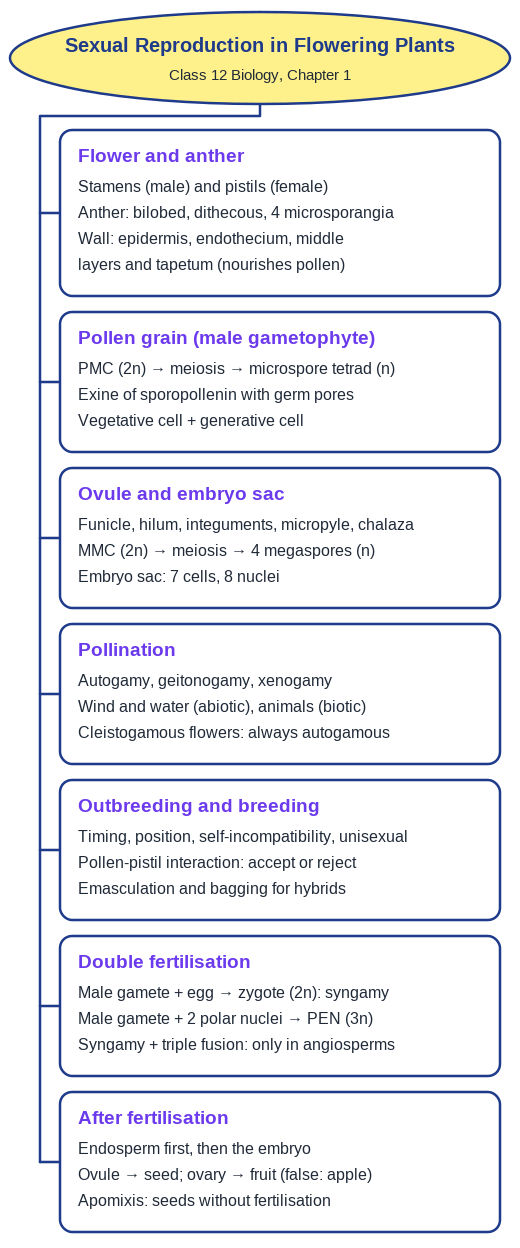
Flowering plants mein sexual reproduction flower (phool) mein hota hai. Male gametophyte, yaani pollen grain, anther mein meiosis se banta hai; female gametophyte, yaani embryo sac, ovule mein banta hai aur 7-celled, 8-nucleate hota hai. Pollination pollen ko stigma tak laata hai, aur pollen tube do male gametes ko embryo sac tak pahunchaati hai. Double fertilisation se diploid zygote aur triploid endosperm nucleus bante hain; phir ovule seed banta hai aur ovary fruit.
Ye chapter kis baare mein hai?
Har aam, chawal ka har daana aur sarson ka har beej (seed) flowering plant (angiosperm) ke sexual reproduction ka nateeja hai. Phoolon ke rang, khushboo aur shape isi kaam mein madad karte hain. Ye chapter, Unit VI Reproduction ka pehla chapter, poori kahani step by step batata hai: flower ke andar male aur female gametophytes kaise bante hain, pollen stigma tak kaise pahunchta hai, fertilisation kaise hota hai, aur ovule seed aur ovary fruit kaise banti hai. Do exceptions bhi hain: bina fertilisation ke seeds (apomixis) aur ek seed mein kai embryos (polyembryony).
Flower mein reproduction kahan hota hai?
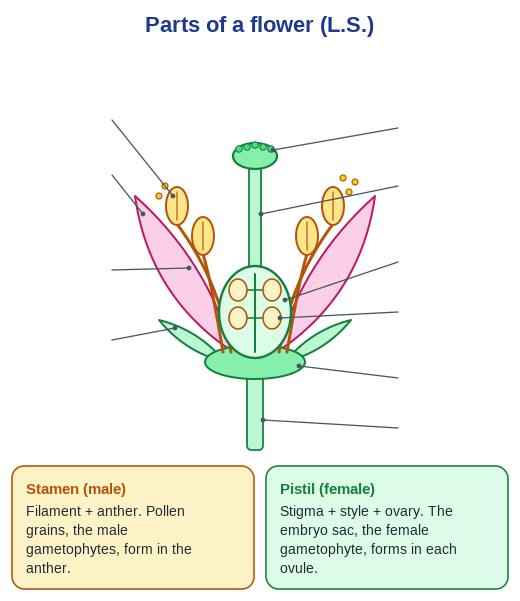
Flower dikhne se kaafi pehle hi plant “tay” kar leta hai ki ab phool aayenge: hormones aur structure mein badlaav se floral primordium shuru hota hai, jo inflorescence, buds aur flowers banata hai. Flower mein androecium, yaani stamens ka ghera, male reproductive organ hai, aur gynoecium, jo ek ya zyada pistils ka bana hai, female reproductive organ hai. Stamen mein patli dandi, filament, aur upar aam taur par do lobes wala anther hota hai. Pistil ke teen hisse hain: stigma, jahan pollen utarta hai; style, patli dandi; aur neeche phula hua ovary, jiske cavity mein placenta par ovules lage hote hain. Male gametophyte anther mein banta hai aur female gametophyte ovule mein.
Anther ke andar kya hai?
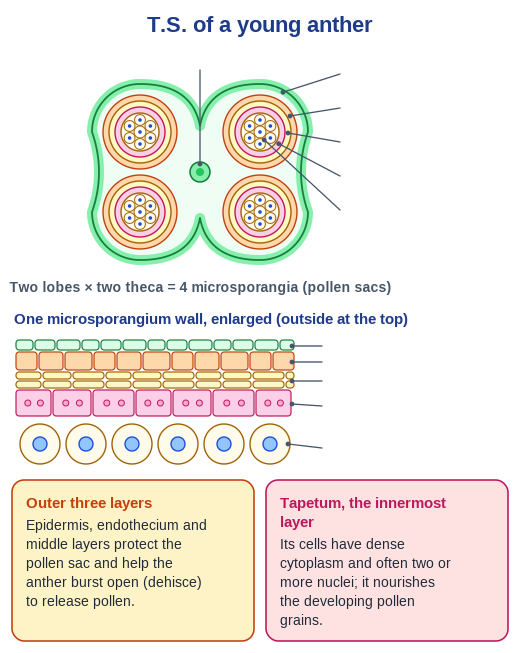
Typical anther bilobed hota hai, aur har lobe mein do theca hote hain, isliye ye dithecous hai. Transverse section mein ye chaukor sa dikhta hai, aur har kone par ek microsporangium hota hai, har lobe mein do. Yahi aage chalkar pollen sacs bante hain. Har microsporangium ke chaaron taraf chaar wall layers hain: epidermis, endothecium aur middle layers, jo suraksha karti hain aur anther ko phatne (dehiscence) mein madad karti hain; aur tapetum, sabse andar wali layer, jo bante hue pollen ko poshan deti hai. Tapetum ki cells mein ghana cytoplasm aur aksar ek se zyada nucleus hote hain. Young anther mein har microsporangium ka beech ka hissa sporogenous tissue se bhara hota hai.
Pollen grains kaise bante hain?
Har sporogenous cell pollen mother cell (PMC) ban sakti hai, jo diploid hai. Ye meiosis se chaar haploid microspores banati hai, jo saath rehkar microspore tetrad banate hain. Isi ko microsporogenesis kehte hain. Anther pakne aur sookhne par microspores alag hokar pollen grains ban jaate hain, har microsporangium mein kai hazaar.
Pollen grain hi male gametophyte hai. Ye aam taur par gol aur lagbhag 25–50 micrometre ka hota hai, aur iski wall do layers ki hai. Sakht bahari exine sporopollenin ki bani hai, jo tez garmi aur strong acids aur alkalis jhel leti hai; ise todne wala koi enzyme abhi tak nahi mila, isliye pollen fossils mein bhi bacha rehta hai. Exine mein germ pores hain, jahan sporopollenin nahi hota. Patli andar wali intine cellulose aur pectin ki bani hai. Mature grain mein ek badi vegetative cell aur ek chhoti, spindle jaisi generative cell hoti hai. 60% se zyada angiosperms pollen isi 2-celled stage par chhodte hain; baaki mein generative cell pehle mitosis se do male gametes bana leti hai (3-celled stage). Padho microsporogenesis aur megasporogenesis.
Pollen kitni der kaam ka rehta hai, ye temperature aur nami par tikta hai: chawal aur gehun ka pollen 30 minute mein viability kho deta hai, jabki Rosaceae, Leguminoseae aur Solanaceae ke kuch members ka pollen mahino tak rehta hai. Liquid nitrogen mein −196 °C par pollen saalon tak rakha ja sakta hai, crop breeding ke pollen banks mein. Kuch plants ka pollen allergy aur asthma karta hai; Parthenium (carrot grass), jo import kiye gehun ke saath India aaya, inmein se ek hai.
Ovule ke hisse kya hain?
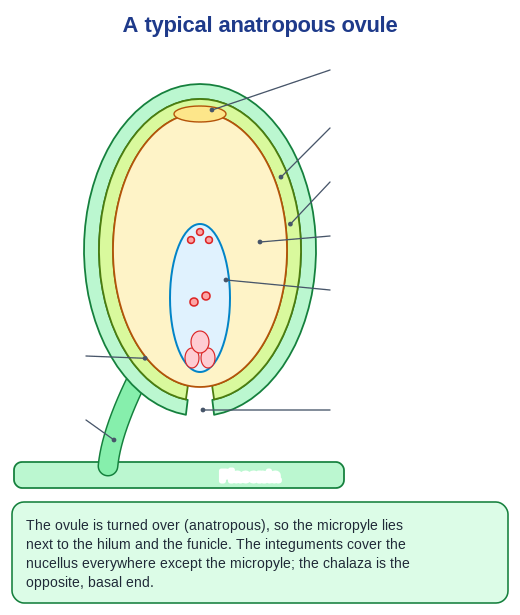
Ovule, yaani megasporangium, placenta se ek dandi, funicle, ke sahare juda hota hai; jahan dandi ovule ki body se milti hai wo hilum hai. Ek ya do integuments ovule ko dhakte hain, bas sire par ek chhota chhed, micropyle, chhod dete hain. Ulta, neeche wala sira chalaza hai. Integuments ke andar nucellus hai, khana bhari cells ka dher, aur usme embryo sac yaani female gametophyte hota hai. Ek ovary mein ek ovule (gehun, dhaan, aam) ya bahut saare (papita, tarbooz, orchids) ho sakte hain.
Embryo sac kaise banta hai?
Nucellus ke micropyle wale hisse mein ek megaspore mother cell (MMC) banti hai, jo badi aur diploid hai. Ye meiosis se chaar haploid megaspores banati hai; ye megasporogenesis hai. Zyadatar flowering plants mein ek megaspore bachta hai aur baaki teen khatam ho jaate hain. Ek hi megaspore se embryo sac banne ko monosporic development kehte hain.
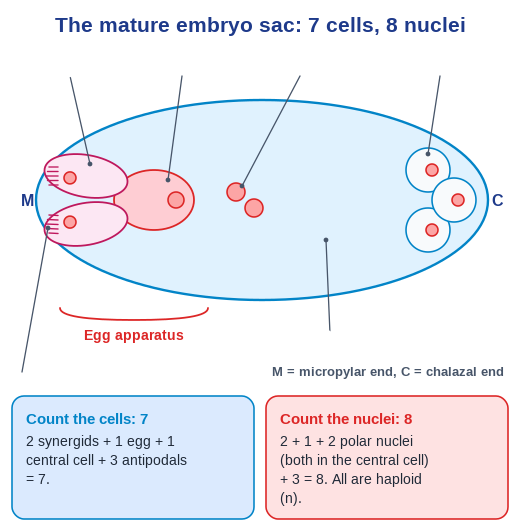
Functional megaspore ka nucleus mitosis se teen baar batata hai: 2, phir 4, phir 8 nuclei. Ye divisions free nuclear hain: 8-nucleate stage tak koi cell wall nahi banti. Phir chhe nuclei ke chaaron taraf walls ban kar cells banti hain, jabki do, polar nuclei, ek badi central cell mein rehte hain. Micropylar end par egg apparatus mein do synergids aur ek egg cell hoti hai; synergids par filiform apparatus hota hai, jo pollen tube ko rasta dikhata hai. Chalazal end par teen antipodals hain. Isliye mature embryo sac 7-celled lekin 8-nucleate hai.
Pollination kya hai?
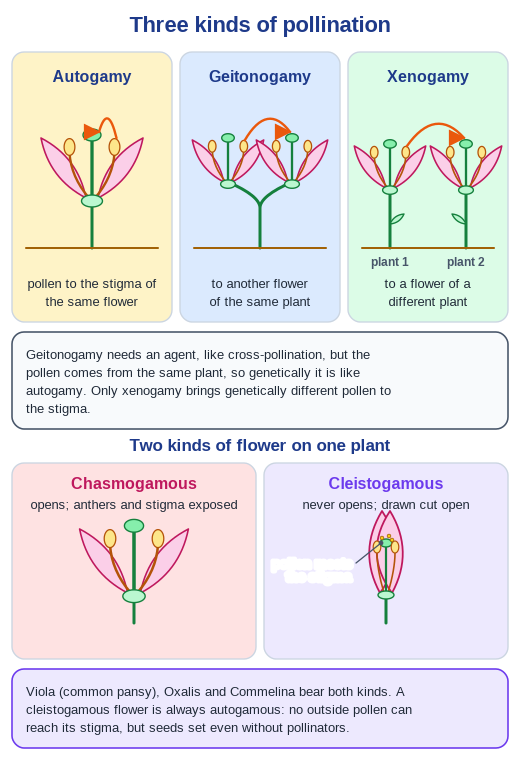
Dono tarah ke gametes khud chal nahi sakte, isliye pollen ko stigma tak pahunchana padta hai. Pollination (paragan) yaani pollen grains ko anther se pistil ke stigma tak le jaana. Iske teen types hain: autogamy, usi flower mein; geitonogamy, usi plant ke doosre flower par, jisme agent chahiye lekin genetically ye autogamy jaisa hai; aur xenogamy, doosre plant ke flower par, jo akela genetically alag pollen laata hai. Viola, Oxalis aur Commelina khulne wale chasmogamous aur band rehne wale cleistogamous flowers dono banate hain; band wale hamesha autogamous hote hain aur bina pollinators ke bhi seed banate hain. Padho pollination kya hai.
Wind aur water abiotic agents hain, aur inme pollen ka stigma par girna bas kismat ki baat hai, isliye aise flowers bahut zyada pollen banate hain. Wind-pollinated flowers ka pollen halka aur bina chipchipa hota hai, stamens khule hote hain aur stigma bada, aksar pankh jaisa (makka, ghaas). Water pollination kam hai, lagbhag 30 genera tak, zyadatar monocots, jaise Vallisneria, Hydrilla aur sea-grass Zostera. Zyadatar flowering plants animals use karte hain, khaaskar madhumakkhi (bees), aur titli, moths, beetles, birds, bats aur chhipkali bhi; aise flowers bade, rangeen, khushboodaar aur nectar se bhare hote hain.
Flowers self-pollination se kaise bachte hain?
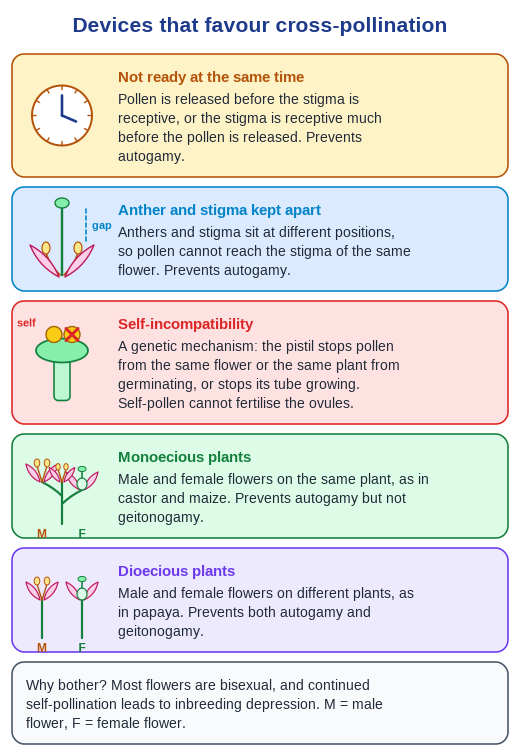
Lagaataar self-pollination se inbreeding depression aata hai, isliye kai plants mein outbreeding devices hain: pollen chhodne aur stigma ke ready hone ka alag samay; anthers aur stigma alag jagah; self-incompatibility, ek genetic rok jo apne pollen ko ugne ya badhne nahi deti; aur unisexual flowers. Monoecious plant, jaise castor ya makka, jisme male aur female flowers ek hi plant par hain, autogamy rokta hai lekin geitonogamy nahi; dioecious plant, jaise papita, dono rokta hai.
Pollen stigma par girne ke baad kya hota hai?
Pistil chemical signals se pollen ko pehchaanta hai. Sahi (compatible) pollen accept hota hai: wo ugta hai aur germ pore se pollen tube nikaalta hai, jo style se neeche, ovary mein, micropyle se ovule mein aur filiform apparatus se ek synergid mein jaati hai. Galat (incompatible) pollen stigma ya style mein hi rok diya jaata hai. Pollen girne se lekar tube ke ovule mein ghusne tak ki ye saari ghatnaayein pollen-pistil interaction hain.
Plant breeders isi samajh se artificial hybridisation karte hain. Wo bisexual flower bud ke anthers phatne se pehle nikaal dete hain (emasculation), use butter paper ke bag se dhak dete hain (bagging), receptive stigma par chune hue male parent ka pollen daalte hain, aur phir bag chadha dete hain.
Double fertilisation kya hai?
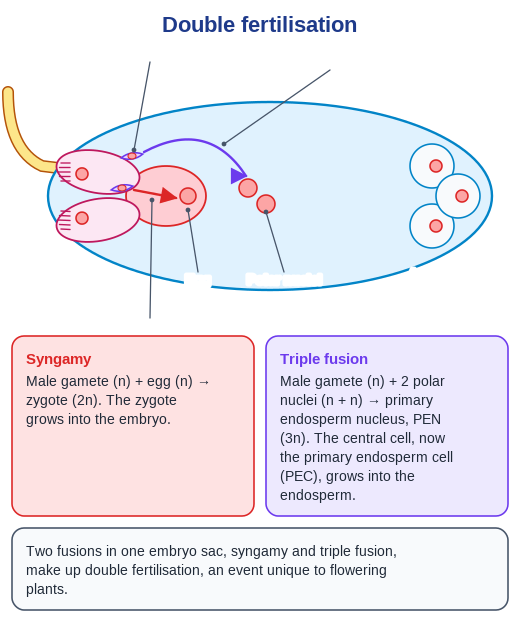
Pollen tube ek synergid mein do male gametes chhodti hai. Ek egg se judta hai: ye syngamy hai, aur isse diploid zygote banta hai. Doosra do polar nuclei se judta hai: ye triple fusion hai, aur isse triploid primary endosperm nucleus (PEN) banta hai. Ek hi embryo sac mein do fusions ko double fertilisation kehte hain, jo sirf flowering plants mein hota hai. Padho double fertilisation kya hai.
Endosperm, embryo aur seed kaise bante hain?
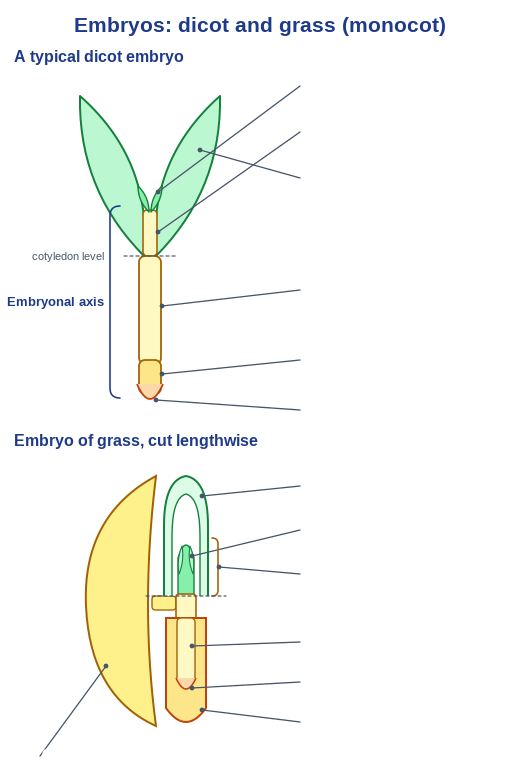
Endosperm pehle banta hai, taaki embryo ko khana pakka mile. Aam taur par PEN bina walls ke kai baar batata hai (free-nuclear endosperm) aur phir walls banti hain (cellular endosperm). Kachche nariyal ka paani free-nuclear endosperm hai aur safed malai (kernel) cellular endosperm. Zygote proembryo, globular aur heart-shaped stages se hokar embryo banta hai. Dicot embryo mein ek embryonal axis aur do cotyledons hote hain: unke upar ka epicotyl plumule par khatam hota hai, aur neeche ka hypocotyl root cap wale radicle par. Grass embryo mein ek cotyledon, scutellum, hota hai; shoot apex coleoptile mein aur radicle coleorrhiza mein dhaka rehta hai.
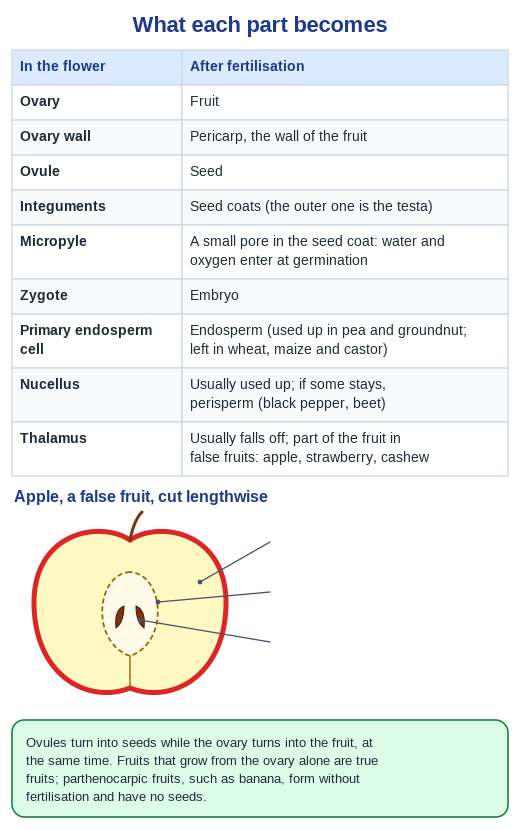
Seed sexual reproduction ka aakhri product hai. Jin seeds mein endosperm nahi bachta wo non-albuminous hain (matar, moongphali); jinme kuch bachta hai wo albuminous hain (gehun, makka, jau, castor). Bacha hua nucellus perisperm hai (kaali mirch, beet). Integuments sakht hokar seed coats bante hain, aur micropyle paani aur oxygen ke liye ek chhed ki tarah rehta hai. Pakke seeds sookhkar mass se 10–15% nami par aa jaate hain aur sahi haalaat milne tak dormant reh sakte hain.
Ovary ka kya hota hai?
Jab ovules seeds bante hain, tab ovary fruit banti hai aur uski wall pericarp. Fruits goodedaar (amrood, santra, aam) ya sookhe (moongphali, sarson) ho sakte hain. Jab thalamus bhi fruit ka hissa banta hai, jaise apple, strawberry aur kaju mein, to wo false fruit hai; sirf ovary se bane fruits true fruits hain. Parthenocarpic fruits, jaise kela, bina fertilisation ke bante hain aur unme beej nahi hote.
Apomixis aur polyembryony kya hain?
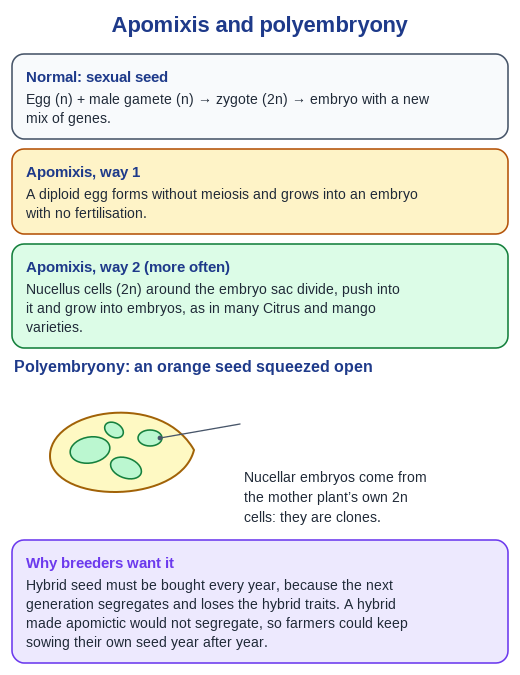
Asteraceae aur grasses ki kuch species bina fertilisation ke seeds banati hain: apomixis, ek asexual reproduction jo sexual ki nakal karta hai. Kuch mein bina meiosis ke diploid egg banta hai aur embryo ban jaata hai. Zyada aksar, jaise Citrus aur aam ki kai varieties mein, nucellus ki cells embryo sac mein ghuskar embryos ban jaati hain, isliye ek seed mein kai embryos hote hain: polyembryony. Hybrid seed har saal naya khareedna padta hai, kyunki agli generation segregate karti hai; apomictic hybrids aisa nahi karenge, isliye scientists apomixis ke genes par research kar rahe hain.
Aage badhne se pehle
Seeds kheti ki neev hain: inke pollination aur fertilisation ko paani nahi chahiye, ye door tak failte hain, seedling ke liye khana rakhte hain aur nayi variations laate hain. Book ek lupine seed, Lupinus arcticus, ka zikr karti hai jo andaazan 10,000 saal baad uga, aur 2000 saal purane khajoor (date palm) ke beej ka bhi. Chapter ko ek kram mein yaad rakho: flower → gametophytes → pollination → fertilisation → seed, aur chaar zaroori diagrams (anther, ovule, embryo sac, embryo) itni baar banao ki bina dekhe label kar sako. Saari 18 exercises aur chapter ke andar ke sawal Chapter 1 ke NCERT solutions mein hal hain.
Key terms (zaroori shabd)
| Term | Matlab |
|---|---|
| Androecium aur gynoecium | Flower ke stamens ka ghera, jo male reproductive organ hai, aur pistils, jo female reproductive organ hain. |
| Microsporangium | Anther ki chaar pollen sacs mein se ek, har lobe mein do; pollen grains isi ke andar bante hain. |
| Tapetum | Microsporangium ki sabse andar wali wall layer. Iski cells mein ghana cytoplasm aur aksar ek se zyada nucleus hote hain, aur ye bante hue pollen ko poshan deti hai. |
| Microsporogenesis | Pollen mother cell (2n) se meiosis dwara microspores banna; chaaron microspores pehle tetrad mein saath rehte hain. |
| Sporopollenin | Exine ka material, jo sabse tikau organic cheezon mein se ek hai; germ pores par ye nahi hota. |
| Ovule (megasporangium) | Placenta par laga hissa jisme ek ya do integuments ke andar nucellus aur embryo sac hote hain; ek sire par micropyle, doosre par chalaza. |
| Megasporogenesis | Megaspore mother cell (2n) se meiosis dwara chaar megaspores banna. |
| Embryo sac | Female gametophyte: aam taur par 7-celled aur 8-nucleate, jisme egg apparatus, do polar nuclei wali central cell aur teen antipodals hote hain. |
| Pollination | Pollen grains ko anther se pistil ke stigma tak pahunchana. |
| Cleistogamous flower | Aisa flower jo kabhi khulta hi nahi, isliye uska apna pollen hi uske stigma par girta hai: ye hamesha autogamous hota hai. |
| Self-incompatibility | Ek genetic mechanism jisme pistil usi flower ya usi plant ke pollen ko germinate hone ya tube badhane se rok deta hai. |
| Emasculation | Bisexual flower bud ke anthers ko phatne se pehle forceps se nikaal dena, taaki wo khud ko pollinate na kar sake. |
| Double fertilisation | Ek hi embryo sac mein syngamy aur triple fusion dono hona; ye sirf flowering plants mein hota hai. |
| Perisperm | Kuch seeds mein bacha hua nucellus, jaise kaali mirch (black pepper) aur beet mein. |
| Apomixis | Bina fertilisation ke seed banna; ye asexual reproduction hai jo sexual reproduction ki nakal karta hai. |
Is chapter ke topics
Practice karo
-
Microsporangium ki sabse andar wali wall layer, jo bante hue pollen ko poshan deti hai, kaunsi hai?
Jawab dekho
Jawab: (d) tapetum
-
Ek flowering plant ki leaf cell mein 24 chromosomes hain. Uski egg cell mein kitne honge?
Jawab dekho
Jawab: (b) 12
-
Flowering plant ka ek typical mature embryo sac hota hai:
Jawab dekho
Jawab: (b) 8-nucleate aur 7-celled
-
Kaunsa pollination stigma tak genetically alag pollen laata hai?
Jawab dekho
Jawab: (c) xenogamy
-
Primary endosperm nucleus hota hai:
Jawab dekho
Jawab: (c) triploid
-
Inme se false fruit kaunsa hai?
Jawab dekho
Jawab: (b) apple
Students ke sawal
Class 12 Biology Chapter 1 ke main topics kya hain?
Flower, uska stamen aur pistil; anther, microsporogenesis aur pollen grain; ovule, megasporogenesis aur embryo sac; pollination ke types aur agents, outbreeding devices, pollen-pistil interaction aur artificial hybridisation; double fertilisation; endosperm, embryo, seed aur fruit; aur apomixis aur polyembryony.
Kya Sexual Reproduction in Flowering Plants 2026-27 ki NCERT Class 12 Biology book mein hai?
Haan. Ye Biology, yaani Reprint 2026-27 wali Class 12 textbook, ki Unit VI, Reproduction, ka pehla chapter hai, pages 3 se 25. Rationalised book isi se shuru hoti hai; purana pehla chapter, Reproduction in Organisms, ab book mein nahi hai.
Is chapter ke kaunse diagrams practice karne chahiye?
Exercises do labelled diagrams maangti hain: typical angiosperm ovule (Exercise 4) aur 7-celled, 8-nucleate embryo sac (Exercise 6). Chapter anther ka transverse section, pollen grain, aur dicot aur grass embryos bhi detail mein samjhaata hai, isliye ye bhi practice karo.
Syngamy aur triple fusion mein kya fark hai?
Syngamy mein ek male gamete egg se judta hai aur diploid zygote banta hai, jo embryo banta hai. Triple fusion mein doosra male gamete central cell ke do polar nuclei se judta hai aur triploid primary endosperm nucleus banta hai, jo endosperm banta hai.
Koi sawal atak gaya?
Photo lo, Lagnever AI step-by-step samjhayega. 7 din ka trial sirf ₹2.
Google Play se app lo Browser mein kholo
Parents ke liye: trial ke baad plan har mahine UPI ya card autopay se renew hota hai. App mein kabhi bhi cancel kar sakte hain.