
Class 12 Biology Chapter 1: Sexual Reproduction in Flowering Plants Notes
This chapter in five lines
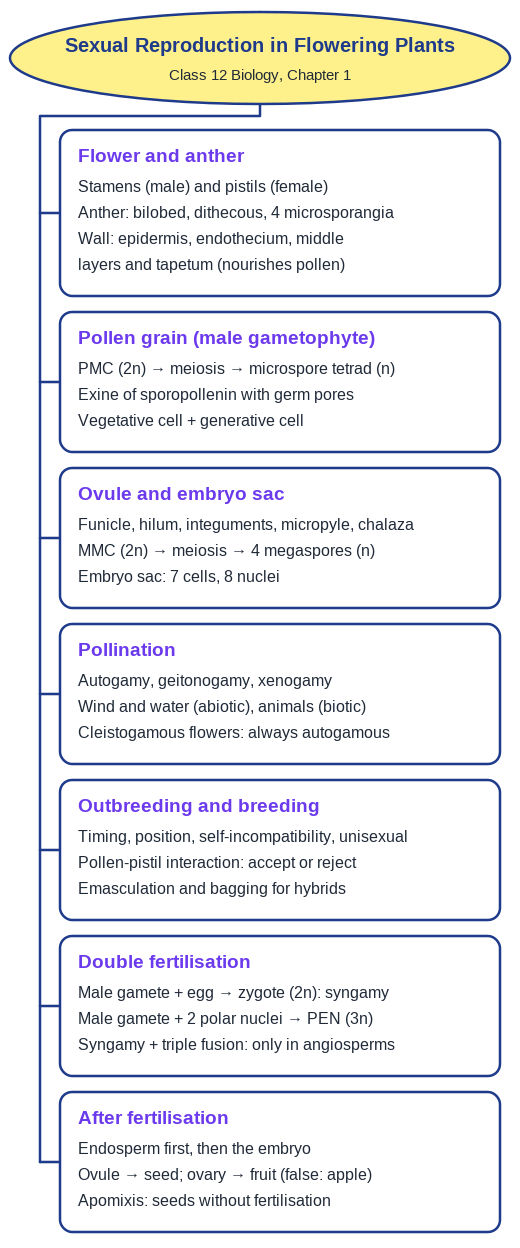
The flower is where flowering plants reproduce sexually. Pollen grains, the male gametophytes, form by meiosis in the anther; the embryo sac, the female gametophyte, forms in the ovule and is 7-celled and 8-nucleate. Pollination carries pollen to the stigma, and a pollen tube brings two male gametes to the embryo sac. Double fertilisation gives a diploid zygote and a triploid endosperm nucleus; then the ovule becomes the seed and the ovary the fruit.
What is this chapter about?
Every mango, every grain of rice and every mustard seed is the end product of sexual reproduction in a flowering plant (angiosperm). The colours, scents and shapes of flowers are adaptations that help it happen. This chapter, the first of Unit VI, Reproduction, follows the process step by step: how the male and female gametophytes form inside the flower, how pollen reaches the stigma, how fertilisation happens, and how the ovule turns into a seed and the ovary into a fruit. It also covers two exceptions: seeds without fertilisation (apomixis) and seeds with many embryos (polyembryony).
Where in the flower does reproduction happen?
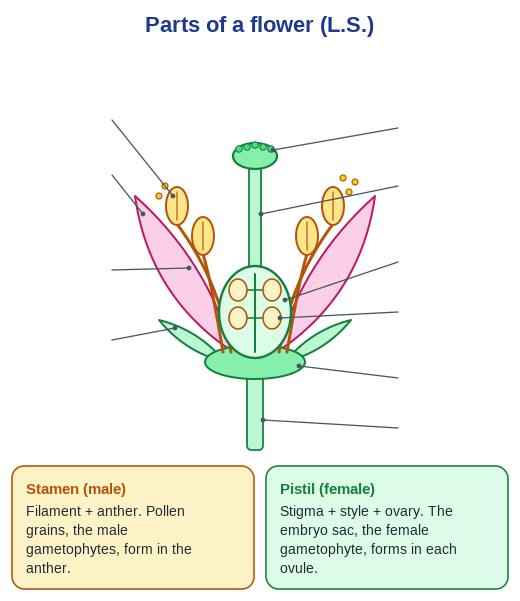
A plant “decides” to flower well before any flower can be seen: hormonal and structural changes start a floral primordium, which grows into inflorescences, buds and flowers. In the flower, the androecium, a whorl of stamens, is the male reproductive organ, and the gynoecium, made of one or more pistils, is the female reproductive organ. A stamen has a slender stalk, the filament, and a usually bilobed head, the anther. A pistil has three parts: the stigma, a landing platform for pollen; the style, a slender stalk; and the swollen ovary at the base, whose cavity holds the ovules on a cushion called the placenta. The male gametophyte develops in the anther and the female gametophyte in the ovule.
What is inside an anther?
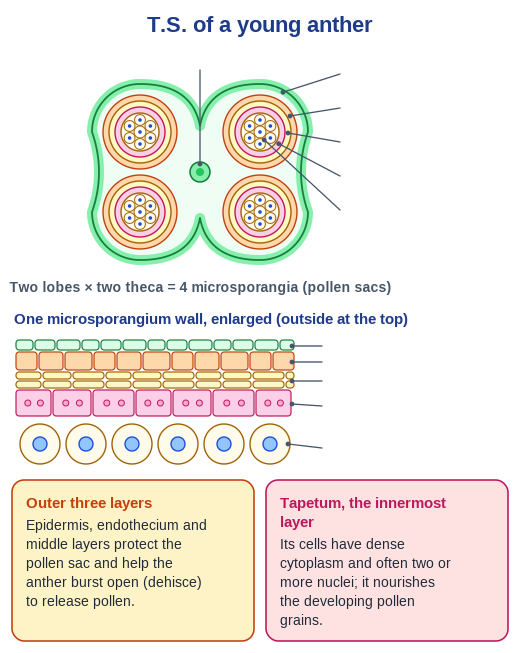
A typical anther is bilobed, and each lobe has two theca, so it is dithecous. In a transverse section it looks four-sided, with a microsporangium at each corner, two in each lobe. These become the pollen sacs. Each microsporangium is ringed by four wall layers: the epidermis, endothecium and middle layers, which protect it and help the anther burst open (dehiscence), and the tapetum, the innermost layer, which nourishes the developing pollen. Tapetal cells have dense cytoplasm and often more than one nucleus. In a young anther, the centre of each microsporangium is filled with compact sporogenous tissue.
How do pollen grains form?
Each sporogenous cell can act as a pollen mother cell (PMC), which is diploid. It divides by meiosis into four haploid microspores that stay together as a microspore tetrad. Forming microspores this way is microsporogenesis. As the anther matures and dries, the microspores separate and grow into pollen grains, several thousand in each microsporangium.
A pollen grain is the male gametophyte. It is usually round, about 25–50 micrometres across, with a two-layered wall. The hard outer exine is made of sporopollenin, which withstands high temperatures and strong acids and alkalis; no enzyme that breaks it down is known, so pollen survives as fossils. The exine has germ pores, where sporopollenin is absent. The thin inner intine is made of cellulose and pectin. A mature grain holds a large vegetative cell and a small, spindle-shaped generative cell. In over 60% of angiosperms, pollen leaves the anther at this 2-celled stage; in the others, the generative cell first divides by mitosis into two male gametes (3-celled stage). Read microsporogenesis and megasporogenesis.
How long pollen stays able to fertilise varies with temperature and humidity: rice and wheat pollen loses viability within 30 minutes, while pollen of some members of Rosaceae, Leguminoseae and Solanaceae lasts for months. Pollen can be stored for years in liquid nitrogen at −196 °C, in pollen banks for crop breeding. Pollen of some plants causes allergies and asthma; Parthenium (carrot grass), which came to India mixed with imported wheat, is one cause.
What are the parts of an ovule?
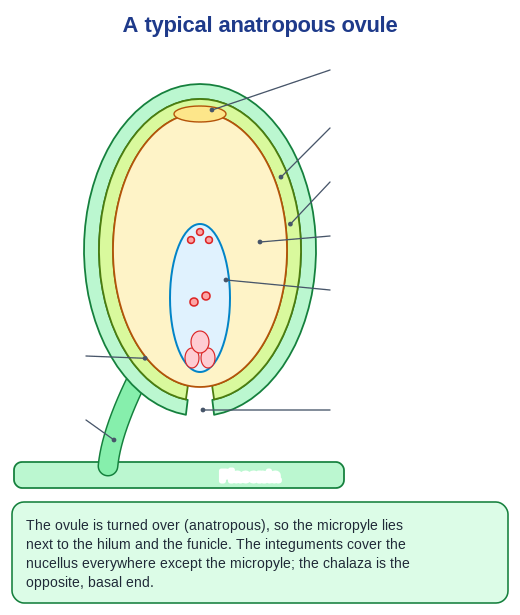
An ovule, or megasporangium, hangs from the placenta on a stalk, the funicle; the point where the stalk joins the body of the ovule is the hilum. One or two integuments wrap the ovule everywhere but the tip, where a small gap called the micropyle remains. The opposite, basal end is the chalaza. Inside the integuments is the nucellus, a mass of cells rich in food, and in it lies the embryo sac or female gametophyte. An ovary may hold one ovule (wheat, paddy, mango) or many (papaya, water melon, orchids).
How does the embryo sac form?
A single megaspore mother cell (MMC), a large diploid cell, forms in the micropylar region of the nucellus. It divides by meiosis into four haploid megaspores; this is megasporogenesis. In most flowering plants, one megaspore survives and the other three degenerate. Forming the embryo sac from a single megaspore is called monosporic development.
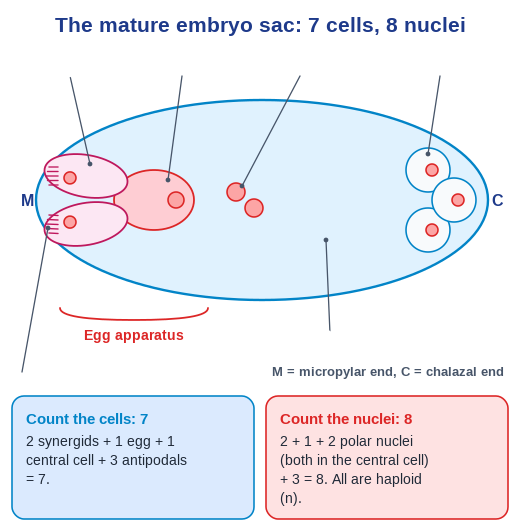
The nucleus of the functional megaspore divides by mitosis three times, giving 2, 4 and then 8 nuclei. These divisions are free nuclear: no cell walls form until the 8-nucleate stage. Then six nuclei get walls and become cells, while two, the polar nuclei, stay in one large central cell. At the micropylar end, the egg apparatus is made of one egg cell and two synergids; the synergids carry the filiform apparatus, which guides the pollen tube. At the chalazal end are three antipodals. So the mature embryo sac is 7-celled but 8-nucleate.
What is pollination?
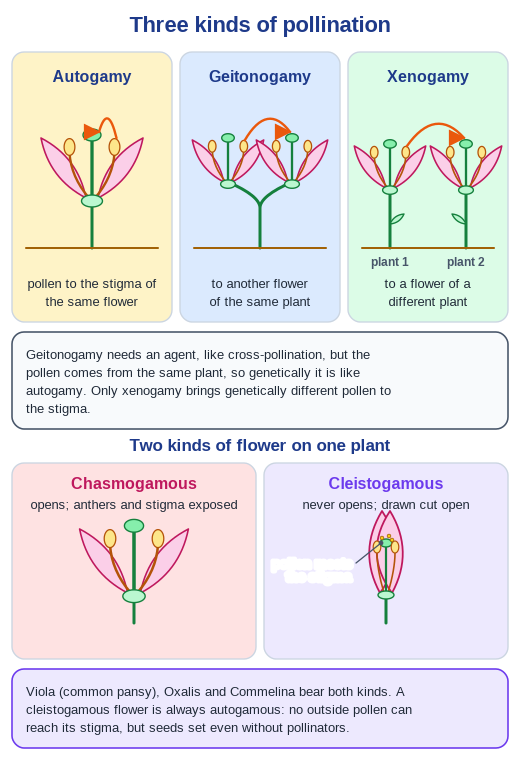
Both kinds of gametes are non-motile, so pollen must be carried to the stigma. Pollination is the transfer of pollen grains from an anther to the stigma of a pistil. It is of three kinds: autogamy, within the same flower; geitonogamy, to another flower of the same plant, which needs an agent but is genetically like autogamy; and xenogamy, to a flower of a different plant, the only kind that brings genetically different pollen. Viola, Oxalis and Commelina bear open chasmogamous flowers and closed cleistogamous flowers; the closed ones are always autogamous and set seed even without pollinators. Read pollination.
Wind and water are abiotic agents, and pollen landing on a stigma is then a matter of chance, so these flowers make huge amounts of pollen. Wind-pollinated flowers have light, non-sticky pollen, exposed stamens and large, often feathery stigmas (maize, grasses). Water pollination is rare, limited to about 30 genera, mostly monocots, such as Vallisneria, Hydrilla and the sea-grass Zostera. Most flowering plants use animals, chiefly bees, but also butterflies, moths, beetles, birds, bats and even lizards; such flowers tend to be big, brightly coloured, scented and full of nectar.
How do flowers avoid self-pollination?
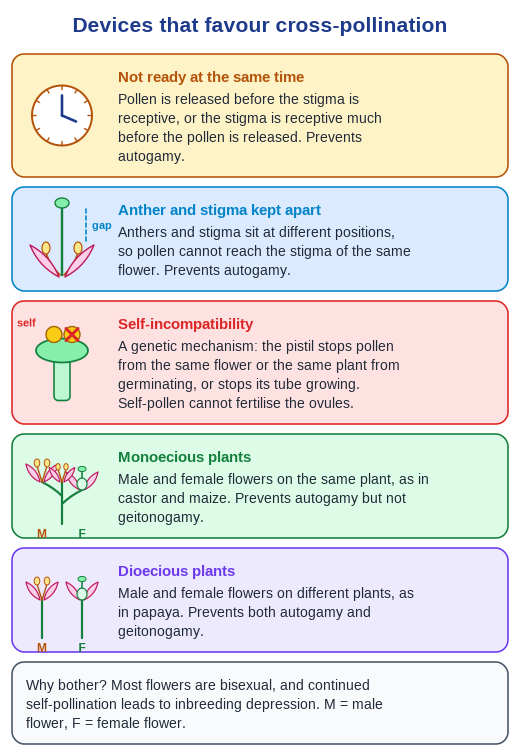
Continued self-pollination leads to inbreeding depression, so many plants have outbreeding devices: pollen release and stigma receptivity at different times; anthers and stigma at different positions; self-incompatibility, a genetic block that stops self-pollen from germinating or growing; and unisexual flowers. A monoecious plant such as castor or maize, with male and female flowers on one plant, avoids autogamy but not geitonogamy; a dioecious plant such as papaya avoids both.
What happens after pollen lands on the stigma?
The pistil recognises the pollen through chemical signals. Compatible pollen is accepted: it germinates and sends a pollen tube out through a germ pore, down the style, into the ovary and the ovule through the micropyle, and into a synergid through the filiform apparatus. Incompatible pollen is rejected on the stigma or in the style. These events, from pollen landing until the tube enters the ovule, are pollen-pistil interaction.
Plant breeders use this knowledge in artificial hybridisation. They remove the anthers of a bisexual flower bud before they burst (emasculation), cover it with a butter-paper bag (bagging), dust its receptive stigma with pollen from the chosen male parent, and bag it again.
What is double fertilisation?
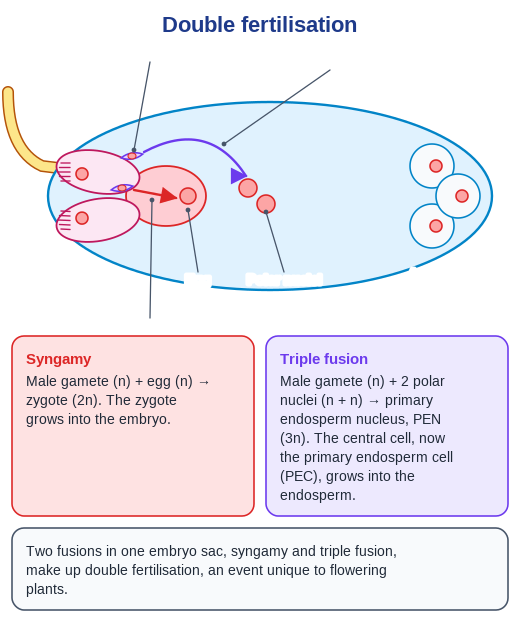
The pollen tube releases two male gametes into a synergid. One fuses with the egg: this is syngamy, and it gives the diploid zygote. The other fuses with the two polar nuclei: this is triple fusion, and it gives the triploid primary endosperm nucleus (PEN). Two fusions in one embryo sac make double fertilisation, which is unique to flowering plants. Read double fertilisation.
How do the endosperm, embryo and seed develop?
The endosperm develops first, so the embryo is assured of food. Usually the PEN divides many times without walls (free-nuclear endosperm) and then walls form (cellular endosperm). Tender coconut water is free-nuclear endosperm and the white kernel is cellular endosperm. The zygote grows through the proembryo, globular and heart-shaped stages into the embryo. A dicot embryo has an embryonal axis and two cotyledons: the epicotyl above them ends in the plumule, and the hypocotyl below ends in the radicle with a root cap. A grass embryo has one cotyledon, the scutellum, with the shoot apex sheathed in a coleoptile and the radicle in a coleorrhiza.
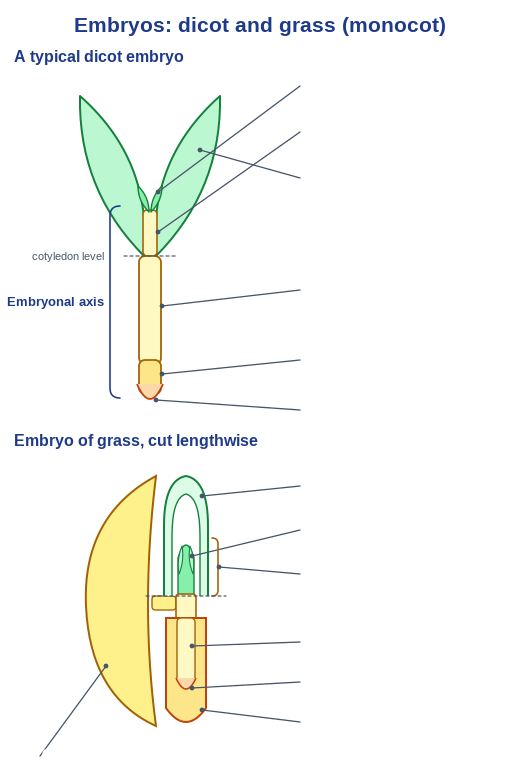
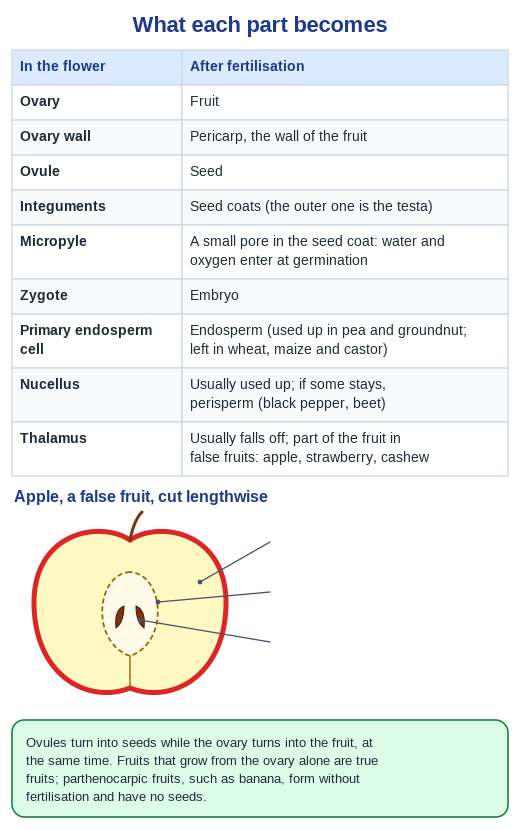
The seed is the end result of sexual reproduction. Seeds with no endosperm left are non-albuminous (pea, groundnut); those that keep some are albuminous (wheat, maize, barley, castor). Leftover nucellus is perisperm (black pepper, beet). Integuments harden into seed coats, and the micropyle stays as a pore for water and oxygen. Mature seeds dry to 10–15% moisture by mass and may stay dormant until conditions suit germination.
What becomes of the ovary?
While the ovules become seeds, the ovary becomes the fruit, and its wall becomes the pericarp. Fruits can be fleshy (guava, orange, mango) or dry (groundnut, mustard). When the thalamus also forms part of the fruit, as in apple, strawberry and cashew, it is a false fruit; fruits from the ovary alone are true fruits. Parthenocarpic fruits, such as banana, form without fertilisation and are seedless.
What are apomixis and polyembryony?
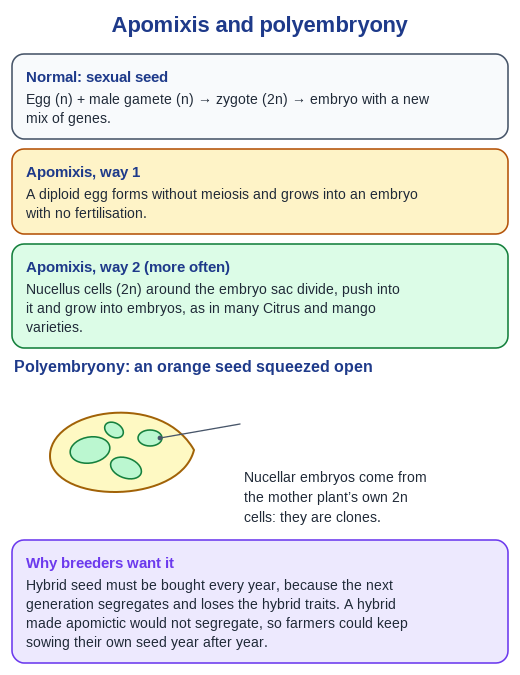
Some species of Asteraceae and grasses form seeds without fertilisation: apomixis, a kind of asexual reproduction that mimics the sexual kind. In some, a diploid egg forms without meiosis and grows into an embryo. Usually, as in many varieties of Citrus and mango, nucellus cells push into the embryo sac and become embryos, so one seed holds several: polyembryony. Hybrid seed must be bought afresh every year, because the next generation segregates; apomictic hybrids would not, which is why researchers study the genes for apomixis.
Before we move on
Seeds are the basis of agriculture: they do not need water for pollination and fertilisation, they disperse, they carry food for the seedling and they bring new variations. The book notes a lupine seed, Lupinus arcticus, that germinated after an estimated 10,000 years, and a 2000-year-old date palm seed. Learn the chapter as a sequence, flower to gametophytes to pollination to fertilisation to seed, and draw the four key diagrams (anther, ovule, embryo sac, embryo) until you can label them from memory. All 18 exercises and the questions inside the chapter are answered in the NCERT solutions for Chapter 1.
Key terms
| Term | Meaning |
|---|---|
| Androecium and gynoecium | The whorl of stamens, the male reproductive organs, and the pistils, the female reproductive organs, of a flower. |
| Microsporangium | One of the four pollen sacs of an anther, two in each lobe; pollen grains develop inside it. |
| Tapetum | The innermost wall layer of a microsporangium. Its cells have dense cytoplasm, often more than one nucleus, and nourish the developing pollen. |
| Microsporogenesis | Meiosis in a pollen mother cell (2n) that gives four microspores, which first stay together as a tetrad. |
| Sporopollenin | The material of the exine, one of the most resistant organic materials known; it is absent at the germ pores. |
| Ovule (megasporangium) | The body on the placenta that holds the nucellus and the embryo sac inside one or two integuments, with the micropyle at one end and the chalaza at the other. |
| Megasporogenesis | The formation of four megaspores from the megaspore mother cell (2n) by meiosis. |
| Embryo sac | The female gametophyte: usually 7-celled and 8-nucleate, with the egg apparatus, a central cell with two polar nuclei, and three antipodals. |
| Pollination | The transfer of pollen grains from an anther to the stigma of a pistil. |
| Cleistogamous flower | A flower that never opens, so its own pollen reaches its stigma: it is always autogamous. |
| Self-incompatibility | A genetic mechanism by which the pistil stops pollen from the same flower or the same plant from germinating or growing a tube. |
| Emasculation | Removing the anthers from a bisexual flower bud with forceps before they burst, so that it cannot pollinate itself. |
| Double fertilisation | Syngamy and triple fusion taking place in the same embryo sac, an event unique to flowering plants. |
| Perisperm | Remains of the nucellus left in a few seeds, for example black pepper and beet. |
| Apomixis | The formation of seeds without fertilisation: asexual reproduction that copies the outcome of the sexual process. |
Topics in this chapter
Practice
-
The innermost wall layer of a microsporangium, which nourishes the developing pollen, is the:
Show answer
Answer: (d) tapetum
-
A leaf cell of a flowering plant has 24 chromosomes. How many chromosomes does its egg cell have?
Show answer
Answer: (b) 12
-
A typical mature embryo sac of a flowering plant is:
Show answer
Answer: (b) 8-nucleate and 7-celled
-
Which kind of pollination brings genetically different pollen to the stigma?
Show answer
Answer: (c) xenogamy
-
The primary endosperm nucleus is:
Show answer
Answer: (c) triploid
-
Which of these is a false fruit?
Show answer
Answer: (b) apple
Questions students ask
What are the main topics of Class 12 Biology Chapter 1?
The flower and its stamen and pistil; the anther, microsporogenesis and the pollen grain; the ovule, megasporogenesis and the embryo sac; pollination, its kinds and agents, outbreeding devices, pollen-pistil interaction and artificial hybridisation; double fertilisation; the endosperm, embryo, seed and fruit; and apomixis and polyembryony.
Is Sexual Reproduction in Flowering Plants in the 2026-27 NCERT Class 12 Biology book?
Yes. It is Chapter 1, the first chapter of Unit VI, Reproduction, in Biology, the Class 12 textbook marked Reprint 2026-27, on pages 3 to 25. The rationalised book begins with it; the older first chapter, Reproduction in Organisms, is no longer in the book.
Which diagrams should I practise for this chapter?
The exercises ask for two labelled diagrams: a typical angiosperm ovule (Exercise 4) and the 7-celled, 8-nucleate embryo sac (Exercise 6). The chapter also describes the transverse section of an anther, the pollen grain, and the dicot and grass embryos in detail, so practise those too.
What is the difference between syngamy and triple fusion?
Syngamy is the fusion of one male gamete with the egg, giving the diploid zygote that grows into the embryo. Triple fusion is the fusion of the other male gamete with the two polar nuclei of the central cell, giving the triploid primary endosperm nucleus that grows into the endosperm.
Stuck on a question?
Take a photo and Lagnever AI explains it step by step. Try it for 7 days for ₹2.
Get it on Google Play Open in browser
For parents: after the trial, the plan renews monthly by UPI or card autopay. You can cancel anytime in the app.