
What are microsporogenesis and megasporogenesis?
Answer in short
Microsporogenesis is the making of microspores in the anther, when a pollen mother cell divides by meiosis; the microspores grow into pollen grains. Megasporogenesis is the formation of four megaspores from the megaspore mother cell by meiosis in the ovule; usually one survives and develops into the 7-celled, 8-nucleate embryo sac.
Stuck on a question? Take a photo and Lagnever AI explains it step by step. Try it for 7 days for ₹2. Get it on Google Play
Where do the two gametophytes form?
A flower has two reproductive parts. The stamen, a filament carrying an anther, is the male part; the pistil, with its stigma, style and ovary, is the female part. The male gametophyte, the pollen grain, develops inside the anther. The female gametophyte, the embryo sac, develops inside each ovule in the ovary. Both start with a diploid mother cell that divides by meiosis.
What does the inside of an anther look like?
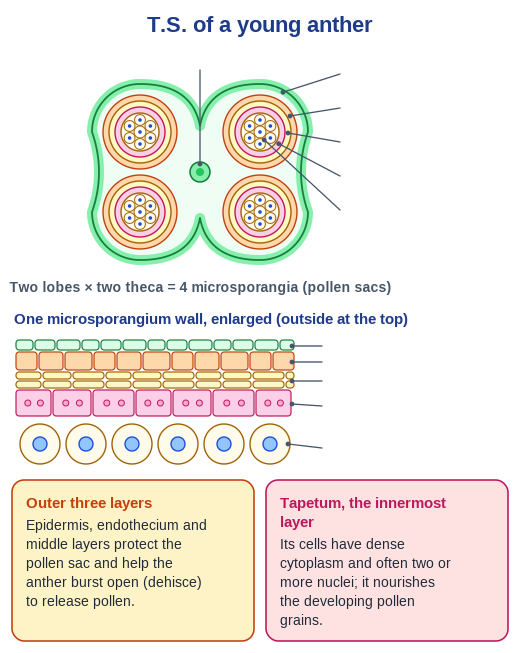
A typical anther has two lobes, and each lobe has two theca: it is bilobed and dithecous. Cut across, it looks four-sided, with one microsporangium at each corner. The microsporangia run the length of the anther and later become the pollen sacs.
Four wall layers ring each microsporangium:
- Epidermis, the outermost layer.
- Endothecium.
- Middle layers. With the two above, they protect the pollen sac and help the anther burst open (dehisce) to release pollen.
- Tapetum, the innermost layer. It nourishes the developing pollen. Its cells have dense cytoplasm and often two or more nuclei.
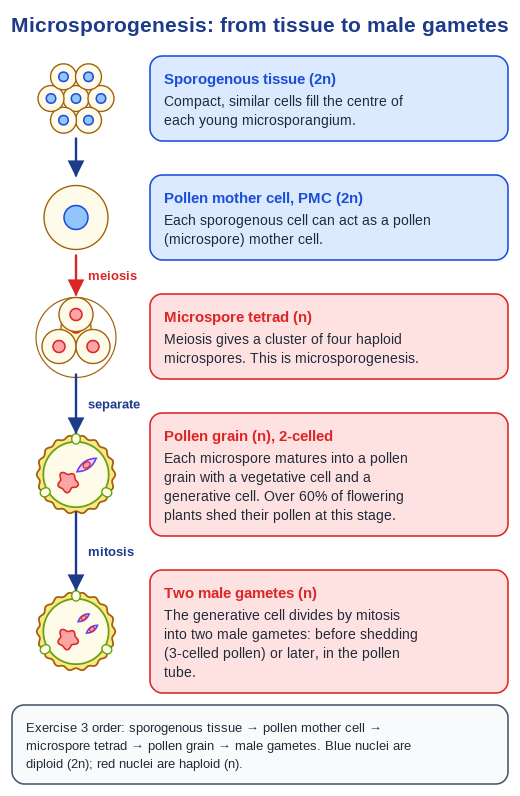
The centre of a young microsporangium is filled with sporogenous tissue, compact cells that all look alike.
How does a pollen mother cell make pollen?
Each sporogenous cell can act as a pollen mother cell (PMC). The PMC is diploid (2n) and divides by meiosis into four haploid (n) microspores, which stay together as a microspore tetrad. This is microsporogenesis. As the anther matures and dries, the microspores separate and each becomes a pollen grain. One microsporangium makes several thousand of them.
What is a pollen grain made of?
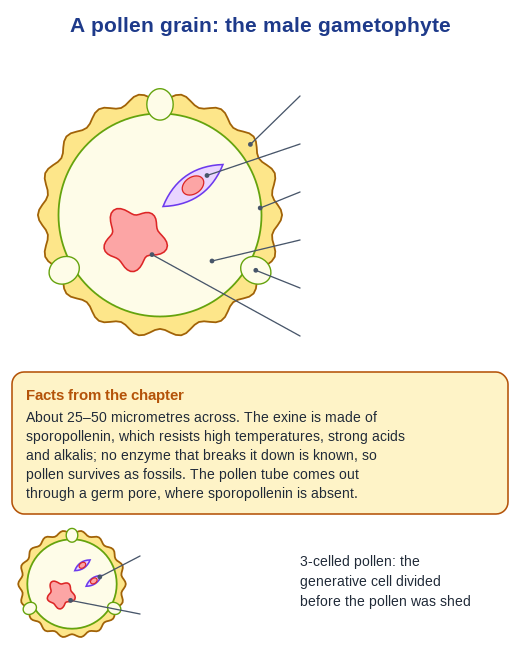
A pollen grain is usually round and about 25–50 micrometres across. Its wall has two layers:
- The exine is hard and patterned. It is made of sporopollenin, which withstands high temperatures and strong acids and alkalis; no enzyme that breaks it down is known. That is why pollen survives as fossils. The germ pores are gaps where sporopollenin is absent.
- The intine is thin and continuous, made of cellulose and pectin.
A mature pollen grain has two cells. The vegetative cell is large, stores food and has a big, irregular nucleus. The generative cell is small and spindle-shaped and floats in the vegetative cell. Over 60% of flowering plants shed pollen at this 2-celled stage. In the rest, the generative cell first divides by mitosis into two male gametes, so the pollen is shed 3-celled.
What are the parts of an ovule?
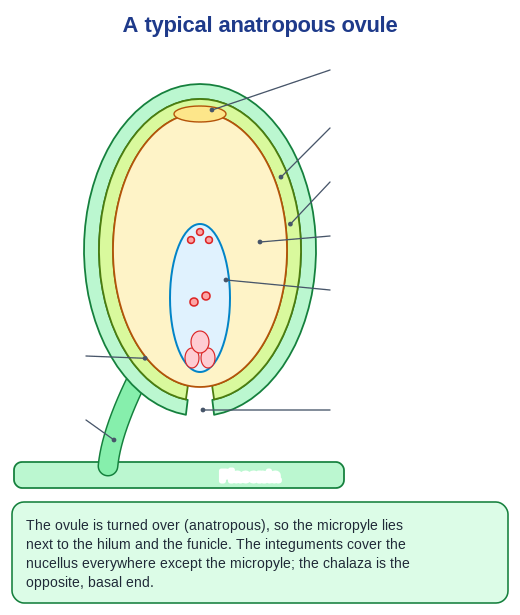
The ovule, or megasporangium, grows from the placenta inside the ovary. Its stalk is the funicle, which joins the body of the ovule at the hilum. One or two integuments cover it, leaving a small opening, the micropyle, at one end. The opposite, basal end is the chalaza. Inside lies the nucellus, a mass of food-rich cells, and within it the embryo sac.
How does megasporogenesis happen?
Near the micropyle, the nucellus usually has one large megaspore mother cell (MMC) with thick cytoplasm and a large, clear nucleus. This MMC is diploid and divides by meiosis into four haploid megaspores. This is megasporogenesis. In most flowering plants only one megaspore is functional and the other three degenerate. Since the embryo sac comes from a single megaspore, this is called monosporic development.
Why is the embryo sac 7-celled but 8-nucleate?
The functional megaspore’s nucleus divides by mitosis, and the two nuclei move to opposite ends. Two more rounds give 4 and then 8 nuclei. These divisions are free nuclear: no walls form between the nuclei until the 8-nucleate stage.
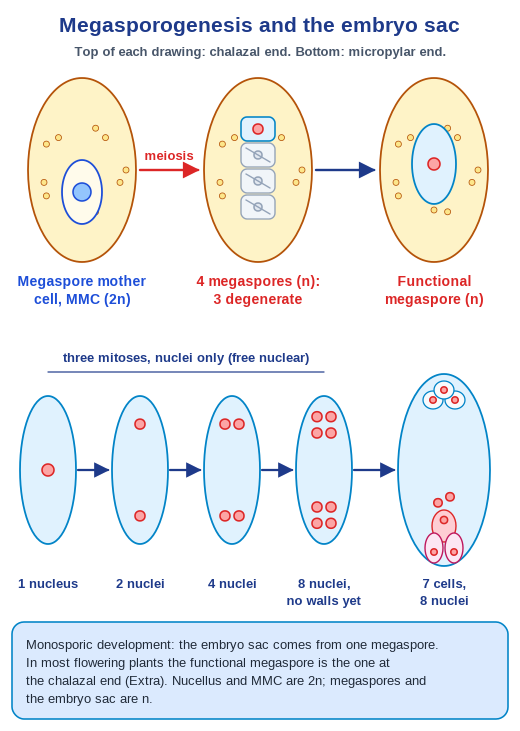
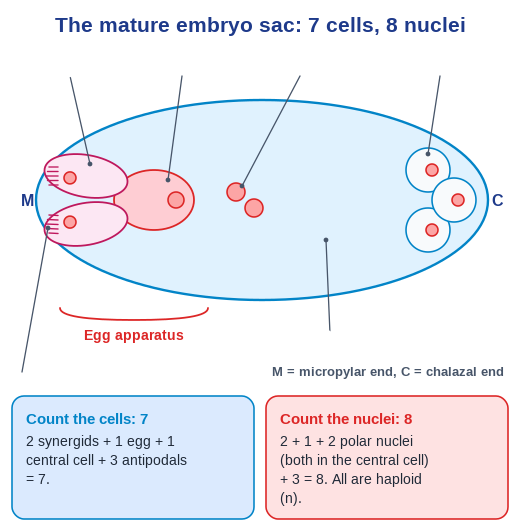
Then walls form. Three cells at the micropylar end make the egg apparatus: one egg cell and two synergids. The synergids carry the filiform apparatus, thickenings that guide the pollen tube. Three cells at the chalazal end are the antipodals. The remaining two nuclei, the polar nuclei, share one large central cell. Count them: 2 + 1 + 3 + 1 = 7 cells, but 2 + 1 + 3 + 2 = 8 nuclei.
How do the two processes compare?
| Point | Microsporogenesis | Megasporogenesis |
|---|---|---|
| Where | Microsporangium of the anther | Nucellus of the ovule |
| Mother cell | Pollen mother cell (2n) | Megaspore mother cell (2n) |
| Division | Meiosis | Meiosis |
| Product | Four microspores, all become pollen | Four megaspores, usually one survives |
Next topic: pollination. See also the chapter notes and the NCERT solutions.
Practice
-
Which wall layer of the microsporangium nourishes the developing pollen grains?
Show answer
Answer: (d) tapetum
-
The pollen mother cell and the microspores formed from it are, respectively:
Show answer
Answer: (b) 2n and n
-
How many mitotic divisions turn the nucleus of the functional megaspore into the 8 nuclei of the embryo sac?
Show answer
Answer: (c) three
-
Why do pollen grains survive as fossils?
Show answer
Answer: Their exine is made of sporopollenin, which withstands high temperatures and strong acids and alkalis, and no enzyme that breaks it down is known.
-
Name the cells of the egg apparatus and say where it lies.
Show answer
Answer: One egg cell and two synergids; it sits at the end of the embryo sac nearest the micropyle.
Questions students ask
What is the difference between microsporogenesis and megasporogenesis?
Microsporogenesis happens in the microsporangia of the anther: a pollen mother cell divides by meiosis into four microspores, all of which become pollen grains. Megasporogenesis happens in the nucellus of the ovule: the megaspore mother cell divides by meiosis into four megaspores, and usually only one survives to form the embryo sac.
What is the role of the tapetum?
The tapetum is the innermost wall layer of the microsporangium. It nourishes the developing pollen grains; its cells have dense cytoplasm and generally more than one nucleus.
Why is the embryo sac called 7-celled and 8-nucleate?
Its eight nuclei come from three mitoses of the functional megaspore's nucleus. Six of them get walls as separate cells (two synergids, the egg and three antipodals), while the two polar nuclei stay together in one central cell, so there are 7 cells.
What is monosporic development?
It is the formation of the embryo sac from a single functional megaspore, while the other three megaspores degenerate. It is the usual way in most flowering plants.
Stuck on a question?
Take a photo and Lagnever AI explains it step by step. Try it for 7 days for ₹2.
Get it on Google Play Open in browser
For parents: after the trial, the plan renews monthly by UPI or card autopay. You can cancel anytime in the app.