
What is pollination?
Answer in short
Pollination is the transfer of pollen grains from an anther to the stigma of a pistil. It can be autogamy (within the same flower), geitonogamy (to another flower of the same plant) or xenogamy (to a flower of a different plant). Wind and water are abiotic agents; animals, mostly insects such as bees, are biotic agents.
Stuck on a question? Take a photo and Lagnever AI explains it step by step. Try it for 7 days for ₹2. Get it on Google Play
Why do flowering plants need pollination?
The male gametes form in the pollen grain and the egg forms in the embryo sac, deep inside the ovule. Neither kind of gamete can move by itself, so pollen has to be carried to the pistil. Pollination is the transfer of pollen grains from an anther to the stigma of a pistil. Plants rely on outside agents for this, and flowers show a wide range of adaptations to make it happen.
What are the three kinds of pollination?
They differ in where the pollen comes from:
- Autogamy: pollen reaches the stigma of the same flower. In a flower that opens, complete autogamy is rare: pollen release and stigma receptivity must happen together, and the anthers and stigma must lie close.
- Geitonogamy: pollen reaches another flower of the same plant. It needs an agent, like cross-pollination, but genetically it is the same as autogamy.
- Xenogamy: pollen reaches a flower of a different plant. It is the only kind that brings genetically different pollen.
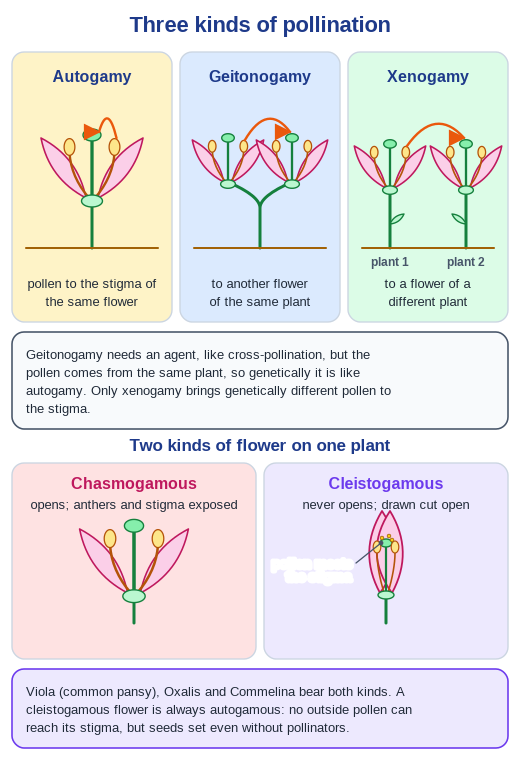
Viola (common pansy), Oxalis and Commelina make two kinds of flowers. Chasmogamous flowers open and expose their anthers and stigma. Cleistogamous flowers never open: the anthers burst inside the bud and pollen falls on the stigma close by. They are always autogamous, so seed-set is assured even with no pollinators around.
How do wind and water carry pollen?
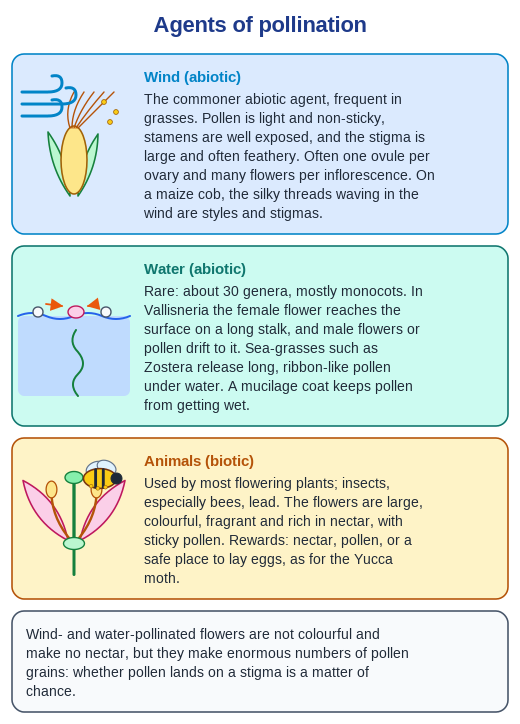
Wind and water are abiotic agents. Whether pollen lands on a stigma is then a matter of chance, so these flowers make far more pollen than there are ovules to fertilise.
Wind is the commoner of the two, especially in grasses. Wind-pollinated flowers have light, non-sticky pollen, well-exposed stamens and large, often feathery stigmas to trap pollen from the air. They often have one ovule per ovary and many flowers packed into an inflorescence. On a maize cob, the silky threads that wave in the wind are the styles and stigmas.
Water pollination is rare: about 30 genera, mostly monocots. In Vallisneria, the female flower reaches the surface on a long stalk, and male flowers or pollen released on the surface drift to it with the currents. In sea-grasses such as Zostera, the female flowers stay under water and long, ribbon-like pollen drifts to them. A mucilage coat keeps the pollen from getting wet. Not all water plants use water: water hyacinth and water lily lift their flowers above the surface, where insects or wind pollinate them.
How do animals pollinate flowers?
Most flowering plants use animals, the biotic agents: bees, wasps, ants, flies, beetles, butterflies, moths, sunbirds, hummingbirds and bats, and in some species even lemurs, tree-dwelling rodents and lizards. Bees lead. Insect-pollinated flowers are usually big, brightly coloured, scented and full of nectar; small ones are grouped into an inflorescence to be seen. Flowers visited by flies and beetles give off foul smells. Visitors are paid with rewards, usually nectar and pollen. While collecting them, the animal touches the anthers and gets coated with sticky pollen, which it carries to a stigma.
Some rewards are places to lay eggs. Amorphophallus, whose flower is about 6 feet tall, is one example. A moth and the Yucca plant depend on each other completely, and neither can finish its life cycle alone: the moth lays eggs in the ovary and pollinates the flower. Insects that take nectar or pollen without pollinating are pollen or nectar robbers.
How do plants avoid self-pollination?
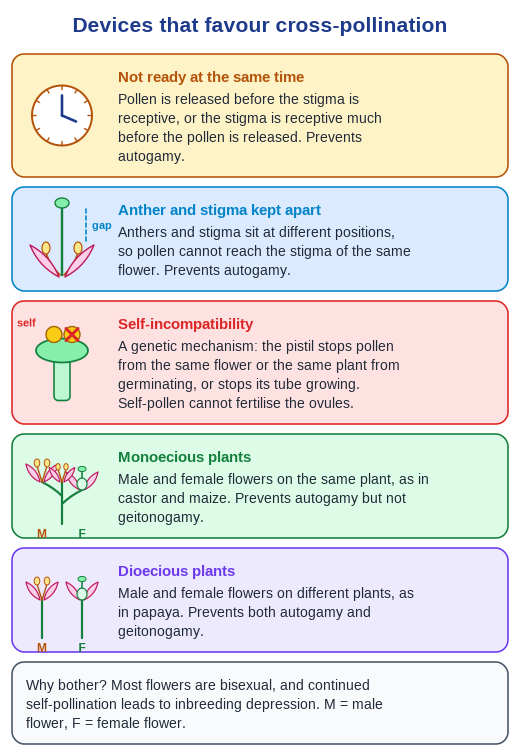
Most flowers are bisexual, and continued self-pollination causes inbreeding depression. Plants have several outbreeding devices:
- Pollen is released before the stigma is receptive, or the other way round.
- Anthers and stigma sit at different positions.
- Self-incompatibility, a genetic mechanism, stops pollen of the same flower or plant from germinating or growing a tube in the pistil.
- Unisexual flowers: monoecious plants such as castor and maize avoid autogamy but not geitonogamy; dioecious plants such as papaya avoid both.
What is pollen-pistil interaction?
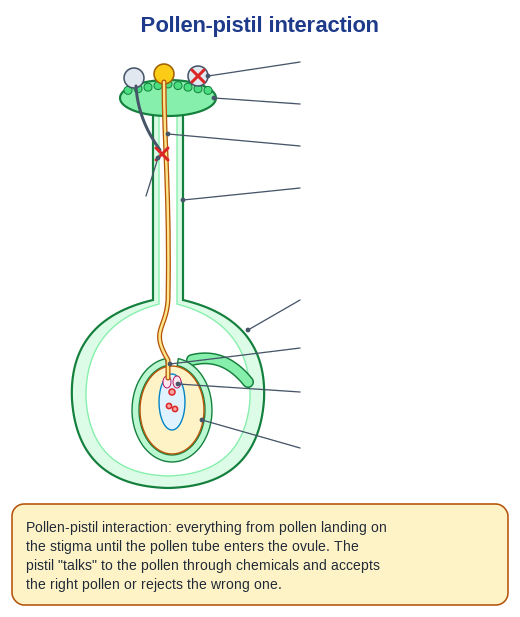
Pollination alone does not make sure that the right pollen arrives. The pistil recognises pollen through a chemical “dialogue” and accepts compatible pollen while rejecting the rest. Accepted pollen germinates and grows a pollen tube through a germ pore, down the style and into the ovary; the tube enters the ovule through the micropyle and a synergid through the filiform apparatus. These events, from pollen landing until the tube enters the ovule, are pollen-pistil interaction.
How do breeders make hybrids?
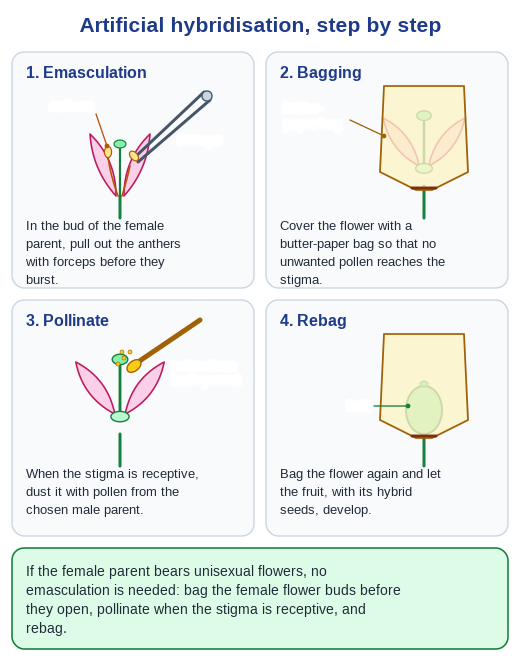
In artificial hybridisation, only the chosen pollen must reach the stigma. If the female parent has bisexual flowers, the anthers are pulled out of the bud before they burst (emasculation), and the flower is covered with a butter-paper bag (bagging). When the stigma is receptive, pollen from the male parent is dusted on it and the flower is bagged again. Unisexual female flowers need no emasculation; they are simply bagged before they open.
Next topic: double fertilisation. Previous topic: microsporogenesis and megasporogenesis. See also the chapter notes and the NCERT solutions.
Practice
-
Pollen moving from an anther to the stigma of a second flower on the same plant is called:
Show answer
Answer: (b) geitonogamy
-
Papaya has male and female flowers on different plants. This prevents:
Show answer
Answer: (c) both autogamy and geitonogamy
-
Which of these is pollinated by water?
Show answer
Answer: (c) Vallisneria
-
Why do wind-pollinated flowers make so much pollen?
Show answer
Answer: Pollen reaching a stigma by wind is a matter of chance, and much of it is lost, so a large amount makes up for the loss.
-
Why must a breeder bag a flower after emasculation?
Show answer
Answer: So that no unwanted pollen reaches its stigma; only pollen from the chosen male parent should pollinate it.
Questions students ask
What are the three kinds of pollination?
Autogamy, when pollen reaches the stigma of the same flower; geitonogamy, when it reaches another flower of the same plant; and xenogamy, when it reaches a flower of a different plant. Only xenogamy brings genetically different pollen.
What are cleistogamous flowers?
Flowers that never open. Their anthers and stigma lie close together, so pollen falls on the stigma inside the bud. They are always autogamous and set seed even without pollinators. Viola, Oxalis and Commelina bear them along with open flowers.
What is self-incompatibility?
A genetic mechanism that stops a plant's own pollen, whether from the same flower or another flower on the same plant, from fertilising its ovules. The pistil prevents the pollen from germinating or stops the pollen tube growing.
What are emasculation and bagging?
Emasculation is removing the anthers from a bisexual flower bud with forceps before they burst. Bagging is covering the flower with a bag, usually of butter paper, so that unwanted pollen cannot reach its stigma. Both are used in artificial hybridisation.
Stuck on a question?
Take a photo and Lagnever AI explains it step by step. Try it for 7 days for ₹2.
Get it on Google Play Open in browser
For parents: after the trial, the plan renews monthly by UPI or card autopay. You can cancel anytime in the app.