
What is double fertilisation?
Answer in short
Double fertilisation is the pair of fusions in one embryo sac of a flowering plant. One male gamete fuses with the egg (syngamy) to form the diploid zygote; the other fuses with the two polar nuclei (triple fusion) to form the triploid primary endosperm nucleus. The zygote becomes the embryo and the primary endosperm cell the endosperm.
Stuck on a question? Take a photo and Lagnever AI explains it step by step. Try it for 7 days for ₹2. Get it on Google Play
How do the male gametes reach the egg?
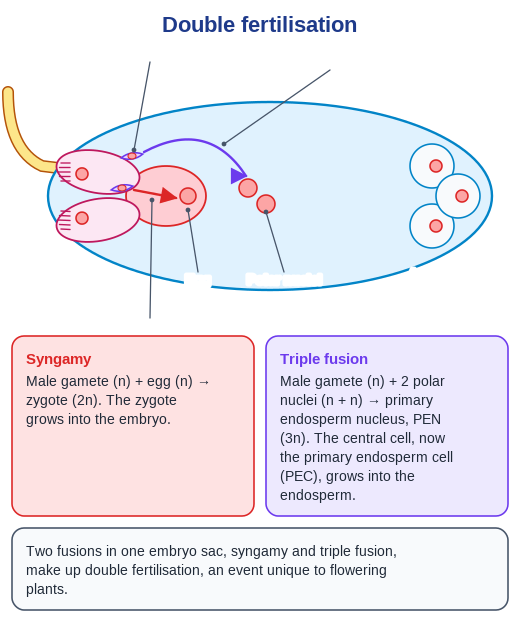
After compatible pollination, the pollen tube grows down the style, passes through the micropyle into the ovule, and from there through the filiform apparatus into one of the two synergids. There it releases its two male gametes. If the pollen was shed at the 2-celled stage, the generative cell divides into these two gametes as the tube grows; 3-celled pollen carries them from the start.
What are syngamy and triple fusion?
The two male gametes take different routes:
- One male gamete moves to the egg and fuses with its nucleus. This is syngamy, and it forms the diploid zygote.
- The other goes to the two polar nuclei of the central cell and fuses with both. Three haploid nuclei join, so this is called triple fusion, and it forms the triploid primary endosperm nucleus (PEN). The central cell is now the primary endosperm cell (PEC).
Two kinds of fusion in one embryo sac make up double fertilisation, which happens only in flowering plants. The zygote develops into the embryo and the PEC into the endosperm.
How does the endosperm develop?
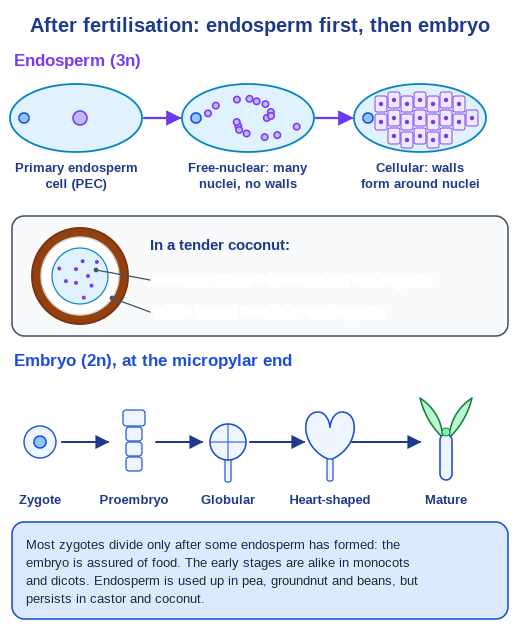
Endosperm development comes before embryo development. The PEC divides again and again into a triploid endosperm whose cells store food for the embryo. In the commonest type, the PEN divides many times without any walls forming, giving free-nuclear endosperm; later walls form and the endosperm becomes cellular. The water of a tender coconut is free-nuclear endosperm with thousands of nuclei, and the white kernel around it is cellular endosperm.
The embryo may use up all the endosperm before the seed matures, as in pea, groundnut and beans, or some may stay in the seed and feed the seedling at germination, as in castor and coconut.
How does the embryo develop?
The embryo grows at the micropylar end, where the zygote lies. Most zygotes divide only after some endosperm has formed, which assures the embryo of food. The early stages are alike in monocots and dicots: the zygote becomes a proembryo, then a globular, a heart-shaped and finally a mature embryo.
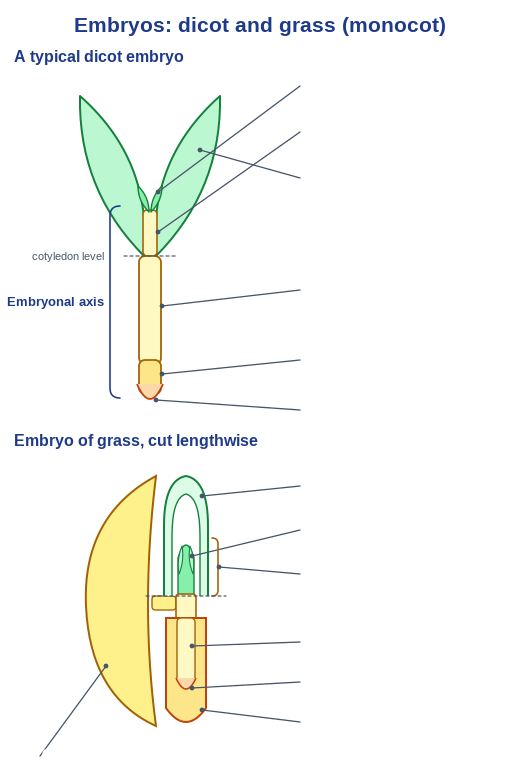
A dicot embryo has an embryonal axis and two cotyledons. Above the level of the cotyledons, the epicotyl ends in the plumule, or stem tip. Below it, the hypocotyl ends in the radicle, or root tip, covered by a root cap. A monocot embryo has one cotyledon. In grasses it is the scutellum, at one side of the axis. The radicle and root cap are wrapped in a sheath, the coleorrhiza; above the scutellum, the epicotyl carries the shoot apex and a few leaf primordia inside a hollow sheath, the coleoptile.
How does an ovule become a seed?
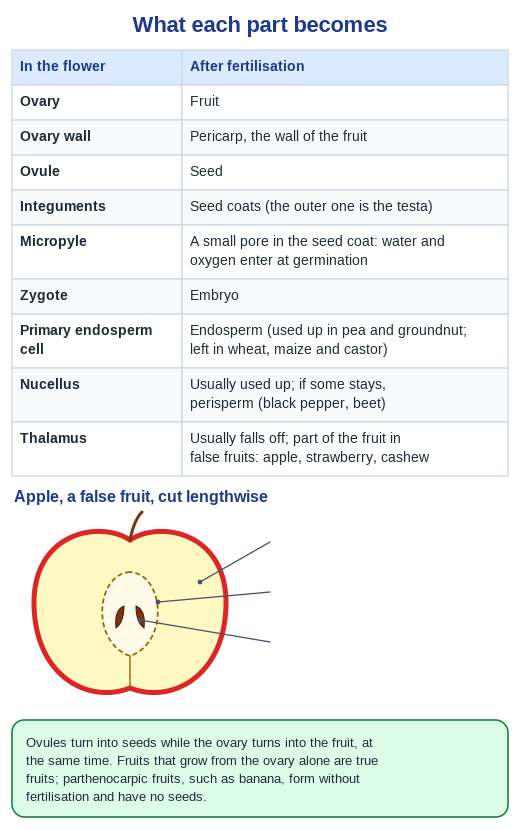
The seed is the end result of sexual reproduction, often described as a fertilised ovule. It has seed coats, one or two cotyledons and an embryonal axis. Seeds without leftover endosperm are non-albuminous (pea, groundnut); seeds that keep some are albuminous (wheat, maize, barley, castor). In black pepper and beet, part of the nucellus also remains, as perisperm. The integuments harden into tough seed coats, and the micropyle stays as a pore that lets in oxygen and water at germination. As it matures, the seed dries to 10–15% moisture by mass and may enter dormancy until moisture, oxygen and a suitable temperature let it germinate.
How does the ovary become a fruit?
At the same time, the ovary becomes the fruit, and its wall becomes the pericarp. In apple, strawberry and cashew the thalamus also forms part of the fruit, so these are false fruits; most fruits come from the ovary alone and are true fruits. A few fruits, such as banana, develop without fertilisation: they are parthenocarpic and seedless, and growth hormones can induce this.
What are apomixis and polyembryony?
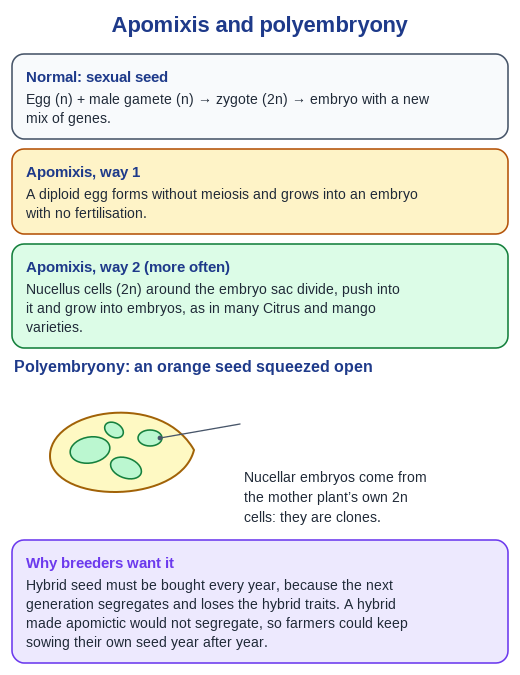
Some species of Asteraceae and grasses make seeds without fertilisation. This is apomixis, a kind of asexual reproduction that mimics sexual reproduction. Sometimes a diploid egg forms without meiosis and grows into an embryo. Usually, as in many varieties of Citrus and mango, nucellus cells around the embryo sac divide, push into it and grow into embryos. One seed then holds several embryos: polyembryony. Such embryos are clones of the mother plant.
Hybrid seed must be bought every year, because plants raised from it segregate and lose the hybrid traits. A hybrid made apomictic would not segregate, so farmers could save its seed. That is why laboratories are studying the genes for apomixis.
Previous topic: pollination. See also the chapter notes and the NCERT solutions.
Practice
-
Triple fusion is the fusion of a male gamete with:
Show answer
Answer: (c) two polar nuclei
-
Which seed is albuminous?
Show answer
Answer: (c) castor
-
In a grass embryo, the sheath around the radicle and root cap is the:
Show answer
Answer: (b) coleorrhiza
-
Why does the zygote usually divide only after some endosperm has formed?
Show answer
Answer: The endosperm stores food. Forming it first is an adaptation that assures nutrition to the developing embryo.
-
Are the embryos from nucellus cells in a mango seed clones? Why?
Show answer
Answer: Yes. They form from the mother plant's own diploid nucellus cells without fertilisation, so they are genetically identical to the mother plant.
Questions students ask
Why is it called double fertilisation?
Because two fusions happen in the same embryo sac: syngamy, the fusion of a male gamete with the egg, and triple fusion, the fusion of the other male gamete with the two polar nuclei. It is unique to flowering plants.
What is the ploidy of the zygote and the endosperm?
The zygote is diploid (2n), from one male gamete and the egg. The primary endosperm nucleus, and so the endosperm, is triploid (3n), from one male gamete and two polar nuclei.
What is the difference between albuminous and non-albuminous seeds?
Albuminous seeds keep part of the endosperm because the embryo does not use all of it, as in wheat, maize, barley and castor. Non-albuminous seeds have none left because the embryo has used it up, as in pea and groundnut.
What is apomixis?
Apomixis is the formation of seeds without fertilisation, found in some species of Asteraceae and grasses. It is a kind of asexual reproduction that mimics sexual reproduction, and the embryos are genetically identical to the parent.
Stuck on a question?
Take a photo and Lagnever AI explains it step by step. Try it for 7 days for ₹2.
Get it on Google Play Open in browser
For parents: after the trial, the plan renews monthly by UPI or card autopay. You can cancel anytime in the app.