
Why and how do we conserve biodiversity?
Answer in short
We conserve biodiversity for narrowly utilitarian reasons (products such as food and medicines), broadly utilitarian reasons (services such as oxygen and pollination) and ethical reasons (intrinsic value). In situ conservation protects whole ecosystems: hotspots, reserves, parks, sanctuaries and sacred groves. Ex situ conservation keeps threatened species in zoos, gardens, seed banks and cryopreserved form.
Stuck on a question? Take a photo and Lagnever AI explains it step by step. Try it for 7 days for ₹2. Get it on Google Play
This page covers section 13.2 of the chapter. Back to the Chapter 13 notes.
Why should we conserve biodiversity?
The reasons fall into three groups. Some are obvious, some less so, but each matters.
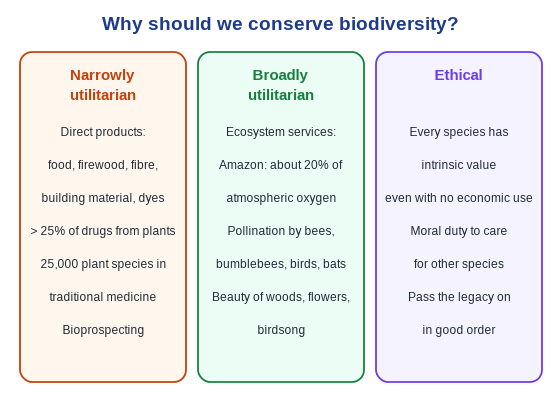
1. Narrowly utilitarian
Nature gives people a long list of direct economic gains:
- food: cereals, pulses, fruits;
- firewood, fibre and construction material;
- industrial products: tannins, lubricants, dyes, resins, perfumes;
- medicines: more than 25 per cent of the drugs sold in the world market come from plants, and 25,000 plant species are used in the traditional medicines of native peoples. Many more medicinal plants may be waiting in tropical rain forests.
Bioprospecting means searching through the variety of genes, molecules and species for things that can be sold or used. Countries rich in biodiversity stand to gain the most from it.
2. Broadly utilitarian
Biodiversity drives many ecosystem services:
- Oxygen: the shrinking Amazon forest is estimated to produce, by photosynthesis, about 20 per cent of the oxygen in Earth’s atmosphere. The book suggests asking what a hospital pays for one oxygen cylinder to sense the value of this service.
- Pollination: plants give us fruits and seeds only when pollinated, and bees, bumblebees, birds and bats do this work. Doing it by hand would cost a great deal.
- Intangible benefits: walking through dense woods, seeing spring flowers, waking to a bulbul’s song. These are hard to put a price on.
- The chapter summary adds pest control, climate moderation and flood control to the list of services.
3. Ethical
We share the planet with millions of plant, animal and microbe species. Every species has intrinsic value, even if it has no economic value to us now or ever. We have a moral duty to look after their well-being and to pass our biological legacy on, in good order, to future generations.
How do we conserve biodiversity?
| In situ (on site) | Ex situ (off site) | |
|---|---|---|
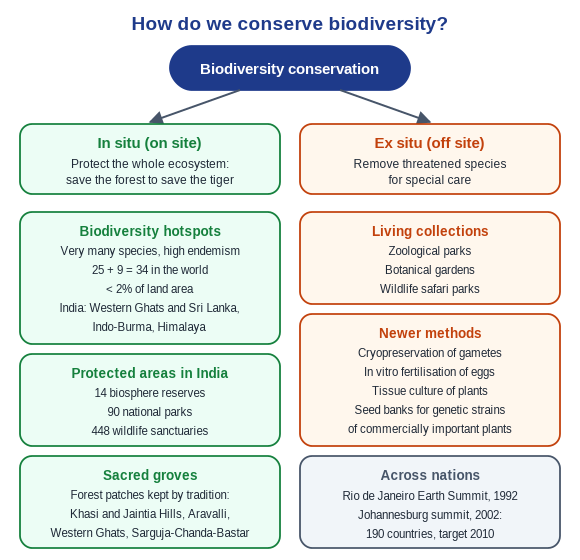
| Idea | Protect the whole ecosystem; all its biodiversity is protected with it | Take threatened species out of their habitat into special settings |
| When used | The normal approach: save the forest to save the tiger | When a species is endangered or threatened and needs urgent help |
| Examples | Hotspots, biosphere reserves, national parks, wildlife sanctuaries, sacred groves | Zoological parks, botanical gardens, wildlife safari parks, cryopreservation, in vitro fertilisation, tissue culture, seed banks |
In situ conservation
Nations face a conflict between development and conservation, and few can afford to protect all their biological wealth. The number of species needing rescue always exceeds the money and effort available. So conservationists set global priorities.
Biodiversity hotspots
- A hotspot is a region with very high species richness and a high degree of endemism (species confined to that region).
- 25 hotspots were identified first; 9 were added later, giving 34 in the world.
- Hotspots are also places where habitat is being lost fast.
- Three cover India’s richest regions: Western Ghats and Sri Lanka, Indo-Burma and Himalaya. (As the book names them; we do not draw maps.)
- All 34 together cover less than 2 per cent of Earth’s land, but they hold an extremely large number of species. Strict protection of them could slow the present wave of extinctions by almost 30 per cent.
Protected areas in India
Ecologically unique, biodiversity-rich regions are protected by law:
| Type | Number in India (book) |
|---|---|
| Biosphere reserves | 14 |
| National parks | 90 |
| Wildlife sanctuaries | 448 (the summary says more than 450) |
Sacred groves
India also has religious and cultural traditions of protecting nature. In many communities, tracts of forest were set aside, and every tree and animal inside was revered and fully protected. Such sacred groves are found in:
- the Khasi and Jaintia Hills of Meghalaya;
- the Aravalli Hills of Rajasthan;
- the Western Ghat regions of Karnataka and Maharashtra;
- the Sarguja, Chanda and Bastar areas of Madhya Pradesh.
In Meghalaya, sacred groves are the final shelter left for many rare and threatened plants.
Ex situ conservation
When a plant or animal is endangered or threatened, that is, likely to vanish from the wild soon, it may be taken out of its habitat and kept where it can be protected and specially cared for.
- Living collections: zoological parks, botanical gardens and wildlife safari parks. Many animals that are extinct in the wild still survive in zoos.
- Cryopreservation: gametes of threatened species can be stored for long periods in a viable and fertile state.
- In vitro fertilisation: eggs can be fertilised outside the body.
- Tissue culture: plants can be propagated from small pieces of tissue.
- Seed banks: seeds of many genetic strains of crop and other commercially valuable plants are kept for years.
Conservation across borders
Biodiversity ignores political boundaries, so its conservation is the shared job of all nations.
- 1992, Rio de Janeiro: the Convention on Biological Diversity, known as ‘The Earth Summit’, called on all nations to conserve biodiversity and to use its benefits sustainably.
- 2002, Johannesburg (South Africa): at the World Summit on Sustainable Development, 190 countries pledged to achieve, by 2010, a clear slowdown in biodiversity loss, worldwide as well as in each region and locality.
Summing up the chapter
Patterns tell us where biodiversity is richest; the Evil Quartet tells us why it is shrinking (see patterns and loss of biodiversity); and the three arguments and two approaches on this page tell us why and how to save it. Practise with the NCERT solutions for Chapter 13.
Practice
-
The argument that every species has intrinsic value, whether or not it is useful to us, is the:
Show answer
Answer: (c) ethical argument
-
How many biodiversity hotspots were first identified, before more were added?
Show answer
Answer: (b) 25
-
Which of these is an in situ method?
Show answer
Answer: (c) Sacred grove
-
Name the three biodiversity hotspots that cover India's richest regions.
Show answer
Answer: Western Ghats and Sri Lanka, Indo-Burma, and Himalaya.
-
Why is ex situ conservation needed when in situ conservation protects whole ecosystems?
Show answer
Answer: Some species are endangered or threatened, likely to die out in the wild soon unless they are helped. They need urgent care that their habitat cannot give, so they are kept and bred in zoos or botanical gardens, and their gametes or seeds are stored by cryopreservation and in seed banks.
Questions students ask
What is a biodiversity hotspot?
A region with very high species richness and a high degree of endemism (species found nowhere else), chosen for maximum protection. There are 34 in the world, together covering less than 2 per cent of the land.
What are sacred groves?
Patches of forest set aside by religious and cultural tradition, in which all trees and wildlife are revered and fully protected. In Meghalaya they are the final shelter of many rare and threatened plants.
What was the Earth Summit?
The Convention on Biological Diversity held in Rio de Janeiro in 1992. It asked all nations to conserve biodiversity and use its benefits sustainably. In 2002, at Johannesburg, 190 countries pledged to reduce the rate of biodiversity loss significantly by 2010.
Stuck on a question?
Take a photo and Lagnever AI explains it step by step. Try it for 7 days for ₹2.
Get it on Google Play Open in browser
For parents: after the trial, the plan renews monthly by UPI or card autopay. You can cancel anytime in the app.