
What are the patterns of biodiversity, and why is it being lost?
Answer in short
Species diversity generally falls from the equator to the poles and rises with area up to a limit (log S = log C + Z log A). Species are now lost 100 to 1,000 times faster than before humans, mainly through the Evil Quartet: habitat loss and fragmentation, over-exploitation, alien species invasions and co-extinctions.
Stuck on a question? Take a photo and Lagnever AI explains it step by step. Try it for 7 days for ₹2. Get it on Google Play
This page covers sections 13.1.2 to 13.1.4 of the chapter. Back to the Chapter 13 notes.
Latitudinal gradient
Species are not spread evenly over the globe. The clearest pattern is the latitudinal gradient: going from the equator towards the poles, species diversity generally falls. Barring a handful of exceptions, the tropics, between 23.5° N and 23.5° S, hold more species than temperate or polar lands.
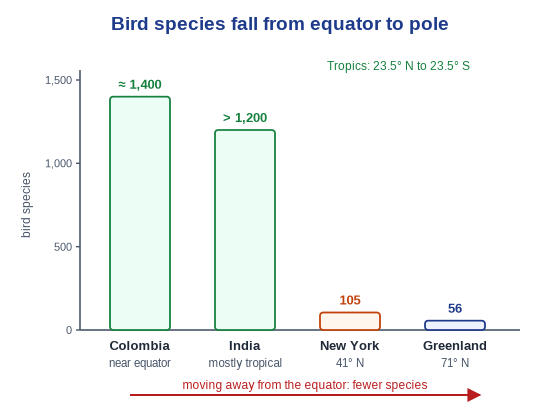
| Place | Latitude (book) | Bird species (book) |
|---|---|---|
| Colombia | near the equator | nearly 1,400 |
| India | mostly tropical | more than 1,200 |
| New York | 41° N | 105 |
| Greenland | 71° N | 56 |
A tropical forest in Ecuador can also hold up to 10 times the vascular plant species of an equal temperate forest in the US Midwest, and the Amazonian rain forest is the richest place on Earth (numbers on the chapter page).
Why are the tropics richer?
| Hypothesis | The idea |
|---|---|
| 1. Evolutionary time | Speciation needs time. Temperate lands were hit by frequent glaciations; the tropics stayed largely undisturbed for millions of years and had longer to diversify. |
| 2. Stable environment | Tropical climates are less seasonal, more constant and predictable. Such conditions favour niche specialisation, so more species can fit in. |
| 3. Solar energy | The tropics receive more solar energy, so productivity is higher, which may indirectly support more species. |
Species-area relationship
Alexander von Humboldt, the German naturalist and geographer, explored South American jungles and saw that, within a region, the more area he explored, the more species he found, but only up to a limit. For many groups (angiosperms, birds, bats, freshwater fishes) the graph of species richness against area is a rectangular hyperbola. Plotted on log-log axes it turns into a straight line:
log S = log C + Z log A
| Symbol | Meaning |
|---|---|
| S | species richness |
| A | area |
| Z | slope of the line (regression coefficient) |
| C | Y-intercept |
Taking antilogs gives the same law in power form, S = C·A^Z.
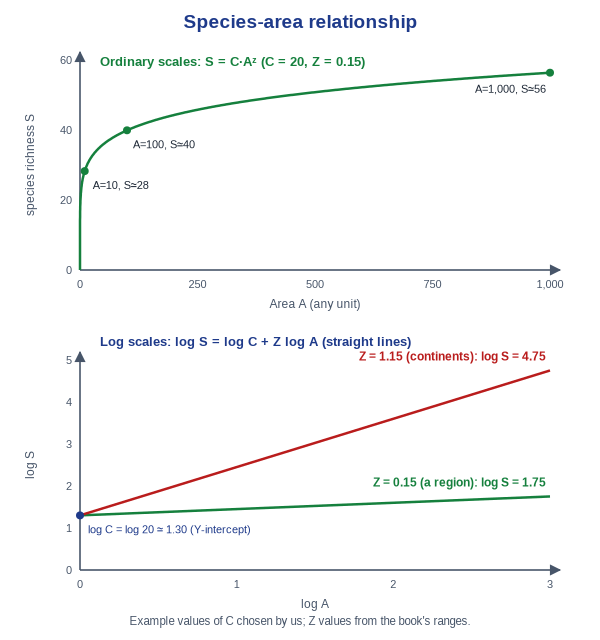
The value of Z:
- Within a region: Z = 0.1 to 0.2, almost whatever the group or place: the slopes for plants in Britain, birds in California and molluscs in New York state are remarkably close.
- Across very large areas such as continents: the line is much steeper, Z = 0.6 to 1.2. For frugivorous (fruit-eating) birds and mammals in tropical forests of different continents, Z = 1.15.
Worked example (our numbers, checked by script). Take C = 20.
| Area A | S with Z = 0.15 | S with Z = 1.15 |
|---|---|---|
| 10 | 20 × 10^0.15 ≈ 28 | 20 × 10^1.15 ≈ 283 |
| 100 | ≈ 40 | ≈ 3,991 |
| 1,000 | ≈ 56 | ≈ 56,368 |
- Doubling the area multiplies S by 2^Z: about 1.11 for Z = 0.15 and 2.22 for Z = 1.15.
So a steeper slope means species richness is far more sensitive to area.
Does species diversity matter to an ecosystem?
There is no settled answer yet. For decades ecologists held that species-rich communities tend to be more stable: steadier in productivity from year to year, resistant or resilient to occasional disturbances, and able to resist invasion by alien species.
David Tilman’s long-term experiments with outdoor plots gave some early answers: plots with more species had total biomass that swung less from one year to the next, and higher diversity led to higher productivity.
Paul Ehrlich’s rivet popper hypothesis gives the idea a picture:
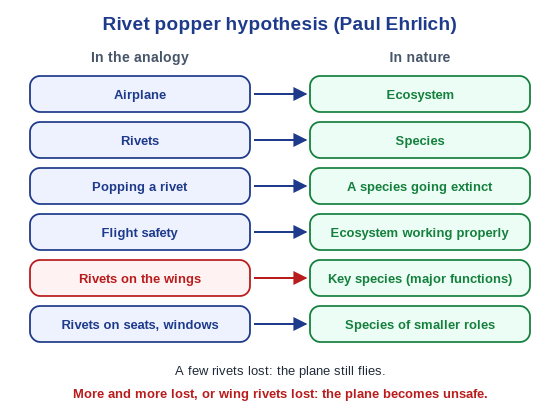
- The airplane is the ecosystem; its thousands of rivets are species.
- Each passenger who pops out a rivet to take home causes one extinction. At first the plane flies safely, but as more rivets go it becomes dangerously weak.
- Which rivet goes matters too: losing rivets on the wings (key species on which the main ecosystem functions depend) is far worse than losing a few on the seats or windows.
Loss of biodiversity
Speciation is adding few, if any, new species, but species keep disappearing, and human activities are clearly responsible.
The record:
- IUCN Red List (2004): 784 species extinct in the last 500 years: 338 vertebrates, 359 invertebrates and 87 plants.
- Recent extinctions: dodo (Mauritius), quagga (Africa), thylacine (Australia), Steller’s sea cow (Russia) and three subspecies of tiger (Bali, Javan, Caspian). 27 species vanished in the last twenty years.
- Extinctions are not random across groups: amphibians appear especially vulnerable.
- More than 15,500 species face extinction now: 12 per cent of all bird species, 23 per cent of mammals, 32 per cent of amphibians and 31 per cent of gymnosperms.
The ‘Sixth Extinction’: the fossil record shows five mass extinctions during more than 3 billion years of life, all before humans. The present one is different in its rate: 100 to 1,000 times faster than in pre-human times, and driven by our activities. If present trends continue, nearly half of all species may vanish within the next 100 years.
The Evil Quartet
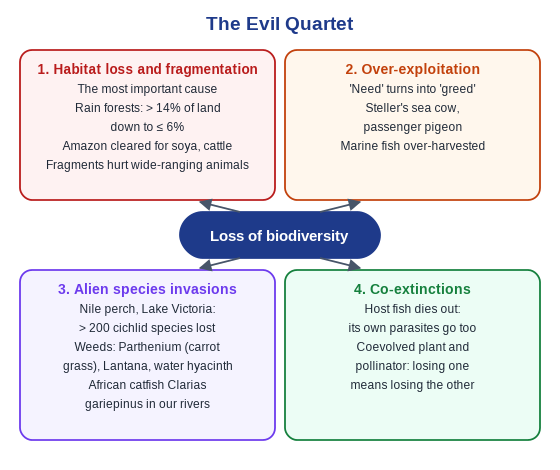
| Cause | What happens | Book examples |
|---|---|---|
| Habitat loss and fragmentation (most important) | Habitats are destroyed, polluted or cut into small pieces; animals needing large territories and migratory animals decline | Tropical rain forests down from more than 14 per cent of land to no more than 6 per cent; Amazon cleared for soya beans and cattle grassland |
| Over-exploitation | Need turns into greed and natural populations are harvested faster than they recover | Steller’s sea cow, passenger pigeon; over-harvested marine fish |
| Alien species invasions | Some introduced species spread out of control and push native species into decline or extinction | Nile perch in Lake Victoria (more than 200 cichlid species lost); Parthenium, Lantana, water hyacinth; African catfish Clarias gariepinus |
| Co-extinctions | Species tied to another in an obligatory way die out along with it | Parasites of a host fish; a coevolved plant and its pollinator |
Linking forward
Next: biodiversity conservation. Practise with the NCERT solutions for Chapter 13.
Practice
-
If Z = 0.2 for a group of species in a region, doubling the area multiplies the number of species by about:
Show answer
Answer: (b) 1.15
-
Which of these is not one of the three hypotheses for high species richness in the tropics?
Show answer
Answer: (d) Frequent glaciations
-
The extinction of a parasite along with its host fish is an example of:
Show answer
Answer: (b) co-extinction
-
On log scales, the species-area line for a region has log C = 1 and Z = 0.15. What is log S when log A = 2?
Show answer
Answer: log S = log C + Z log A = 1 + 0.15 × 2 = 1.30, so S = 10^1.30 ≈ 20 species (our example).
-
Why are mammals and birds with large territories hit hardest by habitat fragmentation?
Show answer
Answer: When a large habitat is broken into small patches, each patch may be too small to hold the territory such an animal needs, and migratory animals lose the routes and stopovers they rely on, so their populations decline.
Questions students ask
What does a steeper slope (larger Z) mean in the species-area relationship?
It means the number of species changes much faster with area. Across whole continents Z is 0.6 to 1.2, so a given loss of area takes away a far larger share of species than within one region, where Z is only 0.1 to 0.2.
What is the rivet popper hypothesis?
An analogy by Paul Ehrlich. An ecosystem is like an airplane held together by rivets (species). Removing a few rivets may not cause trouble at once, but removing more and more, or removing the rivets on the wings (key species), makes the plane unsafe.
What are the four causes of biodiversity loss?
The Evil Quartet: habitat loss and fragmentation, over-exploitation, alien species invasions and co-extinctions. Habitat loss and fragmentation is the most important.
Stuck on a question?
Take a photo and Lagnever AI explains it step by step. Try it for 7 days for ₹2.
Get it on Google Play Open in browser
For parents: after the trial, the plan renews monthly by UPI or card autopay. You can cancel anytime in the app.