
NCERT Solutions Class 12 Biology Chapter 3: Reproductive Health
Answers to all 12 end-of-chapter exercises of Chapter 3, Reproductive Health, of Biology, the Class 12 NCERT textbook. Page numbers follow the 2026-27 reprint (pages 41–50). The exercises are quoted from the book; the answers are our own, built from the chapter. This chapter has no separate in-text question boxes, so the few questions its text raises are answered in short at the end. The book prints no answer key for this chapter. Short notes: Chapter 3 notes.
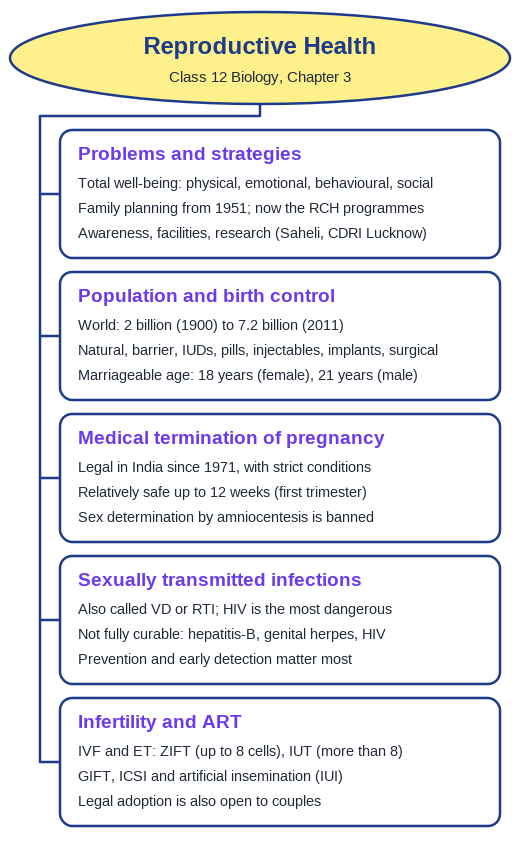
Exercises 1 to 4: reproductive health in society
1. “What do you think is the significance of reproductive health in a society?”
Reproductive health means total well-being in the physical, emotional, behavioural and social aspects of reproduction. It matters to a society because:
- people with correct information can avoid STIs, unwanted pregnancies and unsafe abortions;
- care during pregnancy, delivery and after birth lowers the maternal mortality rate (MMR) and the infant mortality rate (IMR);
- couples can plan small, healthy families, which helps to check population growth;
- awareness reduces social evils such as sex abuse, sex-related crimes and female foeticide.
A reproductively healthy society has people with normal reproductive organs and normal emotional and behavioural interactions in all sex-related aspects.
2. “Suggest the aspects of reproductive health which need to be given special attention in the present scenario.”
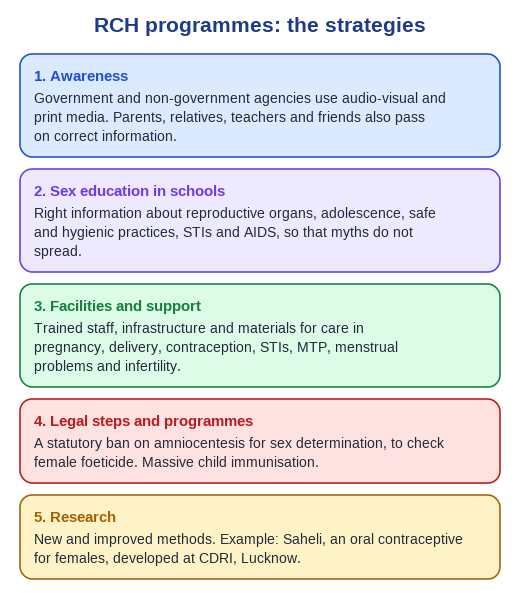
- Awareness and sex education: correct information on reproductive organs, adolescence and its changes, and safe and hygienic sexual practices.
- Prevention and early cure of STIs, including HIV infection, especially in the 15–24 age group.
- Birth control: educating fertile couples and people of marriageable age about the available options.
- Mother and child care: care of pregnant mothers, medically assisted delivery, post-natal care, breastfeeding and immunisation.
- Safe and legal MTP, and preventing female foeticide through the ban on sex determination.
- Help for infertile couples, and equal opportunities for the male and the female child.
- Stopping sex abuse and sex-related crimes.
3. “Is sex education necessary in schools? Why?”
Yes. The chapter says it should be encouraged, because it:
- gives young people the right information, so that they do not believe myths or hold misconceptions about sex-related matters;
- explains the reproductive organs, adolescence and the changes that come with it;
- teaches safe and hygienic sexual practices, and how STIs and AIDS spread and are prevented;
- helps adolescents to lead a reproductively healthy life and to grow into responsible adults.
4. “Do you think that reproductive health in our country has improved in the past 50 years? If yes, mention some such areas of improvement.”
Yes. The chapter lists these signs of improvement:
- better awareness about sex-related matters;
- more medically assisted deliveries and better post-natal care, which have lowered maternal and infant mortality rates;
- more couples with small families;
- better detection and cure of STIs;
- more medical facilities for all sex-related problems, including help for infertile couples.
Massive child immunisation and the legal ban on sex determination belong to the same effort.
Exercises 5 to 8: population, contraception and amniocentesis
5. “What are the suggested reasons for population explosion?”
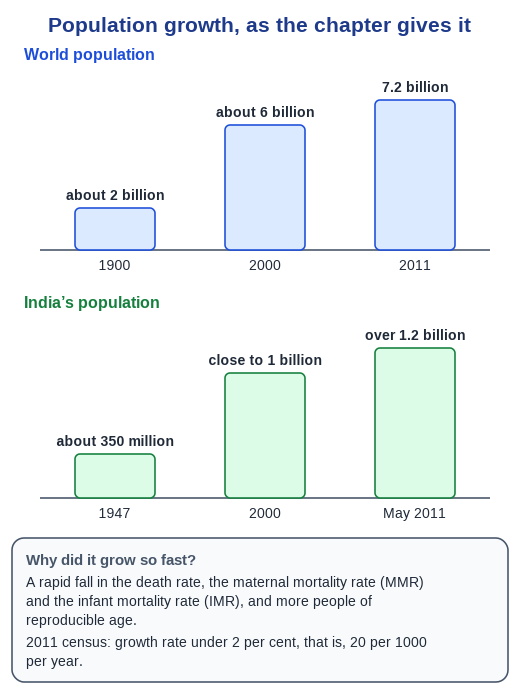
The chapter suggests these probable reasons:
- a rapid decline in the death rate;
- a rapid decline in the maternal mortality rate (MMR);
- a rapid decline in the infant mortality rate (IMR);
- an increase in the number of people of reproducible age.
Behind these lie better health facilities and better living conditions. The result: the world population rose from about 2 billion in 1900 to 7.2 billion in 2011, and India’s from about 350 million at independence to over 1.2 billion in May 2011.
6. “Is the use of contraceptives justified? Give reasons.”
Yes, the use of contraceptives is justified.
- The population is growing fast. By the 2011 census the growth rate was just under 2 per cent (about 20 per 1000 per year). At that rate the numbers keep climbing quickly. This could lead to a scarcity of even food, shelter and clothing. Smaller families, made possible by contraceptives, are the most important step against this.
- Contraceptives prevent unwanted pregnancies, and so reduce the need for MTP.
- They let couples delay the first pregnancy or space their children.
- Condoms also protect the user from STIs and AIDS.
Two cautions from the chapter: contraceptives are not a regular requirement of reproductive health, since they act against a natural event; and they can have ill-effects (nausea, abdominal pain, breakthrough bleeding, irregular menstrual bleeding or even breast cancer), so a method should be chosen with a qualified medical professional.
7. “Removal of gonads cannot be considered as a contraceptive option. Why?”
A contraceptive should prevent conception and, ideally, be reversible with no or least side effects. Removing the gonads fails on both counts:
- The testes and ovaries make not only gametes but also the sex hormones (Chapter 2). Removing them would stop these hormones, which the body needs for its secondary sexual characters and normal reproductive functions.
- It makes the person permanently infertile; it can never be reversed.
Contraceptive methods only stop the gametes from meeting or the embryo from implanting. Even the surgical methods, vasectomy and tubectomy, leave the gonads in place and only block gamete transport. (The reasoning about hormones draws on Chapter 2; the chapter itself does not discuss removal of gonads.)
8. “Amniocentesis for sex determination is banned in our country. Is this ban necessary? Comment.”
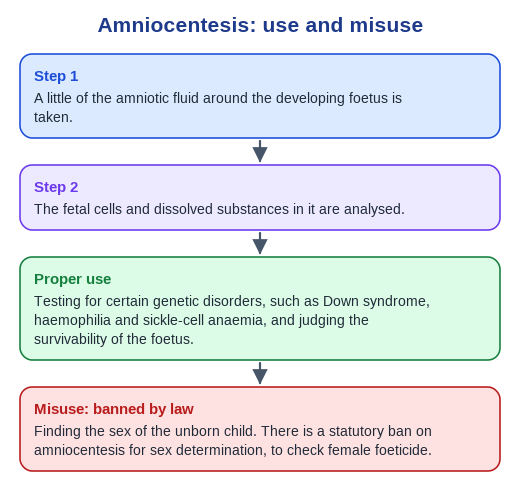
Yes, the ban is necessary. In amniocentesis, some amniotic fluid of the developing foetus is taken to analyse the fetal cells and dissolved substances. Its proper use is to test for certain genetic disorders, such as Down syndrome, haemophilia and sickle-cell anaemia, and to judge the survivability of the foetus.
The technique was being misused to find the sex of the unborn child, and a female foetus was then often aborted. The statutory ban on amniocentesis for sex determination is meant to check this female foeticide, which is reported to be high in India. Such abortions are illegal and are also dangerous for the mother.
Exercises 9 and 10: infertility and STDs
9. “Suggest some methods to assist infertile couples to have children.”
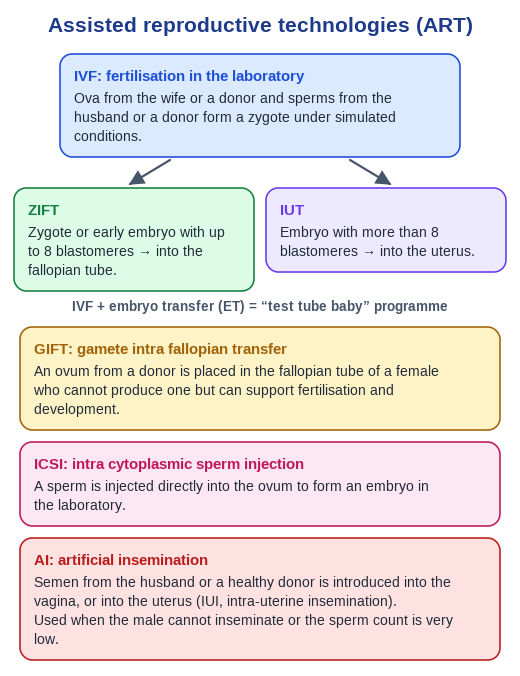
Infertility clinics can diagnose and correct some disorders. Where that is not possible, these assisted reproductive technologies (ART) are used:
| Method | What is done |
|---|---|
| IVF and ET (test tube baby programme) | Ova and sperms are fertilised in the laboratory; the zygote or embryo is then transferred into the female |
| ZIFT | Zygote or early embryo (up to 8 blastomeres) transferred into the fallopian tube |
| IUT | Embryo with more than 8 blastomeres transferred into the uterus |
| GIFT | Ovum from a donor transferred into the fallopian tube of a female who cannot produce one |
| ICSI | A sperm is injected directly into the ovum in the laboratory |
| AI, including IUI | Semen from the husband or a healthy donor is introduced into the vagina or the uterus |
Legal adoption is one more way for such couples to become parents.
10. “What are the measures one has to take to prevent from contracting STDs?”
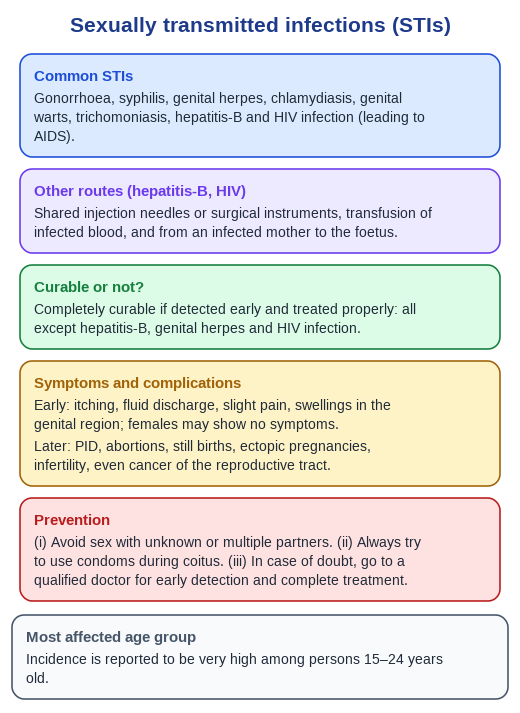
The chapter gives three simple principles:
- Avoid sex with unknown partners or multiple partners.
- Always try to use condoms during coitus.
- In case of doubt, go to a qualified doctor for early detection, and get complete treatment if an infection is diagnosed.
Since hepatitis-B and HIV also spread through blood, shared injection needles and surgical instruments must be avoided as well.
Exercises 11 and 12: true or false, and corrections
11. “State True/False with explanation”
- (a) “Abortions could happen spontaneously too. (True/False)” True. An abortion that is induced on purpose is MTP. A pregnancy can also end by itself, without any intervention. (Extra: such a spontaneous abortion is commonly called a miscarriage.)
- (b) “Infertility is defined as the inability to produce a viable offspring and is always due to abnormalities/defects in the female partner. (True/False)” False. Infertility is the inability to conceive or produce children even after 2 years of unprotected sexual cohabitation, and the cause can lie in either partner. The reasons can be physical, congenital, diseases, drugs, immunological or even psychological. The chapter says that, more often than not, the problem lies in the male partner.
- (c) “Complete lactation could help as a natural method of contraception. (True/False)” True. During intense lactation after childbirth, ovulation and the cycle do not occur (lactational amenorrhea). The method works only up to a maximum of six months after parturition.
- (d) “Creating awareness about sex related aspects is an effective method to improve reproductive health of the people. (True/False)” True. Correct information removes myths and helps people to prevent STIs, unwanted pregnancies and sex-related crimes. Creating awareness is a major task of the RCH programmes.
12. “Correct the following statements :”
- (a) “Surgical methods of contraception prevent gamete formation.” Corrected: Surgical methods of contraception block gamete transport and so prevent conception; gamete formation continues.
- (b) “All sexually transmitted diseases are completely curable.” Corrected: Except hepatitis-B, genital herpes and HIV infection, sexually transmitted diseases are completely curable if detected early and treated properly.
- (c) “Oral pills are very popular contraceptives among the rural women.” Corrected: Oral pills are very popular contraceptives among urban women. (The chapter itself says only that pills are well accepted by females and that IUDs are among the most widely accepted methods in India; “urban” is the correction usually expected here.)
- (d) “In E. T. techniques, embryos are always transferred into the uterus.” Corrected: In E.T. techniques, embryos with up to 8 blastomeres are transferred into the fallopian tube (ZIFT), and embryos with more than 8 blastomeres into the uterus (IUT).
Questions the chapter’s text raises
Page 41: why is it significant to maintain reproductive health? Because a society is healthy only when its people are well in all aspects of reproduction. Good reproductive health means fewer STIs, safer pregnancies and births, planned families and fewer sex-related social evils. See Exercise 1.
Pages 42–43: where was Saheli developed? At the Central Drug Research Institute (CDRI), Lucknow. Saheli is a non-steroidal oral contraceptive for females, taken once a week.
Page 46: why MTP? To end unwanted pregnancies that follow casual unprotected intercourse, failure of a contraceptive, or rape, and in cases where continuing the pregnancy could be harmful or even fatal to the mother, the foetus or both.
Practice
-
Which of these is NOT a natural method of contraception?
Show answer
Answer: (d) cervical cap
-
The statutory marriageable age in India, as the chapter gives it, is:
Show answer
Answer: (b) 18 years for females, 21 for males
-
In GIFT, what is transferred into the fallopian tube?
Show answer
Answer: (c) an ovum from a donor
-
Expand RCH, MMR, IMR and PID.
Show answer
Answer: RCH: Reproductive and Child Health Care (programmes). MMR: maternal mortality rate. IMR: infant mortality rate. PID: pelvic inflammatory diseases.
-
Give one example each of a non-medicated, a copper-releasing and a hormone-releasing IUD.
Show answer
Answer: Non-medicated: Lippes loop. Copper-releasing: CuT (also Cu7, Multiload 375). Hormone-releasing: Progestasert (also LNG-20).
Stuck on a question?
Take a photo and Lagnever AI explains it step by step. Try it for 7 days for ₹2.
Get it on Google Play Open in browser
For parents: after the trial, the plan renews monthly by UPI or card autopay. You can cancel anytime in the app.