
Class 12 Biology Chapter 3 NCERT Solutions Hinglish mein: Reproductive Health
Class 12 ki NCERT textbook Biology ke Chapter 3, Reproductive Health, ki saari 12 end-of-chapter exercises ke jawab. Page numbers 2026-27 reprint ke hisaab se hain (pages 41–50). Sawal Hinglish mein hain; jawab hamare apne hain, chapter ke aadhaar par. Is chapter mein alag se in-text question boxes nahi hain, isliye text mein uthaye gaye kuch sawalon ke chhote jawab aakhir mein hain. Book is chapter ke liye answer key nahi deti. Chhote notes: Chapter 3 ke notes.
Exercises 1 se 4: society mein reproductive health
1. Aapke hisaab se society mein reproductive health ka kya mahatva hai?
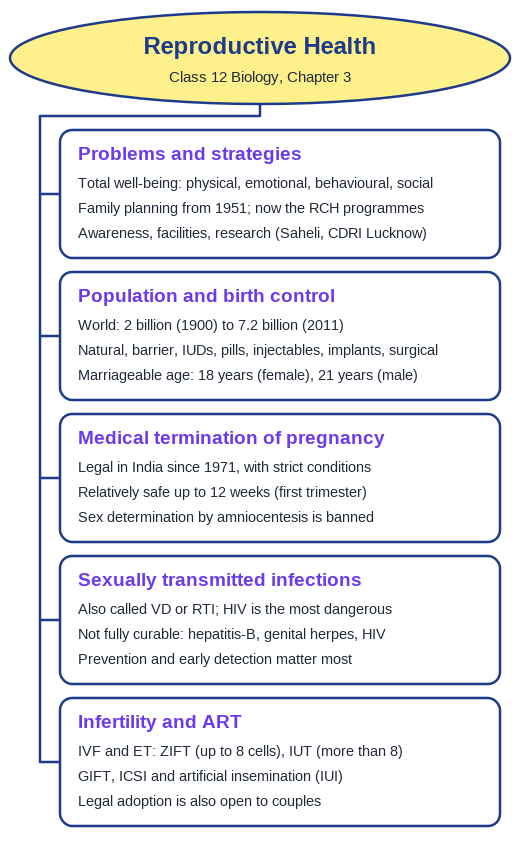
Reproductive health ka matlab hai reproduction ke physical, emotional, behavioural aur social pehluon mein poori well-being. Society ke liye ye isliye zaroori hai:
- sahi jaankari wale log STIs, unwanted pregnancies aur unsafe abortions se bach sakte hain;
- pregnancy, delivery aur janm ke baad ki care se maternal mortality rate (MMR) aur infant mortality rate (IMR) ghatte hain;
- couples chhote, swasth parivaar plan kar sakte hain, jisse population growth rukti hai;
- awareness se sex abuse, sex-related crimes aur female foeticide jaisi social evils kam hoti hain.
Reproductively healthy society mein logon ke reproductive organs normal hote hain aur sex-related sabhi pehluon mein unke emotional aur behavioural interactions bhi normal hote hain.
2. Reproductive health ke wo pehlu sujhao jin par aaj ke haalaat mein khaas dhyaan dene ki zaroorat hai.
- Awareness aur sex education: reproductive organs, adolescence aur uske badlaav, aur safe aur hygienic sexual practices ki sahi jaankari.
- STIs se bachaav aur jaldi ilaaj, HIV infection samet, khaaskar 15–24 saal ke age group mein.
- Birth control: fertile couples aur marriageable age ke logon ko available options ke baare mein batana.
- Maa aur bachche ki care: pregnant mothers ki care, medically assisted delivery, post-natal care, breastfeeding aur immunisation.
- Safe aur legal MTP, aur sex determination par ban se female foeticide ko rokna.
- Infertile couples ki madad, aur male aur female child ke liye baraabar mauke.
- Sex abuse aur sex-related crimes ko rokna.
3. Kya schools mein sex education zaroori hai? Kyun?
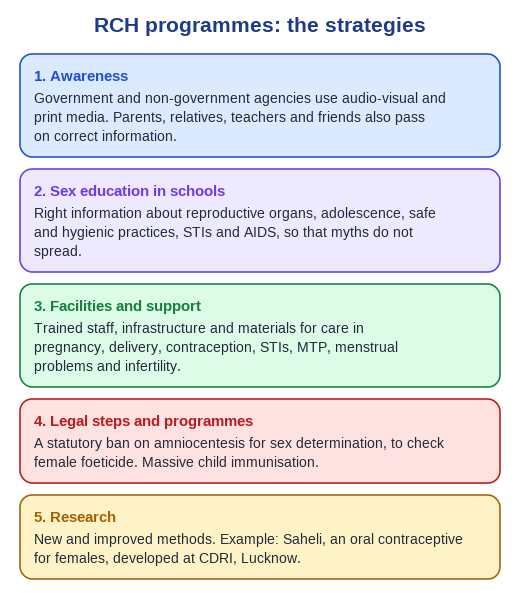
Haan. Chapter kehta hai ki ise badhava milna chahiye, kyunki ye:
- young logon ko sahi jaankari deti hai, taaki wo sex-related baaton ke myths ya misconceptions par bharosa na karein;
- reproductive organs, adolescence aur uske saath aane wale badlaav samjhati hai;
- safe aur hygienic sexual practices sikhati hai, aur ye bhi ki STIs aur AIDS kaise phailte hain aur kaise roke jaate hain;
- adolescents ko reproductively healthy zindagi jeene aur zimmedaar adults banne mein madad karti hai.
4. Kya aapko lagta hai ki pichhle 50 saalon mein hamare desh mein reproductive health sudhri hai? Agar haan, to sudhaar ke kuch aise areas batao.
Haan. Chapter sudhaar ke ye sanket ginata hai:
- sex-related baaton ke baare mein behtar awareness;
- zyada medically assisted deliveries aur behtar post-natal care, jisse maternal aur infant mortality rates ghate hain;
- chhote parivaar wale zyada couples;
- STIs ki behtar pehchaan aur ilaaj;
- sabhi sex-related problems ke liye zyada medical facilities, infertile couples ki madad samet.
Massive child immunisation aur sex determination par legal ban bhi isi koshish ka hissa hain.
Exercises 5 se 8: population, contraception aur amniocentesis
5. Population explosion ke suggested reasons kya hain?
Chapter ye probable reasons deta hai:
- death rate mein tez giraavat;
- maternal mortality rate (MMR) mein tez giraavat;
- infant mortality rate (IMR) mein tez giraavat;
- reproducible age ke logon ki sankhya mein badhotri.
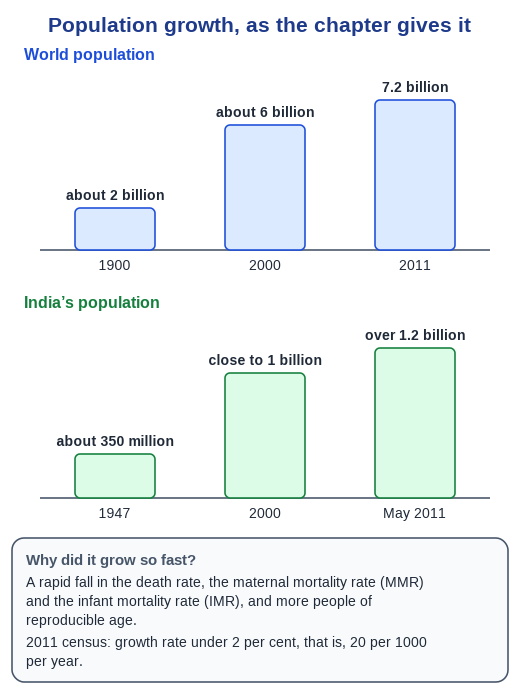
Inke peechhe behtar health facilities aur behtar living conditions hain. Nateeja: world population 1900 ke lagbhag 2 billion se 2011 mein 7.2 billion ho gayi, aur India ki independence ke samay ke lagbhag 350 million se May 2011 mein 1.2 billion se zyada.
6. Kya contraceptives ka use justified hai? Reasons do.
Haan, contraceptives ka use justified hai.
- Population tezi se badh rahi hai. 2011 census ke hisaab se growth rate 2 per cent se thoda kam tha (lagbhag 1000 par 20 har saal), aur is rate par population tezi se badh sakti hai. Isse khana, ghar aur kapde tak ki kami ho sakti hai. Contraceptives se mumkin hone wale chhote parivaar iske khilaaf sabse zaroori kadam hain.
- Contraceptives unwanted pregnancies ko rokte hain, aur is tarah MTP ki zaroorat ghatate hain.
- Inse couples pehli pregnancy ko delay kar sakte hain ya bachchon mein antar rakh sakte hain.
- Condoms user ko STIs aur AIDS se bhi bachate hain.
Chapter ki do saavdhaaniyan: contraceptives reproductive health ki regular zaroorat nahi hain, kyunki ye ek natural event ke khilaaf kaam karte hain; aur inke ill-effects ho sakte hain (nausea, abdominal pain, breakthrough bleeding, irregular menstrual bleeding ya breast cancer tak), isliye method qualified medical professional ki salaah se chunna chahiye.
7. Gonads ko nikaalna contraceptive option nahi maana ja sakta. Kyun?
Contraceptive ko conception rokna chahiye aur, ideal roop mein, reversible hona chahiye, bina ya kam se kam side effects ke. Gonads nikaalna dono baaton mein fail hota hai:
- Testes aur ovaries sirf gametes nahi, sex hormones bhi banate hain (Chapter 2). Inhe nikaalne se ye hormones band ho jaayenge, jo body ko secondary sexual characters aur normal reproductive functions ke liye chahiye.
- Isse vyakti hamesha ke liye infertile ho jaata hai; ise kabhi reverse nahi kiya ja sakta.
Contraceptive methods sirf gametes ko milne se ya embryo ko implant hone se rokte hain. Surgical methods, vasectomy aur tubectomy, mein bhi gonads apni jagah rehte hain aur sirf gamete transport block hota hai. (Hormones wali reasoning Chapter 2 se li gayi hai; ye chapter khud gonads nikaalne par baat nahi karta.)
8. Hamare desh mein sex determination ke liye amniocentesis banned hai. Kya ye ban zaroori hai? Comment karo.
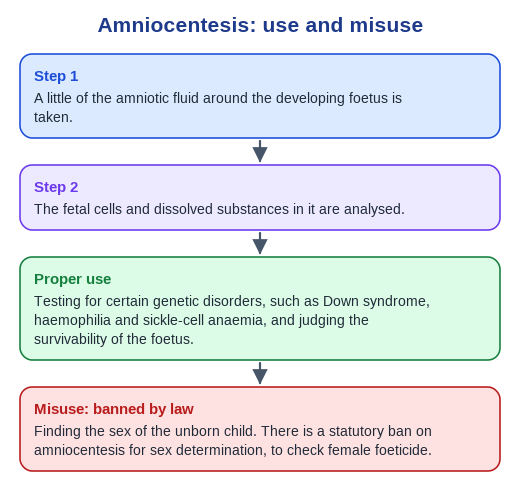
Haan, ye ban zaroori hai. Amniocentesis mein developing foetus ka thoda amniotic fluid lekar fetal cells aur ghule hue substances ki jaanch hoti hai. Iska sahi use kuch genetic disorders, jaise Down syndrome, haemophilia aur sickle-cell anaemia, ki jaanch karna aur foetus ki survivability ka andaaza lagana hai.
Is technique ka misuse unborn child ka sex jaanne ke liye ho raha tha, aur female foetus ko aksar abort kar diya jaata tha. Sex determination ke liye amniocentesis par statutory ban isi female foeticide ko rokne ke liye hai, jo India mein zyada reported hai. Aise abortions illegal hain aur maa ke liye bhi khatarnaak hain.
Exercises 9 aur 10: infertility aur STDs
9. Infertile couples ko bachche paane mein madad karne ke kuch methods sujhao.
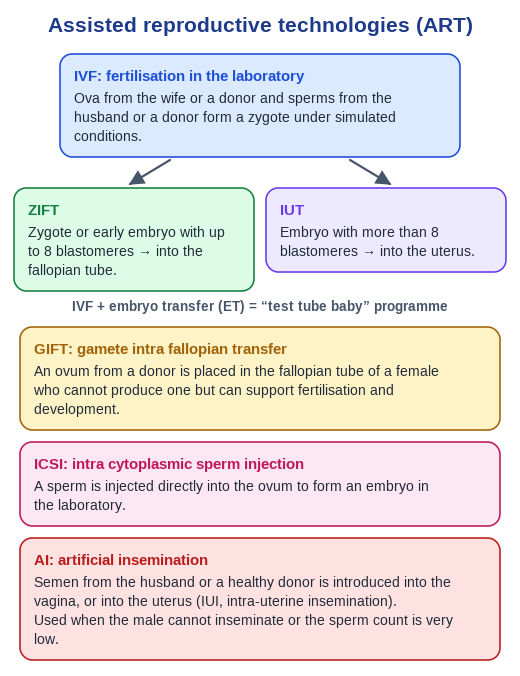
Infertility clinics kuch disorders ko pehchaan kar theek kar sakte hain. Jahan ye mumkin nahi, wahan ye assisted reproductive technologies (ART) use hoti hain:
| Method | Kya kiya jaata hai |
|---|---|
| IVF aur ET (test tube baby programme) | Ova aur sperms ka fertilisation laboratory mein; phir zygote ya embryo female mein transfer |
| ZIFT | Zygote ya early embryo (8 blastomeres tak) fallopian tube mein transfer |
| IUT | 8 se zyada blastomeres wala embryo uterus mein transfer |
| GIFT | Donor ka ovum us female ki fallopian tube mein transfer jo ovum nahi bana sakti |
| ICSI | Laboratory mein sperm ko seedhe ovum mein inject karna |
| AI, IUI samet | Husband ya healthy donor ka semen vagina ya uterus mein pahunchana |
Legal adoption bhi aise couples ke liye parents banne ka ek aur raasta hai.
10. STDs se bachne ke liye kya-kya measures lene chahiye?
Chapter teen simple principles deta hai:
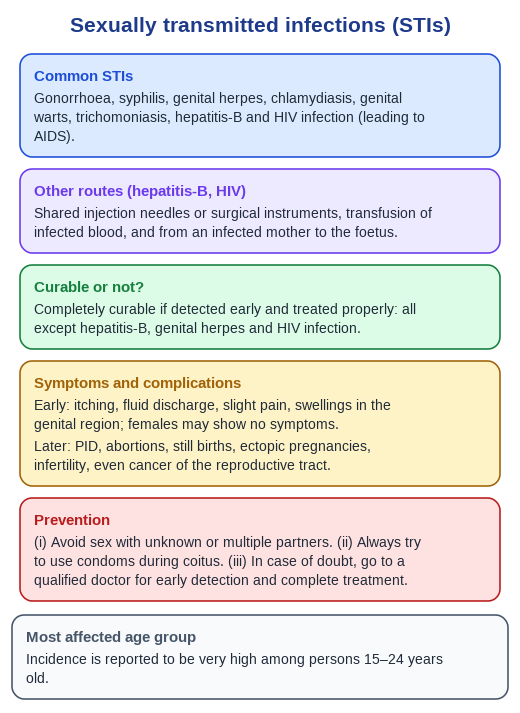
- Unknown partners ya multiple partners ke saath sex se bacho.
- Coitus ke dauraan hamesha condoms use karne ki koshish karo.
- Shak hone par jaldi jaanch ke liye qualified doctor ke paas jao, aur infection nikalne par poora ilaaj karao.
Hepatitis-B aur HIV blood se bhi phailte hain, isliye shared injection needles aur surgical instruments se bhi bachna zaroori hai.
Exercises 11 aur 12: sahi-galat aur sudhaar
11. Explanation ke saath True/False batao:
- (a) Abortions apne aap (spontaneously) bhi ho sakte hain. True. Jaan-boojhkar kiya gaya abortion MTP hai. Pregnancy bina kisi intervention ke apne aap bhi khatm ho sakti hai. (Extra: aise spontaneous abortion ko aam taur par miscarriage kehte hain.)
- (b) Infertility viable offspring paida na kar paane ko kehte hain, aur ye hamesha female partner ki abnormalities/defects ki wajah se hoti hai. False. Infertility yaani 2 saal tak unprotected sexual cohabitation ke baad bhi conceive na kar paana ya bachche paida na kar paana, aur wajah kisi bhi partner mein ho sakti hai. Kaaran physical, congenital, bimaariyan, drugs, immunological ya psychological bhi ho sakte hain. Chapter kehta hai ki zyadatar baar problem male partner mein hoti hai.
- (c) Complete lactation contraception ke natural method ke roop mein madad kar sakta hai. True. Janm ke baad intense lactation ke dauraan ovulation aur cycle nahi hote (lactational amenorrhea). Ye method parturition ke baad zyada se zyada chhah mahine tak hi kaam karta hai.
- (d) Sex-related pehluon ke baare mein awareness badhana logon ki reproductive health sudhaarne ka effective method hai. True. Sahi jaankari myths ko hatati hai aur logon ko STIs, unwanted pregnancies aur sex-related crimes rokne mein madad karti hai. Awareness badhana RCH programmes ka ek bada kaam hai.
12. In statements ko sahi karo:
- (a) Contraception ke surgical methods gamete formation ko rokte hain. Sahi: Contraception ke surgical methods gamete transport ko block karke conception rokte hain; gamete formation chalta rehta hai.
- (b) Saari sexually transmitted diseases poori tarah curable hain. Sahi: Hepatitis-B, genital herpes aur HIV infection ko chhodkar sexually transmitted diseases jaldi pata chalne aur sahi ilaaj se poori tarah curable hain.
- (c) Oral pills rural women mein bahut popular contraceptives hain. Sahi: Oral pills urban women mein bahut popular contraceptives hain. (Chapter khud sirf itna kehta hai ki pills females mein well accepted hain aur IUDs India ke sabse zyada accepted methods mein se hain; yahan aam taur par “urban” wala sudhaar hi expected hai.)
- (d) E.T. techniques mein embryos hamesha uterus mein transfer hote hain. Sahi: E.T. techniques mein 8 blastomeres tak ke embryos fallopian tube mein (ZIFT) aur 8 se zyada blastomeres wale embryos uterus mein (IUT) transfer hote hain.
Chapter ke text mein uthaye gaye sawal
Page 41: reproductive health banaye rakhna kyun zaroori hai? Kyunki society tabhi swasth hai jab uske log reproduction ke har pehlu mein theek hon. Achchhi reproductive health ka matlab hai kam STIs, safe pregnancies aur births, planned families aur kam sex-related social evils. Exercise 1 dekho.
Pages 42–43: Saheli kahan bani? Central Drug Research Institute (CDRI), Lucknow mein. Saheli females ke liye non-steroidal oral contraceptive hai, jo hafte mein ek baar li jaati hai.
Page 46: MTP kyun? Casual unprotected intercourse, contraceptive ke fail hone ya rape se hui unwanted pregnancies ko khatm karne ke liye, aur un cases mein jahan pregnancy jaari rakhna maa, foetus ya dono ke liye harmful ya fatal ho sakta ho.
Practice karo
-
Inme se kaun sa contraception ka natural method NAHI hai?
Jawab dekho
Jawab: (d) cervical cap
-
Chapter ke hisaab se India mein statutory marriageable age kya hai?
Jawab dekho
Jawab: (b) females ke liye 18 saal, males ke liye 21
-
GIFT mein fallopian tube mein kya transfer hota hai?
Jawab dekho
Jawab: (c) donor ka ovum
-
RCH, MMR, IMR aur PID ke full forms likho.
Jawab dekho
Jawab: RCH: Reproductive and Child Health Care (programmes). MMR: maternal mortality rate. IMR: infant mortality rate. PID: pelvic inflammatory diseases.
-
Non-medicated, copper-releasing aur hormone-releasing IUD ka ek-ek example do.
Jawab dekho
Jawab: Non-medicated: Lippes loop. Copper-releasing: CuT (Cu7, Multiload 375 bhi). Hormone-releasing: Progestasert (LNG-20 bhi).
Koi sawal atak gaya?
Photo lo, Lagnever AI step-by-step samjhayega. 7 din ka trial sirf ₹2.
Google Play se app lo Browser mein kholo
Parents ke liye: trial ke baad plan har mahine UPI ya card autopay se renew hota hai. App mein kabhi bhi cancel kar sakte hain.